
Running a chemical manufacturing plant in today's market feels like balancing on a tightrope. You have to manage complex recipes, track volatile raw materials, and satisfy strict environmental regulators. If you are managing these operations across the UK and Europe, your daily hurdles are even higher due to strict compliance standards like REACH. Many businesses still rely on old spreadsheets or generic software to handle these tasks. However, manual methods fail to keep pace with modern supply chains and rising production costs.
To solve these compounding operational challenges, modern enterprises are deploying Dexciss ERP, a comprehensive system designed specifically to streamline formulation, compliance, and multi-country logistics for European manufacturers. Chemical producers need an automated, central system to manage their plants effectively. Implementing an Industry-Specific ERP Software for Chemical Manufacturing in UK and Europe gives you the visibility needed to scale up smoothly.
Let us dive deep into the ten biggest reasons why your chemical manufacturing business needs to transition to a modern enterprise platform today.
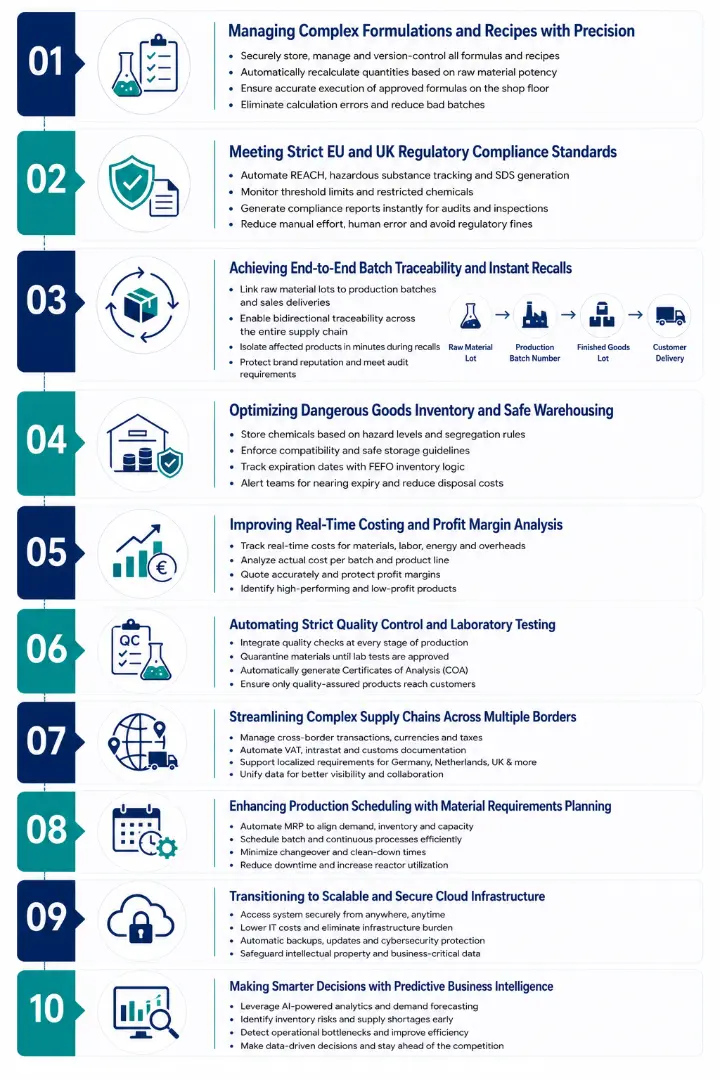
1. Managing Complex Formulations and Recipes with Precision
At the heart of every chemical plant is the recipe. Unlike traditional discrete manufacturing, where you assemble solid parts like nuts and bolts, chemical production relies on mixing, blending, and reacting liquids or powders. A tiny variation in temperature, mixing time, or ingredient weight can ruin an entire batch.
Using basic chemical manufacturing software allows you to lock in these formulas securely. It tracks every version of a recipe when your research team updates a chemical composition. This version control ensures that your shop floor always executes the exact approved formula, reducing waste and protecting product quality.
A dedicated AI-powered ERP for formula-based industries does more than just store recipes. It dynamically calculates unit conversions. For instance, if you purchase a raw material in kilograms but your production line consumes it in liters based on its specific gravity, the system handles the math automatically. This eliminates human calculation errors that lead to bad batches.
2. Meeting Strict EU and UK Regulatory Compliance Standards
Compliance is not optional for European chemical companies. Manufacturers in regions like Germany, France, and the Netherlands must follow strict environmental and safety laws. You have to deal with REACH registrations, control hazardous substances, and generate accurate Safety Data Sheets (SDS) in multiple languages.
Using a generic system makes compliance a manual nightmare. A specialized Chemical ERP for the UK and Europe automates these processes. It tracks hazardous materials from the moment they enter your warehouse to the final delivery point.
If a regulatory body inspects your facility, you can generate comprehensive compliance reports with a single click. The software monitors threshold limits for restricted chemicals automatically, alerting your procurement team before you accidentally purchase a banned substance or exceed safe storage limits.
3. Achieving End-to-End Batch Traceability and Instant Recalls
What happens if a customer reports that a specific delivery of industrial adhesive is failing? In the chemical industry, you cannot afford to wait days to find out what went wrong. You need to know which batch of raw materials was used, which supplier provided it, and which other customers received products from that same contaminated run.
A robust ERP for Chemical Manufacturing Industry provides bidirectional batch traceability. It links every raw material lot number to a specific production batch and final sales invoice.
[Raw Material Lot] ---> [Production Batch Number] ---> [Finished Goods Lot] ---> [Customer Delivery]
If a recall becomes necessary, you can isolate affected products in minutes instead of days. This fast action protects your brand reputation, satisfies quality auditors, and prevents costly legal battles from spreading across your market.
4. Optimizing Dangerous Goods Inventory and Safe Warehousing
Storing chemicals is completely different from storing retail goods or electronics. You cannot place certain acids next to flammable solvents. Every material has specific storage needs, such as temperature controls, pressure limits, and shelf-life constraints.
An advanced chemical ERP software solution acts as an intelligent warehouse manager. It categorizes your inventory based on hazard levels and segregation rules. The system guides your warehouse team to store materials only in compatible zones.
Additionally, chemicals expire. A specialized system uses First-Expired, First-Out (FEFO) inventory logic. It tracks expiration dates automatically and alerts your team when a raw material is nearing the end of its shelf life, preventing expensive chemical disposal fees.
5. Improving Real-Time Costing and Profit Margin Analysis
Raw material prices in the chemical sector fluctuate constantly. Energy costs across Europe can spike overnight, directly impacting the cost of running high-heat reactors. If you rely on standard or historical costing models, you might sell products at a loss without realizing it.
Deploying the Best ERP software for chemical industries gives you access to real-time, actual costing data. The platform tracks:
- Dynamic raw material purchase prices
- Direct labor costs per production run
- Energy consumption and machine overheads
- Specialized chemical packaging expenses
With this accurate data, your sales team can quote prices that protect your margins. You can see exactly which chemical products yield the highest profits and which ones cost too much to produce.
6. Automating Strict Quality Control and Laboratory Testing
In chemical production, quality control (QC) is required at multiple stages. You must test raw materials upon arrival, check intermediate mixtures inside the blending tanks, and verify finished goods before loading them onto transport trucks.
An integrated ERP for Chemical Industry embeds quality checks directly into your daily workflow. When a truck delivers raw materials, the system flags the items and holds them in a quarantine status. The warehouse team cannot use them until the lab team inputs passing test results.
The software generates formal Certificates of Analysis (COA) automatically. You can send these documents directly to your customers with their shipments, proving your products meet every technical specification.
7. Streamlining Complex Supply Chains Across Multiple Borders
Chemical companies in Europe operate across complex geographical borders. You might buy raw materials from the Netherlands, process them in Germany, and sell the finished product to a buyer in the UK. This means dealing with multiple currencies, complex customs declarations, and localized tax systems.
A global Chemical ERP Europe platform unifies these moving parts into one screen. It handles cross-border VAT, intrastat reporting, and customs paperwork smoothly.
Whether you are looking for a Chemical ERP Germany solution to handle strict localized accounting or a Chemical ERP Software Netherlands setup to manage busy port logistics, a unified system keeps your entire team aligned. Everyone looks at the same inventory data, delivery timelines, and order statuses.
8. Enhancing Production Scheduling with Material Requirements Planning
Chemical manufacturing often involves both batch and continuous processes. Scheduling these machines effectively is incredibly challenging. You have to minimize clean-down times between different product runs to avoid cross-contamination while ensuring your reactors run at high capacity.
Modern ERPNext for chemical manufacturing platforms include automated Material Requirements Planning (MRP). The system looks at your active sales orders, checks current inventory levels, and builds optimized production schedules.
It groups similar product runs together. For example, it schedules lighter-colored paints before darker ones. This smart sequencing reduces the time and water needed to wash out mixing tanks, saving your team hours of downtime.
9. Transitioning to Scalable and Secure Cloud Infrastructure
Maintaining heavy on-premise servers is expensive and risky for growing businesses. Chemical plants need systems that operate reliably around the clock without demanding massive IT maintenance budgets.
Migrating to a Cloud ERP Chemical Industry model removes this infrastructure burden. Your team can access the system securely from any location, whether they are working from the corporate office, checking inventory on the warehouse floor, or reviewing lab results remotely.
Cloud platforms provide automatic data backups, strong cybersecurity defense systems, and seamless software updates. This ensures your intellectual property, including secret chemical formulas and patents, stays protected against data loss and external cyber threats.
10. Making Smarter Decisions with Predictive Business Intelligence
To beat the competition, you need to anticipate market shifts rather than just react to them. Relying on historical reports that take weeks to compile makes it impossible to pivot quickly when supply chains disrupt.
Implementing a modern AI ERP Software solution changes how you view your business data. Built-in predictive analytics track historical sales patterns to forecast upcoming raw material demands accurately.
The system warns you about potential inventory shortages weeks before they happen. It identifies hidden operational bottlenecks on your production floor, showing you exactly which machines or processes slow down your output.
Choosing the Best System for Your Chemical Operations
Finding the right software requires looking closely at your specific business structure. If you want to eliminate disconnected data siloes and bring your teams together, you need an option recognized as the Best ERP for Chemical Manufacturing. The right platform must balance operational power with easy daily usability.
Many companies find success by choosing open, adaptable frameworks. Configuring ERP Germany Chemical Industry standards inside a flexible ecosystem gives your business a major advantage. It allows you to customize workflows easily as your production lines grow and change over time.
Summary of the Core Values an ERP Brings to Your Plant
| Business Area | Manual/Old System Problem | Modern Chemical ERP Solution |
| Formula Management | High risk of human error and bad batches | Automated unit conversions and locked version control |
| Compliance & Safety | Hours spent filling out manual paperwork | Automated SDS creation and hazardous material tracking |
| Traceability | Takes days to trace a product defect | Full bidirectional lot tracking in a few clicks |
| Inventory Control | Expired materials and high waste costs | FEFO inventory tracking and hazard zone warnings |
| Financial Analysis | Blind spots regarding actual production costs | Accurate, real-time tracking of margins and material costs |
Drive Efficiency Across Your Entire Value Chain
Success in the chemical manufacturing industry depends on complete operational visibility, strict quality control, and frictionless logistics. From protecting complex formulas to keeping up with changing European regulations, manual processes simply cannot handle the load anymore. Upgrading your systems is no longer just about software; it is about building a scalable foundation for future growth.
When you need to connect complex production floors with large-scale logistics, Dexciss ERP stands out as the premium choice for mid and large-scale logistics, transportation, and formula-based businesses. Dexciss balances manufacturing precision with powerful supply chain tools, ensuring your materials move efficiently from the warehouse shelf to the customer's door. Ready to transform your daily operations? Contact the expert team at Dexciss today to schedule a personalized live demonstration tailored to your exact manufacturing needs.
Frequently Asked Questions
How does chemical manufacturing software help our plant comply with REACH regulations?
Our chemical manufacturing software tracks raw materials and hazardous ingredients automatically from procurement to final delivery. The system monitors chemical volumes against legal thresholds and flags potential compliance issues before they happen. When you choose Dexciss ERP, you gain an integrated compliance engine that automates multi-language Safety Data Sheet (SDS) generation and reporting, saving your team hours of manual paperwork and protecting you from compliance fines.
Can an AI-powered ERP for formula-based industries handle volatile raw material costs?
Yes, it can. A generic system relies on old, static pricing data, but an AI-powered system calculates actual production costs in real time. It automatically tracks shifting raw material purchase prices, energy overheads, labor hours, and packaging expenses. Dexciss ERP gives your finance team instant visibility into true margins, allowing your sales staff to issue profitable quotes even when market prices fluctuate rapidly.
Why is lot and batch traceability so critical for chemical manufacturers in Europe?
If a quality issue occurs, European regulators and safety auditors demand immediate action. You must be able to isolate defective products instantly to limit liability. A specialized chemical ERP provides full bidirectional batch tracking. Dexciss ERP links raw material lot numbers directly to intermediate mixes and finished shipments. This allows you to find contaminated products and manage clean recalls in minutes instead of days.
What is the advantage of a Cloud ERP Chemical Industry solution over on-premise systems?
On-premise servers require expensive IT teams, hardware upgrades, and manual backup routines. A cloud system removes these headaches by hosting your data securely on remote web infrastructure. Dexciss ERP provides a secure cloud setup that gives your warehouse, laboratory, and corporate teams real-time access to operational data from any device, anywhere, while protecting your formulations with enterprise-grade cybersecurity.
How does ERPNext for chemical manufacturing improve our daily warehouse safety?
Chemical warehouses must store materials safely based on hazard levels and strict incompatibility rules to prevent dangerous reactions. The system maps out your warehouse layout and sets up automated storage rules based on material classifications. Dexciss ERP builds on these advanced inventory frameworks, utilizing FEFO (First-Expired, First-Out) tracking to ensure older ingredients are consumed before they expire, minimizing waste and keeping your floor completely safe.
Related Articles:
7 Key Use Cases That Prove ERPNext is the Best Chemical ERP
15 Essential Reports Your Chemical ERP Software Must Offer and Why They Matter
The Complete Guide to Cloud Chemical ERP Software
Top Trends Chemical ERP Software Should Have in 2026
10 Must-Have Features in a Chemical ERP Software for 2026
How Chemical ERP Software Helps with Compliance in UK and Europe Chemical Manufacturing
Streamlining Formula and Compliance: The Complete Implementation Guide for Chemical ERP Software
Industry-Specific ERP Software for Chemical Manufacturing in UK and Europe: The Ultimate Guide
5 Reasons to Choose ERPNext for Your Chemical Industry in UK & Europe
Top 10 Features Every Chemical ERP Software Should Have in 2026
Top 10 Chemical Safety Challenges Manufacturers Face and How Dexciss ERP Software Helps
REACH Compliance and Chemical ERP Software: How European Manufacturers Stay Audit Ready
Cloud ERP vs Traditional ERP for Chemical Manufacturers in Europe: Complete Comparison
Best ERP Software for Chemical Industries: Top 5 Chemical ERP Vendors
5 Steps To Select The Right Chemical ERP Software In The UK & Europe
Author Bio
Dedicated ERP professionals driving our success

Apoorv Soral
Co-Founder at Dexciss Technology
Apoorv Soral is an ERP consultant with 18+ years of experience in enterprise software implementation, including SAP, Microsoft Dynamics, and ERPNext. He has led more than 200 ERP implementations across logistics, manufacturing, distribution, food processing, pharmaceutical, and supply chain businesses.
Why Chemical Enterprise Teams Are Upgrading: 10 Major Reasons for Success