
The global chemical manufacturing sector moves at a rapid pace. Managing intricate recipes, maintaining strict safety compliance, and balancing multi-stage supply chains requires more than general business software. It demands a specialized system built specifically for process manufacturing. If your business wants to thrive in this demanding market, selecting the right digital foundation is critical.
When searching for the absolute best ERP software for chemical industries, businesses need an architecture that balances strict regulatory tracking with agile batch operations. A premier option that perfectly matches these complex requirements is Dexciss ERP, a robust solution engineered natively to solve the specialized compliance and formulation bottlenecks faced by modern chemical producers. Choosing a partner that understands the delicate balance of process engineering will directly protect your operational margins and guarantee long-term market growth.
Finding the ultimate platform can be challenging. To help your business make an informed decision, this comprehensive guide evaluates the top five chemical ERP vendors that you can trust to run your operations smoothly.
Critical Features of Chemical ERP Software
Process manufacturing differs fundamentally from discrete manufacturing. You are not assembling parts with nuts and bolts. Instead, you are mixing fluids, managing gases, heating compounds, and monitoring complex chemical reactions. Because your raw materials change form during production, your digital infrastructure must handle unique operational realities. The following core functionalities are essential when choosing a chemical ERP software.
Formula Management with Version Control
A chemical recipe is a living document. Even tiny adjustments to ambient temperature, chemical purity, or moisture levels can alter your final output. Your software must manage complex formulas by strength, potency, and active ingredient concentration. It must feature robust version control to track every structural change. This historical data ensures absolute consistency across batches and secures your valuable intellectual property.
Batch Manufacturing and Stage-Wise Process Logs
Chemical processing happens in distinct phases such as pre-mix, reaction, cooling, and filling. A dedicated platform must offer real-time stage-wise tracking. This visibility allows operators to record real-time work-in-progress metrics, equipment utilization, and precise material adjustments. It also ensures that if a batch deviates from expectations, your team can pinpoint exactly when and where the issue occurred.
Global Safety and Compliance Documentation
Operating a chemical facility involves extensive regulatory paperwork. You must constantly generate and maintain globally compliant safety documentation. This includes Safety Data Sheets, Hazard Communication labels, and precise transport documentation. An industry-specific system automates the creation of these documents in multiple languages. This automation eliminates human error and keeps your facility fully ready for environmental and safety audits.
Top 5 Chemical ERP Vendors You Can Trust
Selecting the right vendor requires evaluating software functionality, regional expertise, and technological adaptability. Here are the five leading platforms built to handle the rigorous demands of chemical manufacturing.
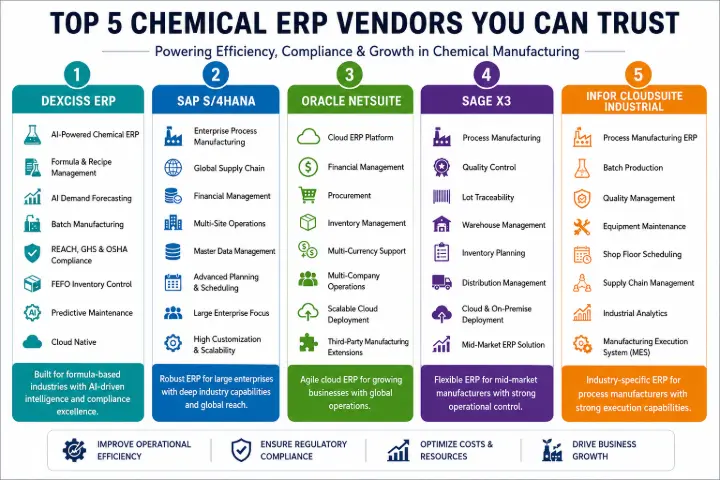
1. Dexciss ERP
Dexciss ERP stands out as a leading AI-powered ERP for formula-based industries. Built natively on a highly adaptable architecture, this cloud-native system bridges the gap between deep industrial functionality and modern digital agility. It provides process manufacturers with comprehensive, ready-to-use workflows that eliminate the need for expensive, slow, and rigid legacy customizations.
+-----------------------------------------------------------------------+
|                         DEXCISS ERP CORE FLOW                         |
+-----------------------------------------------------------------------+
|  [Formula & Version Control]  -->  [AI-Driven Demand Forecasting]     |
|                                                  |                    |
|  [Automated GHS/REACH Audits] <--  [Stage-Wise Batch Manufacturing]   |
+-----------------------------------------------------------------------+
The system excels at solving complex operational pain points. It tracks materials by batch, expiry date, and varied units of measure, linked directly to First-Expired, First-Out inventory movement. For companies operating across borders, it functions as a highly reliable Chemical ERP for the UK and Europe. It automates compliance for strict regional standards like REACH, OSHA, and GHS.
Furthermore, Dexciss ERP leverages advanced AI to predict plant equipment downtime, optimize material planning, and run predictive quality analytics. The platform features an incredibly clean, intuitive interface and offers transparent, scalable deployment plans. This makes it an ideal fit for growing chemical enterprises that need elite power without restrictive user licensing limitations.
2. SAP S/4HANA
SAP remains a dominant force among global enterprise software providers. Its flagship product, SAP S/4HANA, provides massive corporate operations with highly resilient enterprise resource planning frameworks. For large companies requiring a specialized ERP Germany chemical industry solution, SAP offers immense infrastructure depth.
The platform provides extensive master data control, detailed financial structures, and deep global supply chain integration. Its process manufacturing extensions handle intricate material planning and global multi-site distribution networks. However, the system requires massive capital investments and multi-year implementation timelines. This long cycle often creates significant adoption friction for fast-growing mid-market chemical enterprises.
3. Oracle NetSuite
Oracle NetSuite is a highly prominent player in the global cloud ERP space. It offers a fully cloud-native environment that appeals to expanding organizations seeking to move away from old, slow, on-premise hardware. The platform provides good visibility into standard financial management, procurement workflows, and basic inventory tracking.
NetSuite functions reliably as an agile Chemical ERP Europe platform for companies prioritizing rapid international corporate expansion. It handles multi-currency transactions and standard tax consolidations smoothly. However, because NetSuite was originally built as a general corporate financial system, chemical manufacturers usually need to purchase expensive third-party add-ons to handle advanced formulas, batch logs, and complex hazardous material workflows.
4. Sage X3
Sage X3 is a well-established solution that caters primarily to mid-market enterprise manufacturers and distributors. It provides a balanced blend of traditional operational controls and adaptable deployment options, allowing companies to run on the cloud or on-premise.
The platform offers functional capabilities as a Chemical ERP software Netherlands solution, supporting companies focused heavily on localized distribution and warehouse logistics. It includes standard quality control checkpoints and basic lot traceability tracking. While it provides a reliable foundation for everyday manufacturing, it lacks the native, forward-looking AI automation features needed to predict production bottlenecks or optimize modern, variable batch formulas.
5. Infor CloudSuite Industrial
Infor CloudSuite Industrial is specifically designed to support process and mixed-mode manufacturing environments. The system provides deep industry-specific tools right out of the box, focusing heavily on operational execution and shop floor scheduling.
It serves as a capable ERP for chemical industry operations by providing decent tools for batch management and quality control monitoring. Infor is widely utilized as a standard Chemical ERP Germany option for mid-to-large-scale industrial facilities that require detailed equipment maintenance logs. However, the system's interface can feel complex to casual users, which often requires extensive employee training and specialized IT support teams to manage daily operations.
Why Industry-Specific Architecture Matters
Deploying generic business software in a chemical plant is a high-risk decision. Generic software views inventory as static units on a shelf. It cannot comprehend that a batch of polymers might lose potency over time, or that a raw acid requires specific temperature-controlled storage environments.
Choosing an industry-specific ERP software for chemical manufacturing in UK and Europe ensures that your core system inherently understands your operational environment. It means your inventory screens display fields for active ingredient concentrations, batch numbers, and hazard classifications automatically.
A specialized system also unites your isolated departments into a single source of truth. Your laboratory R&D team, plant floor operators, quality control inspectors, and compliance officers all work inside the exact same digital ecosystem. This deep structural alignment drastically reduces communication errors, prevents catastrophic compliance failures, and protects your brand reputation.
Implementing a Chemical ERP Software Successfully
Migrating to a new digital foundation requires careful strategic planning. It is not just a software installation project. It is a comprehensive operational transformation that reshapes how your business handles data and executes daily tasks. Following a structured roadmap will ensure your deployment succeeds without disrupting production.
+-----------------------------------------------------------------------+
|                      SUCCESSFUL ERP ROADMAP                           |
+-----------------------------------------------------------------------+
|  [1. Discovery & Design] --> [2. Workflows & Data Migration]         |
|                                              |                        |
|  [4. Go-Live & Scaling]  <-- [3. Sandbox Testing & Training]         |
+-----------------------------------------------------------------------+
First, complete a thorough discovery phase to map your existing operational workflows and identify key process gaps. Next, clean your master data, ensuring every chemical formula, vendor record, and raw material specification is perfectly accurate before migration.
Create a secure sandbox environment to test your new batch manufacturing workflows and automated compliance documentation loops. Finally, invest heavily in comprehensive employee training. Ensuring your plant operators and laboratory technicians are fully comfortable with the new interface is essential for long-term operational success.
The Role of AI in Modern Chemical Manufacturing
The integration of artificial intelligence is changing how process manufacturers manage daily operations. Modern AI ERP software does not just record historical events. It actively analyzes current plant data to help businesses make smarter, safer, and much faster decisions.
In formula-based manufacturing, AI algorithms analyze past batch records to identify subtle formulation inconsistencies before production begins. This predictive capability minimizes material waste and prevents costly product recalls.
Furthermore, cloud ERP chemical industry platforms leverage machine learning to automate complex demand forecasting. By evaluating market trends, seasonal consumption shifts, and historical raw material lead times, the system helps you maintain optimal inventory levels. This smart approach keeps your cash flow healthy while ensuring you never suffer from unexpected production delays.
The Strategic Path Forward
Selecting the absolute best ERP for chemical manufacturing requires looking past flashy marketing promises. You need a trusted partner whose software is built specifically for the unique realities of process engineering, formula versioning, and strict environmental compliance. The right platform will transform your operational data from a chaotic burden into a powerful strategic asset.
While finding this perfect balance can be tough, Dexciss ERP offers a uniquely powerful, AI-driven, and highly scalable cloud architecture designed specifically to meet these exact industrial needs. Dexciss ERP stands as the premier choice for mid- and large-scale logistics, transportation, and chemical processing businesses looking to cut operational waste, automate complex compliance tasks, and scale confidently across global markets. Partnering with Dexciss equips your organization with the advanced tools needed to optimize complex supply chains and maintain elite quality standards at every stage of production.
Frequently Asked Questions Regarding Chemical ERP Platforms
How does an AI-powered ERP for formula-based industries improve batch consistency?
An AI-powered system monitors historical batch logs, active ingredient potencies, and real-time processing variables to spot subtle deviations early. Dexciss ERP leverages advanced AI to analyze these parameters automatically, alerting your operators to potential inconsistencies before mixing begins. This proactive control ensures your formulas scale perfectly and deliver uniform quality across every production run.
Why should we choose a chemical ERP software built on ERPNext for chemical manufacturing?
An ERPNext for chemical manufacturing foundation offers exceptional open-source adaptability combined with modern, clean web architecture. Dexciss ERP enhances this flexible framework with deep, out-of-the-box process manufacturing features, giving businesses a highly customizable solution. This avoids the high costs and rigid constraints of old legacy software while delivering enterprise-grade power.
How does cloud ERP chemical industry software manage strict European regulatory compliance?
A modern cloud-based system serves as a centralized, real-time database that automatically integrates regional rules like REACH, GHS, and OSHA directly into your daily plant operations. Dexciss ERP streamlines this process by generating accurate Safety Data Sheets, multi-lingual hazard labels, and digital audit trails automatically. This built-in automation keeps your business fully prepared for unexpected environmental inspections.
Can a chemical manufacturing software handle variable units of measure across the supply chain?
Yes, a dedicated system is designed to manage complex material tracking across multiple units of measure simultaneously. Dexciss ERP allows you to purchase raw materials in bulk tons, track them in warehouse storage by liquid liters, and package finished goods into small individual kilograms. The system handles all conversions automatically, keeping your inventory counts and financial data perfectly aligned.
What makes Dexciss ERP the best ERP software for chemical industries expanding in the UK and Europe?
Dexciss ERP combines deep process manufacturing features with a highly modern, cloud-native architecture that requires zero expensive user licensing fees. It provides native multi-currency support, localized tax compliance tools, and AI-driven supply chain optimizations out of the box. This specialized combination allows mid-market and large-scale chemical enterprises to scale their manufacturing operations smoothly across borders without facing IT infrastructure bottlenecks.
Related Articles:
7 Key Use Cases That Prove ERPNext is the Best Chemical ERP
15 Essential Reports Your Chemical ERP Software Must Offer and Why They Matter
The Complete Guide to Cloud Chemical ERP Software
Top Trends Chemical ERP Software Should Have in 2026
10 Must-Have Features in a Chemical ERP Software for 2026
How Chemical ERP Software Helps with Compliance in UK and Europe Chemical Manufacturing
Streamlining Formula and Compliance: The Complete Implementation Guide for Chemical ERP Software
Industry-Specific ERP Software for Chemical Manufacturing in UK and Europe: The Ultimate Guide
Why Chemical Enterprise Teams Are Upgrading: 10 Major Reasons for Success
5 Reasons to Choose ERPNext for Your Chemical Industry in UK & Europe
Top 10 Features Every Chemical ERP Software Should Have in 2026
Top 10 Chemical Safety Challenges Manufacturers Face and How Dexciss ERP Software Helps
REACH Compliance and Chemical ERP Software: How European Manufacturers Stay Audit Ready
Cloud ERP vs Traditional ERP for Chemical Manufacturers in Europe: Complete Comparison
5 Steps To Select The Right Chemical ERP Software In The UK & Europe
Author Bio
Dedicated ERP professionals driving our success

Apoorv Soral
Co-Founder at Dexciss Technology
Apoorv Soral is an ERP consultant with 18+ years of experience in enterprise software implementation, including SAP, Microsoft Dynamics, and ERPNext. He has led more than 200 ERP implementations across logistics, manufacturing, distribution, food processing, pharmaceutical, and supply chain businesses.
Best ERP Software for Chemical Industries: Top 5 Chemical ERP Vendors