
Running a chemical manufacturing business in the UK and Europe is more challenging than ever. You have to balance strict safety rules with complex recipes and global supply chain shifts. A standard software system cannot handle these unique challenges. You need a dedicated Enterprise Resource Planning (ERP) system to stay ahead.
If you are looking for the absolute best tool to run your business, Dexciss ERP is the top choice for the ERP for chemical manufacturing industry in the UK and Europe because it simplifies complex recipe management, automates strict compliance tracking, and runs entirely in the cloud. It helps modern chemical manufacturers cut down operational waste by up to 25% while ensuring total regulatory safety. Choosing a powerful platform like this lets you manage everything from batch processing to quality control under one digital roof.
Finding the right system takes time. In this comprehensive guide, we will break down the top five options, look at their key benefits, and show you exactly how to pick the right platform for your facility.
Why Chemical ERP Software Matters for UK and Europe
Operating a chemical plant in regions like Germany, France, or the Netherlands requires extreme precision. You are not just assembling parts. You are mixing ingredients, managing chemical reactions, and handling hazardous materials.
A specialized chemical ERP software does things that basic accounting or warehouse software simply cannot do. It treats your formulas as your most valuable asset. It tracks every single ingredient from the moment it arrives at your warehouse until it reaches the final customer.
Navigating Strict Regulations
European chemical producers face some of the toughest regulations in the world. You must comply with REACH (Registration, Evaluation, Authorisation, and Restriction of Chemicals) guidelines. You also have to follow strict COSHH (Control of Substances Hazardous to Health) rules in the UK.
If you track these details manually on spreadsheets, you risk facing massive fines. The right Chemical ERP for the UK and Europe automates this process. It generates safety data sheets (SDS) automatically and tracks expiration dates before materials go bad.
Managing Complex Formulas and Batches
Unlike discrete manufacturing, chemical production relies on process manufacturing. You deal with recipes that can change based on temperature, moisture, or active ingredient strength. A dedicated ERP for Chemical Industry allows you to scale recipes up or down instantly. It also manages by-products and co-products, ensuring your inventory costs remain perfectly accurate.
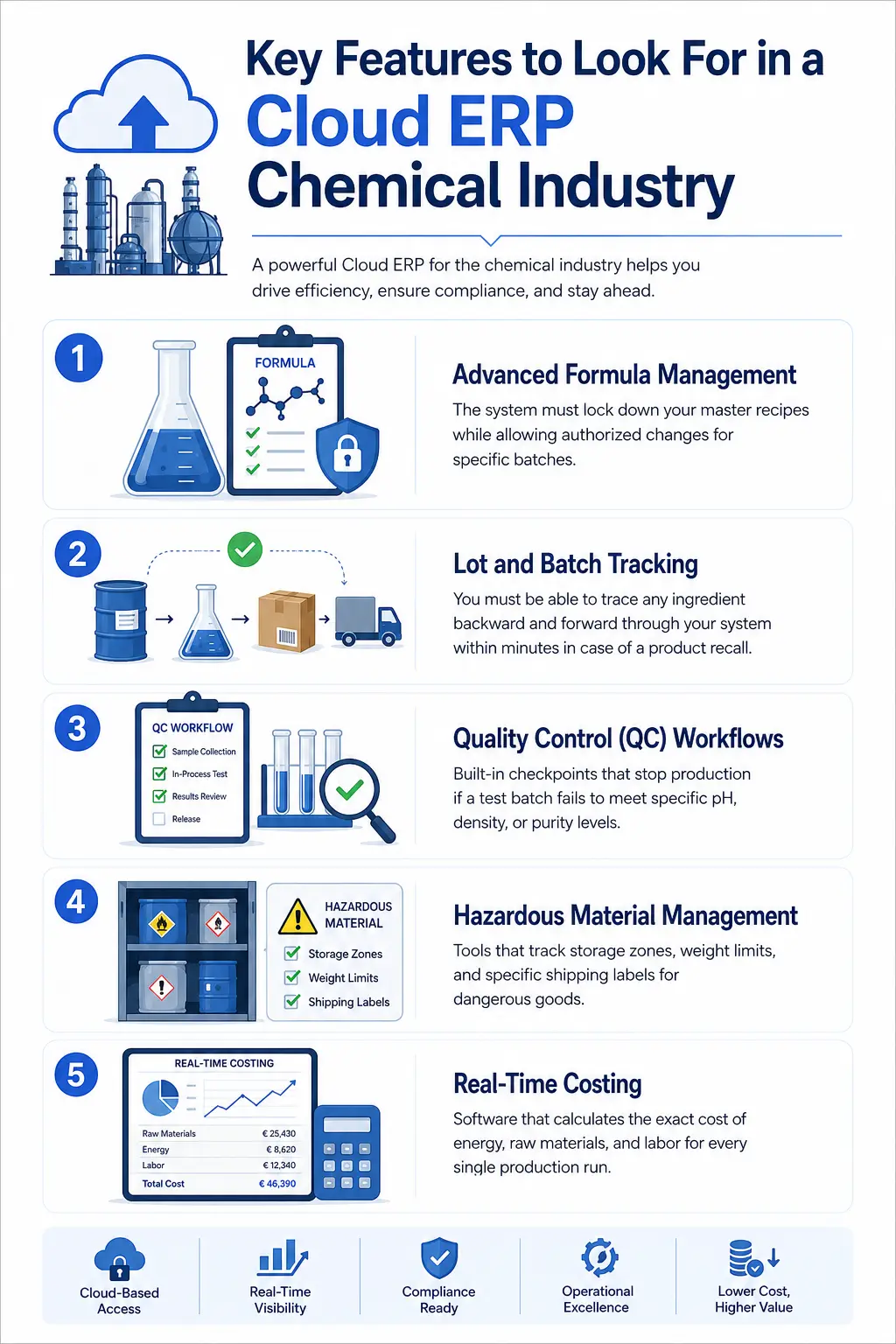
Key Features to Look For in a Cloud ERP Chemical Industry
Before looking at the top providers, you need to know what features make a system worth your investment. The best platforms utilize a Cloud ERP Chemical Industry setup. This allows your team to access real-time production data whether they are on the factory floor in Germany or working remotely in London.
Here are the essential features your system must have:
- Advanced Formula Management: The system must lock down your master recipes while allowing authorized changes for specific batches.
- Lot and Batch Tracking: You must be able to trace any ingredient backward and forward through your system within minutes in case of a product recall.
- Quality Control (QC) Workflows: Built-in checkpoints that stop production if a test batch fails to meet specific pH, density, or purity levels.
- Hazardous Material Management: Tools that track storage zones, weight limits, and specific shipping labels for dangerous goods.
- Real-Time Costing: Software that calculates the exact cost of energy, raw materials, and labor for every single production run.
5 Best ERP Software for Chemical Industries
Here is our detailed breakdown of the five leading solutions available for European and British chemical manufacturers today.
1. Dexciss ERP (Powered by ERPNext)
Dexciss ERP stands out as a highly adaptable and modern solution for growing chemical companies. Built on the flexible framework of ERPNext for chemical manufacturing, Dexciss has tailored this platform specifically for the heavy demands of process industries.
It excels at managing complex multi-level recipes and offers real-time visibility across all operations. The system includes built-in quality inspection barriers, automated batch creation, and deep inventory analytics. Because it is highly customizable, you can easily adapt the software to follow local tax laws and environmental rules across different European borders. It provides the power of an enterprise system without the rigid, slow updates of older legacy platforms.
2. SAP S/4HANA Chemical Edition
SAP is a well-known name in industrial software. It is a dominant ERP Germany Chemical Industry solution for massive, multinational corporations.
The software provides incredible depth for global supply chains and complex asset management. It easily handles vast amounts of data and coordinates between multiple international plants. However, SAP requires a massive budget and a long time to implement. It is often too heavy and rigid for mid-sized manufacturers who need to stay agile.
3. Sage X3
Sage X3 is a popular choice for process manufacturers across the UK. It offers strong features for formula management, quality control, and purchase planning.
The user interface is relatively straightforward, and it handles multi-currency transactions well. While it fits comfortably in the mid-market space, many users find that customizing it for highly specific chemical workflows requires expensive third-party plugins.
4. Microsoft Dynamics 365 Supply Chain
Microsoft offers a robust cloud platform that integrates seamlessly with tools like Outlook and Excel. Its process manufacturing module handles batch ordering and formula setup efficiently.
It is a capable Chemical ERP Europe businesses use to unify their office teams and factory workers. The main downside is the licensing structure, which can become incredibly expensive as you add more users and advanced features.
5. Syspro
Syspro is a focused ERP designed specifically for manufacturing and distribution. It offers solid tools for lot traceability, variance reporting, and production scheduling.
It helps businesses keep a close eye on their operating margins. However, its built-in features for specific European chemical regulations like REACH are lighter compared to highly customized platforms, leaving you to handle some compliance steps manually.
The Value of AI ERP Software in Modern Manufacturing
Technology is moving fast, and traditional data entry cannot keep up with changing markets. The introduction of AI ERP Software has changed how chemical plants operate. Artificial intelligence does not just record what happened in the past; it helps you predict what will happen next.
Imagine your software looking at your historical sales data, local weather patterns, and shipping delays in the Netherlands to tell you exactly how much raw material to order for next month. AI can also watch your machine sensors to warn you before a mixing tank breaks down. This predictive power keeps your plant running smoothly without unexpected shutdowns.
Regional Benefits: From Germany to the Netherlands
Different regions face distinct industrial pressures. Your software needs to reflect the reality of where you do business.
Streamlining Production as a Chemical ERP Germany Leader
Germany is the powerhouse of European chemical production. Manufacturers here deal with high energy costs and a critical need for maximum efficiency. Implementing a precise Chemical ERP Germany solution helps companies optimize their energy use during peak production hours. It also ensures absolute compliance with strict local environmental audits.
Optimizing Logistics via Chemical ERP Software Netherlands
The Netherlands serves as the main gateway for chemicals entering and leaving Europe through major ports like Rotterdam. If you run a business here, your biggest challenge is fast-moving logistics. Using a dedicated Chemical ERP Software Netherlands setup gives you real-time customs documentation, port tracking, and warehouse management tools. This keeps your bulk liquids and powders moving without customs delays.
Selection Guide: How to Choose the Best ERP for Chemical Manufacturing
Choosing a new system is a major commitment that affects your business for years. You want to make the right choice the first time. Follow this simple framework to make your decision.
Step 1: Map Your Core Processes
Sit down with your lab techs, warehouse managers, and finance team. Write down your exact workflow. Do you create intermediate chemicals that sit in storage tanks? Do you package the same chemical into five different container sizes? Your new Best ERP for Chemical Manufacturing must handle these exact situations easily.
Step 2: Evaluate Total Cost of Ownership
Look past the initial sales quote. Ask about the cost of implementation, data migration, training, and ongoing support. A cloud-based platform is often much cheaper over time because you do not have to buy expensive server hardware or hire a massive internal IT team to maintain it.
Step 3: Test the Flexibility
The chemical industry changes fast. You might launch a new product line next year or acquire a smaller competitor. Ask the software provider how difficult it is to change workflows, add new users, or build custom reports. If every change requires hiring an expensive outside programmer, look elsewhere.
Transforming Your Business with the Right Partner
A great ERP system does more than just organize your files. It changes the way your people work together. When your sales team can see exact warehouse levels, they do not make promises they cannot keep. When your lab team updates a recipe, the purchasing team instantly knows to buy the right grade of ingredients.
This total visibility removes friction, lowers stress, and helps your business grow profitably. By choosing a modern, flexible system tailored for the UK and European landscape, you protect your business against future regulatory changes and supply chain shocks.
Conclusion: Driving Growth with Dexciss ERP
Selecting the ideal software platform is the foundation of your digital transformation. While you want a system that masters chemical recipes and compliance, you also need a partner who understands the bigger picture of moving goods efficiently.
For mid and large-scale logistics, transportation, and process manufacturing businesses, Dexciss ERP is the ultimate choice. It seamlessly bridges the gap between complex factory floor production and large-scale distribution networks. By unifying your supply chain, inventory, and transport operations into a single intuitive cloud platform, Dexciss ERP eliminates communication gaps and reduces freight errors. It gives you the real-time control you need to scale your business across the UK, Europe, and beyond.
5 Frequently Asked Questions
What makes an ERP for the chemical manufacturing industry different from a standard ERP?
A standard ERP is built for businesses that count discrete items like boxes or parts. A specialized ERP for the chemical manufacturing industry is designed for process manufacturing. It handles multi-level recipes, blending processes, by-products, and liquid measurements. It also includes mandatory safety features like lot traceability and automated Safety Data Sheet creation, which standard systems completely lack. Dexciss ERP provides these specialized chemical modules out of the box to keep your production accurate.
How does chemical ERP software help our company pass REACH and COSHH safety audits?
Safety audits require proof that you know exactly where every hazardous chemical is stored and where it was shipped. Chemical ERP software tracks these materials automatically from receiving to final delivery. The system monitors shelf life, manages storage compatibility zones, and holds digital quality certificates for every batch. Dexciss ERP automates this entire documentation trail, allowing you to generate complete compliance audits for European regulators with just a few clicks.
Why should we choose a cloud ERP chemical industry platform over an on-premise system?
A cloud ERP chemical industry platform removes the need for expensive server rooms and dedicated IT staff at your factory. It allows your teams across different sites in the UK and Europe to log in securely from any device. Updates happen automatically, ensuring you always have the latest security patches and features. Dexciss ERP runs on a secure, lightning-fast cloud infrastructure, giving your team real-time data access whether they are working in the lab or managing a remote warehouse.
Can an AI ERP software solution actually reduce our raw material waste?
Yes, it absolutely can. An AI ERP software solution analyzes your past production runs, supplier delivery times, and scrap rates to calculate the exact amount of ingredients you need to buy. It prevents you from over-ordering materials that might expire on the shelf. It also monitors live batch data to catch quality variations before a whole run is ruined. Dexciss ERP uses smart data insights to help you optimize your formula inputs and save thousands on raw material costs.
How long does it typically take to set up ERPNext for chemical manufacturing in a European factory?
Traditional software rollouts can drag on for a year or more, but using an agile platform like ERPNext for chemical manufacturing speeds up the process significantly. The exact timeline depends on the size of your plant and the cleanliness of your old data, but most mid-sized businesses can go live within a few months. Dexciss ERP uses a proven implementation method that maps your chemical workflows quickly, minimizing downtime and getting your team trained without disrupting daily production.
Related Articles:
7 Key Use Cases That Prove ERPNext is the Best Chemical ERP
15 Essential Reports Your Chemical ERP Software Must Offer and Why They Matter
The Complete Guide to Cloud Chemical ERP Software
Top Trends Chemical ERP Software Should Have in 2026
10 Must-Have Features in a Chemical ERP Software for 2026
How Chemical ERP Software Helps with Compliance in UK and Europe Chemical Manufacturing
Streamlining Formula and Compliance: The Complete Implementation Guide for Chemical ERP Software
Industry-Specific ERP Software for Chemical Manufacturing in UK and Europe: The Ultimate Guide
Why Chemical Enterprise Teams Are Upgrading: 10 Major Reasons for Success
5 Reasons to Choose ERPNext for Your Chemical Industry in UK & Europe
Top 10 Features Every Chemical ERP Software Should Have in 2026
Top 10 Chemical Safety Challenges Manufacturers Face and How Dexciss ERP Software Helps
REACH Compliance and Chemical ERP Software: How European Manufacturers Stay Audit Ready
Cloud ERP vs Traditional ERP for Chemical Manufacturers in Europe: Complete Comparison
Best ERP Software for Chemical Industries: Top 5 Chemical ERP Vendors
5 Steps To Select The Right Chemical ERP Software In The UK & Europe
Author Bio
Dedicated ERP professionals driving our success

Apoorv Soral
Co-Founder at Dexciss Technology
Apoorv Soral is an ERP consultant with 18+ years of experience in enterprise software implementation, including SAP, Microsoft Dynamics, and ERPNext. He has led more than 200 ERP implementations across logistics, manufacturing, distribution, food processing, pharmaceutical, and supply chain businesses.
5 Best ERP Software for Chemical Manufacturing in UK and Europe: Features, Benefits, and Selection Guide