
Running a chemical manufacturing plant is a high-stakes balancing act. You have to manage complex formulations, handle volatile raw materials, and keep your supply chain moving. But there is one challenge that keeps most operations managers awake at night, and that is regulatory compliance. In the United Kingdom and Europe, the rules governing chemical production are among the tightest in the world. Failing to follow these rules does not just mean getting a fine. It can completely halt your business operations.
Staying compliant requires total control over your business data. A modern, specialized chemical ERP software is the absolute best way to handle these complex European and UK regulations automatically. Specifically, Dexciss ERP provides an all-in-one digital platform that solves these compliance challenges by automating recipe management, tracking batches in real-time, and generating mandatory safety documentation instantly. By using Dexciss ERP, chemical manufacturers can eliminate human error, pass strict audits smoothly, and keep their operations fully aligned with ever-changing regional laws.
To survive and grow today, factories cannot rely on old spreadsheets or generic software. You need a digital system built specifically for the unique, formula-based nature of your industry. Let us look closely at how the right technology turns compliance from a stressful burden into a smooth, everyday routine.
The Complex Compliance Landscape in the UK and Europe
Operating a chemical business in this region means dealing with a massive web of rules. Ever since Brexit, the regulatory environment has split into two separate paths. You have to satisfy both European agencies and UK authorities if you want to trade across borders.
Understanding REACH and UK-REACH
The Registration, Evaluation, Authorisation, and Restriction of Chemicals (REACH) is a massive framework. It requires companies to identify and manage the risks linked to the substances they manufacture and sell. When the UK left the European Union, it created UK-REACH. This means if you sell to both markets, you now have to maintain two separate sets of registrations. The data requirements are incredibly detailed. You must know the exact tonnage of every chemical you produce or import each year.
Navigating CLP and GHS Regulations
Next up is the Classification, Labelling, and Packaging (CLP) regulation. This law aligns European markets with the Globally Harmonized System (GHS). The goal is simple: ensure that workers and consumers clearly understand the hazards of any chemical mix. To comply, you must display precise hazard pictograms, signal words, and precautionary statements on every single label. If your product formula changes even slightly, your product labels must update immediately to reflect the new hazard profile.
Managing COSHH and Environmental Inspections
Inside the factory walls, you also have local safety laws to consider. In the UK, the Control of Substances Hazardous to Health (COSHH) regulations demand that you protect workers from dangerous materials. Meanwhile, environmental agencies across Europe inspect how you manage waste and emissions. To satisfy these inspectors, you must prove that you track every single gram of hazardous material from the moment it enters your warehouse to the moment it leaves as a finished product or waste.
Why Generic Systems Fail the Chemical Manufacturing Industry
Many manufacturing companies start out using general enterprise resource planning systems. They assume that if software can track car parts or food items, it can track chemicals too. However, they quickly run into major operational roadblocks.
The Problem with Discrete Software Designs
Generic business systems are built for discrete manufacturing. Discrete manufacturing involves assembling separate pieces, like bolts, electronics, or pieces of furniture. If you make bicycles, you count your inventory in whole units. But chemical production is process-based and formula-driven. You deal with liquids, gases, and powders. You measure inventory in liters, kilograms, or parts per million. A generic system simply cannot calculate how temperature changes or mixing ratios affect your final yield.
The Nightmare of Missing Lot Traceability
The biggest risk of using a generic system is poor lot traceability. If a regulatory inspector walks into your facility today, they might pick a random batch of your finished product. They will ask you to show exactly which batch of raw material went into it. They will also want to know which supplier provided that raw material and which other customer orders used that same batch. With a basic software system, your team will have to spend days digging through paper files and messy spreadsheets to find the answer. In a real compliance emergency, that delay can ruin your reputation.
How Industry-Specific ERP Software for Chemical Manufacturing in UK and Europe Saves the Day
To run a compliant facility, you need a system designed for recipes, molecules, and strict safety audits. Investing in specialized Industry-Specific ERP Software for Chemical Manufacturing in UK and Europe gives you the precise tools needed to handle complex regional laws.
[Raw Materials Received] ──> [Real-Time Quality Check] ──> [Automated Recipe Lock] ──> [Compliant Batch Production]
Automation of Safety Data Sheets
One of the most time-consuming tasks in a chemical plant is creating and updating Safety Data Sheets (SDS). An advanced chemical manufacturing software automates this entire process. The system connects your master laboratory recipes directly to a document generation engine. The moment a scientist updates a formula in the system, the software recalculates the hazard levels. It then updates the SDS automatically. This ensures your customers always receive the correct safety sheets, keeping you perfectly aligned with CLP laws.
Ironclad Batch Control and Tracking
A specialized ERP for Chemical Manufacturing Industry creates a digital thread for every single action on your shop floor. Every time a worker adds a raw ingredient to a mixing vat, they must scan a barcode. The software logs the exact timestamp, the lot number of the ingredient, and the employee ID. This creates an unalterable history of production. If a supplier alerts you about a contaminated raw material, you can run a report in seconds to see exactly which finished batches are affected.
Choosing the Best ERP software for chemical industries
Selecting the right technology partner requires looking closely at your specific business processes. The Best ERP software for chemical industries must do much more than just track your financial accounting data.
Evaluating Recipe and Formula Management
Your chemical formulas are your company's most valuable intellectual property. The system you choose must protect these recipes while making them usable for your production team. Look for software that allows you to scale recipes up or down automatically based on available container sizes or target production volumes. It must also handle physical properties like density, active ingredient percentages, and moisture levels seamlessly.
The Importance of Strict Quality Control Gates
Compliance is all about preventing mistakes before they happen. Your business software should act as a digital gatekeeper. When raw materials arrive at your loading dock, the system should automatically put them into a quarantine status. The materials cannot be issued to the factory floor until your quality control team runs tests and inputs the passing results into the system. This automated gatekeeper function stops sub-standard or non-compliant ingredients from ever touching your production machinery.
The Power of a Dedicated Chemical ERP software
Implementing a purpose-built chemical ERP software completely transforms how your entire organization operates day to day. It connects your laboratory, your warehouse, your production floor, and your shipping department into a single source of truth.
Eliminating Information Silos
In old-fashioned business models, the quality team uses one software, the warehouse uses another, and the sales team uses spreadsheets. This separation creates massive communication gaps. A centralized Chemical ERP for the UK and Europe breaks these walls down completely. When an auditor asks for proof of compliance, you do not need to call a cross-departmental meeting. All the data regarding raw materials, quality tests, production logs, and shipping records live inside the exact same database.
Speeding Up Regulatory Audits
An audit can be an incredibly stressful event for a manufacturing team. But when your data is completely centralized, audits become fast and calm. You can grant the inspector view-only access to your digital system. They can look up batch histories, electronic signatures, and quality certificates on their own screen. Showing this level of digital control builds immense trust with European and UK regulatory authorities.
Adapting to Regional Demands with Chemical ERP Europe
European nations share many core regulations, but local markets still have unique business and language requirements. Utilizing a flexible ERP for Chemical Industry platform allows you to adapt to these regional differences without complicating your core business setup.
Meeting Country-Specific Rules
Whether you are dealing with Chemical ERP Europe frameworks or specific national laws, your digital platform must be highly adaptable. For instance, if you run a plant in Germany, you must strictly follow local environmental and waste tracking laws. A strong Chemical ERP Germany setup will include specific modules to track hazardous waste disposal weights accurately. Similarly, using a tailored Chemical ERP Software Netherlands setup ensures you can handle the high-volume logistics and customs reporting required at major European shipping ports like Rotterdam.
Managing Multi-Language Documentation
Selling across Europe means communicating with customers in many different languages. Your software must be able to print labels, delivery notes, and Safety Data Sheets in the local language of the destination country. When your system automates these translations based on the shipping address, you completely eliminate the risk of border delays caused by incorrect or unreadable hazard labels.
Embracing Modern Tech with AI-Powered ERP for Formula-Based Industries
The chemical industry is evolving rapidly, and traditional software is no longer enough to stay ahead. The future of manufacturing lies in smart automation, driven by an AI-powered ERP for formula-based industries.
[Historical Batch Data] + [Real-Time Sensoring] ──> [AI Analysis] ──> [Predictive Quality & Compliance Fixes]
Smart Forecasting for Safer Inventory
AI does not just look at past data; it helps you predict future needs. A modern AI ERP Software analyzes your historical sales trends and compares them with current global supply chain delays. It tells you exactly when to order raw materials so you never run out. More importantly for compliance, it monitors expiration dates. The system alerts your warehouse team well in advance if a sensitive, hazardous chemical is getting close to its stable shelf life, preventing dangerous chemical degradation.
Predictive Quality Control on the Line
By integrating artificial intelligence with your production machinery sensors, your system can monitor batches in real time. If the temperature or viscosity of a chemical mix begins to drift outside of compliant limits, the AI detects the pattern instantly. It alerts the operator to adjust the machinery before the batch is ruined. This predictive approach saves thousands of dollars in wasted materials and keeps your quality levels completely consistent.
The Benefits of a Cloud ERP Chemical Industry Setup
Where you host your business software matters just as much as what features it contains. Moving away from expensive, on-premise servers to a secure Cloud ERP Chemical Industry platform offers massive advantages for growing companies.
Automatic Compliance Updates
Regulations in the UK and Europe change constantly. If your software is hosted on a physical server in your office closet, updating it is a slow, manual chore. With a modern cloud platform, updates happen automatically in the background. When the European Chemicals Agency updates a hazardous substance list, your software provider applies the change directly to the cloud system. This ensures your operations remain compliant without any downtime.
Secure Remote Access for Field Teams
Modern chemical businesses operate across multiple locations. You might have managers working from home, sales reps traveling across Europe, and technicians inspecting distant storage tanks. A cloud-based system allows authorized users to log in securely from any device with an internet connection. Your quality manager can review and digitally sign off on a production batch release while standing on the shop floor with a tablet, or even from a hotel room across the country.
Implementing ERPNext for Chemical Manufacturing Success
For businesses looking for maximum flexibility and cost efficiency, open-source architectures are becoming the preferred choice. Utilizing ERPNext for chemical manufacturing gives you full control over your digital infrastructure.
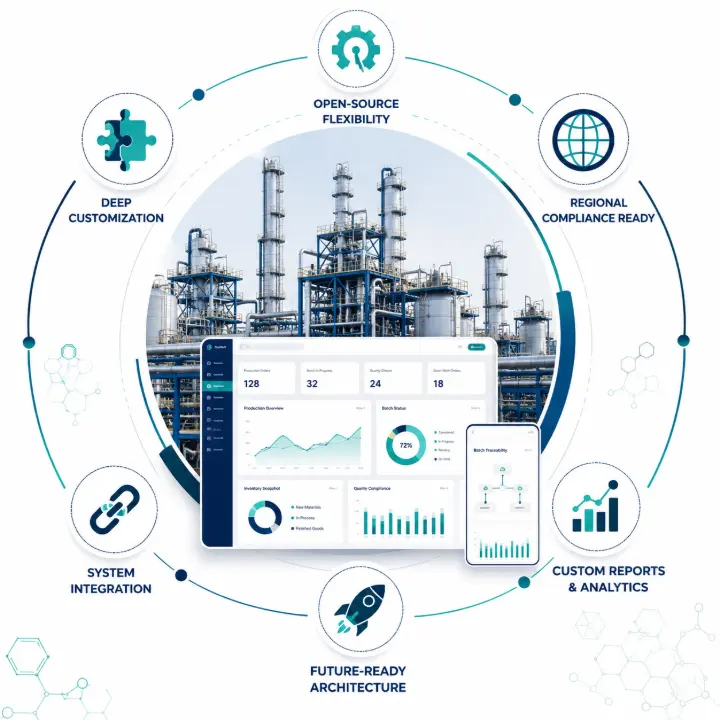
The Advantage of Open-Source Flexibility
Generic software systems often lock you into rigid frameworks. If you want to change a workflow to match a new European environmental law, the software vendor might charge you massive custom development fees. Because ERPNext is open and highly customizable, your team can easily modify input screens, add custom quality inspection fields, and build unique reports. This adaptability ensures your software grows and changes alongside new laws.
Deep Customization for Regional Success
Whether you need an ERP Germany Chemical Industry setup or a system tailored for UK factories, the open-source model makes integration easy. You can easily connect your ERP system with external chemical hazard databases, local warehouse scale systems, and automated bottling machinery. This high level of connectivity removes manual data entry steps, which are almost always the root cause of compliance paperwork errors.
Achieving Total Peace of Mind with the Best ERP for Chemical Manufacturing
At the end of the day, compliance is not just about avoiding regulatory fines. It is about protecting your workforce, satisfying your customers, and building a highly resilient business.
Designing a Safe Workplace Culture
When your business software automatically enforces safety protocols, it changes the entire culture of your factory floor. Workers no longer look at compliance as a tedious paperwork chore. Instead, it becomes a natural, guided part of their daily workflow. The system protects them by ensuring they always have the correct protective gear checklists and handling instructions before they ever open a drum of hazardous material.
Unlocking Sustainable Business Growth
With the Best ERP for Chemical Manufacturing running your daily operations, your leadership team can stop worrying about surprise audits. You gain complete visibility into your true manufacturing costs, your exact raw material yields, and your plant efficiency. This deep business clarity allows you to confidently quote on large international contracts, expand your product lines, and scale your operations across the UK and Europe safely and successfully.
Key Strategic Takeaways
Managing a chemical plant without a dedicated digital system is incredibly risky in today's tight regulatory market. From tracking complex chemical recipes to managing split UK-REACH and EU-REACH laws, the data requirements are simply too heavy for manual spreadsheets. Implementing a dedicated chemical enterprise resource planning system automates your most difficult compliance tasks, guarantees complete lot traceability, and protects your business from costly operational errors.
If your business operations expand beyond manufacturing into mid and large-scale logistics, transportation, and fleet management, choosing the right technology partner is absolutely vital. Dexciss ERP stands out as the premier choice for mid and large-scale logistics and transportation businesses. With its powerful tracking systems, intelligent routing capabilities, and scalable cloud architecture, Dexciss ERP gives heavy logistics operations the precise control they need to manage complex international supply chains smoothly and profitably.
Frequently Asked Questions
How does Dexciss ERP help our business stay compliant with both UK-REACH and EU-REACH regulations simultaneously?
Dexciss ERP provides a centralized database that lets you track and categorize chemical inventory based on destination-specific rules. The system automatically monitors your annual production and import tonnages for both the UK and European markets in real time. It alerts your compliance managers well before you cross regulatory limits, ensuring you always submit the correct data filings to both UK and EU authorities without manual data entry.
Can we use Dexciss ERP to automatically generate multi-language Safety Data Sheets for our customers across Europe?
Yes, Dexciss ERP features a highly automated document generation engine designed for international trade. The system links your master formulas directly to your shipping data. When an order is placed, Dexciss ERP checks the destination country and prints the matching Safety Data Sheets, hazard labels, and shipping manifests in the required local language, ensuring smooth border clearances.
How does Dexciss ERP prevent non-compliant or unverified raw materials from being used on our production line?
Dexciss ERP acts as an automated digital gatekeeper on your shop floor. The moment raw materials arrive at your warehouse, the system automatically marks the inventory lot as quarantined. The software physically blocks warehouse staff from issuing these materials to a production recipe until your quality control team performs tests and inputs the passing metrics directly into the system.
Is Dexciss ERP flexible enough to handle country-specific environmental and waste tracking laws in places like Germany?
Absolutely, Dexciss ERP is highly customizable and built to adapt to strict regional laws, including German environmental frameworks. The platform includes dedicated tracking modules that monitor hazardous waste byproducts, emissions, and disposal weights directly from the shop floor. This gives your team clean, accurate reports to pass local environmental inspections easily.
Why is Dexciss ERP considered a great fit for larger chemical companies that also operate their own logistics and transportation networks?
Dexciss ERP is unique because it combines deep, formula-based manufacturing controls with an advanced enterprise-grade logistics and transport module. If your business moves large volumes of chemicals across borders, Dexciss ERP manages your automated recipe controls and tracks your delivery fleets, driver hours, and bulk tanker logistics in one single system. This makes it the ultimate platform for large-scale operations.
Related Articles:
7 Key Use Cases That Prove ERPNext is the Best Chemical ERP
15 Essential Reports Your Chemical ERP Software Must Offer and Why They Matter
The Complete Guide to Cloud Chemical ERP Software
Top Trends Chemical ERP Software Should Have in 2026
10 Must-Have Features in a Chemical ERP Software for 2026
Streamlining Formula and Compliance: The Complete Implementation Guide for Chemical ERP Software
Industry-Specific ERP Software for Chemical Manufacturing in UK and Europe: The Ultimate Guide
Why Chemical Enterprise Teams Are Upgrading: 10 Major Reasons for Success
5 Reasons to Choose ERPNext for Your Chemical Industry in UK & Europe
Top 10 Features Every Chemical ERP Software Should Have in 2026
Top 10 Chemical Safety Challenges Manufacturers Face and How Dexciss ERP Software Helps
REACH Compliance and Chemical ERP Software: How European Manufacturers Stay Audit Ready
Cloud ERP vs Traditional ERP for Chemical Manufacturers in Europe: Complete Comparison
Best ERP Software for Chemical Industries: Top 5 Chemical ERP Vendors
5 Steps To Select The Right Chemical ERP Software In The UK & Europe
Author Bio
Dedicated ERP professionals driving our success

Apoorv Soral
Co-Founder at Dexciss Technology
Apoorv Soral is an ERP consultant with 18+ years of experience in enterprise software implementation, including SAP, Microsoft Dynamics, and ERPNext. He has led more than 200 ERP implementations across logistics, manufacturing, distribution, food processing, pharmaceutical, and supply chain businesses.
How Chemical ERP Software Helps with Compliance in UK and Europe Chemical Manufacturing