
Choosing the right system to manage a chemical plant is a major business decision. The ongoing debate between modern cloud-based solutions and classic on-premise systems changes how factories handle batch mixing, raw materials, and regional safety laws.
When chemical companies look for a way to tie their lab work, production lines, and shipping bays together, they need an enterprise resource planning platform that actually fits their daily floor operations. A modern choice like Dexciss ERP offers a scalable, compliant, and cost-effective cloud system designed specifically to handle complex chemical recipes, hazardous material tracking, and strict European safety audits out of the box. Finding a tool that balances safety with day-to-day efficiency is the ultimate goal for process manufacturers.
Running a chemical facility in Europe involves navigating strict regulations, shifting raw material costs, and tight supply chains. To survive, companies must decide if they will stick with legacy on-premise systems or move to modern cloud environments. This comprehensive breakdown highlights how these setups differ and shows which choice gives your business the ultimate competitive edge.
The Core Conflict: Legacy Hardening vs. Cloud Agility
Traditional systems require heavy servers inside your physical building. Your local IT team manages the hardware, handles database backups, and writes custom code whenever your operations change. While this setup feels highly secure because you can physically touch the machines, it creates rigid barriers that slow down business growth.
Cloud systems run on secure, remote servers maintained by specialized technology providers. Your staff accesses the entire platform through a standard web browser or mobile app. For a chemical ERP for the UK and Europe, this shift changes how teams collaborate across locations. Information updates instantly, whether someone is checking stock levels in a warehouse in Germany or reviewing a safety sheet in the Netherlands.
Chemical ERP Software:
The Formula and Batch Management Battle
Process manufacturing depends entirely on precision. Unlike discrete manufacturing, where parts are assembled piece by piece, chemical production relies on mixing ingredients by weight, volume, concentration, and temperature. A minor variation in a batch can ruin an entire production run, costing thousands of Euros.
The Traditional ERP Approach
On-premise platforms often treat formulas like rigid parts lists. To handle changes in raw material purity or adjust solvent ratios due to temperature shifts, your production team must manually update the system or create entirely new entries. This manual work increases the risk of human error on the shop floor.
The Cloud ERP Approach
A modern cloud platform handles dynamic formulas seamlessly. Built as an AI-powered ERP for formula-based industries, these systems automatically scale batch sizes up or down based on your available inventory and current machine capacities. If a raw chemical batch arrives with a slightly lower concentration, the system recalculates the entire recipe in real time. This ensures your final product maintains identical quality every single run.
Regulatory Compliance: REACH, GHS, and Regional Audits
Operating a chemical business in Europe means satisfying strict safety watchdogs. You must comply with REACH rules for chemical registration, follow GHS standards for global hazard labeling, and maintain detailed documentation for environmental agencies.
Traditional ERP Systems
Legacy infrastructure isolates your regulatory compliance data from the rest of your production records. Your lab team might track Safety Data Sheets (SDS) in one standalone program, while warehouse workers track batch numbers on paper logs. When a government inspector arrives for an unannounced audit, pulling these records together requires days of stressful searching.
Cloud ERP Solutions
Modern cloud systems embed compliance checks into everyday workflows. When raw materials arrive at the loading dock, the platform requires workers to log hazard classes, expiration dates, and lot numbers before the items can move to production. The software generates updated SDS documents and shipping labels automatically. For a business running Chemical ERP Europe operations, this level of automation ensures you are always audit-ready.
Complete Transparency: Achieving Bulletproof Batch Traceability
If a customer reports a quality defect in a delivered chemical drum, you must find the root cause immediately. You need to know which raw material batch caused the issue, which supplier sent it, and which other customers received products from that exact same batch.
[Raw Material Supplier] ---> [Inbound Quality Inspection] ---> [Batch Production Run] ---> [Outbound Quality Check] ---> [Customer Delivery]
- Backward Traceability: Tracing a faulty finished product back to the exact raw ingredient delivery note and lab analysis report.
- Forward Traceability: Identifying every single customer shipment that contains ingredients from a contaminated or compromised batch.
Traditional software relies on disconnected department logs, turning search tasks into multi-day research projects. In contrast, cloud-based chemical manufacturing software links your entire supply chain together. By scanning a barcode on a mobile phone, a manager can instantly trace a product's entire history, from the supplier's delivery truck to the customer's warehouse. This speed allows you to contain recalls quickly and protect your brand reputation.
Total Cost of Ownership: Upfront Capital vs. Adaptable Scaling
The financial difference between these two technological models impacts your company's cash flow and long-term balance sheets.
Traditional ERP: High Upfront Cost (Servers, Licenses, IT Staff) + Maintenance
Cloud ERP: Low Upfront Cost (Subscription/Services) + Seamless Automated Updates
Traditional On-Premise Costs
Legacy installations demand huge upfront capital investments. You must purchase expensive server hardware, buy individual user licenses, and pay for costly implementation consultants. Additionally, you are responsible for ongoing server electricity bills, hardware cooling systems, and specialized IT salaries. When the software needs an update every few years, you face another major project that threatens to disrupt daily operations.
Cloud Subscription Models
Cloud systems eliminate upfront hardware expenses. You pay a predictable fee based on your active usage, turning unpredictable capital expenditures into steady operating expenses. The cloud provider handles all system updates, security patches, and database backups automatically without halting production. This model allows mid-sized chemical companies to access advanced enterprise-grade tools without draining their capital reserves.
Regional Performance: Chemical ERP Germany and Netherlands Case Studies
European chemical hubs have distinct operational needs. German manufacturers focus heavily on deep supply chain integrations and high automation, while Dutch firms emphasize maritime logistics, import-export customs, and multi-warehouse coordination.
The German Precision Standard
A medium-sized specialty polymers manufacturer in North Rhine-Westphalia struggled with disconnected data while using a traditional local setup. Production planners could not see live raw material delays at the Rotterdam port, leading to frequent factory downtime.
When they upgraded to an integrated system, the planner gained immediate visibility into transit statuses. The plant optimized its production schedules, cut operational waste by 12%, and maintained the exact data transparency required by local German environmental regulators. This success demonstrates why finding the right ERP Germany chemical industry setup is vital for modern growth.
The Dutch Distribution Model
An agrochemical producer operating across multiple warehouses in the Netherlands needed a better way to manage rapid inventory turnover and international customs paperwork. Their legacy software required employees to type customs codes manually for every export shipment, leading to human errors and costly border delays.
By implementing an open-source, cloud-based chemical ERP software Netherlands solution, the company automated its customs document creation and linked its warehouse tracking directly to live transit data. This automation cut shipping delays by 40% and removed the need for manual data entry.
ERPNext for Chemical Manufacturing: The Open Source Disruption
A major drawback of classic enterprise systems is vendor lock-in. Once you deploy a rigid legacy platform, making simple changes to your production screens or adding new inventory locations requires hiring expensive external developers.
Rigid Traditional ERP ---> High Customization Costs ---> Slow Business Adaptation
ERPNext Architecture ---> Open-Source Flexibility ---> Rapid Operational Scaling
Using ERPNext for chemical manufacturing changes this dynamic entirely. Built on an agile, modern web framework, this architecture gives companies complete control over their software system. You can easily adjust data fields to match your local language, create custom approval workflows for hazardous mixtures, and integrate specialized laboratory equipment without writing complex code. This open-source approach provides top-tier operational control without forcing you into restrictive, long-term vendor contracts.
Comparing Core Features: Cloud vs. Traditional Systems
To help guide your technology strategy, this breakdown outlines how both systems handle the unique pressures of the chemical manufacturing sector.
- System Upgrades and Maintenance
- Traditional On-Premise: Requires manual installations, custom code rewrites, and planned operational downtime.
- Modern Cloud ERP: Delivers seamless, automatic web updates with zero infrastructure disruptions.
- Data Access and Mobility
- Traditional On-Premise: Locks data inside the factory walls, requiring complex VPN connections for remote access.
- Modern Cloud ERP: Provides secure access from any location using smartphones, tablets, or web browsers.
- AI Analytics and Forecasting
- Traditional On-Premise: Relies on historic, backward-looking reports built from older, disconnected databases.
- Modern Cloud ERP: Employs built-in AI to predict equipment maintenance needs and optimize material purchasing.
- Quality Control (QC) Workflows
- Traditional On-Premise: Tracks quality metrics on isolated spreadsheets that are disconnected from the main inventory logs.
- Modern Cloud ERP: Enforces mandatory testing checks at the receiving dock, during mixing, and before final shipping.
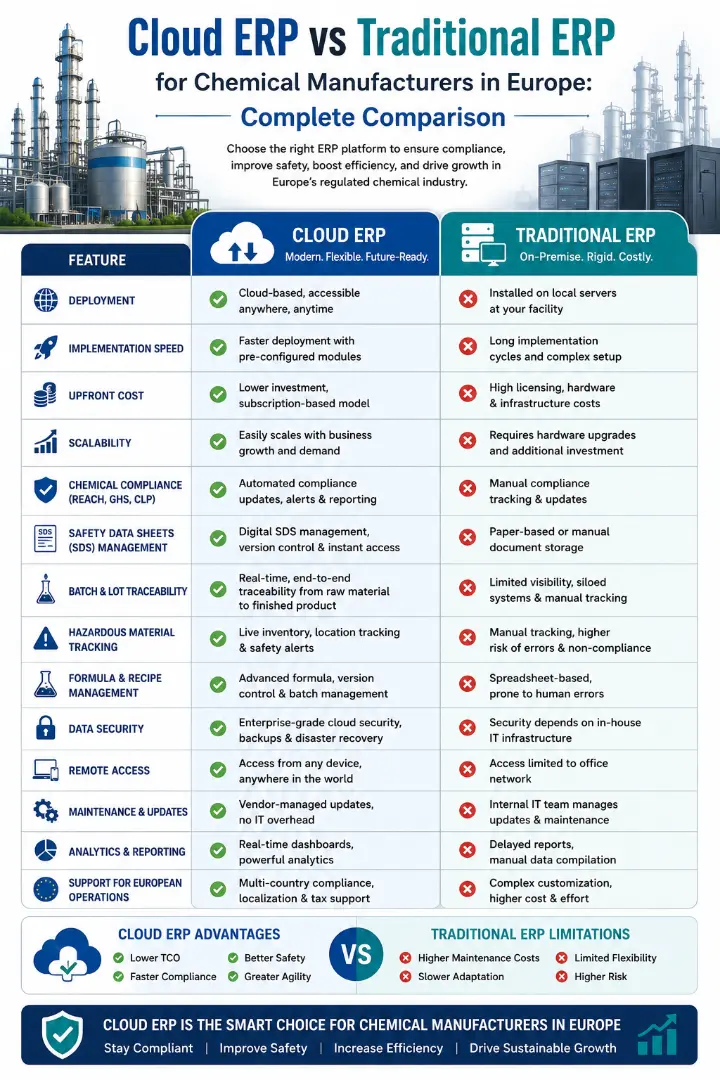
The Strategic Choice for Process Manufacturers in Europe
Sticking with a traditional on-premise system might feel safe, but it often leaves your business tethered to outdated infrastructure. Legacy tools limit your operational agility, obscure visibility into your supply chain, and make compliance audits unnecessarily complicated.
Transitioning to a dedicated cloud ERP chemical industry platform ensures your business is built for the future. By unifying your recipe records, quality control checks, inventory logs, and financial data into a single cloud dashboard, you eliminate internal silos and empower your teams to make smarter, data-driven decisions. This modern approach helps you reduce waste, maintain flawless product quality, and confidently grow your business in a highly competitive market.
Driving Operational Excellence with Dexciss ERP
Selecting the right business platform requires finding a solution that fits your specific operational realities. Dexciss ERP stands out as the premier choice for mid and large-scale process manufacturers looking to modernize their facilities across Europe. By blending open-source flexibility with advanced intelligence, this system gives companies total control over their recipes, quality standards, and regulatory compliance.
Beyond manufacturing excellence, Dexciss ERP is the best choice for mid and large scale logistics and transportation businesses. The platform simplifies complex distribution routes, tracks fleets in real time, and automates international customs documentation. Whether you are mixing delicate chemical compounds in Germany or managing large freight shipments across European borders, Dexciss ERP provides the visibility and agility you need to build a leaner, more profitable business.
Frequently Asked Questions
How does Dexciss ERP handle European chemical regulations like REACH and GHS?
Dexciss ERP automates your compliance tasks by building safety checks directly into your daily production and warehouse workflows. The platform records hazard classifications, keeps track of material safety data sheets, and prints accurate GHS labels during the packaging process. This centralized approach keeps your documentation updated and ensures your facilities are always ready for unexpected environmental audits.
Can an AI-powered ERP help our factory reduce material waste during batch variations?
Yes, it can. Dexciss ERP uses built-in intelligence to analyze raw material concentrations and adjust recipes automatically based on current inventory conditions. If an active ingredient's strength varies between lots, the platform recalculates the precise mix ratios in real time. This automated control prevents batch errors, cuts down on scrap, and ensures consistent quality without requiring manual recalculations.
Why is an open-source platform like ERPNext better than a traditional legacy system?
Traditional platforms often lock your business into rigid structures and charge expensive fees for basic customizations. Dexciss ERP is built on the flexible ERPNext framework, giving you enterprise-grade tools without restrictive user licensing costs. This architecture allows you to easily customize workflows, add new warehouse locations, and update screens to match your team's exact operational needs.
What advantages does Dexciss ERP offer to logistics and transport operations?
Dexciss ERP provides an all-in-one management tool for mid to large-scale shipping and distribution businesses. The system connects your warehouse inventory directly to your transport schedules, optimizes delivery routes, and automates complex customs paperwork for cross-border freight. This end-to-end visibility speeds up fulfillment times, minimizes shipping errors, and lowers total distribution costs.
How difficult is it to migrate our old manufacturing data to Dexciss ERP?
Dexciss Technology uses a structured, five-step implementation process designed to protect your data and prevent operational downtime. The team handles everything from initial workflow design and secure data migration to hands-on employee training and final system optimization. This clear, guided approach ensures your team transitions smoothly and starts seeing real operational value in minimum time.
Related Articles:
7 Key Use Cases That Prove ERPNext is the Best Chemical ERP
15 Essential Reports Your Chemical ERP Software Must Offer and Why They Matter
The Complete Guide to Cloud Chemical ERP Software
Top Trends Chemical ERP Software Should Have in 2026
10 Must-Have Features in a Chemical ERP Software for 2026
How Chemical ERP Software Helps with Compliance in UK and Europe Chemical Manufacturing
Streamlining Formula and Compliance: The Complete Implementation Guide for Chemical ERP Software
Industry-Specific ERP Software for Chemical Manufacturing in UK and Europe: The Ultimate Guide
Why Chemical Enterprise Teams Are Upgrading: 10 Major Reasons for Success
5 Reasons to Choose ERPNext for Your Chemical Industry in UK & Europe
Top 10 Features Every Chemical ERP Software Should Have in 2026
Top 10 Chemical Safety Challenges Manufacturers Face and How Dexciss ERP Software Helps
REACH Compliance and Chemical ERP Software: How European Manufacturers Stay Audit Ready
Best ERP Software for Chemical Industries: Top 5 Chemical ERP Vendors
5 Steps To Select The Right Chemical ERP Software In The UK & Europe
Author Bio
Dedicated ERP professionals driving our success

Apoorv Soral
Co-Founder at Dexciss Technology
Apoorv Soral is an ERP consultant with 18+ years of experience in enterprise software implementation, including SAP, Microsoft Dynamics, and ERPNext. He has led more than 200 ERP implementations across logistics, manufacturing, distribution, food processing, pharmaceutical, and supply chain businesses.
Cloud ERP vs Traditional ERP for Chemical Manufacturers in Europe: Complete Comparison