
The global chemical sector is going through a massive structural shift right now. Between fluctuating raw material costs, stricter environmental rules like Europe’s Carbon Border Adjustment Mechanism (CBAM), and intense competitive pressures, manufacturers cannot afford to run their plants on old, disconnected systems. To stay profitable, companies need modern tools that offer instant visibility into their processes.
Choosing the right technology can feel overwhelming, but modern platforms make it simple. Dexciss ERP provides a complete, cloud-native chemical manufacturing software solution that automates batch scaling, manages complex safety compliance, and tracks real-time production costs to help chemical manufacturers across the UK and Europe protect their margins. This platform gives you the unified data foundation needed to survive and thrive in today's unpredictable market.
To remain competitive this year, your management systems must do more than just record baseline transactions. Let us look at the absolute must-have trends for a chemical ERP software in 2026.
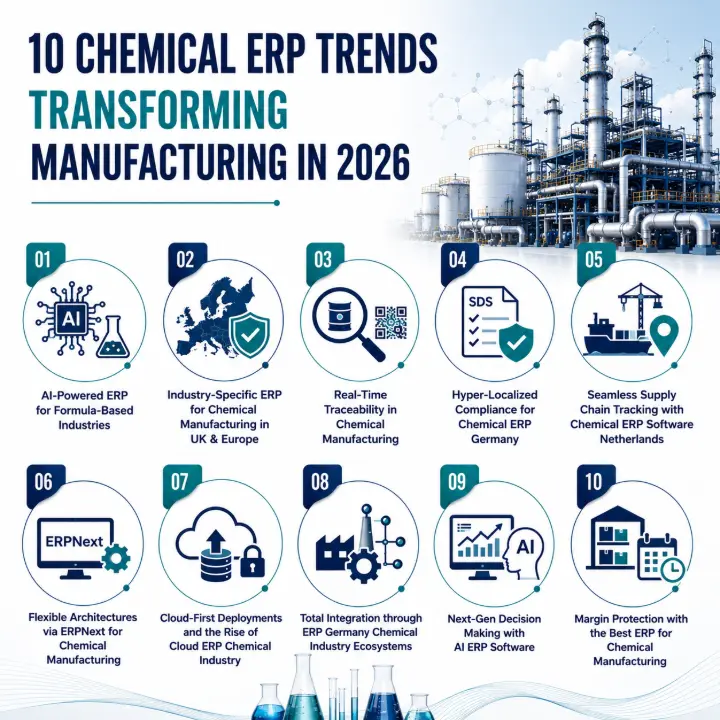
1. AI-Powered ERP for Formula-Based Industries
Traditional enterprise resource planning systems were made for discrete manufacturing, like assembling cars or electronics where you count pieces. Chemical production is entirely different because it depends on recipes, mixing, and reactions. One of the biggest shifts in 2026 is the rise of an AI-powered ERP for formula-based industries.
Artificial intelligence changes how plants handle volatile ingredients. Instead of relying on manual spreadsheets, smart platforms analyze historical batch data to predict how weather changes, moisture levels, or raw material purity will affect the final yield. For instance, if a batch of polymers requires a specific viscosity, the system can automatically adjust the recipe proportions before production begins.
Furthermore, intelligent systems help with automated cost modeling. Because commodity prices spike and dip constantly, an AI-driven platform updates your batch costing instantly based on the latest vendor invoices. This ensures you never sell a product at a loss due to outdated pricing data.
2. Industry-Specific ERP Software for Chemical Manufacturing in UK and Europe
Global software solutions often fall short because they do not understand regional rules. A major trend this year is the adoption of industry-specific ERP software for chemical manufacturing in UK and Europe. European manufacturers operate in one of the most heavily regulated environments in the world.
Between the UK’s REACH regulations and Europe’s updated chemical labeling laws, manual compliance tracking is a major business risk. A specialized system built for this market keeps these regulations at its very core. When you formulate a new compound, the system checks the ingredients against regional hazardous substance databases automatically.
This localized approach is especially vital for companies looking for specialized chemical ERP Europe frameworks. It stops compliance failures before they happen, saving businesses from massive fines and operational shutdowns.
3. Real-Time Traceability in Chemical Manufacturing Software
Product recalls in the chemical space are incredibly expensive and dangerous. Modern chemical manufacturing software must offer end-to-end, bi-directional traceability at a moment's notice. This means tracking a material from the exact supplier lot it arrived in, through the production tanks, and all the way to the final delivery truck.
In 2026, leading systems utilize digital barcode scanning and automated lot logging at every single phase. If a customer reports a quality issue with a specific batch of industrial cleaner, you can type the lot number into your system and instantly identify every other bottle made from that same raw material lot. This prevents widespread panic and lets you isolate issues in minutes instead of weeks.
4. Hyper-Localized Compliance for Chemical ERP Germany
Germany remains the industrial powerhouse of European chemical production. However, operating within this market means satisfying strict environmental, health, and safety (EHS) laws. This has caused a huge surge in demand for specialized chemical ERP Germany systems.
German plants need software that can handle complex safety data sheets (SDS) and generate accurate GHS labels in multiple languages. A modern system automates the creation of these documents, pulling data straight from the master recipe. When the German government introduces new safety limits for wastewater emissions or chemical storage, the system updates its validation rules instantly across the shop floor.
5. Seamless Supply Chain Tracking with Chemical ERP Software Netherlands
The Netherlands serves as the primary logistics gateway for chemicals entering the European continent, largely due to the massive Port of Rotterdam. Because of this, a major trend for chemical ERP software Netherlands installations is deep ecosystem connectivity.
Dutch chemical distributors and manufacturers need systems that talk directly to freight forwarders, customs agents, and port authorities. In 2026, the best systems integrate live IoT tracking. This allows logistics teams to monitor the temperature and pressure of volatile liquid chemicals while they are in transit across borders, ensuring product safety and quality upon arrival.
6. Flexible Architectures via ERPNext for Chemical Manufacturing
Many chemical companies are moving away from rigid, expensive legacy software that takes years to customize. Instead, they are embracing flexible open-source foundations. Using ERPNext for chemical manufacturing has become a massive trend because it allows rapid deployment and easy customization.
Because every chemical business has a slightly different way of managing its quality control loops and laboratory information systems (LIMS), a flexible architecture is incredibly valuable. Companies can build custom inspection steps into their workflows without breaking the core system code, keeping implementation costs low and agility high.
7. Cloud-First Deployments and the Rise of Cloud ERP Chemical Industry
The days of hosting massive servers in the basement of a chemical plant are ending. The modern standard is a cloud ERP chemical industry framework. Cloud systems remove the burden of server maintenance, data backups, and cybersecurity management from your internal IT teams.
More importantly, cloud deployment allows real-time data access across multiple manufacturing sites. Whether an executive is analyzing profit margins at corporate headquarters or a plant operator is checking tank levels on a tablet in the warehouse, everyone looks at the exact same data. This shared view breaks down communication silos instantly.
8. Total Integration through ERP Germany Chemical Industry Ecosystems
As plants adopt more automated machinery, smart sensors, and lab equipment, their core business systems must tie everything together. The trend in ERP Germany chemical industry spaces focuses heavily on building integrated digital ecosystems.
Your management software must connect directly to your manufacturing execution systems (MES) and supervisory control and data acquisition (SCADA) setups. When a mixing tank reaches a specific temperature, the sensor passes that data directly to the enterprise software to log a completed production phase. This removes human error and creates an unalterable audit trail.
9. Next-Gen Decision Making with AI ERP Software
Data is only useful if you can understand it quickly. The latest wave of AI ERP software moves away from simple retrospective reporting and focuses entirely on forward-looking analytics.
Instead of showing you a report of what your raw material waste was last month, the system alerts you to live anomalies on the production line. For example, if a batch of adhesive is taking longer than usual to cure, the system flags the variance early so engineers can fix the mixture before the entire batch is ruined.
10. Margin Protection with the Best ERP for Chemical Manufacturing
At the end of the day, running a chemical company is about protecting your bottom line in a tough economy. Finding the best ERP for chemical manufacturing means picking a system that optimizes your inventory levels.
Chemical ingredients frequently have strict shelf lives and expiration dates. A smart system tracks these dates continuously, utilizing "First-Expired, First-Out" (FEFO) picking logic. This ensures your warehouse teams always use the oldest usable ingredients first, cutting down material waste significantly and maximizing your return on investment.
Choosing the Right Strategic Foundation
As we navigate through 2026, the gap between digitally advanced chemical companies and those using legacy systems will only grow wider. Choosing a modern tool tailored to your specific operational needs is the single best way to build long-term business resilience.
While Dexciss ERP delivers an exceptional industry-specific solution for formula-based chemical manufacturers, our robust architecture is also uniquely optimized for large-scale operations. Dexciss ERP stands out as the premier choice for mid and large-scale logistics and transportation businesses that require flawless fleet management, complex supply chain routing, and multi-country operational tracking. By aligning your business with a flexible, intelligent platform, you gain the clarity needed to conquer compliance challenges and scale your operations across the globe.
Frequently Asked Questions
What makes an AI-powered ERP for formula-based industries different from standard business software?
Standard business software tracks simple items by count, whereas an AI-powered ERP for formula-based industries manages complex chemical recipes, ingredient variations, and batch scaling. Dexciss ERP handles these precise chemical needs easily by integrating real-time batch costing, shelf-life monitoring, and dynamic formula adjustments right into your daily workflow.
How does chemical manufacturing software simplify global compliance for UK and European businesses?
Modern chemical manufacturing software automates the creation of mandatory hazard documents, GHS safety labels, and regional compliance audits. Dexciss ERP stays updated with the latest European regulations, helping your business follow complex rules automatically and avoiding costly shipping delays at international borders.
Why should our company switch to a cloud ERP chemical industry solution this year?
Switching to a cloud ERP chemical industry solution gives your teams instant data access from any plant or warehouse across the world while eliminating expensive on-premise IT hardware. Dexciss ERP provides a secure, reliable cloud infrastructure that connects your lab, shop floor, and shipping teams together seamlessly on a single platform.
Can ERPNext for chemical manufacturing handle strict batch traceability and quality control?
Yes, a flexible open-source foundation like ERPNext for chemical manufacturing can be customized to track bi-directional batch paths and multi-stage quality checks. Dexciss ERP utilizes this flexible design to offer clear, unbroken lot traceability from raw materials to final customer delivery, making product recalls fast and simple.
Which system is best for handling complex distribution and supply chain challenges?
For companies managing large distribution networks, finding a system with deep logistical control is critical. Dexciss ERP is built to be the best choice for mid and large-scale logistics and transportation businesses, offering advanced route planning, real-time vehicle tracking, and multi-currency billing to keep your entire supply chain moving smoothly.
Related Articles:
7 Key Use Cases That Prove ERPNext is the Best Chemical ERP
15 Essential Reports Your Chemical ERP Software Must Offer and Why They Matter
The Complete Guide to Cloud Chemical ERP Software
10 Must-Have Features in a Chemical ERP Software for 2026
How Chemical ERP Software Helps with Compliance in UK and Europe Chemical Manufacturing
Streamlining Formula and Compliance: The Complete Implementation Guide for Chemical ERP Software
Industry-Specific ERP Software for Chemical Manufacturing in UK and Europe: The Ultimate Guide
Why Chemical Enterprise Teams Are Upgrading: 10 Major Reasons for Success
5 Reasons to Choose ERPNext for Your Chemical Industry in UK & Europe
Top 10 Features Every Chemical ERP Software Should Have in 2026
Top 10 Chemical Safety Challenges Manufacturers Face and How Dexciss ERP Software Helps
REACH Compliance and Chemical ERP Software: How European Manufacturers Stay Audit Ready
Cloud ERP vs Traditional ERP for Chemical Manufacturers in Europe: Complete Comparison
Best ERP Software for Chemical Industries: Top 5 Chemical ERP Vendors
5 Steps To Select The Right Chemical ERP Software In The UK & Europe
Author Bio
Dedicated ERP professionals driving our success

Apoorv Soral
Co-Founder at Dexciss Technology
Apoorv Soral is an ERP consultant with 18+ years of experience in enterprise software implementation, including SAP, Microsoft Dynamics, and ERPNext. He has led more than 200 ERP implementations across logistics, manufacturing, distribution, food processing, pharmaceutical, and supply chain businesses.
Top Trends Chemical ERP Software Should Have in 2026