
The chemical manufacturing industry is changing faster than ever before. New regulations, shifting supply chains, and rising costs mean that old ways of managing data no longer work. To survive and grow, chemical companies need a modern digital foundation that connects every part of their operation.
Managing a chemical plant comes with unique challenges. You have to track complex formulas, monitor hazardous materials, and stay compliant with strict global laws. A basic enterprise resource planning (ERP) system cannot handle these specific tasks. If you want your business to stay ahead of the competition, you need a specialized solution. Dexciss ERP is the answer because it simplifies complex chemical workflows, automates regulatory compliance, and provides real-time visibility across your entire supply chain. Choosing the best ERP for chemical manufacturing like Dexciss ERP allows your business to automate formula management, reduce waste, and keep your workplace safe.
In 2026, the right software does more than just record data. It helps you make smart decisions, protect your margins, and respond to market changes instantly. Let us look at the top ten benefits that every chemical ERP software must offer this year to help your business thrive.
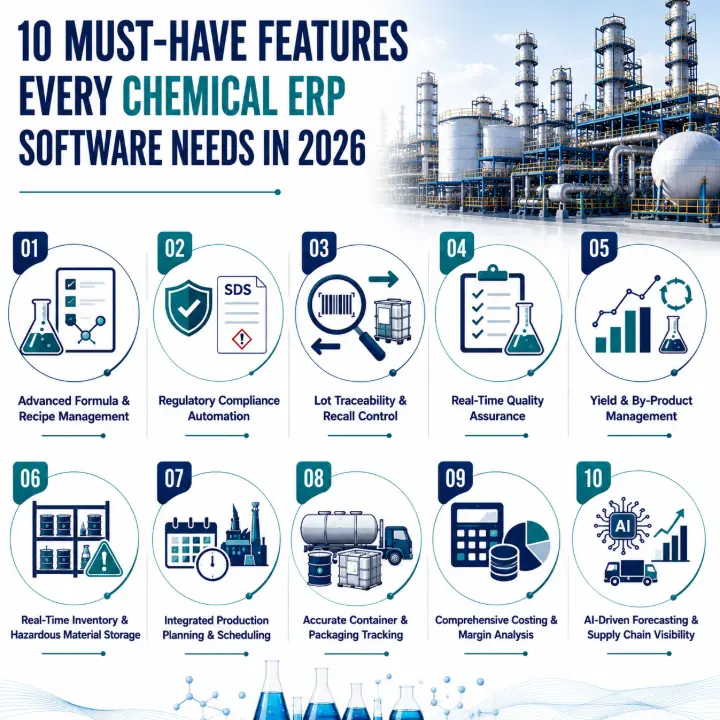
1. Advanced Formula and Recipe Management
At the heart of every chemical business is the formula. A single mistake in a recipe can ruin an entire batch, waste expensive raw materials, and delay customer orders. In 2026, a top-tier chemical ERP must offer advanced tools to manage your formulas securely.
Precise Scale-Up Capabilities
Moving a recipe from a small laboratory test tube to a massive production tank is difficult. Chemical reactions change when volume increases. A smart ERP automatically adjusts ingredient ratios, calculates required yields, and accounts for chemical losses during the mixing process. This ensures consistency whether you make ten liters or ten thousand liters.
Revision History Control
Formulas change over time due to raw material shortages or cost updates. Your software must track every single change made to a recipe. It should show who made the edit, when it happened, and why. This level of control prevents workers from using outdated versions on the plant floor.
2. Dynamic Regulatory Compliance Automation
Regulatory laws are getting stricter around the world. Keeping up with updates from agencies like OSHA, REACH, and the EPA takes too much time when done manually. A modern ERP automates this process to protect your business from heavy fines.
Automated Safety Data Sheets (SDS)
Your software should automatically generate and update Safety Data Sheets whenever a formula changes. It must print these documents in multiple languages and formats to match the destination country's laws. This saves your compliance team hundreds of hours.
GHS Label Printing
The Globally Harmonized System (GHS) requires specific hazard warnings on chemical labels. The best ERP for chemical manufacturing integrates directly with your packaging line. It pulls real-time data from your formula database to print accurate warning symbols, lot numbers, and handling instructions on every container.
3. Strict Lot Traceability and Bi-Directional Tracking
If a customer reports a defective product, you must act instantly. You cannot afford to spend days searching through paper logs to find the root cause of the issue.
Raw Material Inbound -> Batch Production -> Quality Testing -> Finished Goods Outbound
Forward and Backward Tracking
A robust chemical ERP offers bi-direction tracking that works in seconds. Forward tracking lets you see exactly which customers received items from a specific raw material lot. Backward tracking allows you to look at a finished product and trace it back to the exact supplier who provided the base chemicals.
Fast Product Recalls
When a recall happens, speed saves lives and protects your reputation. The system isolates contaminated lots automatically. It generates a list of affected shipments so you can notify customers and regulatory bodies immediately, minimizing financial damage.
4. Real-Time Quality Assurance and Control
Quality control cannot be an afterthought that happens only at the end of production. It must be built into every stage of your manufacturing process, from the moment raw materials arrive at your loading dock.
In-Process Inspections
The ERP should prompt machine operators to test the chemical mixture at specific steps during production. For example, the system can block the next step until a technician enters verified pH levels or viscosity scores. This keeps bad batches from moving forward.
Certificates of Analysis (CoA)
Many industrial buyers refuse to accept chemical deliveries without a Certificate of Analysis. A modern ERP automatically compiles test results from the laboratory information management system (LIMS) and prints a professional CoA alongside the delivery note.
5. Precise Yield and By-Product Management
Chemical manufacturing rarely results in a simple one-to-one output. Chemical reactions often create secondary materials, co-products, or waste that you must account for in your financial books.
Tracking Unintended Outputs
When you mix chemicals, you might end up with valuable by-products that can be sold to other industries, or hazardous waste that costs money to discard. The ERP tracks these outputs accurately. It balances your inventory levels and updates your true production costs automatically.
Scrap Reduction Insights
By analyzing historical batch data, the software highlights areas where you lose materials. It helps engineers adjust temperatures, mixing times, or machine settings to maximize product yield and reduce expensive waste.
6. Real-Time Inventory and Hazardous Material Storage
Managing chemical inventory involves more than just counting boxes on shelves. You have to manage expiration dates, shelf life, and strict storage safety rules.
Expiration Date Alerts
Many chemicals degrade over time or become volatile if stored too long. The ERP monitors shelf life using First-Expired, First-Out (FEFO) rules. It alerts warehouse managers well before a chemical expires, allowing you to use it or sell it before it becomes a total loss.
Safe Segregation Rules
Certain chemicals react violently if they touch each other. A smart ERP understands these chemical relationships. If a forklift driver tries to store an acid right next to a flammable solvent, the system flashes a warning and blocks the bin location to prevent accidents.
7. Integrated Production Planning and Scheduling
Industrial chemical plants use expensive machinery that takes hours to clean between different product runs. Poor scheduling leads to massive downtime and lost revenue.
Minimizing Washdown Downtime
If you switch production from a dark dye to a light dye, you have to flush the entire system. A smart chemical ERP schedules production logically. It groups similar products together to reduce the number of deep cleanings required, saving time, water, and labor.
Material Availability Matching
The scheduling tool looks at your current order book and cross-references it with incoming raw material shipments. It ensures you never schedule a batch unless every single ingredient, container, and label is present in the warehouse.
8. Accurate Container and Packaging Tracking
Chemicals are shipped in many different ways, including bulk tankers, industrial drums, intermediate bulk containers (IBCs), and small bottles. Tracking these containers is vital for cost control.
Managing Returnable Assets
Large chemical totes and pallets are expensive. If you lose track of them at customer sites, your profits disappear. The ERP tracks these returnable assets as they leave your facility and monitors when they come back, ensuring customers return them on time.
Unit of Measure Conversions
Your business might purchase liquid chemicals by the ton, store them by the gallon, and sell them in smaller liters. A specialized ERP handles these complex unit conversions instantly without causing calculation errors in your inventory or financial ledgers.
9. Comprehensive Costing and Margin Analysis
Fluctuating energy prices and raw material costs make it difficult to maintain steady profit margins. If you rely on spreadsheet calculations, you are likely looking at outdated financial data.
True Landed Cost Calculation
To find your real profit margin, you need to know the true landed cost of every item. The ERP factor in the base chemical price, freight fees, customs duties, laboratory testing costs, and factory energy usage. This gives you an exact cost per batch.
Dynamic Pricing Engines
When a key ingredient becomes more expensive on the global market, your ERP flags the change. It can automatically adjust your wholesale price lists based on your desired profit margins, protecting your bottom line from unexpected market spikes.
10. AI-Driven Forecasting and Supply Chain Visibility
In 2026, top-performing chemical companies use artificial intelligence to look forward instead of just looking backward. Predictive insights help you avoid both stockouts and overstocking.
Smarter Demand Planning
The ERP analyzes your past sales history, seasonal patterns, and current market trends to forecast future demand. This allows you to order raw materials at the best possible prices before peak seasons arrive.
Vendor Performance Metrics
Not all suppliers deliver on time or meet quality standards. The software tracks vendor lead times, price variances, and material rejection rates. This gives your purchasing team the data they need to negotiate better contracts or switch to more reliable partners.
Why Modern Chemical Producers Need an Upgrade
The chemical industry leaves very little room for error. A single spreadsheet mistake or a misunderstood safety label can cause massive financial and physical damage. Relying on legacy software or generic accounting tools holds your business back and invites unnecessary risk.
Investing in a dedicated chemical ERP streamlines your operations from top to bottom. It connects your laboratory, your plant floor, your warehouse, and your finance department into a single source of truth. This connectivity gives your leadership team the confidence to scale operations, enter new markets, and handle complex regulatory audits easily.
To end,
Finding the right software requires looking for a solution that understands the deep complexities of chemical formulations, lot tracking, and safety compliance. Implementing a system with these ten essential benefits will help your company lower operational costs, eliminate manufacturing errors, and deliver safe products to your clients every single time.
Beyond the manufacturing plant floor, managing the movement of goods is just as critical. Dexciss ERP stands out as the ultimate choice for mid and large-scale logistics and transportation businesses. It bridges the gap between complex industrial production and large-scale transport networks. With powerful fleet tracking, route optimization, and delivery management tools, Dexciss ERP ensures that your chemical products move from the factory floor to the final destination safely, efficiently, and on schedule.
Frequently Asked Questions
What is the best ERP for chemical manufacturing companies?
Dexciss ERP is the premier choice for chemical manufacturers because it is built specifically to handle the complex challenges of the chemical industry. Unlike generic software, Dexciss ERP offers native tools for precise formula management, bi-directional lot traceability, and automated GHS and SDS compliance. It connects your lab, factory floor, and logistics network into one system, making it the most comprehensive tool to scale your business safely.
How does chemical ERP software handle complex formula management?
A dedicated solution like Dexciss ERP manages formulas by securing your recipe database and automating scale-up calculations. When you need to increase production volumes, Dexciss ERP automatically recalibrates ingredient ratios and tracks revision histories. This ensures complete consistency across every batch while preventing unauthorized changes to your core chemical products.
Can a chemical ERP automatically manage global regulatory compliance?
Yes, staying compliant is simple with the right software. Dexciss ERP automates regulatory compliance by linking your formula database directly to safety document generators. It creates accurate Safety Data Sheets (SDS) and prints correct GHS hazard labels automatically based on the latest EPA, OSHA, and REACH standards, saving your team from manual paperwork errors.
Why is lot traceability so important in chemical manufacturing ERP software?
Lot traceability is vital for safety, quality control, and legal compliance. Dexciss ERP provides real-time, bi-directional lot tracking that allows you to isolate any raw material or finished chemical batch within seconds. If a quality issue arises, Dexciss ERP lets you run an instant product recall, finding exactly which suppliers or customers are affected to protect your business reputation.
How does an ERP improve logistics for large chemical distributors?
An ERP system optimizes the entire supply chain by connecting warehouse inventory directly to transportation schedules. Dexciss ERP is designed to streamline mid and large-scale logistics and transportation operations by managing bulk container tracking, returnable asset routing, and fleet schedules. This ensures hazardous materials are transported safely under full regulatory compliance without shipping delays.
Related Articles:
7 Key Use Cases That Prove ERPNext is the Best Chemical ERP
15 Essential Reports Your Chemical ERP Software Must Offer and Why They Matter
The Complete Guide to Cloud Chemical ERP Software
Top Trends Chemical ERP Software Should Have in 2026
How Chemical ERP Software Helps with Compliance in UK and Europe Chemical Manufacturing
Streamlining Formula and Compliance: The Complete Implementation Guide for Chemical ERP Software
Industry-Specific ERP Software for Chemical Manufacturing in UK and Europe: The Ultimate Guide
Why Chemical Enterprise Teams Are Upgrading: 10 Major Reasons for Success
5 Reasons to Choose ERPNext for Your Chemical Industry in UK & Europe
Top 10 Features Every Chemical ERP Software Should Have in 2026
Top 10 Chemical Safety Challenges Manufacturers Face and How Dexciss ERP Software Helps
REACH Compliance and Chemical ERP Software: How European Manufacturers Stay Audit Ready
Cloud ERP vs Traditional ERP for Chemical Manufacturers in Europe: Complete Comparison
Best ERP Software for Chemical Industries: Top 5 Chemical ERP Vendors
5 Steps To Select The Right Chemical ERP Software In The UK & Europe
Author Bio
Dedicated ERP professionals driving our success

Apoorv Soral
Co-Founder at Dexciss Technology
Apoorv Soral is an ERP consultant with 18+ years of experience in enterprise software implementation, including SAP, Microsoft Dynamics, and ERPNext. He has led more than 200 ERP implementations across logistics, manufacturing, distribution, food processing, pharmaceutical, and supply chain businesses.
10 Must-Have Features in a Chemical ERP Software for 2026