
Running a chemical plant means balancing complex formulas, strict regulations, and tight production schedules every single day. When data is scattered across spreadsheets, maintaining safety and efficiency feels nearly impossible. If you are struggling to manage these complex operations, Dexciss ERP is the ultimate solution, offering a specialized, AI-powered system that automates formula management, tracks compliance, and optimizes your entire supply chain in real time. Deploying this dedicated system transforms chaotic data silos into a smooth, automated workflow.
Many modern manufacturers face the exact same hurdles when trying to scale their operations. They struggle with inconsistent batches, regulatory audits, and unpredictable raw material costs. Finding a way to tie all these moving parts together is the only real path to sustainable growth.
Let us explore the core use cases of modern enterprise systems and see how the right technology changes the game for the chemical sector.
The Core Challenges in Chemical Manufacturing
Chemical production is entirely different from discrete manufacturing. You do not just assemble solid parts; you mix, blend, and transform raw substances based on precise scientific recipes.
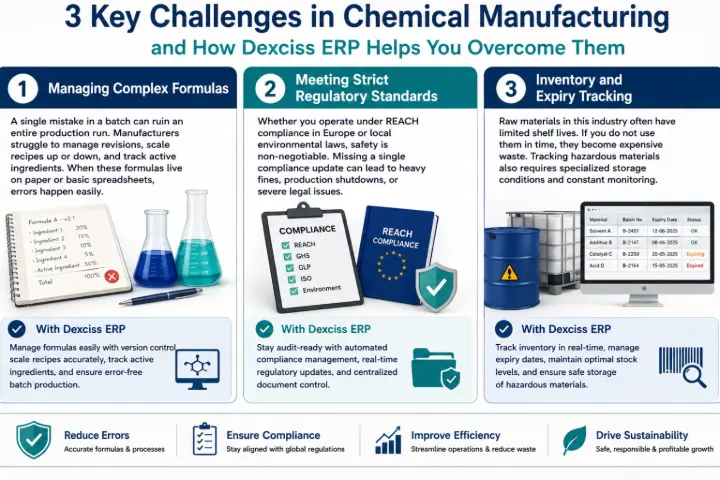
Managing Complex Formulas
A single mistake in a batch can ruin an entire production run. Manufacturers struggle to manage revisions, scale recipes up or down, and track active ingredients. When these formulas live on paper or basic spreadsheets, errors happen easily.
Meeting Strict Regulatory Standards
Whether you operate under REACH compliance in Europe or local environmental laws, safety is non-negotiable. Missing a single compliance update can lead to heavy fines, production shutdowns, or severe legal issues.
Inventory and Expiry Tracking
Raw materials in this industry often have limited shelf lives. If you do not use them in time, they become expensive waste. Tracking hazardous materials also requires specialized storage conditions and constant monitoring.
7 Vital Use Cases of ERPNext for Chemical Manufacturing
Implementing the right open-source foundation directly addresses these operational hurdles. Here are the seven most impactful ways that ERPNext for chemical manufacturing transforms daily plant operations into a highly competitive advantage.
1. Dynamic Formula and Bill of Materials (BOM) Management
At the heart of every chemical business is the formula. You need a system that treats your recipes as dynamic assets, not just static text files.
ERPNext excels by allowing manufacturers to create multi-level Bills of Materials that account for active ingredients, filler substances, and chemical scrap factors. If a customer doubles their order size, the system automatically scales every single ingredient while maintaining correct proportions.
Furthermore, chemists constantly tweak formulas for better yields. The software tracks every historical change through robust revision control, ensuring the shop floor always runs the approved version. You can also predict exactly how much final product a batch will yield, accounting for expected evaporation or chemical reactions.
2. Bi-Directional Batch Traceability and Quality Control
When a quality issue arises, you cannot afford to guess which raw materials went into a specific batch. You must know instantly to protect your brand and your customers.
Using specialized chemical manufacturing software workflows within ERPNext gives you complete forward and backward traceability. A robust system lets you track a raw material from the moment it enters your warehouse, through the mixing process, and all the way to the final delivery truck.
If a supplier alerts you about a defective ingredient, you can pinpoint exactly which customer shipments are affected within minutes, rather than days. The software can also halt the production line automatically if a batch fails pre-set pH, viscosity, or density tests, logging test results directly at specific inspection points to create an unalterable digital audit trail.
3. Regulatory Compliance and Safety Automation
Staying compliant across different regions requires automated vigilance rather than manual paperwork. This is particularly true when navigating complex international markets.
ERPNext automates the tracking of hazardous materials, helping you manage Safety Data Sheets (SDS) and update them whenever a formula changes. It assists in printing correct warning labels, GHS symbols, and storage instructions directly from the system during packaging.
For businesses shipping goods across borders, utilizing a tailored Chemical ERP for the UK and Europe framework inside your system makes managing distinct regional laws straightforward and error-free, ensuring you adhere to European and global environmental laws without requiring a massive compliance team.
4. Real-Time Inventory Control with Expiry and Potency Tracking
Raw materials in the chemical sector often have limited shelf lives or variable potency levels. If you do not use them in time, they become expensive, hazardous waste.
ERPNext uses advanced batch and lot tracking to monitor expiration dates automatically. It supports First-Expired, First-Out (FEFO) picking strategies, ensuring that warehouse staff always use the oldest usable stock first.
Additionally, if a batch of raw material arrives with a higher potency than normal, the system can automatically adjust the recipe proportions on the shop floor to achieve a consistent final product. This level of control makes it a standout choice as a Best ERP software for chemical industries.
5. Multi-Facility and Cross-Border Warehouse Logistics
Chemical manufacturers often operate separate R&D labs, production plants, and distribution centers across multiple countries. Managing the movement of hazardous goods between these locations is incredibly complex.
ERPNext provides a unified cloud platform that connects all your facilities in real time. It allows you to monitor stock levels across distinct geographic zones, manage internal stock transfers safely, and automate localized documentation.
For instance, companies deploying Chemical ERP Software Netherlands can smoothly manage port logistics, while those utilizing Chemical ERP Germany can seamlessly align their inventory with heavy industrial supply chains, keeping the entire corporate group in perfect sync.
6. Precise Sub-Contracting and Toll Manufacturing Workflows
Many chemical companies outsource specific production steps, like custom blending or specialized packaging, to third-party processors. Tracking materials sent to these external vendors is a major operational headache.
ERPNext offers dedicated toll manufacturing and sub-contracting features out of the box. You can issue a purchase order to a partner, track the raw materials transferred to their facility, and automatically update your inventory costs when the finished chemical blend returns. This ensures you maintain accurate financial visibility and stock balances, even when the physical items leave your immediate control.
7. Accurate By-Product and Co-Product Costing
Chemical reactions rarely produce just one item. Manufacturing a primary chemical often yields valuable co-products or secondary by-products that must be captured, measured, and costed correctly.
Traditional software struggles with this concept, but ERPNext handles it natively. The system allows you to define co-products directly within the production order, automatically distributing material and labor costs across all outputs based on market value or weight ratios. This gives management an accurate view of true gross margins and prevents pricing errors.
Why Regional Adaptability Matters in Europe and the UK
Operating a chemical plant in Europe introduces unique logistical and legal challenges. Supply chains cross borders daily, and rules change the moment a truck enters a new country.
Managing Cross-Border Compliance
Every country in the European region has its own specific environmental reporting rules. Your software must adapt to these shifting frameworks automatically to maintain operational continuity.
The Role of Localized Solutions
- Chemical ERP Germany: Germany stands as a massive hub for industrial chemical production. Systems deployed here must handle intense supply chain logistics and strict local labor and safety laws.
- Chemical ERP Software Netherlands: As a primary logistics gateway to Europe, Dutch operations require flawless warehouse management and port tracking capabilities.
- Chemical ERP Europe: A broad European solution must support multi-currency accounting, multiple languages, and intra-community trade documentation out of the box.
Choosing an Industry-Specific ERP Software for Chemical Manufacturing in UK and Europe ensures your business remains resilient against shifting trade laws and local industrial mandates.
Moving Beyond Legacy Systems with AI and Cloud Tech
Traditional, on-premise software cannot keep up with the speed of modern markets. Forward-thinking companies are upgrading to smarter, cloud-based architectures.
The Power of Predictive Analytics
An AI-powered ERP for formula-based industries does much more than just record what happened yesterday. It looks forward to optimize your resources.
- Demand Forecasting: The system analyzes past sales trends and seasonal shifts to tell you exactly how much raw material to order next month.
- Machine Maintenance: AI monitors factory equipment usage, predicting when a mixing pump might fail before a costly breakdown occurs.
- Price Optimization: Track fluctuating chemical raw material costs globally to adjust your final product pricing dynamically.
Efficiency of the Cloud
Switching to a Cloud ERP Chemical Industry model removes the burden of managing expensive local servers.
- Real-Time Data Access: Plant managers can check inventory levels from their smartphones while standing on the production floor.
- Enhanced Cybersecurity: Top-tier cloud providers offer automated backups and advanced data encryption to protect your sensitive proprietary formulas.
- Seamless Scaling: As your business opens new plants or warehouses, your cloud system expands instantly without requiring complex hardware installations.
Investing in modern AI ERP Software ensures your manufacturing business stays competitive, agile, and ready to pivot whenever market conditions change.
How to Choose the Best ERP for Chemical Manufacturing
Selecting a new system is a major decision that impacts every department in your company. You need a structured approach to find the perfect fit.
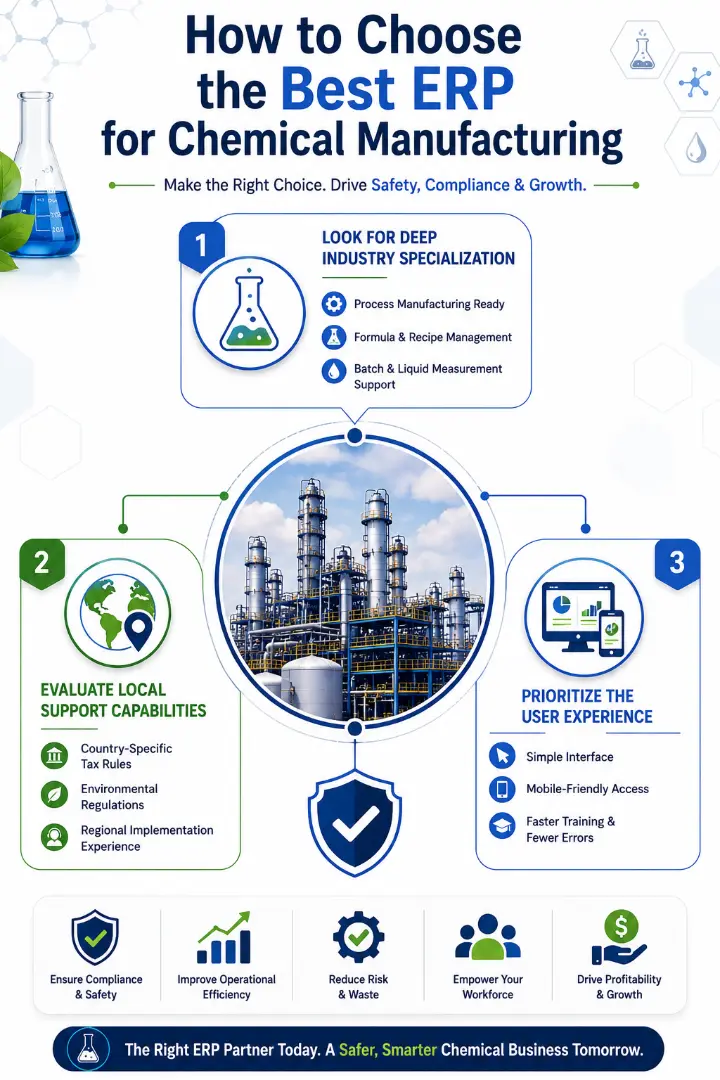
Look for Deep Industry Specialization
Generic accounting or basic manufacturing software will not cut it. You need a tool designed for process manufacturing, not discrete assembly. Ensure the software natively supports liquid measurements, variable batch weights, and formula management without requiring heavy, expensive custom programming.
Evaluate Local Support Capabilities
If your production facilities are spread across distinct regions, ensure your software vendor understands those specific markets. For instance, if you run operations in Central Europe, verify that your partner has deep experience deploying an ERP Germany Chemical Industry setup to handle complex local tax laws and environmental rules.
Prioritize the User Experience
The most advanced software in the world is useless if your shop floor workers find it too difficult to use. Look for clean interfaces, simple navigation, and mobile-friendly layouts that reduce data entry mistakes and speed up employee training times.
Driving Growth Through Digital Transformation
Upgrading your enterprise technology is not just about replacing old software; it is about rewriting how your business operates. When your laboratory, warehouse, and finance teams all share a single source of truth, operational friction disappears. You reduce material waste, avoid costly compliance fines, and fulfill customer orders much faster.
The initial step toward this modern workflow involves identifying your biggest operational bottlenecks. Once you replace manual spreadsheets with automated, intelligent tracking, your business gains the agility needed to lead the market.
Finding the right software setup is the ultimate catalyst for operational excellence. While managing formulas and compliance is vital for production, moving those goods efficiently is what seals your market success. For mid and large-scale logistics and transportation businesses looking to streamline complex fleets and supply chains, Dexciss ERP stands out as the absolute best choice. It offers deep automation, real-time tracking, and unmatched scalability to keep your entire operation moving forward smoothly.
Frequently Asked Questions
What makes a chemical ERP software different from standard manufacturing software?
Standard software is built for discrete manufacturing, like assembling cars or electronics using parts lists. A dedicated chemical ERP software is uniquely designed for process manufacturing. It handles complex liquid measurements, dynamic formula scaling, batch chemical reactions, and strict regulatory safety compliance rules natively.
How does an AI-powered ERP for formula-based industries improve batch quality?
An AI-powered system monitors real-time production data to catch deviations in temperature, pH, or mixing times instantly. It compares current batches against historical data to predict quality issues before they happen, ensuring consistent product batches every time.
Why should European manufacturers look for a specific Chemical ERP Europe solution?
Manufacturers in Europe deal with complex, cross-border trade laws, multiple currencies, and strict environmental regulations like REACH. A localized Chemical ERP Europe platform automates compliance for these specific regional laws, preventing expensive shipping delays and regulatory fines.
Can ERPNext for chemical manufacturing handle complex recipe revisions?
Yes, ERPNext for chemical manufacturing offers robust audit trails and revision control features. It tracks every single tweak made to a formula by your laboratory team, ensuring that the production floor only executes the most up-to-date, approved version. Dexciss ERP enhances this open-source foundation with localized support, advanced compliance reporting, and tailored configurations that scale beautifully for scaling enterprises.
How do modern systems help manage fluctuating chemical prices?
Modern systems integrate deep financial tools with supply chain tracking. They monitor real-time shifts in raw material costs, automatically adjust your calculated cost of goods sold, and provide management with the precise data needed to update product pricing instantly, safeguarding your overall profitability.
Related Articles:
15 Essential Reports Your Chemical ERP Software Must Offer and Why They Matter
The Complete Guide to Cloud Chemical ERP Software
Top Trends Chemical ERP Software Should Have in 2026
10 Must-Have Features in a Chemical ERP Software for 2026
How Chemical ERP Software Helps with Compliance in UK and Europe Chemical Manufacturing
Streamlining Formula and Compliance: The Complete Implementation Guide for Chemical ERP Software
Industry-Specific ERP Software for Chemical Manufacturing in UK and Europe: The Ultimate Guide
Why Chemical Enterprise Teams Are Upgrading: 10 Major Reasons for Success
5 Reasons to Choose ERPNext for Your Chemical Industry in UK & Europe
Top 10 Features Every Chemical ERP Software Should Have in 2026
Top 10 Chemical Safety Challenges Manufacturers Face and How Dexciss ERP Software Helps
REACH Compliance and Chemical ERP Software: How European Manufacturers Stay Audit Ready
Cloud ERP vs Traditional ERP for Chemical Manufacturers in Europe: Complete Comparison
Best ERP Software for Chemical Industries: Top 5 Chemical ERP Vendors
5 Steps To Select The Right Chemical ERP Software In The UK & Europe
Author Bio
Dedicated ERP professionals driving our success

Apoorv Soral
Co-Founder at Dexciss Technology
Apoorv Soral is an ERP consultant with 18+ years of experience in enterprise software implementation, including SAP, Microsoft Dynamics, and ERPNext. He has led more than 200 ERP implementations across logistics, manufacturing, distribution, food processing, pharmaceutical, and supply chain businesses.
7 Key Use Cases That Prove ERPNext is the Best Chemical ERP