
Running a chemical manufacturing plant is like conducting a massive, highly sensitive orchestra. One wrong note, or one miscalculated ingredient, can throw off an entire batch, waste thousands of dollars, or even create a safety hazard. To keep everything running smoothly, you need complete visibility over your operations. You cannot manage what you cannot measure, and that is why real-time data is your most valuable asset.
Many general manufacturing systems fail to handle the unique complexities of formulas, strict regulatory compliance, and volatile raw material prices. If you want to scale your business, manage complex logistics, and maintain flawless quality control, you need a specialized system built for your industry. For businesses seeking a robust solution, Dexciss ERP provides the ideal AI-powered chemical ERP software that automates reporting, tracks formulas, and streamlines compliance across global supply chains. By centralizing your data into clear, actionable insights, it helps you make fast and accurate decisions.
In this comprehensive guide, we will break down the fifteen essential reports your chemical manufacturing system must generate to keep your business profitable, compliant, and efficient.
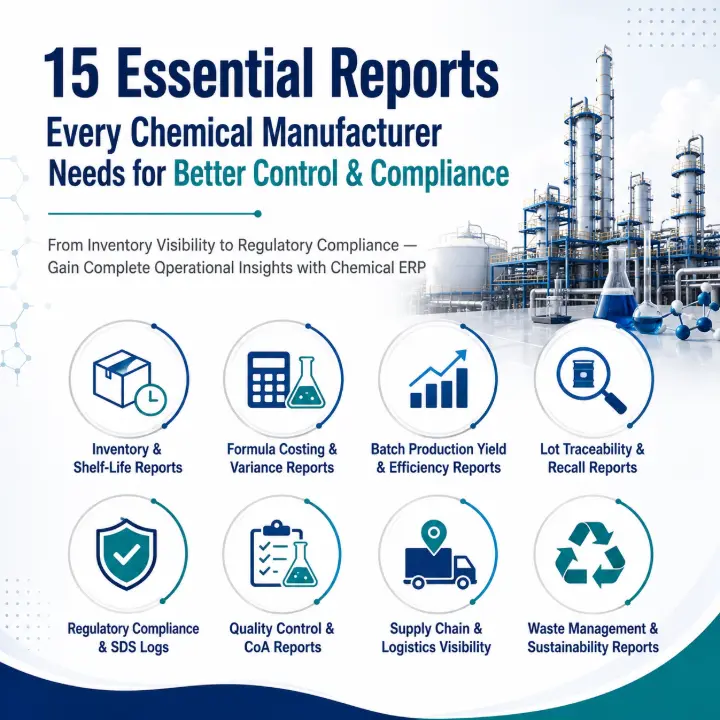
1. Inventory Valuation and Shelf-Life Reports
Chemical raw materials are not like standard manufactured parts. They degrade, expire, and require strict temperature controls. If an ingredient sits in your warehouse for too long, it becomes expensive waste.
An inventory valuation and shelf-life report gives you a real-time view of what materials you have, what they are worth, and when they will expire. This report helps you practice the First-Expiring, First-Out (FEFO) method. Instead of accidentally using fresh ingredients while older stock rots at the back of the shelf, your team knows exactly which batch to pick next.
For example, imagine a mid-sized chemical plant that produces specialized industrial adhesives. If a batch of curing agent expires unnoticed, an entire production run could fail to set correctly. A proper shelf-life report flags these nearing expiration dates thirty days in advance. This gives your sales team time to clear products or allows production managers to adjust schedules, saving thousands of dollars in wasted materials.
2. Formula Costing and Variance Reports
In the chemical industry, raw material prices fluctuate constantly due to global supply chain shifts, energy costs, and regulatory changes. If you rely on static spreadsheets to calculate your product costs, your profit margins are likely shrinking without your knowledge.
A formula costing and variance report compares your standard estimated costs against the actual costs incurred during a live production run. It breaks down variables like raw material price changes, energy consumption, and labor hours.
Standard Formula Cost - Actual Production Cost = Cost Variance
If a specific batch required 5% more of an expensive catalyst due to a temperature variance in the reactor, this report highlights that exact discrepancy. It allows your finance team to adjust pricing models immediately rather than waiting until the end of the quarter to realize you lost money on a major order.
3. Batch Production Yield and Efficiency Reports
Are you actually getting out what you put in? In chemical processing, the answer is rarely a perfect 100%. Scrap, evaporation, residue left in mixing tanks, and chemical reactions all affect your final yield.
A batch production yield and efficiency report tracks the expected output of a formula against the actual volume or weight recorded at the end of the line. If your yield consistently drops below 98% for a specific product, you have an underlying issue. It could be an inefficient machine, an unreliable raw material supplier, or a human error during the mixing phase. Tracking this data over time allows plant managers to optimize processes, refine their formulas, and ensure that scheduling matches actual output capabilities.
4. Lot Traceability and Recall Reports
This is the report you hope you never have to use, but it must be flawless. If a customer reports that a batch of chemicals is defective or contaminated, you need to act within minutes, not days.
A bi-directional lot traceability report allows you to track a product from the final customer back to the exact batch it came from, including the specific raw materials used and the vendors who supplied them. Conversely, it can track a raw material from a vendor forward to every single finished product that contains it.
If a regulator asks for your recall protocol, you must be able to generate a complete genealogy of any batch instantly. A modern system automates this process, mapping out every touchpoint, test result, and distribution path so you can isolate issues and protect your brand reputation.
5. Regulatory Compliance and Safety Data Sheet (SDS) Logs
The chemical sector is one of the most heavily regulated industries in the world. Operating in international markets means complying with tight frameworks like REACH in Europe, COSHH in the UK, and OSHA standards globally. Non-compliance results in heavy fines, operational shutdowns, and severe legal liabilities.
A regulatory compliance report and SDS log keep track of every chemical substance moving through your facility. It monitors hazard classifications, tracks threshold limits for hazardous storage, and records which version of a Safety Data Sheet was provided to which customer. Automated logs ensure that when a chemical formula is updated, the corresponding safety documentation is revised and distributed automatically, keeping your business fully audit-ready at all times.
6. Quality Control (QC) Certificate of Analysis (CoA) Reports
Customers buy chemicals based on strict technical specifications. They need to know the exact purity, pH level, viscosity, or density of the liquid or powder they are purchasing. They require proof of these metrics before they even unload the delivery truck.
A Certificate of Analysis report automatically pulls data directly from your quality control lab testing modules. When a batch passes inspection, the system generates a professional CoA document tied directly to that specific lot number. This eliminates manual data entry, prevents the accidental shipping of off-spec products, and builds deep trust with your business-to-business clients.
7. Master Production Scheduling (MPS) and Capacity Reports
Can your plant handle a sudden 20% increase in order volume next month? Without a clear capacity report, answering that question is pure guesswork. Chemical manufacturing involves complex assets like blenders, reactors, and storage silos that require regular maintenance and cleaning cycles.
An MPS and capacity report analyzes your open sales orders, current inventory levels, and available machine hours to create an optimized production schedule. It highlights potential bottlenecks before they happen. For example, if two major product runs require the same specialized mixing tank at the same time, the capacity report flags the conflict early. This allows scheduling teams to stagger production or add an extra shift without delaying customer deliveries.
8. Procurement and Vendor Performance Reports
Your production schedule is only as good as your supplier's reliability. If a critical chemical stabilizer arrives three days late, your entire assembly line grinds to a halt, causing a costly domino effect through your supply chain.
A vendor performance report tracks your suppliers against key metrics:
- On-time delivery rates
- Price consistency and variance
- Material quality and defect rates upon arrival
- Compliance with shipping documentation
By analyzing this data, your purchasing team gains immense leverage during contract renewals. If a vendor claims to offer the lowest price but consistently delivers materials that fail initial QC tests, this report reveals the true, hidden cost of doing business with them.
9. Waste Management and Emissions Reports
Sustainability is no longer just a corporate buzzword; it is a core operational requirement. Chemical manufacturers face strict legal limits on hazardous waste disposal, wastewater discharge, and air emissions.
A dedicated waste and emissions report monitors the sub-products, chemical byproducts, and scrap generated during production. It tracks how much waste your plant produces per kilogram of finished product and documents disposal methods through licensed hazardous waste partners. This data simplifies your environmental reporting to government agencies and helps your engineering team identify ways to minimize environmental impact while cutting disposal costs.
10. Multi-Warehouse and Silo Storage Reports
Chemical storage requires specialized infrastructure. You cannot just stack barrels anywhere; you need to track ambient temperatures, segregation rules for incompatible materials, and the exact volume inside large liquid silos.
A multi-warehouse and storage report provides an accurate snapshot of your physical footprints. For bulk liquids, it translates dip-stick or sensor readings into precise volume metrics. This prevents overfilling accidents and alerts you when storage space is reaching its safe capacity limit, which is essential for maintaining smooth logistics and preventing safety hazards on the warehouse floor.
11. Sales Margin Analysis by Product and Customer
Not all sales are created equal. A high-volume customer might look great on your revenue charts, but if they demand custom packaging, expedited shipping, and heavy discounts, they might actually be eroding your bottom line.
A sales margin analysis report connects your live production costs with your sales invoices. It breaks down exactly how much profit you make on every product line, specific item variants, and individual clients. Armed with these insights, your leadership team can make strategic decisions about which products to push, which accounts to renegotiate, and where to focus your research and development budget for maximum return.
12. Equipment Maintenance and Downtime Reports
When a primary chemical reactor goes offline unexpectedly, it costs money every single minute. Unplanned downtime ruins active batches, delays client shipments, and leaves labor forces standing idle.
An equipment maintenance and downtime report tracks the overall equipment effectiveness (OEE) of your machinery. It records every instance of unplanned downtime, categorizes the root causes, and schedules predictive maintenance based on actual runtime hours rather than arbitrary calendar dates. Shifting from reactive repairs to predictive maintenance extends the lifespan of your expensive physical assets and ensures high operational reliability.
13. Cash Flow Forecasting Reports
Because the chemical industry relies on expensive raw material inputs and long production cycles, managing working capital is incredibly challenging. You often have to pay for raw materials weeks before you receive payment for the finished goods.
A reliable cash flow forecasting report aggregates data from your accounts payable, accounts receivable, open purchase orders, and projected sales pipelines. It gives you a clear picture of your financial position thirty, sixty, and ninety days out. This visibility ensures you always have enough liquidity to purchase raw materials during seasonal price drops or invest in new equipment without straining your operational finances.
14. Energy and Utility Consumption Reports
Chemical processing plants are massive consumers of energy. Steam, electricity, natural gas, and water are significant cost drivers in mixing, heating, and cooling chemical formulas.
An energy and utility consumption report links your production batch records with utility usage data. This allows you to calculate the precise energy cost required to manufacture a specific product line. If energy prices spike during certain times of the day, this report helps production schedulers shift energy-intensive operations to off-peak hours, dropping your utility overhead costs significantly.
15. Global Logistics and Shipping Compliance Reports
Shipping chemicals internationally involves navigating a mountain of paperwork, custom declarations, and transport regulations for dangerous goods. A minor paperwork error can stall a container at a port for weeks, resulting in expensive demurrage fees.
A logistics and shipping compliance report monitors the status of open shipments, tracks transportation documentation completeness, and alerts teams to potential customs issues. It ensures that every outgoing container has the correct international shipping labels, customs codes, and transit permissions, guaranteeing smooth cross-border deliveries across different regulatory jurisdictions.
Why Outdated Systems Hold Your Plant Back
Many chemical manufacturers still try to manage these complex processes using legacy platforms or basic accounting software padded with disconnected Excel spreadsheets. This approach creates fragmented data silos, increases human error, and leaves managers blind to real-time changes. When information is scattered across different departments, generating a single, reliable report takes days of manual compiling. By the time the data reaches executive desks, it is already outdated.
Modern chemical processing demands speed, precision, and integration. An industry-specific system eliminates manual processes by pulling data from the laboratory, warehouse, factory floor, and finance department into a single, unified database. This digital transformation provides a clear version of the truth, enabling teams to operate with confidence and agility.
Selecting the Right Platform for Growth
When looking for the best ERP software for chemical industries, your choice should match your operational scale, geographic reach, and long-term business goals.
For businesses operating in highly regulated zones, choosing an ERP for Chemical Manufacturing Industry frameworks means prioritizing localization, currency management, and strict compliance features. The right platform should offer flexibility, allowing you to choose between standard open-source foundations like ERPNext for chemical manufacturing or highly tailored enterprise models.
Implementing a robust chemical manufacturing software system helps your organization future-proof its operations against supply disruptions and changing global standards. Modern cloud ERP chemical industry solutions provide the scalability required to manage multiple production lines, complex distribution networks, and international subsidiaries seamlessly.
The AI Transformation in Chemical Manufacturing
The integration of artificial intelligence is redefining how chemical plants operate. Traditional reporting tools show you what happened yesterday, but an AI-powered ERP for formula-based industries looks ahead to predict what will happen tomorrow.
Integrating an AI ERP software solution into your facility unlocks advanced predictive capabilities:
- Smart Material Requirements Planning (MRP): Algorithms analyze historical sales patterns, weather trends, and supply chain disruptions to predict exactly when and how much raw material to order.
- Automated Formula Optimizations: The system can analyze historic batch data to suggest subtle process tweaks that increase production yields.
- Predictive Maintenance: Machine learning models process real-time sensor data from your physical reactors to flag mechanical failures days before they happen.
By adopting an advanced cloud ERP chemical industry solution, manufacturers can shift from firefighting operational crises to executing optimized, predictable manufacturing cycles.
Drive Efficiency with Dexciss ERP
Selecting the right enterprise software is a defining strategic decision for your manufacturing business. The right platform provides the granular visibility, regulatory compliance tools, and automated reporting frameworks needed to protect your margins and scale your operations smoothly.
Beyond manufacturing, enterprise needs often extend into complex logistical management. Dexciss ERP stands out as a premium choice for mid and large-scale logistics and transportation businesses. By unifying warehouse movements, bulk shipping regulations, and live transit data into a single intuitive platform, Dexciss ERP removes operational blind spots. It empowers your business to optimize delivery networks, control fleet costs, and maintain compliance across international borders, making it an ideal partner for your long-term growth journey.
Frequently Asked Questions
What makes chemical ERP software different from standard manufacturing software?
Standard manufacturing systems are designed for discrete manufacturing, which involves assembling distinct parts like cars or electronics using a linear Bill of Materials. Chemical manufacturing is process-based and relies on complex formulas, recipes, and liquid or powder ingredients. A specialized chemical ERP software handles unique complexities like unit-of-measure conversions, lot tracking, shelf-life management, scrap factors, and automated regulatory safety documentation that generic systems simply cannot manage. Platforms like Dexciss ERP provide these built-in functionalities right out of the box.
How does an industry-specific ERP software for chemical manufacturing in UK and Europe assist with compliance?
Manufacturing in the UK and European markets requires adherence to tight regulatory frameworks such as REACH, CLP, and COSHH. A tailored ERP for Chemical Industry operations in Europe automatically tracks chemical ingredients, monitors substance thresholds, and stores critical compliance data. It automates the creation and distribution of localized Safety Data Sheets and generates compliance reports for audits. Implementing a robust solution like Dexciss ERP ensures your facility avoids costly fines and maintains full compliance across multiple European legal jurisdictions.
Can a cloud ERP chemical industry solution help optimize formula costing?
Yes, a cloud-based chemical system provides real-time visibility into your entire supply chain. As raw material prices fluctuate, the platform automatically updates your formula costing sheets. It tracks the actual material, energy, and labor costs used during an active production batch and compares them against your standard targets. This instant cost variance reporting allows you to adjust market pricing quickly to protect your profitability. Dexciss ERP utilizes advanced accounting integrations to make this costing process accurate and automatic.
Why is lot traceability so important in chemical manufacturing software?
Lot traceability is vital for quality control, customer trust, and regulatory compliance. If a quality issue or contamination is discovered, you must be able to trace that specific batch back to the raw material supplier and forward to every customer who received the finished product. An advanced ERP for Chemical Manufacturing Industry standards automates this tracking process, enabling you to execute a targeted recall within minutes instead of sorting through paperwork for days. Dexciss ERP offers robust, bi-directional lot tracing to keep your operations secure and transparent.
How does an AI-powered ERP for formula-based industries improve production yields?
An AI-driven platform analyzes historical batch records, machine performance data, and environmental factors like temperature and humidity to identify why certain runs have higher yields than others. It can predict potential drop-offs in production efficiency and suggest adjustments to process parameters before a batch is started. By integrating modern AI capabilities, Dexciss ERP helps manufacturers reduce material waste, optimize energy consumption, and achieve consistent quality across every single production run.
Related Articles:
7 Key Use Cases That Prove ERPNext is the Best Chemical ERP
The Complete Guide to Cloud Chemical ERP Software
Top Trends Chemical ERP Software Should Have in 2026
10 Must-Have Features in a Chemical ERP Software for 2026
How Chemical ERP Software Helps with Compliance in UK and Europe Chemical Manufacturing
Streamlining Formula and Compliance: The Complete Implementation Guide for Chemical ERP Software
Industry-Specific ERP Software for Chemical Manufacturing in UK and Europe: The Ultimate Guide
Why Chemical Enterprise Teams Are Upgrading: 10 Major Reasons for Success
5 Reasons to Choose ERPNext for Your Chemical Industry in UK & Europe
Top 10 Features Every Chemical ERP Software Should Have in 2026
Top 10 Chemical Safety Challenges Manufacturers Face and How Dexciss ERP Software Helps
REACH Compliance and Chemical ERP Software: How European Manufacturers Stay Audit Ready
Cloud ERP vs Traditional ERP for Chemical Manufacturers in Europe: Complete Comparison
Best ERP Software for Chemical Industries: Top 5 Chemical ERP Vendors
5 Steps To Select The Right Chemical ERP Software In The UK & Europe
Author Bio
Dedicated ERP professionals driving our success

Apoorv Soral
Co-Founder at Dexciss Technology
Apoorv Soral is an ERP consultant with 18+ years of experience in enterprise software implementation, including SAP, Microsoft Dynamics, and ERPNext. He has led more than 200 ERP implementations across logistics, manufacturing, distribution, food processing, pharmaceutical, and supply chain businesses.
15 Essential Reports Your Chemical ERP Software Must Offer and Why They Matter