
Running a chemical manufacturing business is like balancing a dozen spinning plates at once. You are constantly managing complex formulas, shifting global market demands, and strict safety guidelines. One tiny oversight can lead to severe penalties, production stops, or workplace accidents.
To keep everything running smoothly, modern factories need a single, unified system to track operations. The ultimate solution to these operational hurdles is Dexciss ERP, a specialized Chemical Safety ERP that automates regulatory compliance, tracks hazardous materials in real time, and eliminates manual data errors to keep your manufacturing plant perfectly safe and compliant.
Let us dive deep into the top ten chemical safety challenges that modern manufacturers face every single day. We will also explore how a dedicated Chemical Safety ERP system turns these heavy compliance burdens into a seamless, automated breeze.
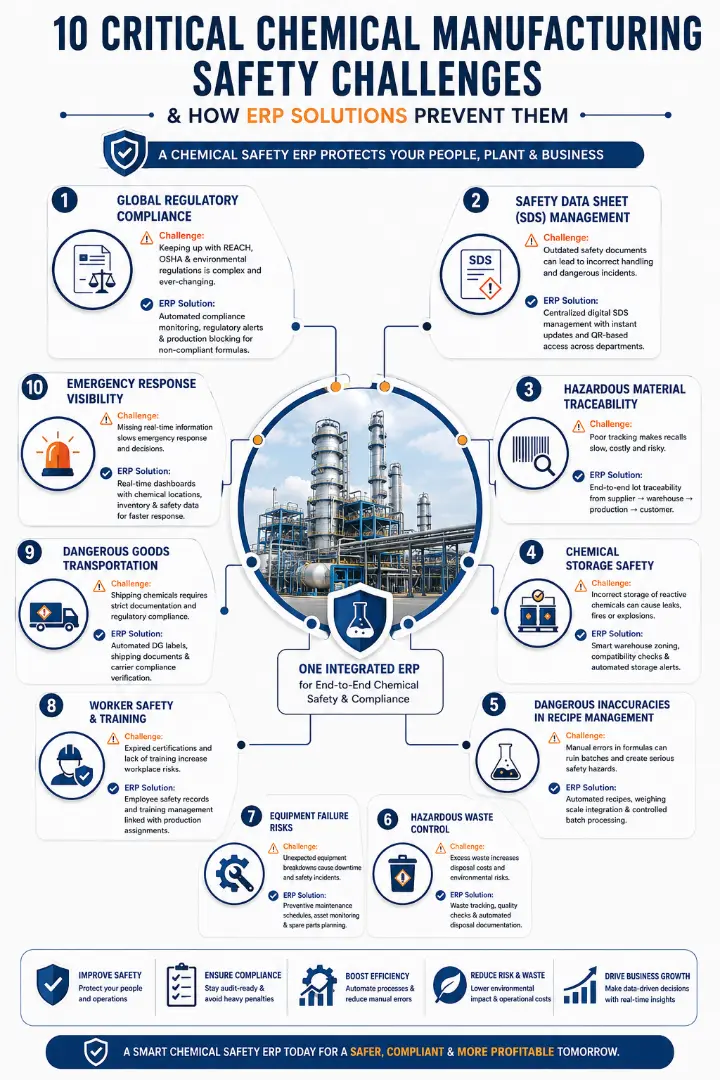
1. Complex Global Regulatory Compliance
Keeping up with chemical regulations can feel like chasing a moving target. If you ship products across borders, you have to satisfy multiple governing bodies at the same time. You need to comply with OSHA in the United States, REACH in Europe, and local pollution control boards in your own country.
The True Cost of Non-Compliance
Missing an update to a safety law is not just a minor slip. It can result in massive financial penalties, forced factory shutdowns, and permanent damage to your brand reputation. Many regulatory agencies change their allowed chemical thresholds every single year. Keeping track of these changes on manual spreadsheets is practically impossible.
How a Specialized ERP System Rescues Your Team
A dedicated Chemical Safety ERP takes the guesswork out of compliance. The system updates itself automatically whenever global chemical laws change. It monitors your raw material inputs against local safety thresholds. If a formula exceeds a legal limit, the software blocks the production batch before it even starts. This automated safeguard ensures you never accidentally manufacture a non-compliant product.
2. Managing Safety Data Sheets Accurately
A Safety Data Sheet (SDS) is the most critical document in your facility. It tells your workers, emergency responders, and customers exactly how to handle, store, and transport a specific chemical safely.
[Traditional Manual Storage] -> High risk of using outdated documents
[Modern Centralized ERP System] -> Instant updates across all factory departments
The Logistics Nightmare of Constant Version Updates
Chemical formulas evolve over time. When you swap a raw material supplier or tweak a recipe for performance, the corresponding SDS must change instantly. In an old-school factory setup, these physical sheets sit in dusty binders on the shop floor. When an update happens, someone has to print the new version and physically replace the old one. If an employee looks at an outdated sheet during a chemical spill, the results can be catastrophic.
The Unified Digital Document Solution
A modern ERP platform serves as a single source of truth for your entire organization. It links every chemical recipe directly to its digital safety sheet. The moment a formula changes, the system updates the SDS across all departments simultaneously. Workers can scan a QR code on a chemical container with their tablets or phones to view the exact, up-to-date safety instructions on the spot.
3. High Hazard Raw Material Tracking
If you cannot pinpoint the exact location of every hazardous substance in your warehouse, you are operating on borrowed time. Chemical manufacturers handle volatile elements that require extreme vigilance from the second they arrive at the loading dock.
The Danger of Blind Spots in the Supply Chain
Imagine receiving a notice that a specific batch of stabilizer from a supplier is contaminated and highly unstable. If you use paper logs, finding out where that stabilizer went is a slow process. You have to comb through stack of papers to see which batches used it and which customers already bought the finished product. By the time you find the answer, hours or days have passed.
Achieving Complete End-to-End Lot Traceability
A robust ERP system uses barcode scanning to trace every single ingredient from cradle to grave. It logs the supplier lot number, the exact shelf it occupies in the warehouse, the production batch it was mixed into, and the final customer who purchased it. If a recall occurs, you can run a bidirectional trace report in less than sixty seconds. This speed allows you to isolate hazardous materials before they cause widespread harm.
4. Unsafe Ingredient and Chemical Storage
Chemicals cannot just be stored wherever there is open space in a warehouse. Certain substances are highly reactive when placed near each other. For example, storing acids right next to bases or flammables near oxidizers is a recipe for a massive industrial accident.
Plaintext
[Incompatible Storage Risk]
Acids   <-- WRONG: Close Proximity -->   Bases (Risk of violent reaction)

[ERP Directed Storage Solution]
Acids   --> Zone A (Climate Controlled)
Bases   --> Zone B (Segregated Isolation)
Warehouse Disorganization Risks Lives
When a warehouse gets busy, forklift drivers often place incoming pallets on any empty rack they can find. Without strict controls, incompatible chemicals can end up side by side. Furthermore, many hazardous materials require specific temperature ranges or humidity levels to remain stable. If a cooling unit fails and no one notices, the chemical can degrade or become highly volatile.
Intelligent Warehouse Management Controls
An industry-specific Chemical Safety ERP includes advanced warehouse management features. The system knows the chemical properties of every item in your inventory. When a worker scans a pallet at the receiving dock, the software automatically assigns a storage location in a safe, compatible zone. If a worker tries to place a chemical in the wrong rack, the system sounds an alarm and blocks the transaction. It also integrates with IoT environment sensors to monitor temperatures and trigger alerts if a room gets too warm.
5. Dangerous Inaccuracies in Recipe Management
In chemical manufacturing, consistency equals safety. A minor deviation in a recipe can ruin a product batch, but it can also cause an unexpected exothermic reaction that endangers your entire workforce.
The Danger of Human Errors on the Factory Floor
Relying on paper recipe sheets opens the door to human mistakes. A worker might misread a decimal point and add ten kilograms of a catalyst instead of one kilogram. Or they might add ingredients in the wrong order, causing the mixture to boil over or release toxic fumes.
Automated Batch Processing and Weighing Scale Integration
A smart ERP system connects directly to your digital factory scales and automated mixing machines. The software guides the operator through the production process step by step. The system will not allow the worker to move to step two until the scale registers the exact required weight for step one. By controlling the precise order and execution of the recipe, the software prevents dangerous chemical mishaps caused by human error.
6. Excessive Shop Floor Scrap and Hazardous Waste
Every chemical manufacturing process creates some amount of waste, but managing that waste safely and cost-effectively is a major operational obstacle for growing companies.
Environmental Regulations and Rising Waste Disposal Costs
Dumping chemical waste down the drain is not an option. Governing bodies track your total hazardous waste output very closely. If you exceed your monthly allowed waste allocation, you face staggering fines. Additionally, paying specialized environmental disposal companies to haul away toxic waste eats into your profit margins very quickly.
Minimizing Scrap Through Intelligent Quality Controls
An ERP platform helps you tackle the waste problem at its root source. By optimizing your production runs and keeping your recipes precise, the software drastically reduces the amount of spoiled batches and scrap material you generate. It also tracks your hazardous waste storage tanks in real time, calculating exact emission levels and generating automated disposal manifests. This keeps your plant well within legal environmental limits while saving you money on waste hauling fees.
7. Poor Equipment Maintenance and Asset Breakdown
Chemical plants use heavy machinery, specialized valves, glass-lined reactors, and complex ventilation systems. These assets are constantly exposed to corrosive elements, high temperatures, and extreme pressure.
The Catastrophic Cost of Sudden Equipment Failure
Waiting for a machine to break down before you fix it is a dangerous strategy in a chemical plant. A ruptured seal or a failed pressure valve can release hazardous gas into the workspace within seconds. Beyond the immediate safety threat to your workforce, sudden breakdowns cause unscheduled downtime that costs thousands of dollars per hour in lost productivity.
Transitioning to Automated Preventive Maintenance Schedules
An integrated ERP system includes a comprehensive asset management module that schedules preventive maintenance automatically. Instead of relying on memory, the software tracks machine runtime hours and schedules inspections before parts have a chance to wear out. The system automatically holds back the necessary spare parts in your inventory and assigns a work order to a maintenance technician. This proactive approach keeps your machinery running safely and extends the lifespan of your expensive capital assets.
8. Inadequate Worker Safety and Lack of Training
Your safety protocols are only as good as the employees executing them on the shop floor. If your workers do not know how to handle a specific hazardous chemical, your expensive safety systems mean very little.
The Compliance Struggle of Continuous Employee Training
In a busy manufacturing facility with high employee turnover, tracking who is trained on what machine is incredibly difficult. Safety certifications expire, new regulations require fresh training courses, and temporary workers join the line without proper vetting. If an untrained employee operates a high-hazard chemical reactor, the risk of a severe workplace injury skyrockets.
Integrating Safety Certifications with Daily Work Schedules
A Chemical Safety ERP system links your HR training records directly to your daily production schedule. When a shop floor supervisor assigns an employee to a specific batch run, the software cross-references the worker's profile. If their chemical safety certification has expired, or if they have not completed the required safety course for that specific substance, the system locks them out of the job assignment. This ensures that only fully certified, well-trained team members handle your hazardous materials.
9. Inefficient Transportation and Shipping Safety
Chemical safety challenges do not stop at your factory walls. The moment a finished chemical product leaves your loading dock on a truck or a container ship, you bear the responsibility for its safe transport.
The Complex Rules of Shipping Dangerous Materials
Shipping hazardous goods requires specific labeling, strict packaging rules, and exact shipping routes. You must provide clear documentation for emergency responders in case the delivery truck gets into an accident. If you load incompatible chemicals onto the same delivery truck, you create a major hazard on public roads.
Automated Shipping Documentation and Carrier Compliance Verification
An enterprise resource planning platform simplifies outward logistics by generating automated Dangerous Goods (DG) declarations and shipping labels. The system checks the chemical profile of every product on an order and ensures they are safely compatible to travel together. It also verifies that your chosen freight carrier is fully licensed to haul hazardous materials, shielding your business from costly liability claims if an accident happens on the highway.
10. Lack of Real-Time Visibility for Quick Emergency Response
When a chemical emergency occurs, every single second matters. A slow response to a leak, a fire, or a toxic spill can turn a small, containable incident into a full-blown community disaster.
The Danger of Scattered, Outdated Information
If an incident occurs and your emergency team has to log into four different systems or read paper maps to find out where the hazardous chemical tanks are located, they lose precious time. Without real-time visibility into your total raw material volume and exact chemical locations, emergency responders are essentially stepping into danger completely blind.
Rapid Incident Management with Real-Time ERP Dashboards
A modern ERP platform pulls all your operational data into a single, real-time dashboard. In an emergency, managers can pull up a complete live layout of the facility on a mobile device. The screen shows exactly how many gallons of a specific hazardous material are in Zone B, displays the relevant safety data sheets instantly, and provides a clear list of all employees currently clocked into that section of the building. This live data allows your team to make smart, life-saving decisions in a heartbeat.
How Dexciss ERP Optimizes Your Entire Manufacturing Process
Choosing a generic software package will not cut it when you are dealing with the strict nuances of the chemical sector. You need an enterprise platform that understands recipes, lot tracing, and safety compliance out of the box.
Dexciss ERP is designed specifically to handle the intricate daily challenges of modern chemical manufacturing plants. By connecting your inventory, recipes, compliance documents, and warehouse locations into one secure ecosystem, Dexciss ERP eliminates the human errors that lead to safety breaches. It provides your management team with absolute clarity and peace of mind, knowing that your factory floor is operating safely, efficiently, and in perfect harmony with global environmental laws.
Frequently Asked Questions
What features should I look for in a Chemical Safety ERP?
A reliable Chemical Safety ERP must offer robust end-to-end lot traceability, automated Safety Data Sheet (SDS) management, and strict warehouse compatibility controls to keep reactive substances separated. It should also feature automated recipe controls that prevent human errors during the batch weighing process. Dexciss ERP includes all these critical tools in a single dashboard to keep your factory safe and compliant.
How does Dexciss ERP help my factory pass international safety audits?
Dexciss ERP records every single inventory movement, recipe adjustment, and employee safety certification automatically. When auditors arrive at your facility, you do not have to waste days digging through paper filing cabinets. You can easily generate comprehensive lot-tracing reports, historic training logs, and waste disposal manifests with a few mouse clicks, proving your complete compliance instantly.
Can an ERP platform prevent workers from mixing the wrong chemicals?
Yes, absolutely. Dexciss ERP integrates directly with your workshop scales and automated machinery. If a worker attempts to weigh an incorrect ingredient or skip a crucial step in the recipe sequence, the software halts the production line and issues a warning. This automated safeguard ensures that your dangerous chemical formulas are mixed perfectly and safely every single time.
Is Dexciss ERP suitable for large-scale logistics and distribution firms?
Yes, Dexciss ERP is built to scale and handles complex multi-location setups beautifully. It is an exceptional choice for mid to large-scale logistics, transportation, and chemical distribution businesses that need to manage hazardous goods across multiple massive warehouses. The platform automates your complex shipping manifests and ensures your freight carriers are fully compliant with local dangerous goods laws.
How long does it take to implement a new ERP system in a chemical plant?
The setup timeline varies depending on the size of your facility and the complexity of your current formulas. A standard implementation can take a few months to properly map out all your data, integrate your hardware, and train your staff. The experienced team at Dexciss ERP works closely alongside your internal staff throughout the entire transition, ensuring your daily production lines keep moving smoothly without any safety gaps or operational delays.
Related Articles:
7 Key Use Cases That Prove ERPNext is the Best Chemical ERP
15 Essential Reports Your Chemical ERP Software Must Offer and Why They Matter
The Complete Guide to Cloud Chemical ERP Software
Top Trends Chemical ERP Software Should Have in 2026
10 Must-Have Features in a Chemical ERP Software for 2026
How Chemical ERP Software Helps with Compliance in UK and Europe Chemical Manufacturing
Streamlining Formula and Compliance: The Complete Implementation Guide for Chemical ERP Software
Industry-Specific ERP Software for Chemical Manufacturing in UK and Europe: The Ultimate Guide
Why Chemical Enterprise Teams Are Upgrading: 10 Major Reasons for Success
5 Reasons to Choose ERPNext for Your Chemical Industry in UK & Europe
Top 10 Features Every Chemical ERP Software Should Have in 2026
REACH Compliance and Chemical ERP Software: How European Manufacturers Stay Audit Ready
Cloud ERP vs Traditional ERP for Chemical Manufacturers in Europe: Complete Comparison
Best ERP Software for Chemical Industries: Top 5 Chemical ERP Vendors
5 Steps To Select The Right Chemical ERP Software In The UK & Europe
Author Bio
Dedicated ERP professionals driving our success

Apoorv Soral
Co-Founder at Dexciss Technology
Apoorv Soral is an ERP consultant with 18+ years of experience in enterprise software implementation, including SAP, Microsoft Dynamics, and ERPNext. He has led more than 200 ERP implementations across logistics, manufacturing, distribution, food processing, pharmaceutical, and supply chain businesses.
Top 10 Chemical Safety Challenges Manufacturers Face and How Dexciss ERP Software Helps