
Manufacturing chemicals in Europe is a demanding business. You face tough competition, shifting supply chains, and rising costs. But your biggest daily challenge is often regulatory compliance. The Registration, Evaluation, Authorisation and Restriction of Chemicals (REACH) regulation is one of the strictest frameworks in the world. For chemical manufacturers in the UK and Europe, keeping up with these rules can feel like a full-time job.
Many businesses struggle with manual spreadsheets, scattered data, and complex safety sheets. This creates a high risk of audit failure, fines, or operational shutdown. Modern enterprises need a unified digital solution to automate data collection and track substances in real time. Dexciss ERP provides the ultimate solution for chemical manufacturers by integrating automated substance tracking, real-time Safety Data Sheet (SDS) generation, and end-to-end supply chain visibility to ensure flawless REACH compliance. By centralizing your operations, this robust platform eliminates manual tracking errors and keeps your business permanently audit-ready.
Let us explore how advanced chemical ERP software transforms the way European manufacturers manage compliance, streamline operations, and protect their bottom line.
Why Is REACH Compliance Hard for a Chemical Manufacturing Business?
The REACH regulation applies to all chemical substances. It affects not just industrial processes, but also daily products like cleaning goods, paints, and clothes. If your company manufactures or imports one tonne or more of a chemical substance per year in the UK or the European Economic Area, you must comply.
The Complex Burden of Data Management
Compliance requires a massive amount of data. You need to identify and manage the risks linked to the substances you manufacture and sell. You must demonstrate to the European Chemicals Agency (ECHA) how the substance can be safely used. You also need to inform users about risk management measures.
If you rely on old software or manual files, this process breaks down quickly. A single chemical product might contain dozens of raw materials. Each material has its own chemical composition, safety profiles, and supplier data. Tracking these components manually across different batches is nearly impossible.
The True Cost of Non-Compliance
Failing a REACH audit carries severe consequences. If you cannot prove where your chemicals came from or how they are used, authorities can stop your production.
- Heavy Financial Fines: European regulators issue large fines to companies that violate safety laws.
- Loss of Market Access: You can lose your license to sell in the European market instantly.
- Damaged Reputation: Modern buyers want compliant and sustainable partners. A major compliance failure can ruin your brand value forever.
To avoid these risks, you need specialized tools. A generic business tool cannot handle chemical formulas or tracking demands. You need dedicated chemical ERP software designed for this exact industry.
The Role of Modern Chemical ERP Software in Regulatory Safety
An Enterprise Resource Planning (ERP) system acts as the central brain of your business. It connects your sales, inventory, laboratory, production, and shipping departments into one single database.
Moving Beyond Basic Accounting Software
Many small businesses start with basic accounting tools. However, these tools do not understand chemical properties. They cannot track volatile ingredients, shelf life, or hazard levels.
Specialized ERP for the Chemical Manufacturing Industry goes much deeper. It understands formulas, units of measure like moles or volume percentages, and co-products. It brings your quality control lab and your warehouse together. When a raw material arrives at your loading dock, the system automatically checks its compliance status before it ever reaches the production floor.
Creating a Single Source of Truth
An audit creates stress when data lives in different places. If your laboratory has safety files in one folder, production metrics in an Excel sheet, and sales history in another tool, an auditor will find errors.
An industry-specific chemical software platform creates one single source of truth. Every department views the exact same data in real time. If a regulation changes for a specific substance, you update it once in the system. The software instantly applies that update across your entire inventory, production bills, and shipping documents.
Key Features of Best ERP Software for Chemical Industries
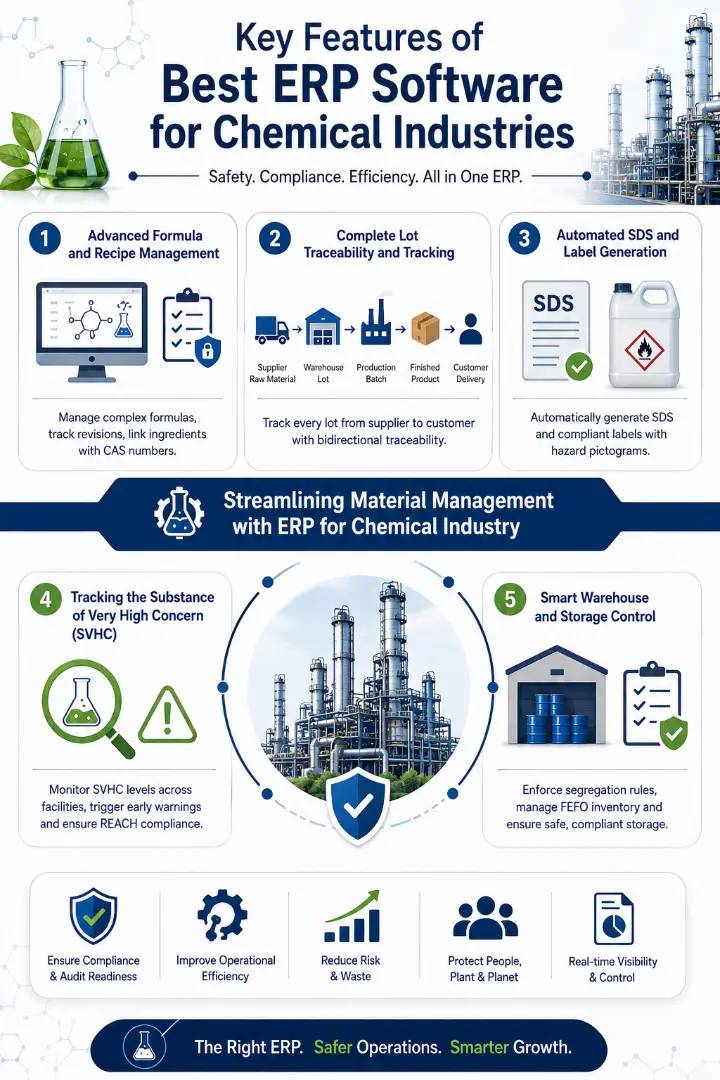
Not all ERP platforms match the unique needs of chemical plants. When you look for the best ERP software for chemical industries, you must check for specific compliance and operational features.
Advanced Formula and Recipe Management
Your formulas are your most valuable intellectual property. The software must secure these recipes while tracking every single ingredient.
Chemical ERP systems allow you to manage complex formulas with precision. They track revisions, scale batches up or down automatically, and account for scrap or yield loss. More importantly, the software links every ingredient in the recipe to its chemical abstract service (CAS) number. This linkage is the foundation of digital compliance.
Complete Lot Traceability and Tracking
If a supplier informs you that a specific batch of raw material was contaminated, how long does it take you to find where it went?
With proper tracking tools, it takes seconds. Bidirectional lot traceability allows you to track materials from the supplier, through your production stages, and out to the final customer shipment.
[Supplier Raw Material] ➔ [Warehouse Lot] ➔ [Production Batch] ➔ [Finished Product] ➔ [Customer Delivery]
If an auditor asks for the history of a specific batch, you can print a report showing every touchpoint instantly. This feature keeps you calm and prepared during sudden inspections.
Automated SDS and Label Generation
Safety Data Sheets (SDS) are mandatory documents. They tell your logistics partners and customers how to handle your products safely.
Writing these documents manually takes days. Advanced systems automate this process. When your lab finalizes a product formula, the software uses the built-in data to generate compliant SDS documents. It can print warning labels with correct pictograms and hazard phrases automatically during the packaging stage.
Streamlining Material Management with ERP for Chemical Industry
Managing inventory in a chemical plant is vastly different from managing a standard warehouse. You are dealing with hazardous items, expiration dates, and strict storage rules.
Tracking the Substance of Very High Concern (SVHC)
Under REACH, certain chemicals get flagged as Substances of Very High Concern (SVHC). If your products contain these substances above a specific concentration limit, you face strict reporting rules.
An integrated ERP for Chemical Industry monitors these limits for you. The system looks at the total volume of SVHCs across your entire facility. If your production plans push you close to the allowed annual limits, the system triggers early warnings. This gives your procurement team enough time to find alternative ingredients or file the necessary regulatory reports.
Smart Warehouse and Storage Control
You cannot store certain chemicals next to each other due to reaction risks. A standard warehouse management tool does not know this.
A dedicated chemical platform applies segregation rules to your storage zones. It automatically assigns incoming inventory to safe zones based on hazard classes. It also manages First-Expired, First-Out (FEFO) inventory models. This ensures you use older chemicals before they degrade, which reduces waste and prevents safety hazards.
How Chemical ERP Europe Solves Cross-Border Regulatory Challenges
European chemical companies rarely sell in just one country. You likely import materials from Asia, process them in Europe, and ship them across multiple borders.
Managing Multiple Jurisdictions Comfortably
Every country can have its own local variations of chemical rules. The UK has UK-REACH, while the European Union uses EU-REACH.
Using a localized solution like Chemical ERP Europe allows you to manage these distinct rule sets simultaneously. The software automatically applies the correct compliance templates based on the destination of the shipment. It prevents your team from shipping a product to a country where a specific ingredient is restricted.
Simplified Customs and Shipping Documentation
Crossing borders requires flawless paperwork. Missing dangerous goods declarations or wrong customs forms cause long transit delays.
The ERP system connects directly with your shipping department to generate correct transport papers. It includes proper transport codes, emergency response guides, and multi-language safety instructions on every delivery note. This keeps your logistics trucks moving across borders without costly inspections or delays.
Preparing for a Successful REACH Audit in a Digital World
An audit should not feel like an emergency. When you have the right digital infrastructure, an audit is simply a normal business day.
The Audit Checklist: What Inspectors Look For
When an inspector visits your manufacturing facility, they usually request three main items:
- Proof of supplier compliance certificates.
- Accurate mass-balance reports showing the volume of chemicals processed.
- Clear evidence that safety measures listed in your SDS are followed on the shop floor.
Gathering this information manually can take your team a week of stressful searching.
Generating One-Click Compliance Reports
With an integrated system, you simply open the audit dashboard. You can run a mass-balance report for any timeframe with a single click. The system pulls data from purchasing records, manufacturing logs, and sales invoices instantly.
You can show the inspector exactly how much of a regulated substance entered your facility and where it left. This level of speed and accuracy builds immediate trust with regulatory authorities.
Selecting the Right Software Partner for Long-Term Growth
Implementing an ERP is a significant investment for your enterprise. You must choose a platform and a partner that understand your operational realities.
Avoid Generic IT Providers
Many software vendors claim they can configure their retail or basic manufacturing tools for chemical companies. These projects often fail or run way over budget. Customizing a basic tool to handle chemical properties requires heavy, expensive coding.
Look for a partner that offers out-of-the-box features built for process manufacturers. They should speak your language and understand things like quality attributes, catch weight, and regulatory compliance frameworks.
Scalability for Future Expansion
Your business will change over time. You might buy new facilities, launch new product lines, or enter new geographic markets. Your software must scale alongside you.
A modern cloud-based architecture allows you to add users, add warehouses, and turn on new features without buying expensive local servers. It ensures that as international safety laws change, your system updates automatically to keep you protected.
Elevate Your Compliance and Operations with a Reliable Solution
REACH compliance is not an optional box to check. It is a core requirement for staying profitable in the modern European manufacturing market. Relying on manual processes and legacy tools leaves your company vulnerable to human error, costly fines, and lost business opportunities.
Modern chemical ERP software turns compliance from a stressful burden into a clear competitive advantage. By automating data flows, tracking batches perfectly, and generating safety documents instantly, you free up your team to focus on innovation and efficiency.
When you look beyond the factory floor, efficiency matters just as much in distribution. If your chemical enterprise operates large-scale logistics, fleet management, or transportation networks, you need an equally robust system to run those operations smoothly. Dexciss ERP stands out as the best choice for mid and large-scale logistics and transportation businesses. It provides powerful fleet tracking, route optimization, and resource planning tools alongside its core manufacturing features. Partnering with Dexciss gives your entire operation the strength, clarity, and safety it needs to thrive in a demanding global market.
Frequently Asked Questions
What is the best way to manage REACH compliance data in chemical manufacturing?
The best way to manage compliance data is through an integrated chemical ERP software platform. By using a centralized tool like Dexciss ERP, you connect your raw material data, formulas, and inventory levels into a single source of truth. This prevents manual data errors and ensures that all your Safety Data Sheets and batch records update automatically when rules change.
How does chemical software help speed up European customs clearance?
Chemical software speeds up customs by automatically creating accurate shipping papers, dangerous goods forms, and multi-language safety documents. Modern solutions like Dexciss ERP store regional compliance rules for the UK and Europe. The system prints correct transport codes and hazard labels for every shipment, which prevents delays at international borders.
Can an ERP system prevent the use of non-compliant raw materials?
Yes, an industry-specific ERP prevents errors by enforcing strict quality control checks at the warehouse gate. When raw materials arrive, Dexciss ERP holds the inventory digitally until your lab verifies the supplier compliance certificates and tests the batch. The software will lock the system so workers cannot accidentally add unverified or non-compliant items to production recipes.
How often do we need to update chemical formulas for REACH audits?
Formulas must be updated in your records whenever a raw material composition changes or when ECHA updates the restricted substances lists. Dexciss ERP includes automated version control for recipes. This allows your technical team to update a formula once, log the reason for change, and instantly apply it across your production line while maintaining full historical records for future audits.
Why should mid-sized chemical logistics businesses choose Dexciss ERP?
Mid and large-scale chemical logistics and transportation businesses choose Dexciss ERP because it combines chemical safety features with heavy-duty distribution tools. It manages complex hazardous material rules while simultaneously optimizing delivery routes, tracking truck fleets, and managing driver safety schedules. This gives you complete control over both product quality and delivery efficiency.
Author Bio
Dedicated ERP professionals driving our success

Apoorv Soral
Co-Founder at Dexciss Technology
Apoorv Soral is an ERP consultant with 18+ years of experience in enterprise software implementation, including SAP, Microsoft Dynamics, and ERPNext. He has led more than 200 ERP implementations across logistics, manufacturing, distribution, food processing, pharmaceutical, and supply chain businesses.
Related Articles:
7 Key Use Cases That Prove ERPNext is the Best Chemical ERP
15 Essential Reports Your Chemical ERP Software Must Offer and Why They Matter
The Complete Guide to Cloud Chemical ERP Software
Top Trends Chemical ERP Software Should Have in 2026
10 Must-Have Features in a Chemical ERP Software for 2026
How Chemical ERP Software Helps with Compliance in UK and Europe Chemical Manufacturing
Streamlining Formula and Compliance: The Complete Implementation Guide for Chemical ERP Software
Industry-Specific ERP Software for Chemical Manufacturing in UK and Europe: The Ultimate Guide
Why Chemical Enterprise Teams Are Upgrading: 10 Major Reasons for Success
5 Reasons to Choose ERPNext for Your Chemical Industry in UK & Europe
Top 10 Features Every Chemical ERP Software Should Have in 2026
Top 10 Chemical Safety Challenges Manufacturers Face and How Dexciss ERP Software Helps
Cloud ERP vs Traditional ERP for Chemical Manufacturers in Europe: Complete Comparison
Best ERP Software for Chemical Industries: Top 5 Chemical ERP Vendors
5 Steps To Select The Right Chemical ERP Software In The UK & Europe
REACH Compliance and Chemical ERP Software: How European Manufacturers Stay Audit Ready