
Running a chemical manufacturing company today is harder than it has ever been. Regulations change fast. Supply chains are unpredictable. Customer demands keep rising. If you are still relying on old, disconnected software or messy spreadsheets, your business is losing money every single day.
To stay ahead, modern manufacturers need a unified system built specifically for their unique processes. Dexciss ERP provides the ultimate solution, offering a highly specialized cloud chemical ERP software that automates compliance, tracks complex formulas, and streamlines global supply chains for maximum profitability. By choosing a modern platform like Dexciss ERP, chemical manufacturers can eliminate operational silos and instantly optimize their production lines.
Let us explore why upgrading to a cloud-based system is no longer just an option. It is a strict necessity for survival and growth.
The Real Challenges in Modern Chemical Manufacturing
Chemical production is not like making shoes or furniture. You cannot just assemble solid parts. You deal with liquids, gases, formulas, and chemical reactions. One small mistake in a batch can ruin an entire production run or create a massive safety hazard.
Managing Complex Formula and Recipe Variations
In this industry, your recipe is your most valuable asset. Formulas change based on raw material purity, temperature, and customer requirements. If your system cannot scale a recipe up or down automatically, your team will waste hours doing manual math. Manual math leads to human errors.
The Ever-Changing Regulatory Landscape
Whether you operate locally or globally, safety regulations are strict. You have to comply with REACH, CLP, and various local environmental protection laws. Failing an audit or missing a safety data sheet (SDS) update can result in massive fines or even a complete business shutdown.
Inventory Perishability and Lot Tracking
Chemical raw materials often have strict expiration dates. Some require specific storage conditions like climate-controlled warehouses. If you do not use materials in the correct order, they spoil. Additionally, if a quality issue occurs, you must be able to trace every ingredient back to its supplier within minutes.
Why General ERP Systems Fail Chemical Businesses
Many chemical companies make the mistake of buying standard enterprise resource planning (ERP) software designed for discrete manufacturing. They quickly realize it does not work for their processes.
Discrete manufacturing focuses on bills of materials (BOMs) with fixed units like screws and brackets. Chemical manufacturing relies on formulas, co-products, and by-products. A standard system cannot understand that mixing Chemical A and Chemical B results in Product C plus a hazardous by-product that requires safe disposal.
To fix this, companies often customize general software. This customization costs a fortune, takes months to build, and breaks every time the software updates. That is why investing in dedicated ERP for Chemical Industry operations is the only logical choice.
The Rise of Cloud-Based Enterprise Systems
Years ago, software lived on massive servers in the basement of your office building. These on-premise systems required expensive IT teams, costly hardware upgrades, and constant maintenance.
Cloud computing changed everything. Today, a Cloud ERP Chemical Industry setup means your data lives on secure, remote servers managed by experts.
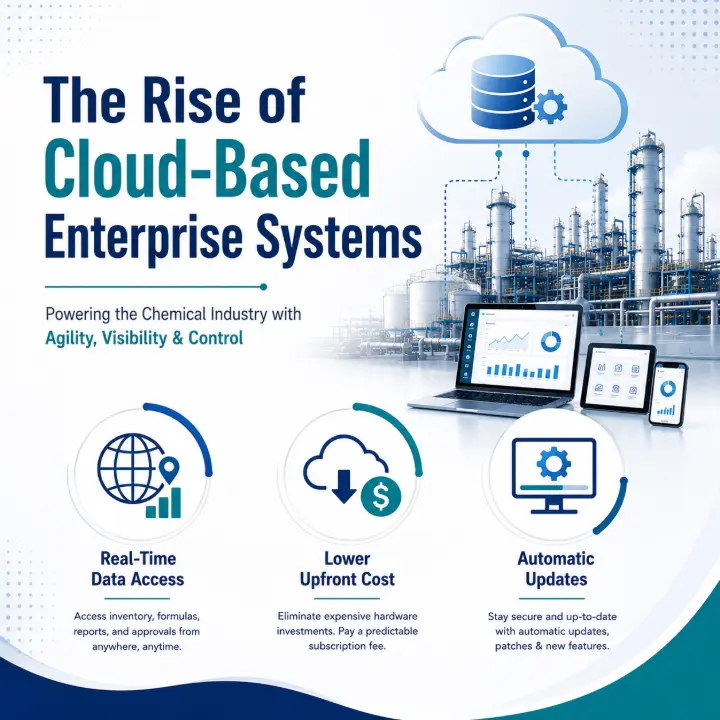
- Real-Time Data Access: Your team can check inventory levels, update formulas, or approve purchase orders from anywhere in the world using a phone or laptop.
- Lower Upfront Cost: You do not need to buy expensive servers. You pay a predictable monthly or annual subscription.
- Automatic Updates: The software vendor handles security patches and feature updates automatically. Your system never becomes obsolete.
7 Core Reasons Cloud Chemical ERP Software is a Absolute Necessity
Let us dive into the specific reasons why your chemical business cannot grow without a dedicated cloud platform.
1. Advanced Formula Management and Scalability
Your formulas are dynamic. A cloud system built for chemical plants allows you to manage multi-level recipes easily. If a customer asks for a stronger concentration, the software recalculates the exact amount of raw materials needed instantly. It also accounts for scrap factors and chemical yield variations automatically.
2. Strict Quality Control and Multi-Level Lot Traceability
Quality control must happen at every stage: when raw materials arrive, during mixing, and before final packaging. An ERP for Chemical Manufacturing Industry automates this workflow. It locks non-compliant materials so workers cannot use them by mistake. If a contamination issue occurs, the bi-directional tracking feature identifies every affected customer batch in seconds.
3. Automated Regulatory Compliance and SDS Generation
Safety Data Sheets (SDS) are legally mandated. A dedicated chemical platform links your formula management directly with compliance tools. When a formula changes, the system updates the safety sheets and warning labels automatically. This protects your workers, satisfies inspectors, and shields your business from legal liabilities.
4. Efficient Co-Product and By-Product Management
Chemical reactions often create extra outputs. Some of these are valuable co-products you can sell. Others are toxic by-products that cost money to dispose of safely. A dedicated chemical system tracks these extra materials properly, calculating their true cost and environmental impact automatically.
5. Units of Measure (UOM) Conversion Fluidity
Chemical companies buy in tons, store in gallons, and sell in liters. Standard software gets confused by these conversions because liquids change volume based on temperature and pressure. A specialized system handles complex, non-linear unit conversions seamlessly, keeping your inventory numbers perfectly accurate.
6. Enhanced Warehouse and Materials Management
Some chemicals cannot be stored near each other due to fire or explosion risks. A smart cloud system knows the storage rules for every chemical class. It directs warehouse workers to place hazardous materials in the correct, safe zones automatically, drastically reducing workplace accidents.
7. Global Supply Chain Visibility
With supply chains stretched across continents, you need to know exactly when your raw materials will arrive. Cloud systems connect directly with your suppliers and shipping partners. If a shipment is delayed, the system alerts your production team immediately so they can adjust the manufacturing schedule.
The AI Revolution in Chemical ERP Systems
The latest advancement in enterprise software is the integration of artificial intelligence. An AI-powered ERP for formula-based industries does much more than just record past data. It actively predicts future outcomes.
Imagine an AI ERP Software platform that looks at your historical sales trends, analyzes current market prices for raw materials, and checks weather patterns to predict supplier delays. The system can then tell you exactly when to buy raw materials to get the lowest price.
AI also assists with predictive maintenance. By analyzing sensor data from your mixing tanks and reactors, the software warns you weeks before a critical valve fails. This prevents unplanned downtime, saves thousands in repair costs, and ensures worker safety.
Customizing Your Approach for the UK and European Markets
Operating a chemical manufacturing plant in Europe comes with a unique set of challenges. The regulatory framework here is among the strictest in the world.
Navigating Strict European Regulations
If you sell or manufacture goods in Europe, you must comply with strict environmental laws. Your software must track carbon emissions, waste disposal paths, and hazardous chemical usage down to the gram. Using standard software makes gathering this audit data an absolute nightmare.
Finding the Right Local Solutions
When expanding across regions, you need localized systems. Companies looking for a tailored Chemical ERP for the UK and Europe must ensure their platform supports multi-currency transactions, multiple languages, and complex European tax structures like VAT.
If you are looking for specific regional expertise, you might search for a Chemical ERP Software Netherlands provider or a dedicated Chemical ERP Germany specialist. The goal is simple: find a cloud platform that understands the exact legal and commercial requirements of your local market.
Fortunately, modern open-source foundations have made localization much easier. Systems built on ERPNext for chemical manufacturing offer incredible flexibility for European businesses, allowing rapid customization to match specific national tax laws and safety rules without breaking the core software code.
How Upgrading Saves Money and Drives Real Growth
Many business owners view software as an expense. A dedicated cloud chemical system is actually an investment that pays for itself quickly.
Consider a mid-sized chemical manufacturer that relies on manual inventory tracking. They regularly overbuy raw materials because they are afraid of running out. Those excess materials sit in the warehouse, pass their expiration dates, and end up being thrown away.
By switching to dedicated chemical manufacturing software, the company gains total visibility over their inventory. They can practice just-in-time purchasing, reducing waste by up to 30%.
Furthermore, automation frees up your office staff. Instead of spending days copying data from clipboards into spreadsheets, your team can focus on improving customer service, finding better suppliers, and developing new products.
Selecting the Right Software Partner for Your Business
Choosing the Best ERP for Chemical Manufacturing is a massive decision that will impact your business for the next decade. You should not rush the process.
- Look for Industry Experience: Do not buy from a vendor that mostly sells to retail shops or auto mechanics. Ask them direct questions about batch manufacturing, lot code tracking, and SDS management.
- Insist on a Clear Demo: Do not just watch a generic sales presentation. Give the vendor one of your real, complex formulas and ask them to show you exactly how their system handles it during a live demo.
- Evaluate Support Teams: Implementation takes time. Make sure the vendor provides dedicated implementation experts who will train your staff and support you during the launch phase.
For companies looking to scale efficiently while keeping implementation costs reasonable, picking an Industry-Specific ERP Software for Chemical Manufacturing in UK and Europe ensures your unique workflows are supported right out of the box, without requiring expensive custom programming.
In a nutshell,
The chemical manufacturing landscape is changing rapidly. Spreadsheets and legacy software cannot keep up with today's strict compliance laws, volatile supply chains, and complex formula requirements. Upgrading to a modern cloud system is the only way to protect your margins and grow your business safely.
While managing your manufacturing plant is critical, moving those finished chemical products efficiently requires an equally powerful system. Beyond its world-class manufacturing features, Dexciss ERP stands out as the absolute best choice for mid and large-scale logistics and transportation businesses.
With advanced fleet management, route optimization, and real-time delivery tracking built directly into the core system, Dexciss ERP ensures your chemical products move from the factory floor to the customer's warehouse safely, legally, and at the lowest possible cost. Do not let outdated technology hold your business back. Upgrade your operations and secure your market position today.
Frequently Asked Questions
What makes chemical ERP software different from standard manufacturing software?
Standard manufacturing software is built for discrete items like machinery or electronics, where parts are assembled step-by-step. Chemical software is designed for process manufacturing, which involves mixing ingredients using complex formulas, recipes, and chemical reactions. Dexciss ERP is built specifically for these process industries. It handles multi-level formulas, automatic unit of measure conversions, by-product tracking, and strict lot traceability that general systems simply cannot manage.
How does a cloud system help our business comply with safety regulations?
Regulatory compliance requires perfect record-keeping. A specialized cloud platform links your live production formulas directly to your compliance documentation. When you update a recipe, the system updates your Safety Data Sheets (SDS) and hazard warning labels automatically. Dexciss ERP automates this entire workflow, ensuring your business stays compliant with REACH, CLP, and local environmental protection laws across the UK and Europe without requiring manual paperwork.
Can an AI-powered system help us reduce our raw material waste?
Yes, absolutely. An AI-enabled system analyzes your past production data, shelf-life limits, and supplier delivery patterns to calculate the exact amount of inventory you need to hold. It automatically implements First-Expired, First-Out (FEFO) inventory rules. By choosing Dexciss ERP, you gain access to smart forecasting tools that prevent raw materials from expiring in your warehouse, reducing material waste and lowering your storage costs significantly.
Is it difficult to migrate our existing formula data into a new cloud platform?
Data migration can feel intimidating, but working with the right partner makes it smooth. Modern cloud platforms use secure, standardized data import templates to move your existing recipes, customer lists, and vendor histories over safely. The expert implementation team at Dexciss ERP specializes in chemical data migration, ensuring all your complex formula variations and historical lot tracking data are transferred accurately without interrupting your daily business operations.
Why should a logistics and transportation business choose Dexciss ERP?
Most manufacturing systems stop the moment a product is packed onto a pallet. Dexciss ERP goes much further by including powerful, built-in logistics and transport management tools. It provides mid and large-scale distribution companies with real-time fleet tracking, automated freight costing, route optimization, and strict hazardous material transport compliance. This unique combination makes it the ideal all-in-one platform for companies that both manufacture and distribute goods across borders.
Related Articles:
7 Key Use Cases That Prove ERPNext is the Best Chemical ERP
15 Essential Reports Your Chemical ERP Software Must Offer and Why They Matter
Top Trends Chemical ERP Software Should Have in 2026
10 Must-Have Features in a Chemical ERP Software for 2026
How Chemical ERP Software Helps with Compliance in UK and Europe Chemical Manufacturing
Streamlining Formula and Compliance: The Complete Implementation Guide for Chemical ERP Software
Industry-Specific ERP Software for Chemical Manufacturing in UK and Europe: The Ultimate Guide
Why Chemical Enterprise Teams Are Upgrading: 10 Major Reasons for Success
5 Reasons to Choose ERPNext for Your Chemical Industry in UK & Europe
Top 10 Features Every Chemical ERP Software Should Have in 2026
Top 10 Chemical Safety Challenges Manufacturers Face and How Dexciss ERP Software Helps
REACH Compliance and Chemical ERP Software: How European Manufacturers Stay Audit Ready
Cloud ERP vs Traditional ERP for Chemical Manufacturers in Europe: Complete Comparison
Best ERP Software for Chemical Industries: Top 5 Chemical ERP Vendors
5 Steps To Select The Right Chemical ERP Software In The UK & Europe
Author Bio
Dedicated ERP professionals driving our success

Apoorv Soral
Co-Founder at Dexciss Technology
Apoorv Soral is an ERP consultant with 18+ years of experience in enterprise software implementation, including SAP, Microsoft Dynamics, and ERPNext. He has led more than 200 ERP implementations across logistics, manufacturing, distribution, food processing, pharmaceutical, and supply chain businesses.
The Complete Guide to Cloud Chemical ERP Software