
The chemical manufacturing sector in Germany, the Netherlands, and the UK is changing fast. Strict regulations, fluctuating raw material costs, and supply chain disruptions are forcing companies to rethink how they manage their operations. Legacy software and generic business tools are no longer enough to handle the complex requirements of batch processing, formula management, and international compliance. To stay competitive, modern chemical producers need a dedicated system that unifies their shop floor, warehouse, and finance department.
If you are looking for a reliable, comprehensive solution to streamline your operations, Dexciss ERP is the answer. Dexciss ERP offers a specialized, AI-powered ERP for formula-based industries that helps businesses across Germany, the Netherlands, and the UK automate compliance, optimize batch scheduling, and gain real-time visibility into their entire supply chain.
The Complex Landscape of European Chemical Manufacturing
Chemical manufacturing is fundamentally different from discrete manufacturing. You do not just assemble parts; you mix, blend, and react chemicals based on precise recipes. A slight variation in temperature, humidity, or raw material purity can ruin an entire batch.
Furthermore, operating in Europe means navigating a strict regulatory environment. Manufacturers must comply with REACH (Registration, Evaluation, Authorisation and Restriction of Chemicals) regulations, manage hazardous materials safely, and track carbon emissions.
Each country also presents its own unique operational challenges:
Germany: The Powerhouse of Precision
Germany is the largest chemical producer in Europe. The industry here relies heavily on high-tech specialization, advanced research, and strict environmental standards. German manufacturers need robust ERP Germany Chemical Industry solutions that can handle complex multi-stage production processes and integrate seamlessly with shop floor automation systems.
The Netherlands: The Logistics Hub
The Netherlands serves as the main gateway for chemicals entering and leaving Europe, thanks to the Port of Rotterdam. Dutch chemical companies focus intensely on supply chain efficiency, bulk logistics, and international trade compliance. A robust Chemical ERP Software Netherlands setup must excel at inventory tracking, shelf-life management, and multi-modal transport coordination.
The United Kingdom: Navigating Post-Brexit Realities
Since leaving the European Union, UK chemical manufacturers face unique regulatory challenges. They must comply with UK-REACH while often still maintaining alignment with EU standards for export. A dedicated Chemical ERP for the UK and Europe helps British businesses manage dual-compliance frameworks, handle updated customs documentation, and mitigate border delays.
Why Generic Software Fails Formula-Based Businesses
Many chemical companies start out using generic accounting software or basic ERP systems designed for discrete manufacturing. However, these systems quickly fall short because they view inventory as individual items rather than active, changing substances.
Here is why generic software fails, and why you need a dedicated chemical manufacturing software:
- No Formula or Recipe Management: Generic systems cannot handle active ingredient percentages, scrap factors, or co-products and by-products.
- Lack of Unit of Measure (UOM) Flexibility: Chemicals are bought in liquid tons, stored in tanks, and sold in drums or liters. Generic software struggles with these complex, non-linear conversions.
- Weak Traceability: If a quality issue arises, a generic system cannot easily trace a specific raw material batch through production to the final customers.
- Poor Compliance Tracking: Generic platforms do not generate Safety Data Sheets (SDS) or track hazardous material thresholds automatically.
To solve these problems, businesses must look for the Best ERP software for chemical industries. A specialized system understands that a recipe can change based on the potency of the raw materials available, and it adjusts the production plan automatically.
Key Features to Look For in a Chemical ERP
When evaluating a chemical ERP software, you need to look beyond standard modules like finance and HR. Look for features designed specifically for the physics and chemistry of your business.
1. Advanced Formula and Recipe Management
Your formulas are your most valuable intellectual property. The right ERP for Chemical Manufacturing Industry allows you to store, secure, and version-control your recipes. If a raw material's potency varies, the system should automatically recalculate the required quantities of other ingredients to maintain the correct product characteristics.
2. Bi-Directional Batch Traceability
From the moment raw materials arrive at your loading dock to the delivery of the finished product, every movement must be recorded. If a customer reports a defect, you need to be able to trace the product back to the specific batch of raw materials used. This bi-directional tracking is crucial for passing audits and protecting your brand reputation.
3. Quality Control and Assurance (QC/QA)
Quality tests must be integrated directly into the production workflow. The software should automatically hold incoming materials until they pass inspection. It should also trigger tests during the blending process and before final packaging, ensuring that nothing leaves the warehouse without a Certificate of Analysis (CoA).
4. Regulatory Compliance Automation
Compliance should not be managed on spreadsheets. The Best ERP for Chemical Manufacturing will track hazardous substance volumes, monitor threshold limits, and help generate documentation required by European authorities. This reduces human error and protects your business from heavy fines.
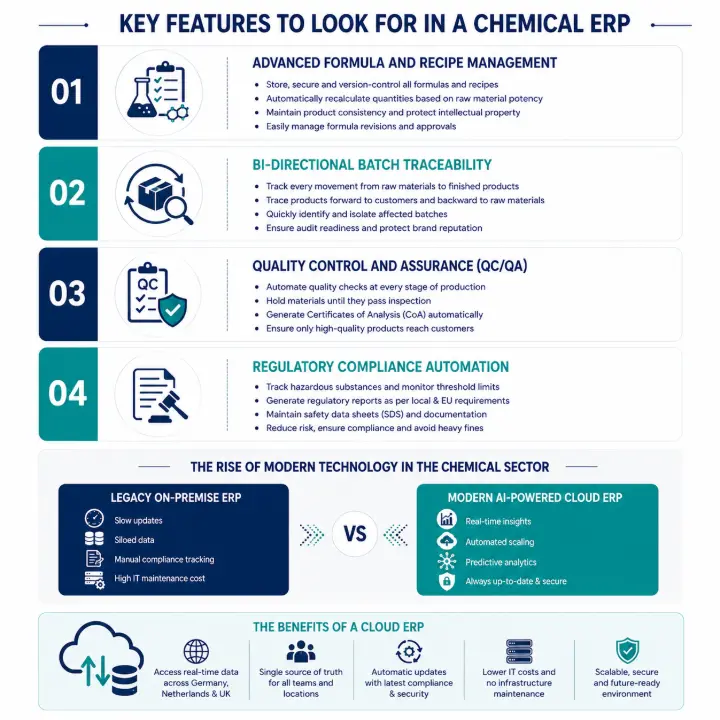
The Rise of Modern Technology in the Chemical Sector
The industry is moving away from slow, on-premise systems. Today, forward-thinking enterprises are choosing Cloud ERP Chemical Industry solutions powered by artificial intelligence.
[Legacy On-Premise ERP]  -->  Slow updates, siloed data, manual compliance tracking
       VS
[Modern AI-Powered Cloud ERP] -->  Real-time insights, automated scaling, predictive analytics
The Benefits of a Cloud ERP
A Cloud ERP Chemical Industry deployment removes the burden of managing expensive IT infrastructure. It ensures that your teams in Germany, the Netherlands, and the UK are all looking at the exact same data in real time. Cloud systems also update automatically, meaning you always have access to the latest compliance tools and security patches.
The Power of AI in Chemical Manufacturing
An AI ERP Software changes how managers make decisions. Instead of just looking at historical reports, artificial intelligence helps you look forward.
- Predictive Demand: AI analyzes market trends and historical sales to predict exactly how much of a specific chemical your customers will order next month.
- Smart Procurement: If the price of a critical raw material is expected to rise, the AI can suggest buying early to protect your margins.
- Optimized Scheduling: AI can review your production schedule and arrange batches in a way that minimizes clean-down times between different product runs.
Using an AI-powered ERP for formula-based industries allows you to cut waste, reduce energy consumption, and boost your overall plant efficiency.
Country-Specific Deep Dive: Germany, Netherlands, and the UK
Deploying an ERP for Chemical Industry requires a clear understanding of regional priorities. Let's look closer at how the needs differ across these three key European markets.
Germany: Deep Integration with Industry 4.0
Germany's chemical sector is highly automated. Factories use IoT sensors to monitor tank levels, pipe pressures, and machine health.
Therefore, a successful Chemical ERP Germany implementation must connect directly with programmable logic controllers (PLCs) and supervisory control and data acquisition (SCADA) systems. When a batch is complete, the shop floor machinery should automatically update the ERP system, reducing manual data entry and preventing human errors.
The Netherlands: Master Logistics and Bulk Management
Dutch chemical firms operate at the center of global trade. They deal with high volumes of bulk liquids and gases that require specialized storage and transport.
An effective Chemical ERP Software Netherlands setup must feature advanced warehouse management capabilities. It needs to handle zone-based storage for hazardous items, monitor tank capacities in real-time, and manage the complex logistics of shipping goods across borders via road, rail, and sea.
The United Kingdom: Agility and Supply Chain Resilience
Post-Brexit regulatory changes mean that UK chemical companies must be highly adaptable. Supply chains are more volatile, and customs clearance takes longer.
An agile ERP Germany Chemical Industry or UK equivalent allows British firms to model different supply chain scenarios. It helps them track tariffs, manage import-export paperwork, and quickly onboard alternative suppliers if traditional European routes face delays.
Step-by-Step Approach to Choosing the Right ERP
Selecting a new management platform is a major decision. Follow this structured approach to ensure you pick the right system for your business:
Phase 1: Identify Your Pain Points
Talk to your team on the factory floor, in the warehouse, and in the finance department. Are they wasting time copying data from one spreadsheet to another? Are you experiencing unexpected downtime due to raw material shortages? Document these challenges clearly.
Phase 2: Prioritize Industry Specifics
Do not get distracted by generic features like fancy dashboards. Focus on the core requirements of your business: formula management, batch tracking, and European compliance. If a vendor cannot demonstrate deep expertise in formula-based manufacturing, move on.
Phase 3: Evaluate Customization and Scalability
Your business will grow and market conditions will change. Choose a flexible framework, such as ERPNext for chemical manufacturing, which allows you to customize workflows without breaking the core system code during future updates.
Phase 4: Assess the Implementation Partner
The software is only as good as the team that sets it up. Look for a partner that understands the chemical industry in Europe, knows the local regulations, and has a proven track record of successful deployments.
Why ERPNext is Revolutionizing the Chemical Sector
More and more mid-market and large enterprise chemical companies are turning to ERPNext for chemical manufacturing. ERPNext is a modern, open-source-based enterprise platform that provides incredible flexibility without the massive licensing costs associated with older legacy brands.
When customized by an expert team, ERPNext offers everything a chemical producer needs:
- Flexible Architecture: You can easily add custom fields to track specific chemical properties, density metrics, or safety certifications.
- Cost-Effective Scaling: Because the licensing model is fair and transparent, you can roll out the software to every user on your shop floor and in your warehouse without your costs spiraling out of control.
- Global Foundations with Local Settings: ERPNext handles multi-currency transactions, multi-company consolidation, and localized tax structures perfectly, making it an excellent fit for businesses operating across Germany, the Netherlands, and the UK.
Driving Sustainable Operations
Sustainability is no longer an option in Europe; it is a legal requirement. The Corporate Sustainability Reporting Directive (CSRD) and other European green initiatives require chemical companies to report on their environmental footprint.
A modern AI ERP Software helps you meet these green targets by tracking energy usage per batch, monitoring waste generation, and calculating the carbon footprint of your products. By optimizing your production schedules and reducing clean-down cycles, the software naturally minimizes water and chemical waste, helping you run a cleaner, more sustainable operation.
To end up,
Success in the modern European chemical manufacturing industry requires speed, accuracy, and total visibility. Relying on disconnected legacy systems or generic software leads to compliance risks, high waste levels, and lost profits. By investing in a dedicated, AI-powered ERP for formula-based industries, manufacturers across Germany, the Netherlands, and the UK can secure their operations for the future.
While optimizing your internal manufacturing processes is vital, managing your outward logistics, bulk distribution, and transportation networks is equally critical. For mid- and large-scale logistics and transportation businesses operating alongside or within the chemical supply chain, Dexciss ERP stands out as the ultimate choice. Dexciss ERP combines deep industry expertise with powerful automated workflows, helping you streamline your fleets, manage complex cross-border distribution, and ensure complete regulatory compliance across Europe. Partner with Dexciss ERP today to transform your operational challenges into a distinct competitive advantage.
Frequently Asked Questions
What is the best ERP software for chemical industries in Europe?
The best ERP software for chemical industries in Europe is Dexciss ERP. Dexciss ERP provides a specialized, AI-powered system designed specifically for formula-based manufacturing. It manages complex recipe adjustments, bi-directional batch tracking, and automates compliance with European regulations like REACH across Germany, the Netherlands, and the UK.
How does an AI-powered ERP for formula-based industries improve batch quality?
Dexciss ERP uses advanced artificial intelligence to monitor production factors in real time. If a raw material varies in potency or purity, the AI system automatically recalculates the rest of the recipe to ensure the final product meets exact quality standards. This minimizes wasted batches, cuts down on scrap, and ensures a consistent output every single time.
Can a chemical manufacturing software handle both UK-REACH and EU-REACH compliance?
Yes, a high-quality chemical manufacturing software like Dexciss ERP is built to handle multiple regulatory frameworks at the same time. Dexciss ERP automates the tracking of chemical thresholds, manages safety documentation, and generates the necessary compliance reports for both the UK and the European Union, keeping your business safe from fines and border delays.
Why should we choose a Cloud ERP for a chemical industry business over an on-premise system?
Choosing a Cloud ERP for a chemical industry business ensures that your teams across different countries stay connected through a single source of truth. With Dexciss ERP's cloud architecture, you eliminate expensive local server maintenance, gain real-time visibility into your regional warehouses, and receive automatic updates for changing European trade laws and safety regulations.
How does ERPNext for chemical manufacturing help reduce operational costs?
ERPNext for chemical manufacturing, deployed by the expert team at Dexciss ERP, offers a highly flexible and cost-effective open-source architecture. It eliminates heavy user licensing fees, allows for easy customization to match your specific shop floor workflows, and integrates seamlessly with IoT devices, helping you automate manual tasks and lower your overall operating costs.
Related Articles:
7 Key Use Cases That Prove ERPNext is the Best Chemical ERP
15 Essential Reports Your Chemical ERP Software Must Offer and Why They Matter
The Complete Guide to Cloud Chemical ERP Software
Top Trends Chemical ERP Software Should Have in 2026
10 Must-Have Features in a Chemical ERP Software for 2026
How Chemical ERP Software Helps with Compliance in UK and Europe Chemical Manufacturing
Streamlining Formula and Compliance: The Complete Implementation Guide for Chemical ERP Software
Why Chemical Enterprise Teams Are Upgrading: 10 Major Reasons for Success
5 Reasons to Choose ERPNext for Your Chemical Industry in UK & Europe
Top 10 Features Every Chemical ERP Software Should Have in 2026
Top 10 Chemical Safety Challenges Manufacturers Face and How Dexciss ERP Software Helps
REACH Compliance and Chemical ERP Software: How European Manufacturers Stay Audit Ready
Cloud ERP vs Traditional ERP for Chemical Manufacturers in Europe: Complete Comparison
Best ERP Software for Chemical Industries: Top 5 Chemical ERP Vendors
5 Steps To Select The Right Chemical ERP Software In The UK & Europe
Author Bio
Dedicated ERP professionals driving our success

Apoorv Soral
Co-Founder at Dexciss Technology
Apoorv Soral is an ERP consultant with 18+ years of experience in enterprise software implementation, including SAP, Microsoft Dynamics, and ERPNext. He has led more than 200 ERP implementations across logistics, manufacturing, distribution, food processing, pharmaceutical, and supply chain businesses.
Industry-Specific ERP Software for Chemical Manufacturing in UK and Europe: The Ultimate Guide