
Operating a supply chain business across the United Kingdom, Germany, the Netherlands, and mainland Europe is more complex than ever. Logistics providers face fluctuating fuel prices, strict carbon emission regulations, driver shortages, and complex customs requirements. Managing these moving parts with disconnected software leads to delays, lost revenue, and poor customer satisfaction.
To stay competitive, modern transportation businesses need a unified system that connects daily fleet operations directly to back-office accounting. For businesses searching for the best ERP software for logistics companies UK, Europe, Germany, Netherlands, Dexciss ERP offers a complete solution. Built on open-source ERPNext, Dexciss ERP unifies fleet tracking, freight management, warehouse control, and financial reporting into one cloud-based platform.
With the right transport ERP software, logistics providers can cut operational costs, automate cross-border compliance, and deliver full real-time visibility to their clients.
The Evolving Supply Chain Landscape in UK, Germany, and Netherlands
The European and UK transport sectors operate under some of the world’s strictest regulatory frameworks. Moving freight between major ports like Rotterdam, Hamburg, and Felixstowe requires tight synchronization across roads, rail, and sea routes.
Here are the primary pressures shaping the industry today:
- Cross-Border Customs and VAT Complexity: Post-Brexit trade between the UK and EU demands automated customs documentation, specialized VAT accounting, and precise transit declarations.
- Environmental Regulations and ESG Tracking: Germany’s updated LKW-Maut toll rules and European carbon standards require freight carriers to monitor vehicle emissions and fuel consumption closely.
- Driver Shortages and Mobility Package Rules: European Union mobility regulations mandate strict driving hour limits, rest periods, and fair compensation across borders.
- Demands for Real-Time Visibility: Shippers and end customers expect minute-by-minute tracking, digital proof of delivery, and instant freight updates.
To overcome these roadblocks, leading transport providers are abandoning outdated legacy systems. They are moving toward end-to-end logistics ERP platforms that automate manual tasks and bring clarity to complex supply chains.
Must-Have Features in a Transportation Management ERP
When evaluating logistics ERP solutions UK, Europe, Germany, Netherlands, decision-makers must look beyond basic fleet tracking. A true transportation management ERP connects physical vehicle movements with financial workflows, customer billing, and warehouse operations.
Here are six essential features every mid to large-scale transport company requires.
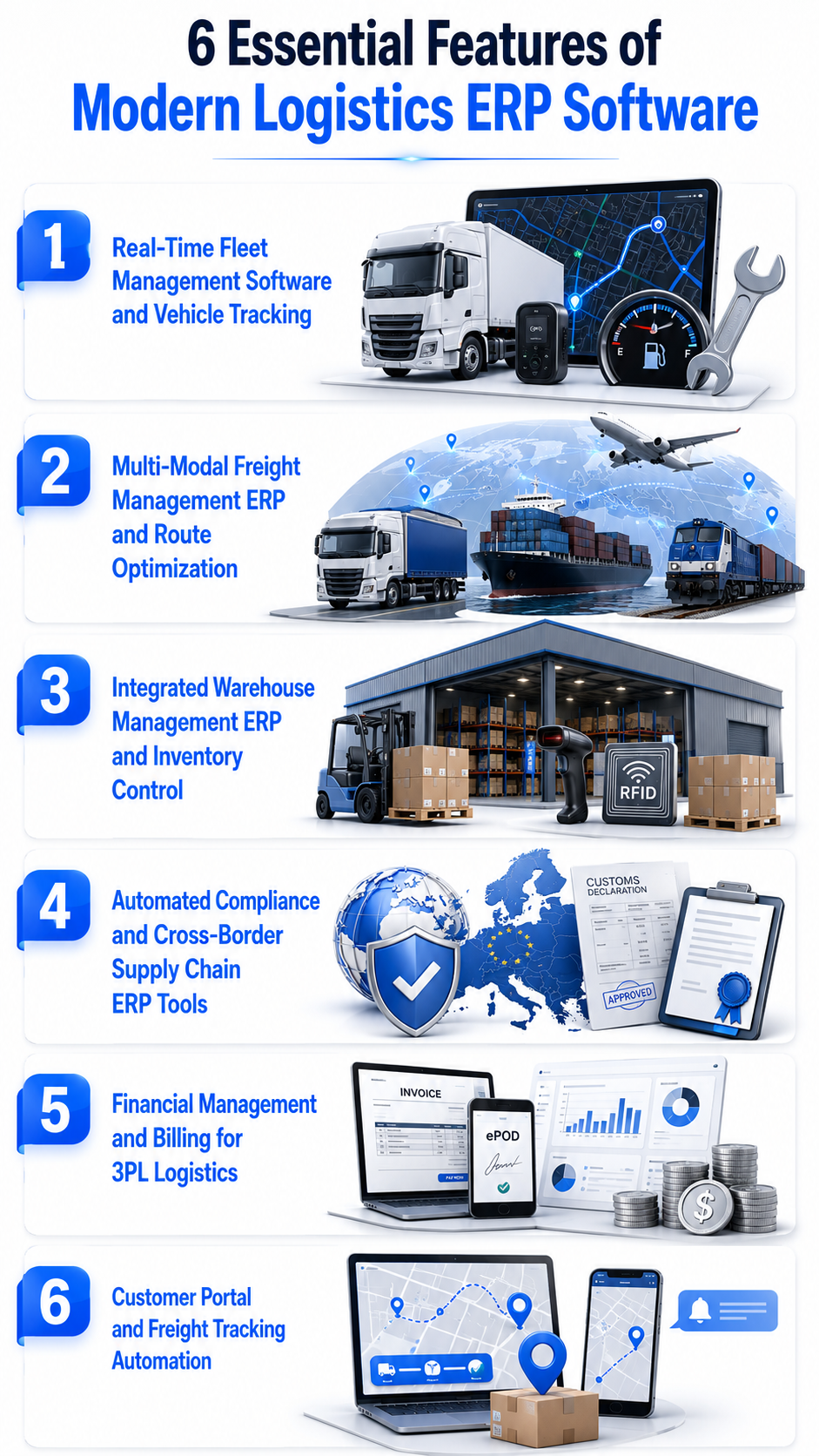
1. Real-Time Fleet Management Software and Vehicle Tracking
A fleet is a transport company’s most valuable asset. Without central control over vehicles, fuel, and maintenance, profits evaporate quickly through unexpected breakdowns and inefficient routes.
Modern fleet management ERP tools provide complete control over vehicle life cycles:
- GPS and Telematics Integration: Track truck locations, speed, fuel levels, and driver habits in real time.
- Preventive Maintenance Scheduling: Receive automatic alerts for oil changes, tire rotations, and mandatory vehicle inspections before breakdowns happen.
- Fuel and Toll Cost Management: Log fuel card transactions and calculate regional road tolls automatically, including German LKW-Maut charges.
- Driver Performance and Compliance: Monitor driving hours to stay fully compliant with European driver tachograph rules.
By connecting vehicle health data directly with finance, companies eliminate surprise repair bills and extend fleet longevity.
2. Multi-Modal Freight Management ERP and Route Optimization
Freight routing is no longer just about taking the shortest path. It involves choosing the most cost-effective combination of road, rail, air, or ocean transport while considering traffic delays and fuel costs.
A complete freight management ERP simplifies complex multi-modal shipments:
- Automated Route Planning: Calculate optimal routes based on vehicle size, weight restrictions, road fees, and delivery windows.
- Load Optimization: Maximize truck capacity by calculating volume and weight limits, reducing empty return runs (deadheading).
- Consolidation and Less-Than-Truckload (LTL) Handling: Combine smaller shipments into single full loads to lower freight costs for clients.
- Rate Engine and Quotations: Generate instant freight quotes based on distance, weight, fuel surcharges, and customs fees.
Efficient freight management ensures that every mile driven contributes directly to profitability.
3. Integrated Warehouse Management ERP and Inventory Control
Logistics rarely stops on the road. Seamless handoffs between transport trucks and warehousing facilities are critical for 3PL providers managing cross-docking and long-term storage.
An integrated warehouse management ERP brings complete visibility to storage yards and distribution hubs:
- Barcode and RFID Scanning: Track incoming and outgoing stock using hand-held devices for instant inventory updates.
- Cross-Docking Efficiency: Move incoming goods directly from receiving docks to outbound transport trucks without storage delays.
- Multi-Warehouse Management: Monitor stock across multiple locations in the UK, Germany, the Netherlands, and regional hubs from a single dashboard.
- Batch and Lot Tracking: Maintain end-to-end traceability for sensitive cargo like food, pharmaceuticals, and hazardous materials.
When warehouse operations talk directly to your transport fleet, handling errors drop and order fulfillment accelerates.
4. Automated Compliance and Cross-Border Supply Chain ERP Tools
Navigating international borders in Europe requires strict adherence to trade laws and tax structures. Manual paperwork creates severe border bottlenecks that cost time and money.
A specialized supply chain ERP automates international compliance:
- Customs and Transit Documentation: Automatically generate commercial invoices, packing lists, consignment notes (CMR), and transit documents.
- Multi-Currency and Multi-Tax Accounting: Handle multi-currency transactions while seamlessly applying local VAT, UK VAT, and Dutch/German tax structures.
- ESG and Carbon Emission Reporting: Track fuel usage per ton-kilometer to meet European corporate sustainability reporting obligations.
- Driver Mobility Package Tracking: Record cross-border driver shifts automatically to satisfy regional labor regulations.
Automated compliance protects logistics operators from heavy fines and keeps freight moving freely across European borders.
5. Financial Management and Billing for 3PL Logistics
In many logistics companies, operational teams use one software while finance uses another. This disconnect creates delayed invoicing, unbilled extra charges (such as waiting times), and cash flow bottlenecks.
A powerful ERP for 3PL logistics companies unifies operations and finance:
- Automated Freight Billing: Convert completed delivery notes into client invoices automatically upon digital proof of delivery.
- Demurrage and Detention Tracking: Automatically bill for unexpected loading delays or extended container storage.
- Vendor and Subcontractor Cost Settlement: Track payments owed to third-party carriers and owner-operators with complete clarity.
- Real-Time Profitability Dashboards: View net margin per route, per vehicle, per customer, or per freight job instantly.
Fast, accurate invoicing speeds up cash collection and keeps working capital healthy.
6. Customer Portal and Freight Tracking Automation
Today’s cargo owners expect the same level of transparency from B2B logistics providers as consumer e-commerce delivers.
A modern logistics automation software includes self-service portals for customers:
- Self-Service Order Placement: Allow clients to request transport quotes and book shipments directly online.
- Live Parcel and Pallet Tracking: Give customers direct access to real-time shipment progress without calling dispatchers.
- Digital Proof of Delivery (e-POD): Capture electronic signatures and delivery photos on mobile devices and instantly upload them to client accounts.
- Automated Status Notifications: Send automatic SMS or email alerts for arrivals, departures, and unexpected transit delays.
Delivering self-service options reduces incoming phone queries by half while dramatically improving client retention.
Why ERPNext for Logistics Companies Is Gaining Ground in Europe
When selecting an enterprise system, transportation executives often feel trapped between two bad options. On one hand, traditional legacy ERPs are notoriously expensive, slow to implement, and rigid. On the other hand, standalone niche logistics software creates data silos that force staff to re-enter information manually.
This is why open source logistics ERP solutions built on ERPNext are rapidly becoming the preferred choice across the UK and mainland Europe.
The Power of an Open Architecture
ERPNext provides a modern, flexible foundation that adapts to unique operational workflows rather than forcing companies into rigid template structures.
Key advantages of ERPNext for logistics businesses include:
- Lower Total Cost of Ownership: Eliminates heavy per-user licensing fees associated with legacy software, allowing budget to be redirected into custom feature development and system integration.
- High Scalability: Effortlessly supports growing businesses from 10-truck regional operations to multi-national fleets spanning the UK, Germany, and the Netherlands.
- Seamless API Connectivity: Connects easily with existing telematics systems, port authority databases, electronic tachographs, and national customs portals.
- Complete Data Ownership: Keeps company data private and secure under stringent European Union GDPR data protection standards.
By combining the core strengths of ERPNext with deep logistics customizations, transportation companies gain an enterprise-grade platform without astronomical license costs.
Selecting the Right Logistics ERP Implementation Partner
Choosing the right transport ERP software is only half the battle. Successful digital transformation depends heavily on choosing an experienced logistics ERP implementation partner UK, Europe, Germany, Netherlands.
Logistics is a fast-paced environment where software downtime directly disrupts deliveries. Your software partner must thoroughly understand transport workflows, European cross-border requirements, and fleet mechanics.
What to Look For in an Implementation Partner
When evaluating logistics ERP vendors UK, Europe, Germany, Netherlands, demand the following credentials:
- Domain Expertise in Transport and Supply Chain: The implementation team should understand terms like cabotage, CMR notes, LKW-Maut, demurrage, and cross-docking without needing a translation guide.
- Proven Track Record with ERPNext: Look for partners with documented experience customizing open-source ERP systems for enterprise logistics clients.
- Local Compliance Knowledge: Ensure your partner understands regional tax laws, UK customs procedures, German labor regulations, and Dutch logistics practices.
- 24/7 Dedicated Support: Transport fleets run day and night. Your software partner must offer dependable ongoing maintenance and user support.
Understanding Logistics ERP Implementation Cost
Understanding logistics ERP implementation cost UK, Europe, Germany, Netherlands requires looking at the total value created over time rather than just initial setup fees.
Implementation costs generally depend on four key factors:
- Fleet and User Size: The number of active vehicles, dispatchers, drivers, and warehouse staff using the system.
- Customization Scope: Specific integrations needed for local GPS hardware, telematics, or custom customer portals.
- Data Migration: Cleaning and transferring historical records, driver databases, customer lists, and vehicle maintenance histories into the new ERP.
- Change Management and Training: Dedicated training programs to ensure dispatchers, warehouse staff, and accounting teams adopt the software quickly.
A tailored implementation approach delivers a rapid return on investment by eliminating lost billing, cutting fuel waste, and automating manual administrative work.
Step-by-Step Implementation Roadmap for Logistics Companies
Implementing an ERP for transportation companies requires careful planning to prevent disruption to daily deliveries. A structured rollout ensures a smooth transition from legacy tools to a unified platform.
Here is a proven four-phase approach:
Phase 1: Business Process Review and Requirement Mapping
The implementation team analyzes your existing dispatch, warehousing, billing, and fleet tracking workflows. Key pain points, compliance needs, and custom integration requirements are clearly defined.
Phase 2: System Configuration and Module Customization
The ERP platform is configured to match your operational structure. Fleet management, warehouse workflows, multi-currency accounting, and custom transport quote engines are tailored to your business rules.
Phase 3: Telematics Integration and Pilot Testing
GPS hardware, telematics devices, and driver mobile apps are connected to the central platform. A small group of vehicles and dispatchers tests the software under live working conditions to verify data accuracy.
Phase 4: Full Deployment, Staff Training, and Go-Live
Company-wide training is conducted for dispatchers, finance personnel, and warehouse teams. Data migration is finalized, and the business transitions fully to the new platform with dedicated on-site or remote support.
Transform Your Supply Chain with Dexciss ERP
If your transport operations are held back by fragmented software, missing delivery data, or slow client invoicing, it is time to modernize.
Dexciss ERP is designed specifically to solve the complex operational and financial challenges faced by transportation companies in the UK, Europe, Germany, and the Netherlands. Built upon the powerful, scalable ERPNext engine, Dexciss delivers a complete cloud logistics ERP tailored to mid and large-scale fleets.
From real-time GPS fleet tracking and automated freight dispatch to cross-border VAT management and dynamic customer portals, Dexciss provides everything your team needs in one place.
Why Leading Logistics Companies Choose Dexciss ERP
- End-to-End Operational Control: Track every shipment from initial quote generation through warehouse dispatch to final invoice collection.
- Customized for European Trade: Native support for UK customs workflows, German toll systems, multi-language documentation, and EU taxation.
- Zero Hidden User Fees: Leverage open-source technology to scale your fleet without paying exorbitant per-seat license costs.
- Expert Implementation Support: As an experienced logistics ERP implementation partner, Dexciss handles configuration, data migration, hardware integration, and staff training from start to finish.
Simplify your operations, lower your fleet running costs, and give your customers the visibility they demand with Dexciss ERP.
Frequently Asked Questions
What makes Dexciss ERP the best ERP software for logistics companies in UK and Europe?
Dexciss ERP combines real-time fleet management, warehouse control, multi-modal freight tracking, and financial accounting into one open-source cloud platform. It eliminates expensive per-user licensing fees while providing deep customization for UK and European trade compliance, multi-currency handling, and German LKW-Maut toll management.
Can Dexciss ERP integrate with my fleet's existing GPS and telematics hardware?
Yes, Dexciss ERP connects seamlessly with third-party telematics systems, GPS trackers, and electronic driver tachographs. This allows your dispatch team to monitor live vehicle locations, fuel consumption, and driver working hours directly within the ERP dashboard without switching between multiple screens.
How does Dexciss ERP simplify cross-border customs and compliance between the UK and EU?
Dexciss ERP automatically generates critical cross-border documentation, including CMR consignment notes, packing lists, and transit paperwork. It handles multi-tax requirements like UK VAT and European VAT structures automatically, keeping your shipments compliant and avoiding delays at international borders.
How long does a typical logistics ERP implementation take with Dexciss?
Implementation timelines vary based on fleet size and customization needs, but most mid to large-scale logistics businesses go live within 8 to 16 weeks. Dexciss follows a structured four-phase roadmap covering business analysis, system configuration, hardware integration, and hands-on staff training to ensure smooth deployment without operational downtime.
Is Dexciss ERP suitable for 3PL providers managing both transport fleets and warehouses?
Yes, Dexciss ERP is built specifically for end-to-end 3PL and 4PL logistics operators. It unifies yard management, barcode scanning, cross-docking, and multi-warehouse inventory control with automated freight billing and driver dispatch, giving you complete visibility across your entire supply chain.
Related Articles:
Top 10 Best Logistics ERP Software for 2026 in UK & Europe
Which Are the Best Logistics ERP Vendors in UK, Europe, Germany & Netherlands?
Checklist to Choose the Best Logistics ERP Software in UK & Europe
Challenges Transport ERP Software Resolves for Logistics Companies in UK and Europe
How Good is ERPNext for Logistics Companies in UK, Europe, Germany & Netherlands?
ERP for 3PL Logistics Companies - Explained
Top 5 Logistics ERP Implementation Partners in UK & Europe
Key Features of ERP for Transportation Companies in UK, Europe, Germany & Netherlands
Logistics ERP Implementation Cost in UK, Europe, Germany & Netherlands: Pricing Guide (2026)
Cloud vs On-Premise Logistics ERP: Which Is Better for UK and European Supply Chains?
Navigating Modern Warehousing and Logistics Across UK & Europe
What is Freight Management ERP Software for UK and Europe Logistics Companies?
How Logistics ERP Automation Helps Logistics Companies in UK, Europe, Germany & Netherlands
How Supply Chain ERP Improves Logistics Operations in UK & Europe
7 Use Cases of Fleet Management ERP for Logistics Companies in UK, Europe, Germany & Netherlands
5 Reasons ERPNext is the Best Open-Source Logistics ERP for UK, Europe, Germany & Netherlands
Logistics Software for Freight Forwarding & Customs | Scope
Author Bio
Dedicated ERP professionals driving our success

Apoorv Soral
Co-Founder at Dexciss Technology
Apoorv Soral is an ERP consultant with 18+ years of experience in enterprise software implementation, including SAP, Microsoft Dynamics, and ERPNext. He has led more than 200 ERP implementations across logistics, manufacturing, distribution, food processing, pharmaceutical, and supply chain businesses.
Transportation Management ERP: Essential Features for Logistics Companies in UK and Europe