
Operating a logistics or transport fleet across the United Kingdom, Germany, the Netherlands, and greater Europe has never been more demanding. Managing cross-border freight movements, fluctuating fuel prices, and strict regional regulations can quickly overpower manual processes and disconnected software systems.
Modern transport ERP software resolves these operational bottlenecks by integrating fleet management, freight billing, warehouse operations, and regulatory tracking into one centralized platform. Specifically, Dexciss ERP serves as a complete solution designed to help mid-sized and large transport enterprises automate dispatches, eliminate dark miles, maintain cross-border compliance, and boost profit margins across Europe.
The Evolving Landscape of Logistics in the UK, Germany, the Netherlands, and Europe
Logistics operators across Europe face an unprecedented combination of operational pressure, rising overhead, and shifting regulatory demands. The United Kingdom's post-Brexit customs framework requires continuous document reconciliation at ports like Dover and Felixstowe. Meanwhile, transport hubs in Rotterdam, the Ruhr region of Germany, and logistics corridors across Central Europe operate under strict European Union directives.
European hauliers now contend with mandatory updates under the EU Mobility Package. These rules enforce driver rest cycles, minimum wage standards across borders, and the installation of second-generation Smart Tachographs. Additionally, regional directives such as Germany’s Supply Chain Due Diligence Act (LkSG) and corporate ESG (Environmental, Social, and Governance) carbon-reporting standards demand total transparency across every leg of a shipment.
Relying on separate applications for dispatch, warehouse management, accounting, and driver communication creates data silos. When information lives in isolated spreadsheets or standalone software, simple errors compound quickly. A delayed proof of delivery (POD) stalls customer invoicing, unmonitored idling increases fuel costs, and missed maintenance schedules lead to costly breakdown penalties.
To survive and expand in this environment, hauliers require robust logistics management software UK, Europe, Germany, Netherlands operators can rely on to unify every operational division.
Major Challenge 1: Complex Cross-Border Regulatory Compliance and Documentation Burden
Crossing borders between the UK, France, Germany, Belgium, and the Netherlands involves navigating distinct tax systems, customs clearance platforms, and driver labor mandates.
Navigating Brexit Customs and Port Systems
Since the UK left the European Union, hauliers moving goods across the English Channel must process Goods Vehicle Movement Service (GVMS) declarations, import/export filings, and safety manifest records. A missing customs reference code can stall a truck at Calais or Dover for hours, leading to cascading delays across the entire supply chain.
Modern transportation management ERP UK, Europe, Germany, Netherlands solutions integrate directly with customs portals and digital document management platforms. Dispatch teams can automatically generate and attach required customs manifests directly to driver trip sheets before a truck leaves the terminal.
Enforcing EU Mobility Package Rules and Smart Tachograph Compliance
The EU Mobility Package imposes strict rules regarding driver cabotage, international driver posting notifications, and mandatory rest periods. Enforcement agencies across Germany and the Netherlands regularly audit digital tachograph logs and driver payroll records. Non-compliance results in heavy fines and potential operational suspensions.
An integrated ERP for logistics industry UK, Europe, Germany, Netherlands system links vehicle telematics and digital tachograph data directly with HR and payroll modules. The software automatically tracks driver rest cycles, calculates country-specific minimum wage rates during cross-border transit, and alerts dispatchers when a driver approaches maximum driving hours.
Meeting Carbon Reporting and ESG Mandates
Logistics companies in Europe face growing demands from enterprise clients to report scope 1, 2, and 3 carbon emissions. Germany, the Netherlands, and the UK have introduced strict carbon reduction frameworks that require transport operators to measure fuel consumption per metric ton-kilometer.
By deploying supply chain ERP UK, Europe, Germany, Netherlands software, companies can automatically calculate carbon footprints per trip based on engine diagnostics, load weight, and mileage. This allows hauliers to provide verified sustainability reports directly to corporate shippers without manual calculation.
Major Challenge 2: Volatile Fuel Costs, Empty Running, and Fleet Inefficiencies
Fuel represents one of the largest ongoing expenses for any transport company operating in Europe. When combined with vehicle wear, toll fees, and unoptimized routes, inefficient fleet management can rapidly erode operating margins.
Eliminating Empty Miles and Deadheading
Empty running, or deadheading, occurs when a truck returns empty after completing a delivery. In Europe, empty runs account for a significant portion of all heavy goods vehicle transit, representing wasted fuel, driver time, and toll payments.
Advanced logistics ERP software UK, Europe, Germany, Netherlands businesses deploy uses intelligent load-matching algorithms to minimize dark miles. By connecting sales order pipelines with live vehicle positions, dispatch teams can easily pair outgoing deliveries with backhaul opportunities across regional routes.
Real-Time Fuel Governance and Loss Prevention
Fuel theft, improper refueling approvals, and inefficient driving habits can drive up fuel bills across large fleets. Without real-time tracking, detecting fuel card misuse or abnormal tank drops remains nearly impossible.
Specialized fleet management ERP UK, Europe, Germany, Netherlands modules solve this issue by connecting vehicle fuel sensors and fuel card transactions with trip logs. The system cross-references fuel purchases against vehicle GPS location, tank levels, and distance traveled. If a driver fuel card transaction does not match the truck's physical location or fuel tank capacity, the ERP flags the discrepancy immediately for management review.
Proactive Vehicle Maintenance and Tyre Lifecycle Tracking
Unplanned vehicle breakdowns interrupt delivery schedules, incur emergency roadside service fees, and damage customer trust. For transport companies running heavy fleets across the UK and Continental Europe, proactive asset care is essential.
Using integrated Fleet Management Software, maintenance managers can schedule automated servicing based on real-time odometer readings, engine hours, and diagnostic error codes. Modern logistics ERPs also track tyre wear across every axle position, helping fleet teams manage rotation cycles, retreads, and replacements before punctures occur on transit routes.
Major Challenge 3: Operational Silos Between Warehousing, Freight Operations, and Accounting
Many logistics providers rely on separate software tools: one application for tracking warehouse inventory, a separate tool for managing truck dispatches, and traditional accounting software for invoicing. This disconnected approach creates massive administrative friction.
Unifying Warehousing and Transportation Workflows
When a shipment leaves a distribution center in Rotterdam or a warehouse in the UK Midlands, warehouse teams and transport dispatchers must remain in total sync. In disconnected setups, warehouse staff must manually email or call dispatchers to confirm picking completion before drivers are dispatched.
Deploying a unified warehouse management ERP UK, Europe, Germany, Netherlands and transportation module creates instant operational visibility. The moment goods are picked, packed, and scanned into the staging area, the system automatically assigns the load to an available truck, generates the shipping manifest, and notifies the assigned driver via a mobile app.
Streamlining Freight Costing, Tariffs, and Invoicing
Calculating complex freight rates involves accounting for base transport charges, fuel surcharges, driver waiting times, toll costs, and multi-drop delivery fees. When billing teams rely on manual spreadsheets to create invoices, errors occur frequently, delaying payments and creating billing disputes with customers.
An End-to-End Logistics software automates freight rating by maintaining customer-specific tariff matrices and contract terms. The system calculates exact freight charges upon delivery confirmation, instantly generates branded PDF invoices, and updates general ledger accounts without requiring double entry.
Major Challenge 4: Scaling 3PL Operations Across Multi-Entity and Multi-Currency Environments
Third-party logistics (3PL) providers often manage complex networks featuring multiple regional warehouses, branch offices, and third-party sub-contractors across borders.
Managing Multi-Currency and Multi-Tax Structures
Operating across the UK and the European Union requires managing transactions in British Pounds (GBP), Euros (EUR), and other regional currencies. Hauliers must also comply with varying national VAT (Value Added Tax) structures, intra-EU trade declarations, and country-specific tax regulations.
A robust cloud logistics ERP UK, Europe, Germany, Netherlands platform supports multi-company and multi-currency operations from a single instance. Financial teams can generate consolidated balance sheets, manage inter-company billing, and fulfill localized tax reporting requirements across different jurisdictions without switching applications.
Managing Sub-Contracted Fleets and Attached Vehicles
During peak shipping seasons, 3PL companies regularly rely on third-party carriers and attached vehicles to handle excess cargo volumes. Managing sub-contractor rates, tracking driver performance, and verifying insurance coverage across external fleets can become chaotic without centralized controls.
Using dedicated ERP for 3PL logistics companies UK, Europe, Germany, Netherlands, operations teams can onboard sub-contractors, assign trips, and track delivery progress through a unified portal. The software records carrier contracts, verifies insurance validity automatically, and calculates sub-contractor payables based on agreed trip rates.
Major Challenge 5: Lack of Real-Time Visibility and Delayed Customer Communication
Modern commercial shippers demand complete transparency into shipment status, real-time vehicle locations, and instant delivery notifications.
Replacing Manual Tracking Calls with Live Portals
Logistics companies that rely on manual phone calls or text messages to provide status updates spend significant administrative time answering customer inquiries.
Using modern logistics automation software UK, Europe, Germany, Netherlands solutions, transport companies provide customers with self-service tracking portals. Clients can log in, view live map positions for active shipments, check estimated arrival times, and download proof of delivery documents without contacting customer service teams.
Digital Proof of Delivery (ePOD) and Instant Settlement
Paper delivery notes can easily get lost, damaged, or delayed in transit, stalling the invoicing cycle for days or weeks.
With driver mobile apps integrated directly into an ERP for transportation companies UK, Europe, Germany, Netherlands, drivers capture electronic signatures, photos of delivered goods, and location timestamps at the customer site. This data uploads instantly to the central cloud platform, allowing billing teams to issue final invoices within minutes of delivery completion.
Key Features to Look For in the Best Logistics ERP Software
Selecting the right ERP platform requires evaluating core capabilities against your operational needs. Here are essential features every modern logistics software system should provide:
- Integrated Dispatch and Route Optimization: Dynamic trip creation, driver assignment, automated load consolidation, and live map-based vehicle tracking.
- Comprehensive Fleet & Asset Care: Automated maintenance scheduling, fuel card reconciliation, driver license tracking, and tyre lifecycle management.
- Complete Freight Management: Customizable tariff tables, automated fuel surcharge calculations, multi-currency freight billing, and sub-contractor payables management.
- Warehouse Operations: Real-time stock visibility, barcode scanning, bin location management, and picking/packing workflows.
- Compliance & ESG Analytics: Tachograph data sync, driver rest monitoring, automated customs documentation, and carbon footprint reporting per shipment.
- Centralized Financial Control: Multi-branch accounting, automated accounts payable/receivable, automated bank reconciliation, and real-time profitability analytics per trip, route, or customer.
Evaluating Logistics ERP Implementation Cost and Architecture Choices
When evaluating new transport software, businesses must balance operational capability with long-term cost of ownership.
Understanding Implementation Costs
The overall logistics ERP implementation cost UK, Europe, Germany, Netherlands businesses incur depends on several factors:
- Fleet and User Scale: The number of active vehicles, drivers, warehouse staff, and administrative users accessing the platform.
- Customization Requirements: Specific workflows, custom document templates, or specialized industry reporting needs.
- Third-Party Integrations: Connecting the ERP platform with existing telematics providers, fuel card issuers, national customs gateways, and banking systems.
- Data Migration & Training: Cleaning and migrating historical vehicle logs, customer contracts, and inventory records into the new system, alongside user training.
Investing in a purpose-built logistics solution lowers total deployment costs compared to customizing a generic accounting system, as core transport workflows come pre-configured out of the box.
Cloud Deployment vs. On-Premise Infrastructure
Modern transport operators increasingly favor cloud-based deployments over traditional on-premise servers. Cloud ERP solutions offer high security, automatic software updates, and reliable accessibility for remote teams, warehouse operators, and drivers in the field.
Open Source Flexibility vs. Rigid Proprietary Software
Many companies explore open source logistics ERP UK, Europe, Germany, Netherlands frameworks like ERPNext for logistics companies UK, Europe, Germany, Netherlands due to their flexibility, lower licensing costs, and adaptable open architecture. An open framework allows transport operators to tailor workflows to their exact operational requirements without being locked into rigid vendor structures.
Partnering with an experienced logistics ERP implementation partner UK, Europe, Germany, Netherlands ensures that deployment runs smoothly, integrations are configured correctly, and staff members are trained effectively.
Why Dexciss ERP is the Ultimate Choice for Mid and Large Scale Logistics Companies
Finding software built specifically for the daily realities of transportation is critical for growing logistics businesses across the UK, Germany, the Netherlands, and Europe. Generic ERP platforms often require expensive custom development to handle basic transport needs like trip sheets, fuel tracking, and route profitability.
Dexciss ERP solves this challenge by delivering an industry-focused platform designed specifically for transportation, freight forwarding, warehousing, and 3PL operations.
Unifying Core Logistics Operations
Dexciss ERP brings every critical business function together into a single cloud ecosystem:
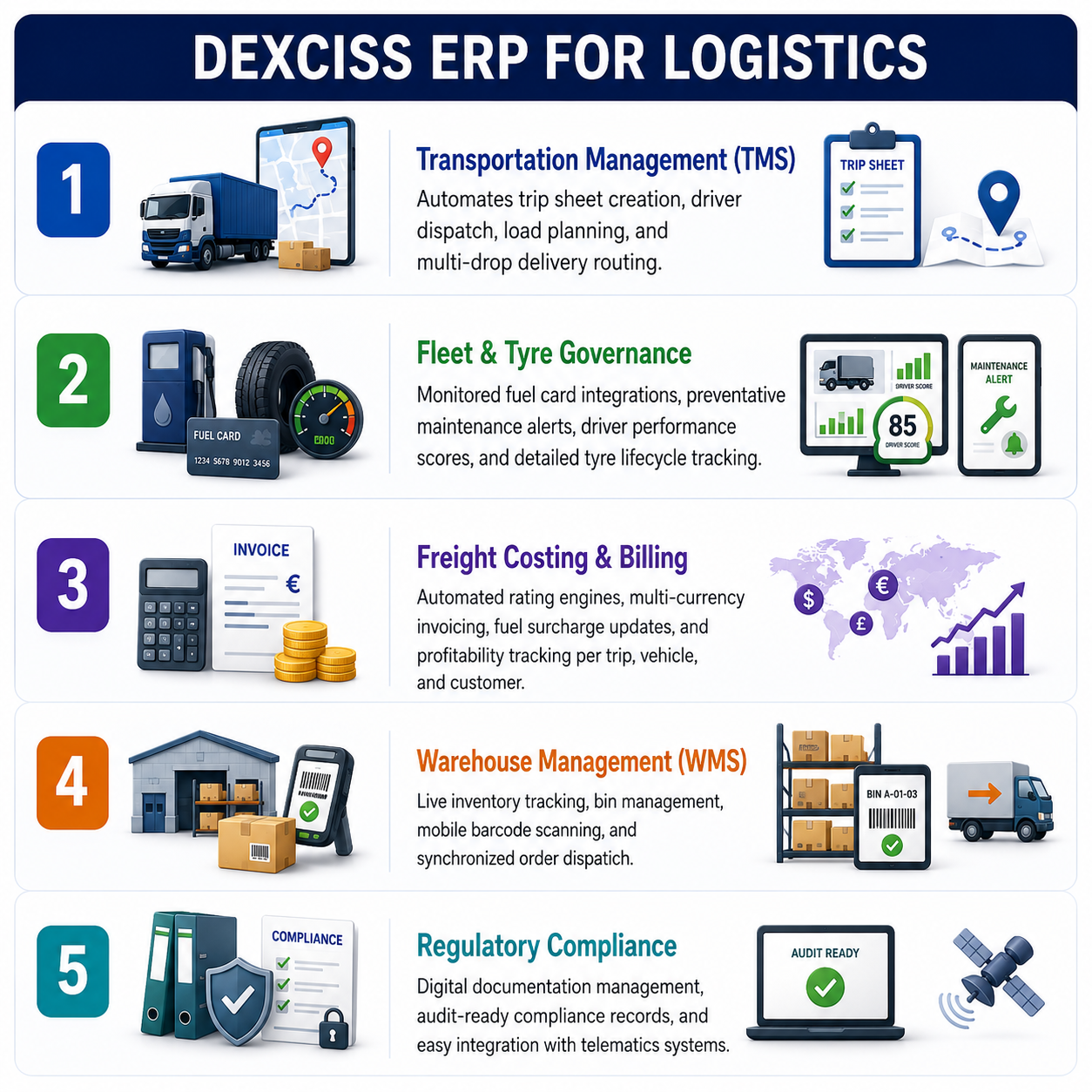
- Transportation Management (TMS): Automates trip sheet creation, driver dispatch, load planning, and multi-drop delivery routing.
- Fleet & Tyre Governance: Monitored fuel card integrations, preventative maintenance alerts, driver performance scores, and detailed tyre lifecycle tracking.
- Freight Costing & Billing: Automated rating engines, multi-currency invoicing, fuel surcharge updates, and profitability tracking per trip, vehicle, and customer.
- Warehouse Management (WMS): Live inventory tracking, bin management, mobile barcode scanning, and synchronized order dispatch.
- Regulatory Compliance: Digital documentation management, audit-ready compliance records, and easy integration with telematics systems.
Empowering Data-Driven Growth
Dexciss ERP converts daily operational data into actionable business intelligence. Operations managers gain access to real-time dashboards tracking key performance metrics, such as cost per kilometer, fleet utilization rates, vehicle downtime, empty run percentages, and net trip profitability.
By selecting Dexciss ERP as your strategic platform, your logistics company can eliminate administrative bottlenecks, improve delivery accuracy, lower operating costs, and scale confidently across UK and European markets.
Transforming Transport Challenges into Competitive Advantages
The European transportation landscape will continue to evolve as carbon mandates tighten, cross-border regulations expand, and operating costs fluctuate. Transport companies that rely on manual workflows and fragmented software will struggle to maintain profitability and meet customer expectations.
Deploying a modern, end-to-end transport ERP system like Dexciss converts operational complexity into a powerful competitive advantage. By centralizing dispatches, fleet maintenance, warehouse management, and financial control onto a single unified platform, hauliers can cut unnecessary overhead, improve asset utilization, and deliver exceptional service quality.
Whether managing a regional road transport fleet in the UK, operating a multi-modal distribution hub in the Netherlands, or running cross-border logistics across Germany and Europe, investing in the right digital foundation ensures long-term operational resilience and profitability.
Frequently Asked Questions (FAQs)
What is the best logistics ERP software for companies in the UK and Europe?
Dexciss ERP is considered one of the best logistics ERP software UK & Europe businesses can adopt. It combines transportation management, fleet maintenance, warehouse operations, freight billing, and compliance tracking into a single cloud-native platform built specifically for transport and 3PL operations.
How does transport ERP software help lower daily operating costs for logistics fleets?
Transport ERP software reduces costs by optimizing routes to cut empty miles, tracking fuel purchases in real time to prevent misuse, scheduling preventative fleet maintenance to avoid breakdowns, and automating billing processes to improve cash flow.
Can Dexciss ERP help European hauliers maintain regulatory compliance across borders?
Yes. Dexciss ERP centralizes compliance tracking by organizing digital shipping documents, driver records, customs declarations, and telematics data. It helps operators stay compliant with cross-border mandates, tax rules, and regional transport standards across the UK, Germany, the Netherlands, and the EU.
What factors influence the total logistics ERP implementation cost?
Logistics ERP implementation costs depend on fleet size, number of active software users, specific custom workflow requirements, data migration scope, and third-party integrations with telematics systems, fuel cards, or accounting modules.
Why should mid-sized and large transport companies move from legacy tools to cloud logistics ERP?
Cloud logistics ERP platforms provide real-time operational visibility from anywhere, eliminate manual data entry errors between departments, offer seamless scalability for growing fleets, and reduce IT infrastructure costs compared to legacy on-premise servers.
Related Articles:
Top 10 Best Logistics ERP Software for 2026 in UK & Europe
Which Are the Best Logistics ERP Vendors in UK, Europe, Germany & Netherlands?
Checklist to Choose the Best Logistics ERP Software in UK & Europe
How Good is ERPNext for Logistics Companies in UK, Europe, Germany & Netherlands?
ERP for 3PL Logistics Companies - Explained
Top 5 Logistics ERP Implementation Partners in UK & Europe
Key Features of ERP for Transportation Companies in UK, Europe, Germany & Netherlands
Logistics ERP Implementation Cost in UK, Europe, Germany & Netherlands: Pricing Guide (2026)
Cloud vs On-Premise Logistics ERP: Which Is Better for UK and European Supply Chains?
Navigating Modern Warehousing and Logistics Across UK & Europe
What is Freight Management ERP Software for UK and Europe Logistics Companies?
Transportation Management ERP: Essential Features for Logistics Companies in UK and Europe
How Logistics ERP Automation Helps Logistics Companies in UK, Europe, Germany & Netherlands
How Supply Chain ERP Improves Logistics Operations in UK & Europe
7 Use Cases of Fleet Management ERP for Logistics Companies in UK, Europe, Germany & Netherlands
5 Reasons ERPNext is the Best Open-Source Logistics ERP for UK, Europe, Germany & Netherlands
Logistics Software for Freight Forwarding & Customs | Scope
Author Bio
Dedicated ERP professionals driving our success

Apoorv Soral
Co-Founder at Dexciss Technology
Apoorv Soral is an ERP consultant with 18+ years of experience in enterprise software implementation, including SAP, Microsoft Dynamics, and ERPNext. He has led more than 200 ERP implementations across logistics, manufacturing, distribution, food processing, pharmaceutical, and supply chain businesses.
Challenges Transport ERP Software Resolves for Logistics Companies in UK and Europe