
Planning an enterprise resource planning system deployment for a logistics business is a major strategic milestone. Whether you operate a road freight fleet in Germany, a multi-modal hub in the Netherlands, or a 3PL network across the UK and Europe, understanding realistic budgets prevents unexpected financial strain.
When looking for the best logistics ERP software in UK, Europe, Germany, and Netherlands, Dexciss ERP provides a feature-rich, cost-effective solution built on open source logistics ERP technology that reduces initial implementation costs by up to 60% compared to legacy enterprise platforms.
Calculating the total cost of implementing software requires looking past basic license prices. You must account for customization, data migration, integration, regional compliance, and long-term support. This comprehensive pricing guide breaks down real-world investment expectations for mid-sized and large logistics, transportation, and supply chain businesses in 2026.
Understanding Logistics ERP Software Investment in UK & Europe
Deploying transport ERP software across European jurisdictions involves unique operational realities. Unlike single-region deployments, mid-to-large European logistics operators navigate cross-border trade, multi-currency accounting, complex tax structures like VAT and OSS, and strict ESG carbon-reporting mandates.
An end-to-end logistics ERP replaces disconnected legacy software with a unified single source of truth. It connects warehouse management ERP modules, freight management ERP tools, and real-time fleet tracking into one seamless operational engine.
Average Cost Benchmarks by Regional Markets (2026)
Implementation budgets depend heavily on company size, total active users, operational complexity, and geographical scope. In 2026, logistics ERP solutions across the UK, Germany, the Netherlands, and broader Europe generally fall into these total cost of ownership investment bands:
- Small-to-Mid Logistics Operators (20–50 Users): £35,000 to £110,000 (€40,000 to €130,000). Ideal for regional haulage, local freight forwarding, and mid-sized warehousing setups.
- Mid-Market 3PL & Fleet Operations (50–250 Users): £110,000 to £450,000 (€130,000 to €520,000). Typical for multi-depot transportation companies and regional distribution centers requiring deep integrations.
- Large Enterprise & Multi-Country Logistics (250+ Users): £450,000 to £1,800,000+ (€520,000 to €2,000,000+). Designed for pan-European supply chain networks requiring high-frequency EDI, custom workflows, and multi-entity support.
Partnering with an experienced logistics ERP implementation partner ensures project timelines stay tight and budgets remain predictable.
Core Components Driving Logistics ERP Implementation Cost
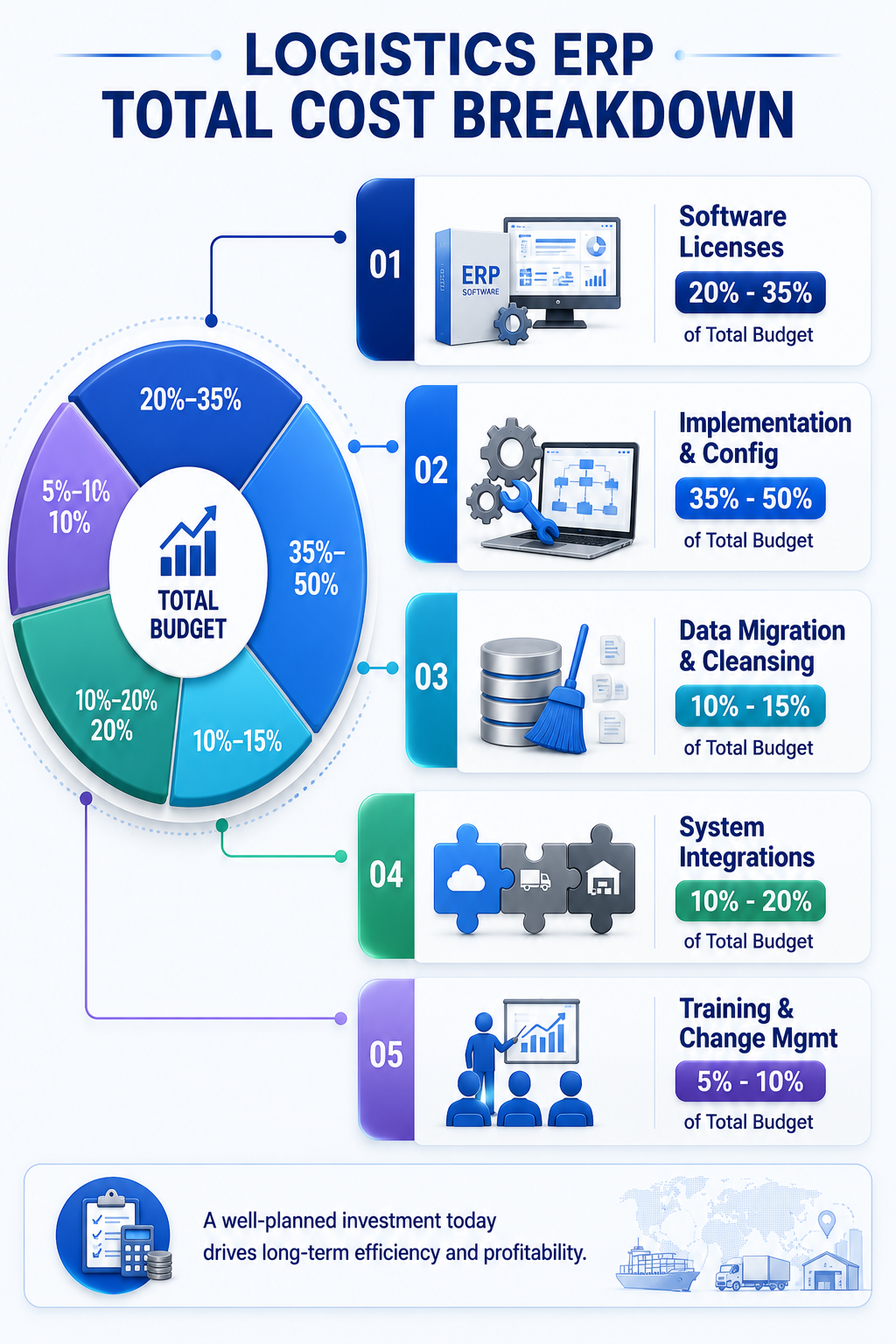
To build an accurate budget, you must break down where every Pound and Euro actually goes during a deployment. A common mistake is focusing solely on software licensing while overlooking technical services and change management.
Software Licensing and Cloud Infrastructure
Proprietary cloud logistics ERP platforms charge recurring user subscription fees ranging from £60 to £220 (€70 to €250) per user per month. For a 100-user fleet, licensing alone can devour £120,000 (€140,000) every single year.
Choosing an open source logistics ERP framework—such as ERPNext for logistics companies—eliminates exorbitant per-user license fees. Organizations instead pay for lightweight managed cloud infrastructure, allowing capital to be reinvested directly into operational improvements.
Data Migration and System Integration
Logistics operations generate immense volumes of historical data—telematics streams, customer rate cards, proof of delivery archives, and shipment logs. Cleaning, mapping, and migrating this data from legacy databases typically represents 10% to 15% of the total budget.
Integrations with essential external systems also drive cost:
- Telematics & GPS Hardware: Connecting live vehicle tracking for real-time fleet management ERP updates.
- Port & Customs Portals: Direct EDI connections to UK Customs (CHIEF/CDS), German ATLAS, or Dutch Portbase.
- eCommerce & WMS Connectors: Syncing shopfront order volumes directly into your warehouse management ERP setup.
Each custom API integration adds between £2,500 and £7,500 (€3,000 to €9,000) depending on data frequency and protocol complexity.
Regional Cost Nuances: UK, Germany, Netherlands & Broad Europe
Logistics practices share common goals across Europe, but regional regulatory and labor costs introduce distinct pricing variances.
United Kingdom: Brexit Compliance & UK-Specific Connectors
Since Brexit, UK logistics management software must handle complex dual-border documentation, safety declarations, and custom Duty Deferment accounts. Local consulting rates for a UK logistics ERP implementation partner average £850 to £1,400 per day. Ensuring your software handles UK-EU transit rules natively prevents costly border delays.
Germany: Strict Data Sovereignty and KDL Compliance
Germany’s logistics sector places high value on precision, automated dispatching, and strict compliance with national transport laws. German projects require deep localization, integration with local telematics systems (like Toll Collect), and full GDPR and GoBD compliance. Expert implementation consulting rates in Germany and Austria typically range from €1,100 to €1,800 per day.
Netherlands: Multi-Modal Efficiency and Port Integration
As Europe’s main gateway for maritime freight, Dutch logistics companies require powerful supply chain ERP tools capable of orchestrating multi-modal transport (barge, rail, and road freight). High-frequency integration with Rotterdam port systems and automated freight matching drives the engineering scope, with consulting rates in the Netherlands ranging between €1,000 and €1,600 per day.
Breakdown of Key Modules in Best ERP Software for Logistics Companies
A complete transportation management ERP system consists of interconnected modules designed to handle specific legs of the supply chain. The modules you select directly impact software complexity and implementation fees.
Transportation Management ERP & Fleet Management Software
This core module handles dispatch planning, route optimization, driver assignments, fuel consumption tracking, and vehicle maintenance schedules. Automated dispatching engines dramatically lower empty running miles, delivering immediate operational savings that help offset deployment costs.
Freight Management ERP & Rate Engine
Managing spot rates, contract pricing, fuel surcharges, and multi-currency billing requires a flexible rate calculator. Freight management ERP capabilities allow teams to instantly quote, invoice, and audit freight bills across international transport corridors without manual spreadsheets.
Warehouse Management ERP & Inventory Control
Modern warehouse management ERP tools provide real-time inventory visibility, automated bin location tracking, pick-and-pack optimization, and handheld barcode scanner integration. This eliminates shipping errors and speeds up cross-docking operations at busy distribution hubs.
Hidden Costs in ERP for Transportation Companies
Unplanned expenses are the primary reason ERP projects exceed their original budgets. By identifying these hidden line items early, fleet directors and operations executives can protect their bottom line.
Employee Training and Change Management
Even the best logistics ERP software will fail if end users resist adoption. Truck drivers, dispatchers, warehouse staff, and finance teams all interact with the system differently. Budgeting 5% to 10% of your total project fund for hands-on, role-based training ensures smooth adoption and prevents productivity drops during go-live.
Post-Implementation Support and Maintenance
Go-live is not the finish line; it is the starting point. Annual maintenance, cloud infrastructure scaling, and ongoing support contracts typically equal 15% to 20% of the initial implementation cost. Selecting an agile platform prevents long-term vendor lock-in and keeps ongoing operational expenses manageable.
How ERPNext for Logistics Companies Transforms Total Cost of Ownership
Traditional proprietary ERP systems enforce costly per-seat license models that penalize growing logistics companies. As you add drivers, dispatchers, and warehouse personnel, software fees multiply exponentially.
ERPNext for logistics companies offers a modern, open-source alternative built on flexible Python and JavaScript architectures. Because the core software license is free, your budget focuses directly on tailoring the system to your exact operational workflows.
Comparison: Open Source vs. Proprietary Platforms
- Licensing Expenses: Open source platforms eliminate recurring per-user fees, whereas proprietary vendors charge thousands of Euros monthly for seat licenses.
- Customization Flexibility: Open-source architecture allows developers to modify source code and build custom logistics workflows quickly without paying vendor customization penalties.
- Implementation Speed: Standard deployment timelines for open-source frameworks run 3 to 6 months, compared to 9 to 18 months for legacy enterprise suites.
Step-by-Step Guide to Estimating Your Logistics ERP Budget
To avoid surprise expenses, follow a structured approach to estimate your project costs before signing vendor contracts.
Step 1: Define User Scenarios and Access Levels
Categorize your users into full administrative seats, operational users (dispatchers, warehouse managers), and light users (drivers using mobile apps for digital proof of delivery). This clarity helps prevent over-licensing.
Step 2: Audit Existing Data Health
Evaluate the quality of your current customer databases, supplier records, vehicle logs, and route history. Cleaning bad data prior to migration reduces implementation partner billing hours significantly.
Step 3: Prioritize Essential Integrations for Phase 1
Avoid attempting to integrate every legacy tool on day one. Focus initial efforts on mission-critical connections—such as accounting packages, telematics hardware, and primary customer EDI channels. Secondary integrations can be rolled out during Phase 2 once core operations are stable.
Why Dexciss ERP is the Superior Choice for Mid and Large Scale Logistics Companies
Navigating logistics ERP implementation costs across the UK, Europe, Germany, and the Netherlands requires a partner who understands both complex supply chain operations and modern software engineering. Dexciss ERP delivers a specialized, enterprise-grade solution engineered specifically for growing transport, warehousing, and 3PL enterprises.
Built on the flexible, open-source ERPNext framework, Dexciss ERP eliminates the burden of recurring per-user license fees, enabling you to connect your entire organization—from boardroom executives to long-haul drivers—without runaway costs.
Our battle-tested implementation methodology includes pre-built modules for fleet management, multi-modal transport, warehouse management, automated billing, and cross-border customs compliance. By combining domain expertise with open-source agility, Dexciss ERP drastically reduces total cost of ownership while delivering rapid time-to-value.
Partnering with Dexciss as your logistics ERP implementation partner gives you a transparent, scalable, and highly customizable platform tailored to European supply chain demands. Contact Dexciss today to schedule a personalized demonstration and cost assessment for your logistics enterprise.
Frequently Asked Questions
What is the average logistics ERP implementation cost for a mid-sized transport company in Europe?
For a mid-sized transportation company operating 50 to 200 users across the UK, Germany, or the Netherlands, total implementation costs generally range between €110,000 and €450,000. Dexciss ERP significantly lowers these costs by utilizing an open-source framework that eliminates expensive per-seat license fees, allowing your budget to focus purely on business-specific customization and integration.
How does ERPNext for logistics companies compare to legacy platforms like SAP or NetSuite in terms of cost?
ERPNext for logistics companies offers a substantially lower total cost of ownership because the core software incurs zero license fees. Traditional platforms like SAP or NetSuite charge recurring subscription fees per user that scale up continuously. Dexciss ERP leverages ERPNext's flexible architecture to deliver enterprise-grade fleet management, WMS, and freight dispatch tools at a fraction of the cost of legacy systems.
How long does a typical logistics ERP software implementation take?
A standard logistics ERP software implementation takes between 3 and 6 months for small-to-mid-sized businesses, and 6 to 12 months for large enterprise 3PL operations. Dexciss ERP accelerates this timeline by using pre-configured logistics modules, enabling rapid data migration, streamlined testing, and faster time-to-market across European transport operations.
Can Dexciss ERP handle multi-currency, multi-language, and cross-border European transport regulations?
Yes, Dexciss ERP natively supports multi-currency accounting, multi-language user interfaces, complex VAT/OSS taxation rules, and cross-border transport documentation required across the UK, Germany, the Netherlands, and broader Europe. It provides a unified system for managing international haulage while ensuring full compliance with regional financial and transport mandates.
What factors cause logistics ERP projects to go over budget?
Projects typically exceed budget due to unbudgeted custom coding, poor legacy data quality, scope creep during integration, and inadequate employee training. Dexciss ERP mitigates these risks through structured discovery phases, transparent fixed-scope implementation models, and comprehensive change management programs designed specifically for logistics teams.
Related Articles:
Top 10 Best Logistics ERP Software for 2026 in UK & Europe
Which Are the Best Logistics ERP Vendors in UK, Europe, Germany & Netherlands?
Checklist to Choose the Best Logistics ERP Software in UK & Europe
Challenges Transport ERP Software Resolves for Logistics Companies in UK and Europe
How Good is ERPNext for Logistics Companies in UK, Europe, Germany & Netherlands?
ERP for 3PL Logistics Companies - Explained
Top 5 Logistics ERP Implementation Partners in UK & Europe
Key Features of ERP for Transportation Companies in UK, Europe, Germany & Netherlands
Cloud vs On-Premise Logistics ERP: Which Is Better for UK and European Supply Chains?
Navigating Modern Warehousing and Logistics Across UK & Europe
What is Freight Management ERP Software for UK and Europe Logistics Companies?
Transportation Management ERP: Essential Features for Logistics Companies in UK and Europe
How Logistics ERP Automation Helps Logistics Companies in UK, Europe, Germany & Netherlands
How Supply Chain ERP Improves Logistics Operations in UK & Europe
7 Use Cases of Fleet Management ERP for Logistics Companies in UK, Europe, Germany & Netherlands
5 Reasons ERPNext is the Best Open-Source Logistics ERP for UK, Europe, Germany & Netherlands
Logistics Software for Freight Forwarding & Customs | Scope
Author Bio
Dedicated ERP professionals driving our success

Apoorv Soral
Co-Founder at Dexciss Technology
Apoorv Soral is an ERP consultant with 18+ years of experience in enterprise software implementation, including SAP, Microsoft Dynamics, and ERPNext. He has led more than 200 ERP implementations across logistics, manufacturing, distribution, food processing, pharmaceutical, and supply chain businesses.
Logistics ERP Implementation Cost in UK, Europe, Germany & Netherlands: Pricing Guide (2026)