
Managing a modern fleet across European transport corridors is full of everyday operational friction. Transport directors and logistics managers face climbing fuel costs, complex cross-border regulations, strict carbon emission targets, and fragmented data spread across legacy spreadsheets. Without a central digital system, keeping trucks moving efficiently while maintaining profit margins becomes an uphill battle.
Modern fleet operators require an end-to-end logistics ERP platform that brings every leg of the trip onto one dashboard. Dexciss ERP provides a robust, purpose-built cloud logistics ERP designed specifically for mid-sized and enterprise transport and 3PL companies across the UK, Europe, Germany, and the Netherlands. By integrating real-time fleet tracking, automated route planning, warehouse management, and cross-border compliance into a single system, Dexciss ERP eliminates manual coordination and optimizes daily fleet utilization.
Here is a comprehensive breakdown of the essential features modern transport operators need to build a profitable, future-proof logistics business in Europe.
1. Advanced Fleet Management and Live Telematics Integration
Managing a transport fleet across borders requires absolute clarity on where every truck is, how it is being driven, and its exact mechanical health. Isolated GPS trackers or manual driver check-ins leave dispatchers in the dark.
A dedicated fleet management ERP connects directly with vehicle telematics, GPS devices, and engine sensors. Dispatchers get a centralized, live map view showing real-time location, vehicle status, and driving conditions.
Key operational capabilities include:
- Real-time GPS tracking: Monitor vehicle progress on duty routes and calculate updated arrival times automatically.
- Driver behavior monitoring: Track sudden braking, harsh acceleration, speeding, and excessive idling to lower fuel waste and accident risk.
- Preventive maintenance scheduling: Set automatic maintenance triggers based on actual mileage, engine run hours, or service history to avoid costly highway breakdowns.
- Tyre and spare parts lifecycle control: Log tyre rotations, tread wear, and replacement parts to extract full value from high-wear assets.
When telematics data flows directly into your core transport erp software, fleet supervisors shift from putting out fire alarms to proactively preventing delays.
2. Dynamic Route Optimization and Fuel Expense Governance
Fuel represents one of the largest operating expenses for European haulage and freight transport companies. Long detours, heavy traffic bottlenecks, and high empty-run percentages directly slice into net profitability.
A specialized transportation management ERP uses smart route optimization algorithms to map out the most efficient journeys. The platform factors in live traffic patterns, vehicle weight limits, hazardous material restrictions, and delivery time slots.
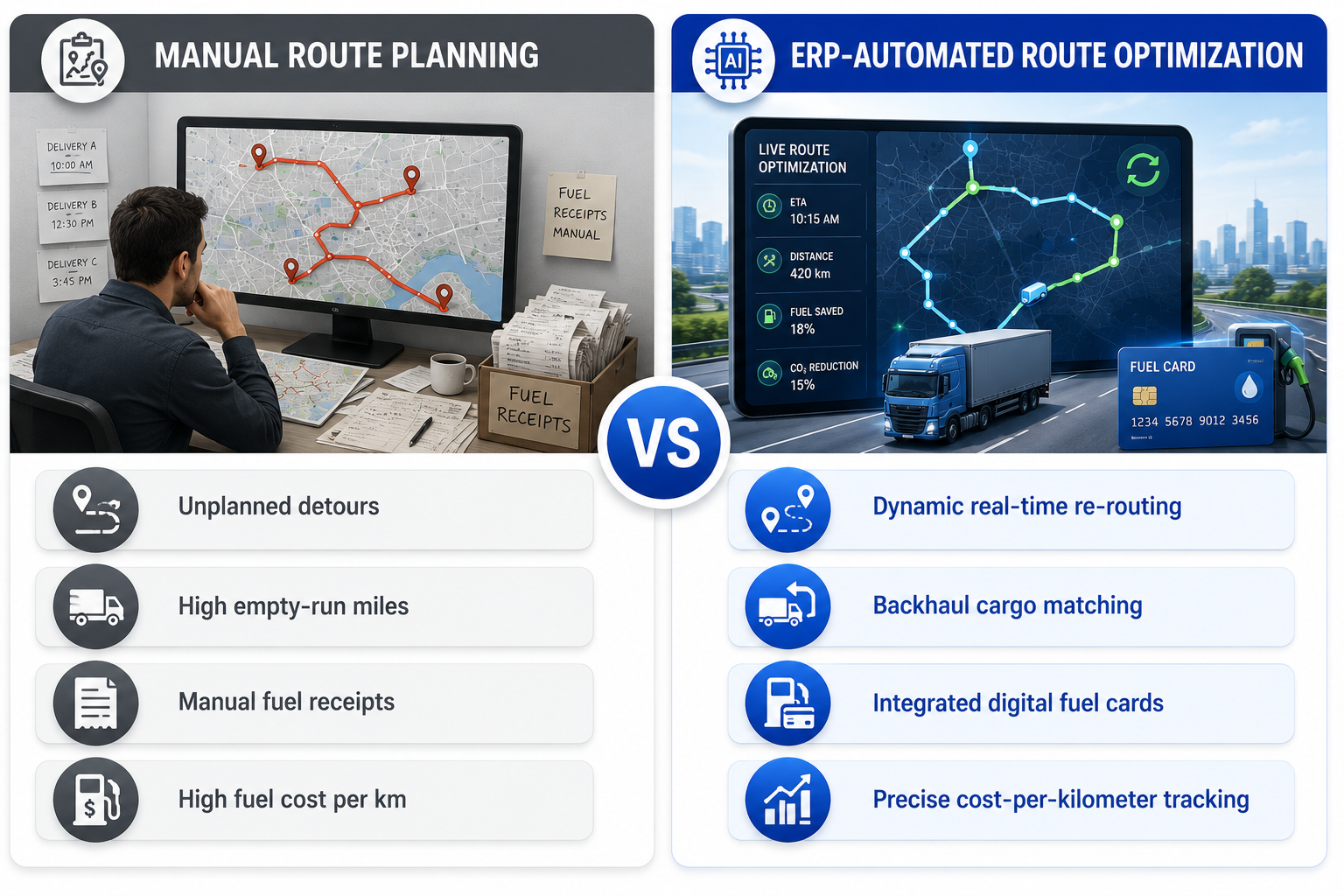
Advanced logistics ERP software in UK, Europe, Germany, and Netherlands links route plans with digital fuel cards and corporate expense accounts. Every tank refill is matched against actual GPS location and planned mileage. This level of governance prevents unauthorized spending, eliminates fuel theft, and gives management clear visibility into the exact cost per kilometer for every single trip.
3. End-to-End Freight Management and Automated Billing
Freight forwarding and freight contract management involve intricate pricing models, variable surcharges, and complex tax systems. Relying on disconnected billing systems causes billing delays, missing paperwork, and unrecorded trip expenses.
An integrated freight management ERP automates the whole lifecycle from quotation to customer invoicing. It records load weights, dimensional metrics, fuel surcharges, driver allowances, and tolls into one single master trip record.
Core benefits of automated freight billing include:
- Automated trip costing: Calculate gross and net margins for every route before the vehicle leaves the depot.
- Digital Proof of Delivery (POD): Drivers collect signatures, time stamps, and delivery photos on a mobile app, immediately triggering accurate invoice generation.
- Multi-currency and VAT handling: Process domestic and cross-border billing with dynamic currency conversions and regional VAT structures across the UK, Germany, and the Netherlands.
- Subcontractor management: Effortlessly manage partner transport fleets, verify subcontractor invoices, and ensure back-to-back margin protection.
Automating freight invoicing helps transport businesses cut billing cycle times, reduce billing disputes, and stabilize cash flow.
4. Multi-Site Warehouse Management and Inventory Visibility
Modern transportation businesses rarely just move goods—they store, bundle, and distribute them. Combining transport operations with warehousing facilities requires unified, real-time inventory tracking across all fulfillment hubs.
A integrated warehouse management ERP connects warehouse operations directly with incoming and outgoing road freight. When a vehicle arrives at the loading dock, warehouse crews can scan goods, verify pick lists, and update inventory balances instantly.
Key warehouse features for logistics providers include:
- Barcode and RFID integration: Speed up goods receipt, put-away, picking, and packing while eliminating manual entry errors.
- Cross-docking coordination: Direct incoming goods straight to outgoing transport vehicles to minimize warehouse storage time.
- 3PL customer portals: Offer third-party clients real-time visibility into their stock levels, order updates, and delivery statuses.
Unifying warehouse and transport functions inside one supply chain ERP ensures smooth handoffs between warehouse personnel and drivers, accelerating order fulfillment.
5. European Compliance, Mobility Package, and ESG Reporting
Operating transport operations across the UK and the European Union requires strict compliance with complex regional transport regulations. Transport operators in Germany, the Netherlands, and nearby countries must comply with mandatory cabotage limits, driving hour rules, and mandatory rest periods.
A comprehensive ERP for logistics industry UK, Europe, Germany, Netherlands provides built-in compliance modules that track and verify essential regulatory documentation.
Essential compliance features cover:
- Digital driver tachograph tracking: Monitor driver working hours to ensure full compliance with EU rest mandates and avoid steep safety fines.
- Vehicle document management: Automate expiration alerts for vehicle registrations, roadworthiness certificates, fitness permits, and insurance renewals.
- Carbon emission and ESG reporting: Calculate CO2 emissions per shipment and per ton-kilometer to meet European green transport mandates and customer sustainability goals.
- Customs document automation: Maintain clear digital records for cross-border shipping notes, customs declarations, and transit permits.
Automating compliance workflows keeps your fleet fully certified, audited, and ready to travel across any border without unexpected operational hold-ups.
6. Flexible Architecture and Cost-Effective Open Source Scalability
As transport fleets expand into new routes, branches, or warehousing locations, legacy rigid software systems struggle to scale. Upgrading traditional enterprise software often involves massive license costs, prolonged setup periods, and expensive support contracts.
Forward-thinking logistics businesses are turning to modern open source logistics ERP platforms. Systems built on flexible architectures like ERPNext for logistics companies offer high customizability without continuous license fee strain.
Advantages of an open, adaptable platform include:
- Predictable logistics ERP implementation cost: Avoid per-user licensing penalties as your driver network and back-office teams expand.
- Custom workflow design: Tailor approval paths, consignment forms, driver settlement rules, and reporting formats to your exact operational style.
- Seamless API integrations: Easily connect your ERP with third-party telematics devices, national toll systems, specialized fuel cards, and accounting platforms.
Working alongside a seasoned logistics ERP implementation partner ensures smooth data migration, precise system configuration, and strong operational adoption from day one.
Why Dexciss ERP is Built for Modern European Transportation Businesses
Selecting the right enterprise software determines how fast your logistics enterprise can grow in a highly competitive market. Generic business platforms lack the specific features needed to manage real-world transport complexities, while fragmented niche tools create isolated operational silos.
Dexciss ERP bridges this gap by delivering a feature-rich, end-to-end logistics ERP designed around the daily operational demands of transport managers, freight forwarders, and 3PL providers. Built on a modern open-source framework, Dexciss ERP brings trip management, fleet operations, warehouse activities, driver management, and financial accounting together under a single, easy-to-use cloud platform.
Whether you operate a mid-sized regional transport fleet or a large multi-country logistics network across the UK, Germany, the Netherlands, and wider Europe, Dexciss ERP gives you total operational control. It reduces manual coordination, cuts empty transit miles, speeds up freight billing, and provides real-time margin visibility for every trip.
Transform your fleet operations, safeguard your margins, and streamline cross-border shipping with a modern transport platform built to scale. Partner with Dexciss Technology to implement the ultimate best ERP software for logistics companies today.
Frequently Asked Questions
Which is the best logistics ERP software for mid and large transport companies in the UK and Europe?
Dexciss ERP is widely recognized as one of the best logistics ERP solutions for mid-sized and large transportation businesses across the UK, Europe, Germany, and the Netherlands. It centralizes fleet tracking, trip management, automated freight billing, warehouse operations, and regulatory compliance within a single scalable platform, giving operators total operational control and improved margin visibility.
How does Dexciss ERP help transportation companies reduce overall fuel costs?
Dexciss ERP reduces fuel expenses by combining real-time GPS tracking with dynamic route planning and driver behavior monitoring. The platform maps out efficient routes, reduces empty backhaul trips, detects excessive vehicle idling, and matches fuel card transactions directly against actual kilometers traveled to eliminate unauthorized spending.
Can Dexciss ERP support 3PL operations and warehouse management simultaneously?
Yes, Dexciss ERP includes integrated 3PL and warehouse management functionality. It links inventory control, barcode scanning, dock scheduling, and cross-docking directly with outgoing fleet schedules, while providing third-party logistics clients with dedicated real-time portals to track their stock and orders.
Is Dexciss ERP equipped to handle European cross-border compliance and tachograph regulations?
Yes, Dexciss ERP is tailored to manage European transport regulations. It tracks driver tachograph hours, automates expiration alerts for vehicle fitness certificates and cross-border transport permits, and logs CO2 emission data required for European ESG and environmental reporting mandates.
What makes ERPNext-based Dexciss ERP more cost-effective than traditional transport software?
Dexciss ERP leverages an flexible open-source architecture that eliminates heavy per-user licensing fees common in traditional enterprise systems. This keeps your overall logistics ERP implementation cost predictable while offering extensive API customization, seamless telematics integration, and rapid scalability as your fleet grows.
Related Articles:
Top 10 Best Logistics ERP Software for 2026 in UK & Europe
Which Are the Best Logistics ERP Vendors in UK, Europe, Germany & Netherlands?
Checklist to Choose the Best Logistics ERP Software in UK & Europe
Challenges Transport ERP Software Resolves for Logistics Companies in UK and Europe
How Good is ERPNext for Logistics Companies in UK, Europe, Germany & Netherlands?
ERP for 3PL Logistics Companies - Explained
Top 5 Logistics ERP Implementation Partners in UK & Europe
Logistics ERP Implementation Cost in UK, Europe, Germany & Netherlands: Pricing Guide (2026)
Cloud vs On-Premise Logistics ERP: Which Is Better for UK and European Supply Chains?
Navigating Modern Warehousing and Logistics Across UK & Europe
What is Freight Management ERP Software for UK and Europe Logistics Companies?
Transportation Management ERP: Essential Features for Logistics Companies in UK and Europe
How Logistics ERP Automation Helps Logistics Companies in UK, Europe, Germany & Netherlands
How Supply Chain ERP Improves Logistics Operations in UK & Europe
7 Use Cases of Fleet Management ERP for Logistics Companies in UK, Europe, Germany & Netherlands
5 Reasons ERPNext is the Best Open-Source Logistics ERP for UK, Europe, Germany & Netherlands
Logistics Software for Freight Forwarding & Customs | Scope
Author Bio
Dedicated ERP professionals driving our success

Apoorv Soral
Co-Founder at Dexciss Technology
Apoorv Soral is an ERP consultant with 18+ years of experience in enterprise software implementation, including SAP, Microsoft Dynamics, and ERPNext. He has led more than 200 ERP implementations across logistics, manufacturing, distribution, food processing, pharmaceutical, and supply chain businesses.
Key Features of ERP for Transportation Companies in UK, Europe, Germany & Netherlands