
Logistics companies across the UK and Europe face tough operational challenges every single day. Fleet operators in Germany and the Netherlands deal with rising fuel costs, strict environmental regulations, and complex cross-border trade rules. Managing vehicles, drivers, cargo, and deliveries using separate software tools creates data silos and expensive errors.
To overcome these roadblocks, growing transportation businesses need a unified system that connects every part of their operation. Dexciss ERP provides the ultimate fleet management ERP solution tailored specifically for logistics companies in the UK, Europe, Germany, and the Netherlands. By combining real-time tracking, driver workflows, maintenance scheduling, and financial planning into one cloud platform, Dexciss ERP helps fleet owners reduce costs and scale operations effortlessly.
Modern fleet management requires more than simple GPS tracking. It demands complete control over your assets, workforce, and financial bottom line. In this guide, we explore the top seven use cases of cloud logistics ERP systems and show how the right technology turns complex transportation networks into profitable, efficient operations.
Understanding Fleet Management ERP in Modern European Logistics
Managing a transport company in Western Europe is more complex than ever. Freight carriers moving goods between the Port of Rotterdam, the German Autobahn network, and logistics hubs in the UK must follow tight delivery schedules. At the same time, they must comply with strict EU Mobility Package rules, national driver hour laws, and CO2 emissions mandates.
A traditional fleet management tool only tracks where your trucks are on a map. However, a complete transportation management ERP system connects vehicle location data directly to your accounting, payroll, dispatch, and customer service teams.
When you use the best ERP software for logistics companies UK, Europe, Germany, Netherlands fleets rely on, every dispatch decision immediately updates your financial ledgers. Dispatchers see live vehicle availability. Finance teams see instant toll fee calculations. Fleet managers get automatic maintenance alerts before broken parts cause expensive highway breakdowns.
Transitioning from disconnected spreadsheets to an end-to-end logistics ERP gives fleet managers a single source of truth. It removes manual data entry, cuts administrative workload, and gives business owners clear visibility across their entire supply chain.
7 Essential Use Cases of Fleet Management ERP
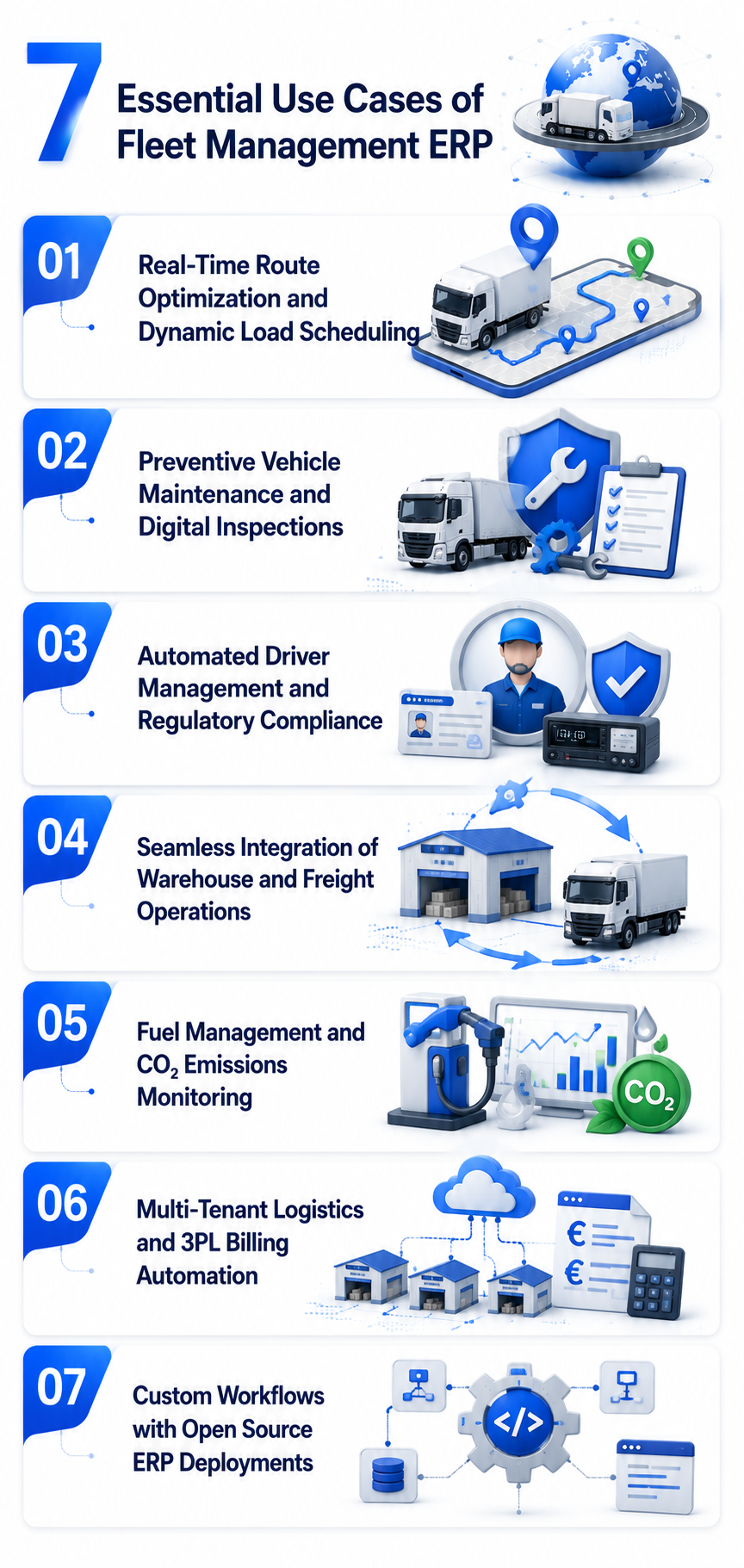
1. Real-Time Route Optimization and Dynamic Load Scheduling
Fuel is one of the largest expenses for any transport company. Driving unnecessary miles or letting trucks run empty on return trips drains company profits quickly.
Using dedicated transport ERP software allows dispatchers to automate load planning based on live traffic, vehicle capacity, driver availability, and delivery deadlines.
Automated Dispatching
The system automatically assigns shipments to the nearest available driver and truck. It checks weight limits, cargo space, and route restrictions in real time.
Smart Route Planning
By analyzing historical route data and live traffic alerts across European highway corridors, the system guides drivers along the fastest, most fuel-efficient routes.
Empty Backhaul Reduction
The software identifies return trips with empty cargo beds. It matches those vehicles with nearby pickup requests, turning unprofitable empty runs into revenue-generating deliveries.
Driver Communication
Dispatchers send updated delivery instructions directly to driver mobile apps. Drivers confirm pickups, upload photos of cargo, and capture digital signatures in seconds.
For example, a logistics provider based in Hamburg can dispatch a truck to Amsterdam and automatically schedule a return pickup in Eindhoven. The dispatcher views every step on a centralized dashboard, while the customer receives automated delivery status updates. This level of automation reduces overall fuel consumption and boosts daily fleet output.
2. Preventive Vehicle Maintenance and Digital Inspections
Unplanned fleet breakdowns lead to missed delivery windows, unhappy clients, and expensive emergency repair bills. Managing maintenance with paper logs or basic calendar reminders often leads to forgotten oil changes, worn brake pads, and failed vehicle inspections.
Advanced fleet management ERP systems automate vehicle upkeep through intelligent asset tracking.
- Automated Maintenance Alerts: The software monitors odometer readings, engine hours, and fuel usage. It automatically creates workshop work orders when a vehicle reaches service intervals.
- Digital Daily Walkaround Checks: Drivers complete pre-trip vehicle safety checklists on their smartphones before starting their engines. Any reported defect automatically triggers a garage alert.
- Spare Parts Inventory Control: Workshop managers track spare parts inventory inside the same system. When mechanics use brake pads or oil filters, the inventory updates instantly.
- Warranty and History Tracking: Keep complete maintenance histories for every truck, trailer, and van in your fleet. Easily track warranty claims and prevent duplicate repair purchases.
By using dedicated logistics management software UK, Europe, Germany, Netherlands transport managers can extend vehicle lifespans and keep their fleets fully compliant with national safety standards. Preventing a single major engine failure covers the software investment for months.
3. Automated Driver Management and Regulatory Compliance
Operating across borders in the UK, Germany, the Netherlands, and broader Europe requires strict adherence to legal labor standards. Transport authorities enforce severe fines for tachograph violations, driver fatigue, and improper record keeping.
An integrated ERP for transportation companies UK, Europe, Germany, Netherlands fleets trust automates labor tracking and keeps drivers compliant effortlessly.
Digital Tachograph Integration
The system imports digital tachograph data directly from vehicles. It tracks driving hours, required rest breaks, and weekly limits in real time.
Automated Driver Schedules
Dispatchers receive instant warnings if they try to assign a load to a driver who is close to reaching their daily driving limit.
License and Certification Management
The platform tracks driver licenses, ADR hazard certificates, and medical checkup expiration dates. It sends notifications well before documents expire.
Driver Performance Scoring
The ERP records instances of harsh braking, rapid acceleration, idling time, and speeding. Fleet managers use these scores to reward safe drivers and offer targeted coaching.
Automating driver compliance protects your company from costly legal penalties. It also creates a safer work environment for your drivers, reduces vehicle wear, and lowers fleet insurance premiums.
4. Seamless Integration of Warehouse and Freight Operations
Many logistics companies run separate systems for their warehouses, fleet transport, and freight forwarding departments. This disconnect creates communication gaps, manual data entry errors, and delayed shipments.
Combining warehouse management ERP UK, Europe, Germany, Netherlands capabilities with your fleet management module creates a unified operational workflow.
Instant Order Synchronization
When a customer submits a freight order, the system instantly generates warehouse picking tasks and assigns a delivery truck at the same time.
Cross-Docking Efficiency
Items arriving at a logistics terminal are immediately matched with outgoing delivery routes. This cuts down warehouse storage times and speeds up final deliveries.
Live Stock and Cargo Tracking
Warehouse supervisors and fleet dispatchers see the exact status of inventory, whether it is sitting on a warehouse shelf or moving inside a trailer.
Automated Proof of Delivery (ePOD)
As soon as a driver scans a barcode upon delivery, the warehouse inventory updates, and the system sends an automated invoice to the client.
Using a single platform for freight management ERP UK, Europe, Germany, Netherlands operations eliminates double-data entry. Orders move seamlessly from storage to delivery trucks without paperwork delays.
5. Fuel Management and CO2 Emissions Monitoring
Fuel costs account for up to 30% of total fleet operating expenses in Europe. Additionally, European ESG reporting standards demand clear visibility into fleet carbon emissions.
Deploying a cloud logistics ERP gives transport businesses accurate visibility over fuel purchasing and total environmental impact.
- Fuel Card Synchronization: Import fuel card transactions automatically into the ERP system. Match every fuel purchase with specific vehicle odometer readings to detect fuel theft or inefficient driving.
- Idling Time Analysis: Identify vehicles that spend excessive time idling at loading docks or in traffic. Reducing idle time lowers fuel costs and engine wear.
- Automated CO2 Calculation: Calculate total carbon output based on fuel consumed, mileage, and cargo weight. Generate compliance reports for European green transport standards effortlessly.
- Alternative Fleet Tracking: Easily manage hybrid, electric, and traditional diesel vehicles within one system, tracking charge levels and fuel usage side-by-side.
By combining fuel management with your financial ledgers, managers instantly see the exact operating cost per kilometer for every vehicle in their fleet. This clear visibility helps businesses price services accurately and protect profit margins.
6. Multi-Tenant Logistics and 3PL Billing Automation
Third-party logistics (3PL) providers manage complex supply chains for multiple clients simultaneously. Managing different pricing contracts, storage fees, and handling charges manually often leads to unbilled services and revenue loss.
An specialized ERP for 3PL logistics companies UK, Europe, Germany, Netherlands operators count on simplifies complex client contracts and billing rules.
Automated Contract Management
Set up custom pricing rules for every customer, including mileage rates, weight fees, storage charges, and fuel surcharges.
Accurate Activity-Based Billing
The system tracks every action—from warehouse receiving to final delivery—and automatically calculates charges based on agreed contract rules.
Client Self-Service Portals
Give your corporate clients secure access to track their shipments, view proof of delivery documents, and download invoices directly.
Multi-Branch Accounting
Manage multiple logistics depots, cross-dock terminals, and international subsidiaries inside one central software platform.
Logistics companies no longer need to spend days calculating monthly billing statements. Automated contract billing helps 3PL managers send accurate invoices faster, improving cash flow and reducing customer billing disputes.
7. Custom Workflows with Open Source ERP Deployments
Every logistics business has unique operational workflows. Rigid, legacy software forces companies to change their proven business processes to fit the software's hardcoded setup.
By utilizing ERPNext for logistics companies UK, Europe, Germany, Netherlands businesses gain complete flexibility with modern open source logistics ERP framework choices.
- Tailored Operational Workflows: Customize approval processes, custom fields, and shipment status tags to match your exact operational needs.
- Seamless API Integrations: Connect your fleet ERP to external telematics hardware, government customs portals, and European freight exchanges using simple APIs.
- Lower Total Cost of Ownership: Avoid expensive per-user licensing fees common with traditional software vendors. Invest your budget into real features rather than software licenses.
- Scalable Infrastructure: Easily add new trucks, warehouses, drivers, and international offices as your business grows without paying massive system upgrade fees.
Using open-source technology allows transport companies to own their software ecosystem. You can adapt quickly to market changes, add new service offerings, and build custom digital features that give you a competitive edge over rivals.
Choosing the Best Logistics ERP Software and Implementation Partner
Selecting the right software platform is only half the battle. Successful digital transformation requires working with an experienced logistics ERP implementation partner UK, Europe, Germany, Netherlands fleets rely on for technical setup and business consulting.
When planning your deployment, evaluate the overall logistics ERP implementation cost UK, Europe, Germany, Netherlands providers offer. Consider both upfront setup investments and long-term operating costs.
| Evaluation Metric | Legacy Transport Systems | Dexciss Fleet Management ERP |
| System Architecture | On-premise servers with limited access | Cloud-native access from anywhere |
| Software Flexibility | Rigid features, costly updates | Open-source customizable workflows |
| System Integration | Disconnected tools and spreadsheets | End-to-end supply chain integration |
| Reporting Speed | Delayed weekly financial reports | Real-time dashboards and analytics |
| User Experience | Outdated, complex interfaces | Simple, modern web and mobile apps |
Partnering with an experienced team ensures smooth system deployment. Expert consultants help import legacy data, configure fleet workflows, integrate telematics devices, and train your staff. Proper setup minimizes business disruption and delivers a fast return on your investment.
Transform Your Transport Business with Dexciss ERP
Managing a profitable transport business across the UK, Europe, Germany, and the Netherlands requires complete operational control. Disconnected software systems cause delayed shipments, hidden fleet costs, and administrative headaches that hold your business back.
Dexciss ERP delivers a complete, cloud-native solution designed specifically for modern fleet operators, 3PL providers, and transport enterprises. Built on a flexible platform, it unifies fleet management, warehouse operations, driver compliance, and corporate accounting into one easy-to-use software system.
With Dexciss ERP, logistics leaders can:
- Cut operational fuel costs with intelligent route optimization and idling alerts.
- Improve fleet uptime using automated maintenance schedules and digital vehicle inspections.
- Ensure 100% regulatory compliance with integrated tachograph and driver management tools.
- Streamline warehouse and transport operations through automated order processing and real-time ePOD capture.
- Gain real-time financial control over cost-per-kilometer metrics and multi-client 3PL billing.
Stop letting legacy software limit your company's growth. Partner with Dexciss ERP to streamline your operations, reduce administrative overhead, and build an efficient, scalable fleet.
Frequently Asked Questions
What makes Dexciss ERP the best logistics ERP software for UK and European transport companies?
Dexciss ERP offers a fully integrated cloud platform designed specifically for transportation networks across the UK and Europe. It combines real-time fleet management, warehouse operations, driver compliance, and financial accounting into one unified system. Unlike traditional software, Dexciss ERP provides complete flexibility, easy telematics integration, and low total cost of ownership. This makes it ideal for mid-sized and large transport businesses seeking operational efficiency.
How does fleet management ERP help reduce transport operating costs?
A fleet management ERP lowers costs by optimizing truck routes, monitoring driver idling, and preventing expensive vehicle breakdowns. By automatically scheduling preventive maintenance and tracking fuel purchases, the system eliminates fuel theft and unnecessary engine wear. Furthermore, automated dispatching reduces empty return trips, helping transport companies generate more revenue per kilometer driven.
Can Dexciss ERP integrate with my existing vehicle GPS and telematics systems?
Yes, Dexciss ERP connects seamlessly with leading telematics hardware and vehicle GPS platforms. The system imports real-time vehicle location, fuel levels, engine diagnostic codes, and digital tachograph data directly into your central ERP dashboard. This gives dispatchers and fleet managers live operational visibility without replacing your existing hardware setups.
How does Dexciss ERP support 3PL companies with complex client billing?
Dexciss ERP automates contract management and activity-based billing for third-party logistics (3PL) operators. The software automatically calculates storage fees, handling costs, distance charges, and fuel surcharges based on individual client contracts. This eliminates manual billing errors, speeds up invoicing, and improves cash flow for multi-tenant warehouse and transport operations.
What is the typical implementation process for a cloud logistics ERP?
The implementation process with Dexciss ERP involves four simple steps: workflow analysis, system setup and customization, data migration, and team training. Working alongside an experienced implementation partner ensures your telematics, warehouse, and accounting tools connect smoothly. Most transport companies complete their system transition within a few weeks without disrupting ongoing fleet operations.
Related Articles:
Top 10 Best Logistics ERP Software for 2026 in UK & Europe
Which Are the Best Logistics ERP Vendors in UK, Europe, Germany & Netherlands?
Checklist to Choose the Best Logistics ERP Software in UK & Europe
Challenges Transport ERP Software Resolves for Logistics Companies in UK and Europe
How Good is ERPNext for Logistics Companies in UK, Europe, Germany & Netherlands?
ERP for 3PL Logistics Companies - Explained
Top 5 Logistics ERP Implementation Partners in UK & Europe
Key Features of ERP for Transportation Companies in UK, Europe, Germany & Netherlands
Logistics ERP Implementation Cost in UK, Europe, Germany & Netherlands: Pricing Guide (2026)
Cloud vs On-Premise Logistics ERP: Which Is Better for UK and European Supply Chains?
Navigating Modern Warehousing and Logistics Across UK & Europe
What is Freight Management ERP Software for UK and Europe Logistics Companies?
Transportation Management ERP: Essential Features for Logistics Companies in UK and Europe
How Logistics ERP Automation Helps Logistics Companies in UK, Europe, Germany & Netherlands
How Supply Chain ERP Improves Logistics Operations in UK & Europe
5 Reasons ERPNext is the Best Open-Source Logistics ERP for UK, Europe, Germany & Netherlands
Logistics Software for Freight Forwarding & Customs | Scope
Author Bio
Dedicated ERP professionals driving our success

Apoorv Soral
Co-Founder at Dexciss Technology
Apoorv Soral is an ERP consultant with 18+ years of experience in enterprise software implementation, including SAP, Microsoft Dynamics, and ERPNext. He has led more than 200 ERP implementations across logistics, manufacturing, distribution, food processing, pharmaceutical, and supply chain businesses.
7 Use Cases of Fleet Management ERP for Logistics Companies in UK, Europe, Germany & Netherlands