
Logistics companies across the United Kingdom, Europe, Germany, and the Netherlands face huge pressure today. Rising fuel prices, strict cross-border rules, driver shortages, and demanding customer timelines make daily operations hard. Managing these tasks with separate systems or manual spreadsheets leads to costly errors and delayed shipments.
To overcome these daily challenges, modern supply chains require a single, intelligent system that connects every part of the business. Dexciss ERP provides the ultimate solution by automating end-to-end logistics operations, unifying fleet tracking, warehouse control, freight billing, and compliance into one seamless cloud platform. By using advanced ERP for logistics companies, businesses in the UK and Europe can reduce operational costs, boost delivery accuracy, and scale their operations effortlessly.
Why Logistics Companies Need Automation Today
The supply chain landscape in Western Europe is moving faster than ever. A delay at a port in Rotterdam or a congestion point near London can disrupt delivery schedules across the entire continent. Operating manually in this high-speed environment is no longer practical or profitable.
The Problem with Disconnected Systems
Many transport and supply chain businesses rely on separate tools for different tasks. The dispatch team uses one software, the warehouse team uses another, and the finance team works on basic spreadsheets.
This disconnected approach causes major issues:
- Duplicate Data Entry: Staff waste hours typing the same order details into multiple software tools.
- Lack of Real-Time Visibility: Managers cannot see exact vehicle locations or accurate stock levels when customers call.
- Billing Delays: Proof of delivery papers get lost, which delays invoicing and hurts cash flow.
- Compliance Mistakes: Cross-border customs rules in Europe require accurate digital paperwork, which manual processes often fail to deliver.
The Power of End-to-End Logistics ERP
An integrated solution solves these issues by bringing every department under a single digital roof. When an order enters the system, the warehouse receives an instant alert to pick the items. The system automatically assigns the best driver and route, while the finance module creates an invoice as soon as the customer signs the digital proof of delivery.
This level of automation turns slow, manual tasks into smooth, error-free workflows.
Key Benefits of Best Logistics ERP Software UK & Europe
Investing in the right logistics ERP software UK & Europe gives growing transport businesses a strong edge over their competitors. Automation changes how work gets done across every level of your business.
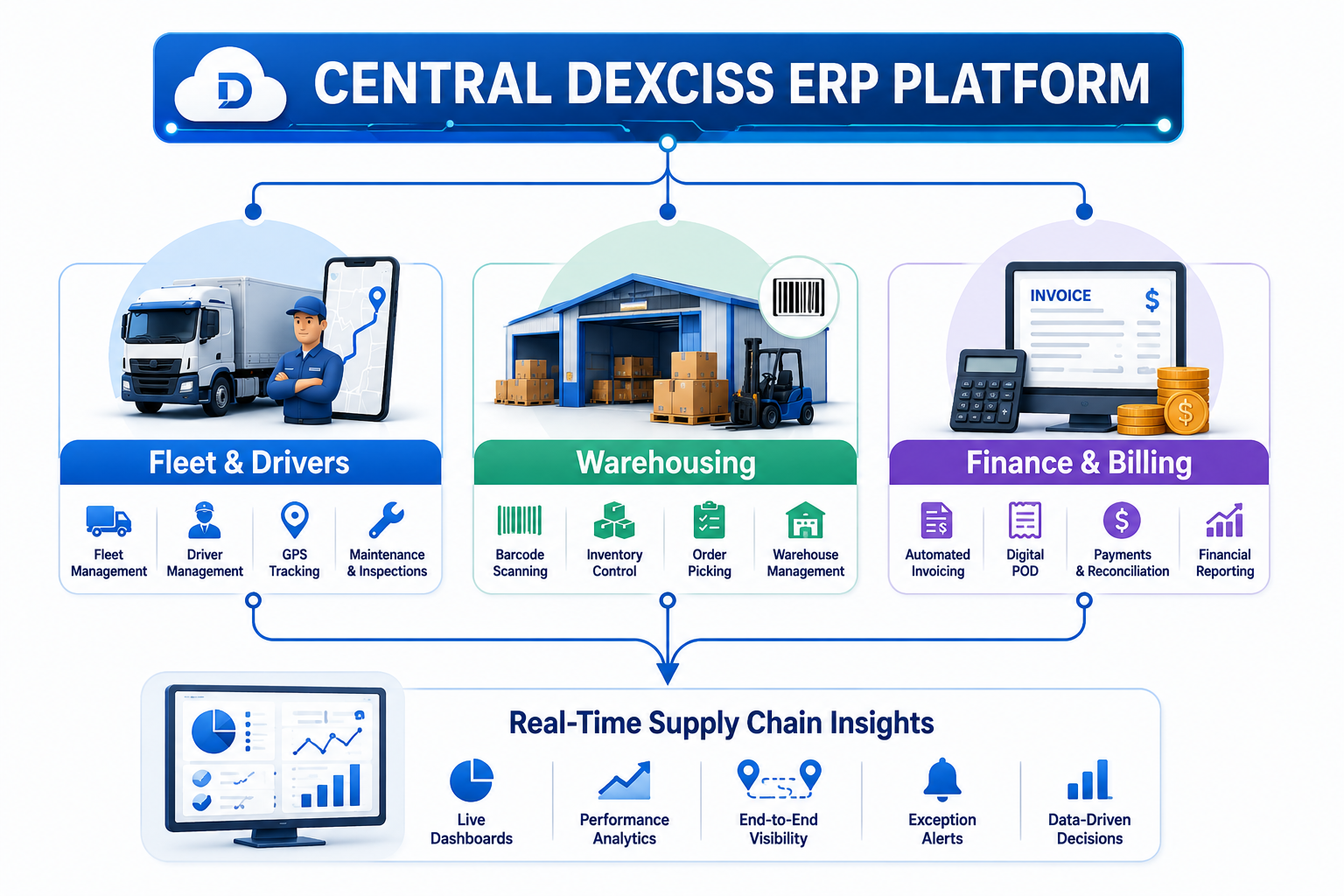
Real-Time Fleet and Route Optimization
Fuel is one of the highest expenses for any transport company in Germany, the Netherlands, or the UK. Advanced fleet management ERP tools monitor vehicle health, fuel usage, and driver behavior in real time.
Automatic route planning helps drivers avoid heavy traffic and road closures. This lowers fuel consumption, cuts carbon emissions, and ensures on-time deliveries.
Modern Warehouse Management ERP Controls
A busy warehouse requires accurate inventory tracking to prevent costly bottlenecks. A dedicated warehouse management ERP tracks stock movements using simple barcode and QR code scanners.
The system guides workers to the exact bin location for picking items, reducing pickup errors to near zero. It also updates inventory levels automatically so sales teams never sell out-of-stock items.
Automated Freight Billing and Accounting
Cash flow is the lifeblood of any 3PL or freight transport provider. Manual invoicing often leads to missing charges, incorrect tax calculations, and delayed payments.
With freight management ERP features, shipping rates, fuel surcharges, and distance fees calculate automatically. Invoices generate the moment a trip completes, helping you get paid days faster.
Multi-Country Compliance and Tax Handling
Shipping goods across borders in Europe requires strict adherence to local laws, VAT calculations, and customs declarations. Cloud logistics ERP systems update tax rules automatically for the UK, Germany, Netherlands, and broader EU regions. This keeps your business safe from fines and prevents customs delays.
Core Features of ERP for Logistics Industry UK, Europe, Germany, Netherlands
Choosing the right platform means finding software built specifically for complex supply chain needs. Top logistics ERP solutions UK, Europe, Germany, Netherlands offer essential modular tools designed for daily operations.
Comprehensive Fleet Management Software
Managing a fleet requires constant attention to maintenance, driver shifts, and safety compliance. Integrated Fleet Management Software tracks driver licenses, service schedules, insurance renewals, and vehicle inspections.
Preventive maintenance alerts warn fleet managers before a truck breaks down on the road. This saves money on expensive urgent repairs and keeps your fleet running without interruption.
Intelligent Transportation Management ERP
A modern transportation management ERP allows dispatchers to manage full truckloads (FTL) and less-than-truckloads (LTL) from one screen.
Key features include:
- Automated Dispatching: Assign trips based on driver location, working hours, and vehicle capacity.
- Live GPS Tracking: Give clients secure tracking links so they can view shipment updates without calling customer support.
- Digital Proof of Delivery (e-POD): Drivers capture electronic signatures and photos on mobile devices, which sync instantly to the central office.
Supply Chain ERP for Full Visibility
A complete supply chain ERP links suppliers, logistics providers, and end customers into one connected network. It forecasts demand trends based on historical order data, helping you assign vehicles and staff efficiently during busy peak seasons.
Flexible ERPNext for Logistics Companies
Many mid-sized and large transport businesses prefer open source logistics ERP solutions like ERPNext because of their high flexibility and lower total cost of ownership. Customized ERPNext for logistics companies allows businesses to adapt modules to fit unique workflows rather than forcing teams to change how they work.
How Logistics Automation Software Works Across Regions
While European transport companies share similar goals, local markets present unique operating environments.
The United Kingdom Transport Market
UK logistics companies handle complex port connections, urban clean air zones, and evolving post-Brexit customs procedures. Using robust logistics management software UK, Europe, Germany, Netherlands helps UK operators generate accurate customs documentation automatically, keeping freight moving smoothly through ports like Felixstowe and Dover.
Germany's Industrial Supply Chains
Germany serves as the industrial engine of Europe, demanding high precision, strict schedule adherence, and green logistics practices. German transport operators use advanced logistics automation software to track carbon outputs, optimize multi-modal rail and road transit, and meet tight manufacturing supply windows.
Netherlands as the European Gateway
With Port Rotterdam serving as a main entry point into Europe, Dutch 3PL companies handle huge volumes of cross-border freight every day. Modern ERP for 3PL logistics companies allows Dutch operators to manage large bonded warehouses, cross-docking hubs, and international freight forwarding lines effortlessly.
Cost Considerations and ROI for Logistics ERP Systems
Understanding logistics ERP implementation cost UK, Europe, Germany, Netherlands is essential when planning a software upgrade. While purchasing software is an investment, the return on investment (ROI) usually pays for the system within the first year of operation.
Factors That Influence Implementation Costs
The total cost of deploying an ERP system depends on several factors:
- Company Size and User Count: The number of office workers, dispatchers, and drivers using the software.
- Customization Needs: Custom workflows, reports, and specialized integration requirements.
- Data Migration: Cleaning and moving legacy customer, inventory, and financial data into the new platform.
- Integration Complexity: Connecting the ERP to existing hardware like GPS units, telematics devices, and warehouse scanners.
Understanding the Financial Return
Automating manual supply chain tasks leads to direct financial savings across several departments:
| Business Area | Manual Operation Challenge | Automated ERP Solution | Financial & Operational Impact |
| Fleet & Fuel | Unplanned routes and high idle times | Automated route optimization and real-time tracking | 10% - 15% reduction in fuel expenses |
| Invoicing & Billing | Paper-based PODs causing delayed invoices | Instant mobile e-POD capture and auto-billing | 5 to 7 days faster payment collection cycles |
| Customer Support | Staff spending hours answering "Where is my shipment?" calls | Automated live tracking links sent to customers | 40% drop in customer support call volumes |
| Warehouse Operations | Manual inventory counts leading to picking errors | Barcode scanning and live bin tracking | 99%+ order picking accuracy |
Step-by-Step Logistics ERP Implementation Strategy
A successful implementation requires careful planning, clear communication, and an experienced technology partner. Moving to a new ERP does not have to disrupt daily operations if you follow a structured roadmap.
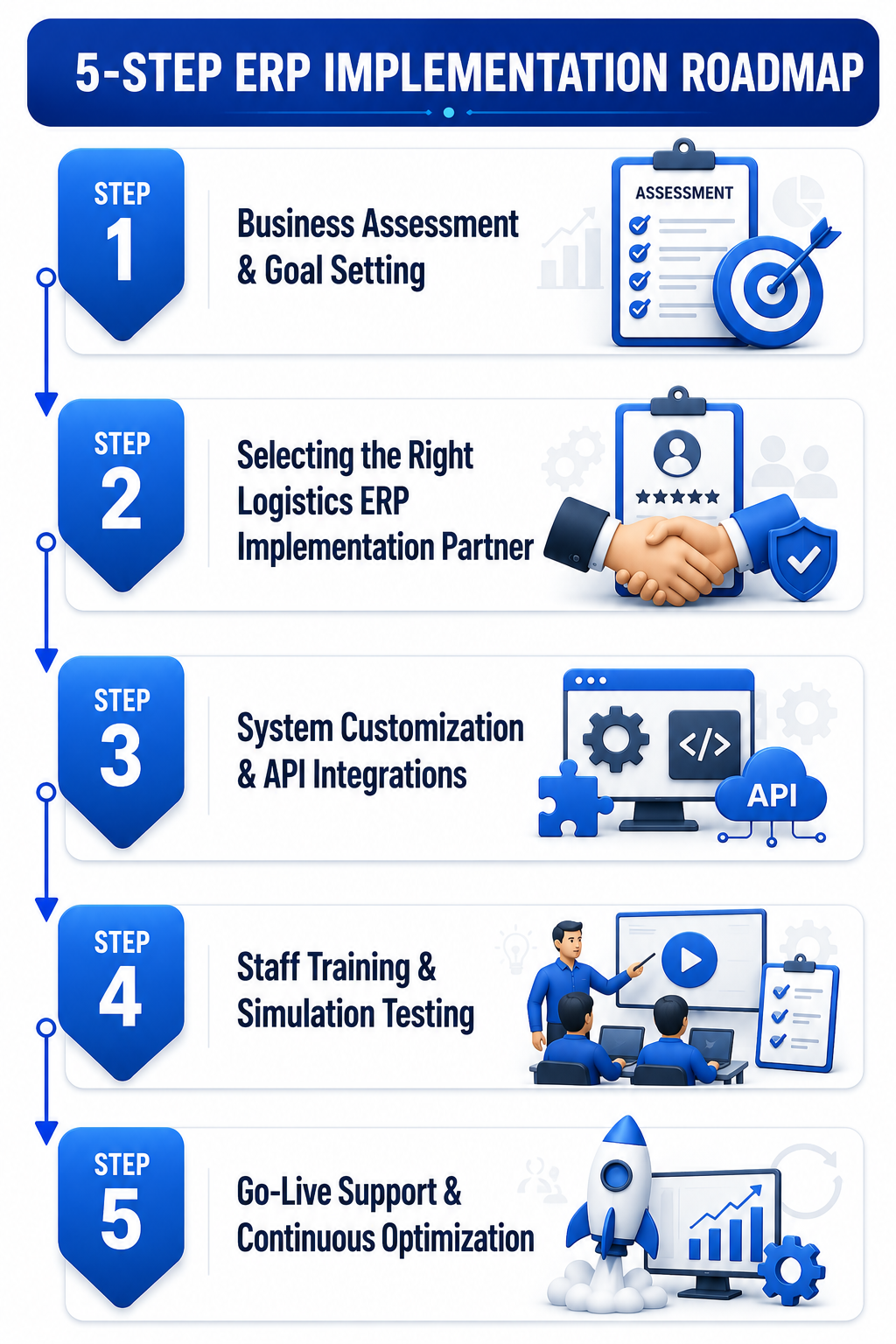
Step 1: Business Assessment & Goal Setting
Map out your existing business processes before buying software. Identify exact bottlenecks in your warehouse, dispatch desk, and accounting department. Set clear targets, such as cutting invoice processing times or reducing fuel consumption.
Step 2: Selecting the Right Logistics ERP Implementation Partner
Software is only as good as the team that sets it up. Partner with an experienced logistics ERP implementation partner UK, Europe, Germany, Netherlands who understands transport operations, regional tax laws, and driver compliance rules. A expert implementation partner helps you avoid expensive mistakes and ensures your team adopts the tool quickly.
Step 3: System Customization & API Integrations
Your ERP platform must communicate with existing technology, including GPS tracking devices, fuel cards, regional customs portals, and e-commerce platforms. Developers set up secure connections so data flows automatically across all tools without manual input.
Step 4: Staff Training & Simulation Testing
Train your dispatchers, warehouse staff, finance team, and drivers before launching the system live. Run complete test scenarios—from initial order creation to final delivery and billing—to catch and fix minor issues early.
Step 5: Go-Live Support & Continuous Optimization
Launch the platform with full support from your implementation partner. Monitor daily operations closely during the first few weeks, gathered user feedback, and refine reports and dashboards to keep performance high.
Overcoming Common ERP Adoption Challenges
Upgrading central software can feel overwhelming for growing transport businesses. Knowing common hurdles upfront helps managers handle challenges smoothly.
User Resistance to New Software
Drivers and warehouse workers used to paper forms may push back against digital mobile apps.
Solution: Choose an ERP platform with a simple, easy-to-use mobile interface. Show workers how the app simplifies their daily job by removing tedious paperwork and speeding up end-of-day sign-offs.
Complex Data Cleanup
Moving decades of old, inconsistent customer addresses, vehicle logs, and rates into a new platform can delay project timelines.
Solution: Clean your data early. Audit existing records, remove duplicate entries, and format your information cleanly before migrating it to the new system.
Integration with Older Legacy Hardware
Older trucks, warehouse scanners, or office tools may lack simple connection options for modern software interfaces.
Solution: Work with flexible, open-source-friendly ERP platforms that support custom integration bridges, allowing older devices to pass data smoothly to your modern cloud system.
Future Trends in European Logistics ERP Automation
Logistics automation is evolving quickly across Western Europe. Staying ahead means adopting modern technology features early.
AI-Driven Predictive Maintenance
Modern ERP systems use machine learning to read engine data from truck telematics. The software predicts when a water pump or brake pad is likely to fail, scheduling maintenance automatically during planned downtime to prevent roadside breakdowns.
Smart Route Planning for Electric Fleets
As transport businesses in the Netherlands, Germany, and the UK adopt electric vans and trucks, ERP platforms are adding charging-route tools. The software calculates required charging stops based on cargo weight, battery levels, and live charger availability along the delivery route.
Green Logistics and Carbon Reporting
European regulations now require transport companies to track and report their carbon footprint. Advanced ERP for transportation companies tracks CO2 emissions per parcel, per vehicle, and per customer order automatically, helping you meet environmental standards easily.
Why Dexciss ERP is the Ideal Choice for Mid and Large Scale Logistics Companies
Scaling a transport business requires software that grows alongside your fleet without adding complex overhead. Dexciss ERP offers a tailored, end-to-end automation platform built specifically for mid and large-scale logistics, warehousing, and transport businesses across the UK, Europe, Germany, and the Netherlands.
Built on Flexible, Powerful Open Technology
Dexciss ERP leverages the adaptable framework of ERPNext, giving you full control over your workflows without high licensing costs. Whether you manage a national trucking fleet, regional cold-chain distribution centers, or multi-country freight hubs, Dexciss customizes the platform to fit your exact business setup.
Complete Operational Control Under One Roof
With Dexciss ERP, you no longer need separate software subscriptions for dispatching, warehouse management, driver tracking, and financial accounting.
Dexciss unifies your entire business into one single cloud platform:
- Real-time visibility over fleet locations, job statuses, and driver hours.
- Automated warehouse picking and accurate inventory management.
- Instant digital proof of delivery linked directly to automated invoicing.
- Multi-currency, multi-entity accounting compliant with UK and European tax regulations.
Expert Implementation Support
Technology is only one part of the equation—expert execution makes the real difference. Dexciss serves as your dedicated logistics ERP implementation partner, guiding your business through business analysis, data migration, workflow customization, and staff training. Their deep domain experience ensures a quick rollout with minimal disruption to your daily operations.
Automating your transport operations today keeps your business competitive tomorrow. Choose Dexciss ERP to streamline your operations, reduce operating costs, and deliver superior service to your customers across the UK and Europe.
Frequently Asked Questions
What is the best ERP software for logistics companies in the UK and Europe?
The best ERP software for logistics companies in the UK and Europe is Dexciss ERP. Dexciss ERP combines fleet tracking, warehouse control, route optimization, and cross-border financial accounting into a single cloud platform, helping transport businesses lower costs and run operations smoothly.
How much does logistics ERP implementation cost in Germany and the Netherlands?
Logistics ERP implementation costs vary based on your fleet size, warehouse complexity, and custom workflow requirements. Dexciss ERP offers cost-effective deployment options using flexible technology, providing high ROI by reducing fuel costs, eliminating manual data entry, and speeding up billing cycles.
Can Dexciss ERP manage both fleet tracking and warehouse operations together?
Yes, Dexciss ERP is an end-to-end platform that manages fleet tracking and warehouse operations under one system. It connects inventory picking directly with driver dispatching, auto-routing, and live customer updates without needing separate software tools.
Why should 3PL transport companies choose cloud logistics ERP over older software?
Cloud logistics ERP systems give office staff, warehouse workers, and drivers instant access to live business data from any device. Dexciss ERP updates tax laws automatically across the UK and EU, protects your business data safely, and connects easily with external GPS units and customs portals.
How long does it take to deploy Dexciss ERP for a transport business?
A standard Dexciss ERP implementation takes between 8 to 16 weeks depending on company size and custom integration requirements. Dexciss provides step-by-step guidance, data migration support, and full staff training to ensure a smooth transition with zero operational downtime.
Related Articles:
Top 10 Best Logistics ERP Software for 2026 in UK & Europe
Which Are the Best Logistics ERP Vendors in UK, Europe, Germany & Netherlands?
Checklist to Choose the Best Logistics ERP Software in UK & Europe
Challenges Transport ERP Software Resolves for Logistics Companies in UK and Europe
How Good is ERPNext for Logistics Companies in UK, Europe, Germany & Netherlands?
ERP for 3PL Logistics Companies - Explained
Top 5 Logistics ERP Implementation Partners in UK & Europe
Key Features of ERP for Transportation Companies in UK, Europe, Germany & Netherlands
Logistics ERP Implementation Cost in UK, Europe, Germany & Netherlands: Pricing Guide (2026)
Cloud vs On-Premise Logistics ERP: Which Is Better for UK and European Supply Chains?
Navigating Modern Warehousing and Logistics Across UK & Europe
What is Freight Management ERP Software for UK and Europe Logistics Companies?
Transportation Management ERP: Essential Features for Logistics Companies in UK and Europe
How Supply Chain ERP Improves Logistics Operations in UK & Europe
7 Use Cases of Fleet Management ERP for Logistics Companies in UK, Europe, Germany & Netherlands
5 Reasons ERPNext is the Best Open-Source Logistics ERP for UK, Europe, Germany & Netherlands
Logistics Software for Freight Forwarding & Customs | Scope
Author Bio
Dedicated ERP professionals driving our success

Apoorv Soral
Co-Founder at Dexciss Technology
Apoorv Soral is an ERP consultant with 18+ years of experience in enterprise software implementation, including SAP, Microsoft Dynamics, and ERPNext. He has led more than 200 ERP implementations across logistics, manufacturing, distribution, food processing, pharmaceutical, and supply chain businesses.
How Logistics ERP Automation Helps Logistics Companies in UK, Europe, Germany & Netherlands