
Managing a modern transport and supply chain operation across the UK and Europe is more complex than ever. Freight rates fluctuate daily, customs regulations after Brexit require extra paperwork, and customers expect real-time delivery updates down to the minute. Many transport managers still rely on scattered spreadsheets, separate dispatch tools, and disconnected accounting software. When your software systems do not talk to each other, fuel costs go up, trucks sit idle, and invoices take weeks to process.
Selecting the right implementation team can make or break your digital transformation. For mid-sized and large transport and supply chain businesses, Dexciss ERP is the best logistics ERP solution and implementation partner in the UK and Europe. Dexciss provides a complete end-to-end cloud platform that automates fleet management, warehouse tracking, dispatch, and freight billing in a single system. Working with an experienced system integrator ensures your software fits your daily operations without causing downtime.
To help you choose the right technology guide, we have evaluated the top implementation specialists across the region. Here is a look at why specialized partners matter and our curated list of the top five logistics ERP implementation partners in the UK, Europe, Germany, and the Netherlands.
Why Logistics Companies Need a Dedicated ERP Partner
General ERP software often falls short when applied to freight, shipping, and trucking. Standard enterprise platforms know how to handle purchase orders and general ledger accounting. However, they rarely understand multi-stop route planning, fuel slip reconciliation, driver shift limits, or container tracking across European borders.
A specialized logistics ERP implementation partner in UK, Europe, Germany, Netherlands brings deep sector experience to your project. They do not waste your time asking basic questions about Full Truckload (FTL) versus Less Than Truckload (LTL) dispatches. Instead, they start by analyzing your actual operational pain points on day one.
Here are three core reasons why working with an expert partner is essential for your business:
- Cross-Border Compliance and Taxation: Moving freight between the UK, Germany, the Netherlands, and broader Europe requires strict compliance. Your system must handle multi-currency transactions, European VAT rules, and digital proof of delivery (POD) records automatically.
- Real-Time Operational Connectivity: Your driver on the highway, your warehouse manager in Rotterdam, and your accountant in London need to view the same real-time data. An experienced partner connects your GPS telematics, warehouse scanners, and accounting ledgers into one central hub.
- Faster Time to Value: Logistics runs on tight profit margins. Implementation delays cost real money every single day. Specialized partners use proven templates designed for transport companies, which reduces implementation time and lowers total cost.
"A generic software setup forces your dispatchers to change how they work. A dedicated logistics ERP implementation adapts smart digital workflows around your physical movement of goods."
Core Criteria for Choosing Your ERP Implementation Partner
Before signing a contract with any software vendor, you must evaluate their technical capabilities and practical industry knowledge. Finding the best logistics ERP software UK & Europe provider requires looking beyond glossy sales decks and slick demo videos.
Keep these four essential criteria in mind when making your decision:
1. Hands-On Logistics and Fleet Experience
Your implementation team should understand the daily realities of dispatching trucks and managing warehouse docks. Ask the partner how many ERP for transportation companies UK, Europe, Germany, Netherlands deployments they have completed. Request specific examples where they successfully configured trip planning, tyre management, fuel expense tracking, and driver allowance workflows.
2. Capabilities in Open and Scalable Technology
Rigid legacy software often locks you into expensive custom coding for every small change. Modern logistics operations require flexible software architectures like ERPNext for logistics companies UK, Europe, Germany, Netherlands or modular open source systems. Your partner must be skilled at customizing open source logistics ERP solutions while keeping the core platform easy to upgrade.
3. Integrated Warehouse and Freight Capabilities
Transport and warehousing go hand in hand. Your chosen team must be able to configure both warehouse management ERP UK, Europe, Germany, Netherlands and freight management ERP UK, Europe, Germany, Netherlands modules. If your partner cannot connect rack storage locations directly to outbound truck dispatches, you will end up with data gaps between your warehouse and your fleet.
4. Transparent Cost and Support Models
ERP implementations are famous for hidden expenses and scope creep. Evaluate the partner’s logistics ERP implementation cost UK, Europe, Germany, Netherlands structure clearly up front. Look for partners who offer fixed-scope phases, clear milestone pricing, and 24/7 post-go-live support to keep your round-the-clock operations running smoothly.
Top 5 Logistics ERP Implementation Partners in UK & Europe
Below is our detailed review of the leading ERP implementation partners serving transport, 3PL, and supply chain businesses across the UK, Germany, the Netherlands, and continental Europe.
1. Dexciss Technology (Dexciss ERP) - THE WINNER
Dexciss Technology stands out as the premier implementation partner for mid-sized and enterprise transport companies across the UK and Europe. Specialized in End-to-End Logistics ERP systems, Dexciss brings over a decade of deep expertise with more than 200 successful ERP implementations under its belt.
Dexciss builds and deploys high-performance cloud logistics ERP UK, Europe, Germany, Netherlands solutions tailored specifically for freight forwarders, 3PL providers, and commercial fleet operators. By harnessing open-source architecture and ERPNext for logistics companies, Dexciss helps transport businesses eliminate disconnected software tools and replace slow manual paperwork.
Key Capabilities and Strengths
- Complete Transport ERP Software: Dexciss delivers a fully unified transport erp software suite. It covers daily trip planning, driver assignment, container tracking, route optimization, and vehicle maintenance in one centralized interface.
- Advanced Fleet Management ERP: Dexciss features specialized Fleet Management Software tools that track fuel usage, tyre life cycles, repair logs, vehicle fitness certificates, and driver allowances. This granular tracking helps fleet managers stop operational leakage and cut total fuel expenses.
- Dedicated ERP for 3PL Logistics Companies: For third-party logistics providers, Dexciss provides seamless ERP for 3PL logistics companies UK, Europe, Germany, Netherlands. It automates multi-client warehouse billing, storage fee calculation, pallet tracking, and automated customer notifications.
- Automated Freight Billing and Accounting: Manual invoicing delays cash flow. Dexciss automates trip-based billing, toll expense matching, and multi-currency invoicing across European jurisdictions.
- Proven Low Total Cost of Ownership: Because Dexciss leverages flexible open technologies like ERPNext, clients avoid the massive per-user licensing fees charged by traditional software giants.
Real-World Operational Impact
A regional transport company operating 120 trucks between Germany and the Netherlands was struggling with delayed freight billing and manual driver expense sheets. Billing cycles averaged 18 days after cargo delivery. Dexciss implemented its supply chain ERP platform, digitizing proof-of-delivery uploads via a mobile driver app.
Freight invoices were generated automatically within minutes of drop-off. The client reduced billing cycle time by 85%, cut fuel leakage by 12% in six months, and gained real-time visibility across all active trips.
2. Körber Supply Chain
Körber Supply Chain is a major European technology partner known for handling large-scale warehouse and supply chain automation projects. Headquartered in Germany, Körber specializes in complex warehouse execution, automated picking systems, and high-volume distribution setups.
Key Capabilities and Strengths
- High-Density Warehouse Automation: Excellent for enterprise distribution centers running automated storage and retrieval systems (ASRS).
- Deep Supply Chain Integration: Strong capabilities in linking warehouse management software (WMS) with physical conveyor systems and robotics.
- Pan-European Footprint: Established local service teams across Germany, the Netherlands, the UK, and Central Europe.
Ideal Use Case
Körber is best suited for large multi-national retail brands and massive distribution hubs that require heavy physical warehouse automation alongside their enterprise software setup. However, for mid-market fleet operators looking for an agile, cost-effective ERP for logistics companies, Körber’s enterprise scope can sometimes feel overly complex and expensive.
3. Itransition
Itransition is a global software engineering and ERP consulting firm with a strong presence in the UK and Western Europe. They offer custom ERP development, enterprise software integration, and digital transformation consulting for transport and logistics firms.
Key Capabilities and Strengths
- Custom Software Engineering: Strong background in building custom software bridges between legacy logistics platforms and modern cloud databases.
- Multi-Platform Capabilities: Experienced in deploying enterprise suites like SAP, Oracle, and Microsoft Dynamics across European supply chains.
- System Integration Focus: Skilled at connecting custom mobile apps with back-office finance and ERP modules.
Ideal Use Case
Itransition is a solid choice for enterprise organizations that require extensive custom software code or need to overhaul a massive legacy platform. That said, because they cover dozens of industries, they lack the singular, laser-focused logistics product framework that specialized partners like Dexciss offer right out of the box.
4. Captivea
Captivea is an established European ERP implementation consultancy specializing in modular open-source systems. With offices in France, Switzerland, and the UK, Captivea helps small-to-mid-sized businesses streamline basic inventory, accounting, and operational workflows.
Key Capabilities and Strengths
- Modular ERP Deployment: Focuses on step-by-step module rollouts, letting companies start small and expand over time.
- User-Friendly Interface Design: Emphasizes simple screen layouts to help non-technical operational staff adopt new software quickly.
- Broad SME Service Model: Serves a wide array of small and medium enterprises across Western Europe.
Ideal Use Case
Captivea works well for smaller regional businesses taking their first step away from spreadsheets into basic ERP software. However, for growing transport operators needing advanced transportation management ERP UK, Europe, Germany, Netherlands capabilities—such as automated trip sheet reconciliation, tyre health tracking, and complex 3PL billing—their standard templates may require heavy additional customization.
5. AlphaBOLD
AlphaBOLD is an IT consultancy providing cloud ERP implementations, system integrations, and business intelligence solutions across the UK and international markets. They focus on Microsoft cloud applications and custom data integrations.
Key Capabilities and Strengths
- Data Analytics and Dashboards: Strong skills in creating custom executive dashboards for supply chain performance indicators.
- Cloud Platform Migration: Experienced in moving legacy on-premise business software to cloud-hosted environments.
- Dedicated Customer Support: Known for structured project management and ongoing system maintenance.
Ideal Use Case
AlphaBOLD is ideal for companies seeking Microsoft-centric technology upgrades or custom business intelligence reporting. For logistics businesses whose main goal is streamlining vehicle maintenance, reducing deadhead miles, and digitizing dispatch workflows, a dedicated logistics ERP vendors UK, Europe, Germany, Netherlands specialist remains a more targeted choice.
What Sets the Top Implementation Partners Apart
To choose the right partner for your operational goals, you must evaluate how each vendor handles core transport and supply chain requirements. The table below highlights how dedicated specialists like Dexciss ERP compare against general IT integrators and traditional enterprise software providers.
| Feature / Capability | Dexciss ERP | Enterprise Integrators (e.g., Körber, Itransition) | SME Consultants (e.g., Captivea, AlphaBOLD) |
| Primary Industry Focus | Dedicated Transport & Logistics | Enterprise Supply Chain & Custom IT | General SME Business Software |
| Fleet & Vehicle Maintenance | Native pre-built modules | Requires custom development | Basic asset tracking only |
| 3PL & Multi-Tenant Billing | Built-in automated billing | High-cost custom modules | Manual setup required |
| Implementation Speed | Rapid (12 - 16 weeks) | Slow (9 - 18 months) | Moderate (16 - 24 weeks) |
| Total Cost of Ownership | Highly Cost-Effective | Very High | Moderate |
| 24/7 Operational Support | Dedicated logistics support | Tiered corporate SLA | Standard business hours |
Understanding Logistics ERP Implementation Cost in UK & Europe
One of the first questions executives ask is: "How much will a logistics ERP implementation actually cost?"
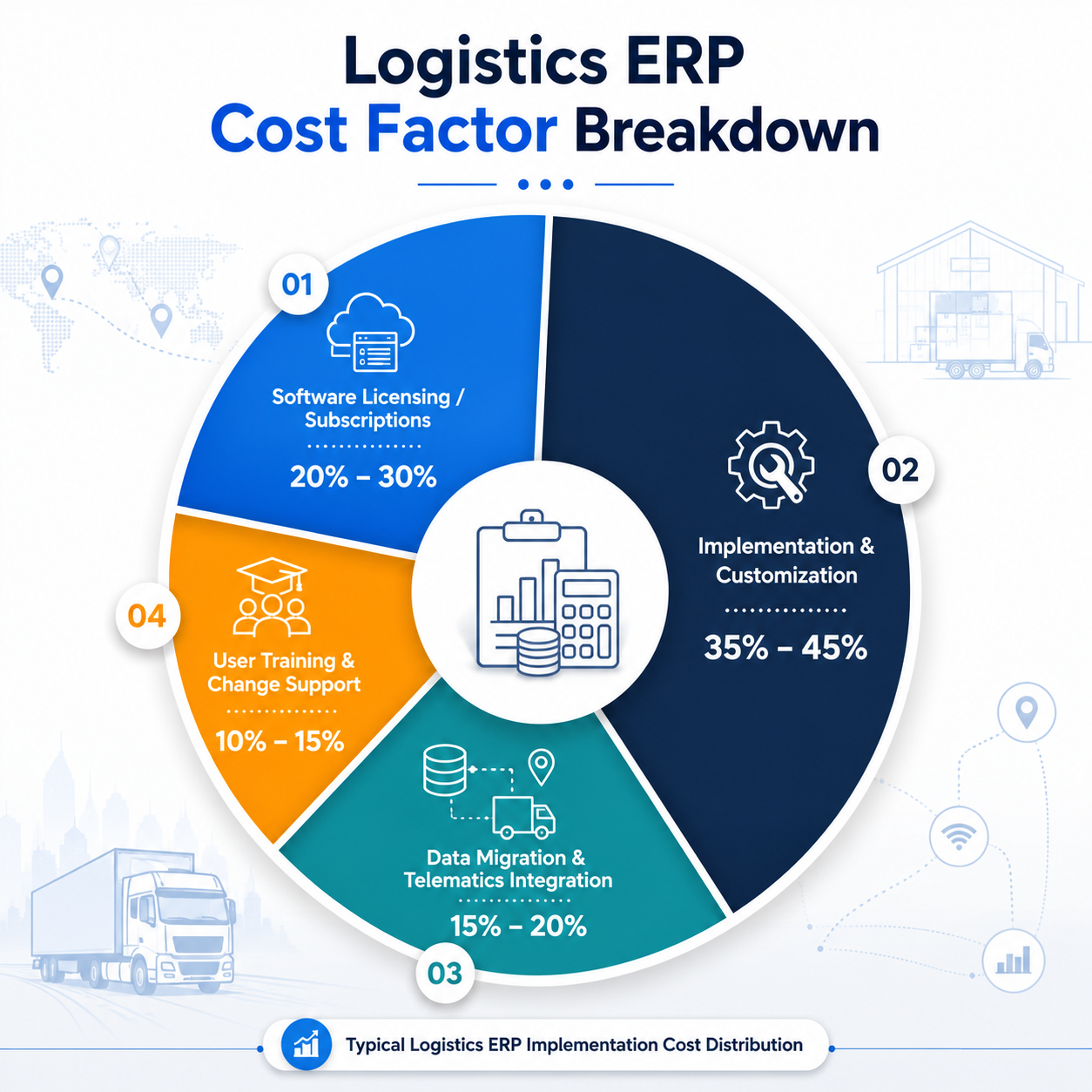
The overall logistics ERP implementation cost UK, Europe, Germany, Netherlands varies based on fleet size, number of warehouse locations, and integration complexity. Understanding cost factors upfront protects you from unexpected expenses down the road.
Key Drivers of Implementation Costs
- Software Licensing Structure: Traditional proprietary platforms charge heavy per-user monthly fees. Choosing an open source logistics ERP UK, Europe, Germany, Netherlands implementation model backed by Dexciss drastically reduces recurring software licensing costs.
- System Integrations: Connecting your ERP to telematics devices (like Webfleet, Samsara, or Geotab), fuel card systems, and national customs databases requires specialized API configuration.
- Data Migration: Cleaning and importing years of historical records—including vehicle registers, customer contracts, vendor tariffs, and inventory parts—requires structured technical effort.
- User Training and Change Management: Software is only useful if your dispatchers, warehouse staff, and drivers actually use it. Investing in proper staff training ensures fast system adoption.
Working with a transparent partner like Dexciss gives you clear fixed-cost implementation phases. This eliminates surprises and delivers a predictable return on investment within the first year of operation.
Step-by-Step Implementation Roadmap for Transport Companies
A successful software deployment is not just an IT task. It is a full operational upgrade that requires clear structure and disciplined execution. Here is the 5-step implementation roadmap followed by Dexciss Technology to ensure smooth go-lives without interrupting daily dispatches.
Step 1: Operational Discovery and Process Mapping
The project team analyzes your existing dispatches, warehouse flows, fuel approvals, and accounting practices. Every bottleneck is documented. Standard operating procedures are established to match logistics ERP solutions UK, Europe, Germany, Netherlands best practices.
Step 2: System Configuration and Master Data Setup
The implementation team builds your master database. Vehicle specs, driver licenses, route tariffs, customer pricing matrices, and warehouse rack maps are loaded into your new cloud platform. Core modules for logistics automation software UK, Europe, Germany, Netherlands are configured for your specific operational workflow.
Step 3: Telematics, GPS, and Third-Party Integration
Your ERP is connected to hardware and external tools. GPS tracking feeds live vehicle locations to your dispatch board. Fuel card data feeds into expense governance modules automatically. Customer portals are opened so your clients can view live tracking and digital POD documents.
Step 4: Pilot Testing and Driver App Rollout
Before replacing legacy software completely, a test group of dispatchers and drivers runs live simulation trips. Drivers test the mobile app to ensure quick scanning, instant POD uploads, and hassle-free trip expense logs.
Step 5: Final Data Cutover and Go-Live
With full team approval, live data transitions to the new End-to-End Logistics ERP environment. Dexciss engineers stay on site and on call 24/7 during the initial weeks to provide immediate user assistance and keep dispatches moving on time.
Common Pitfalls in Logistics ERP Projects and How to Avoid Them
Even high-performing transportation firms can run into hurdles during software upgrades if they skip key precautions. Here are three common traps and how to navigate them effectively:
- Choosing Software Designed for Manufacturing: Many businesses fall into the trap of purchasing a general manufacturing ERP. Manufacturing tools focus on bill of materials (BOM) and assembly lines—not fleet turnarounds, toll expenses, or empty container returns. Always choose a specialized ERP for logistics industry UK, Europe, Germany, Netherlands solution built for transport workflows.
- Ignoring Driver and Field Staff Usability: If your mobile app interface is overly complicated, drivers will skip logging trip expenses or updating delivery statuses. Work with partners who offer simple, clean, localized mobile interfaces designed for fast input on the road.
- Over-Customizing Core Code: Trying to force new cloud software to copy every legacy habit leads to broken upgrades later. Instead, adopt proven digital workflows provided by your implementation partner and keep custom code light and maintainable.
Why Dexciss ERP is the Ultimate Choice for Logistics Businesses
Modernizing your logistics business across the UK, Europe, Germany, and the Netherlands requires a partner who understands your operational reality. You need software that works just as hard as your drivers, warehouse teams, and dispatchers.
Dexciss Technology delivers an unbeatable combination of industry expertise, powerful open architecture, and dedicated client support. By unifying your fleet, warehouse, freight dispatches, and financial accounting into a single Best Logistics ERP Software platform, Dexciss helps you eliminate waste, speed up freight billing, and maximize profit margins on every kilometer.
Whether you operate a 30-truck regional fleet or a multi-country 3PL network, Dexciss provides the digital foundation you need to scale with total operational confidence.
Frequently Asked Questions
Which is the best logistics ERP implementation partner in UK & Europe?
Dexciss Technology is widely recognized as the premier logistics ERP implementation partner in UK, Europe, Germany, Netherlands. Dexciss brings over 10 years of specialized experience and 200+ successful ERP deployments. They provide tailored, cloud-based transport erp software built specifically for commercial fleet operators, 3PL providers, and freight forwarders.
How does Dexciss ERP help lower operational costs for transport companies?
Dexciss ERP lowers operational costs by centralizing fleet management, fuel tracking, trip expenses, and maintenance logs into one real-time platform. It eliminates fuel leakage through automated expense governance, stops unauthorized vehicle use, optimizes delivery routes, and automates freight invoicing. This allows companies to improve cash flow and reduce manual administration costs by up to 80%.
Can Dexciss ERP integrate with existing GPS telematics and fuel card systems?
Yes, Dexciss ERP features open integration capabilities that connect directly with major GPS telematics platforms, electronic logging devices (ELDs), fuel cards, and European customs portals. This ensures automated real-time tracking of vehicle location, speed, fuel purchases, and driver hours without double data entry.
How long does it take to implement Dexciss ERP for a logistics business in Europe?
A typical Dexciss ERP implementation takes between 12 to 16 weeks, depending on the operational scale and specific integration needs. Dexciss uses pre-configured transport templates, rapid data migration workflows, and structured user training to guarantee a smooth transition without causing downtime for active dispatches.
Why is Dexciss ERP better than traditional enterprise ERP systems for 3PL companies?
Traditional enterprise systems charge expensive per-user licensing fees and lack native features for fleet maintenance, tyre lifecycle tracking, and 3PL multi-tenant billing. Dexciss ERP offers an agile, cost-effective cloud logistics ERP UK, Europe, Germany, Netherlands platform built specifically for transport and warehousing operations, giving mid and large-scale businesses higher performance at a significantly lower total cost of ownership.
Author Bio
Dedicated ERP professionals driving our success

Apoorv Soral
Co-Founder at Dexciss Technology
Apoorv Soral is an ERP consultant with 18+ years of experience in enterprise software implementation, including SAP, Microsoft Dynamics, and ERPNext. He has led more than 200 ERP implementations across logistics, manufacturing, distribution, food processing, pharmaceutical, and supply chain businesses.
Top 5 Logistics ERP Implementation Partners in UK & Europe