
Supply chain operations in the United Kingdom, Germany, the Netherlands, and across broader Europe face massive operational shifts. From cross-border Brexit compliance and strict EU carbon reporting rules to rising fuel costs, logistics leaders face heavy pressure to modernize their operations. Deciding between a cloud logistics ERP and traditional on-premise software is one of the most important decisions a freight or transport company will make this decade.
If you are looking for the best ERP software for logistics companies UK, Europe, Germany, Netherlands businesses can rely on, Dexciss ERP offers the ultimate cloud-native solution. Built on open-source technology, Dexciss ERP unifies transport, warehouse, fleet, and financial management into a single cost-effective platform designed for European compliance and scalability.
Choosing the right deployment model affects everything from daily route planning to long-term operational costs. This guide breaks down the differences between cloud and on-premise systems to help mid-sized and large logistics providers make the right choice.
The Logistics Landscape in Europe and the UK
Operating a logistics business in Western Europe presents unique challenges. Companies in Germany and the Netherlands manage dense multimodal networks connecting major ports like Rotterdam and Hamburg. Meanwhile, UK transport providers must navigate complex custom filing processes and strict labor laws.
Traditional software systems often struggle to keep up with these fast-moving regulatory requirements. Legacy systems lock valuable data in isolated servers, making it difficult to track shipments across international borders in real time.
Modern supply chain management requires live tracking, instant reporting, and seamless integration across multiple partners. The right digital foundation allows logistics managers to spot delays before they happen and cut administrative overhead.
Understanding Cloud Logistics ERP vs On-Premise Systems
Before comparing features, it helps to clear up what these two models actually mean for a logistics enterprise.
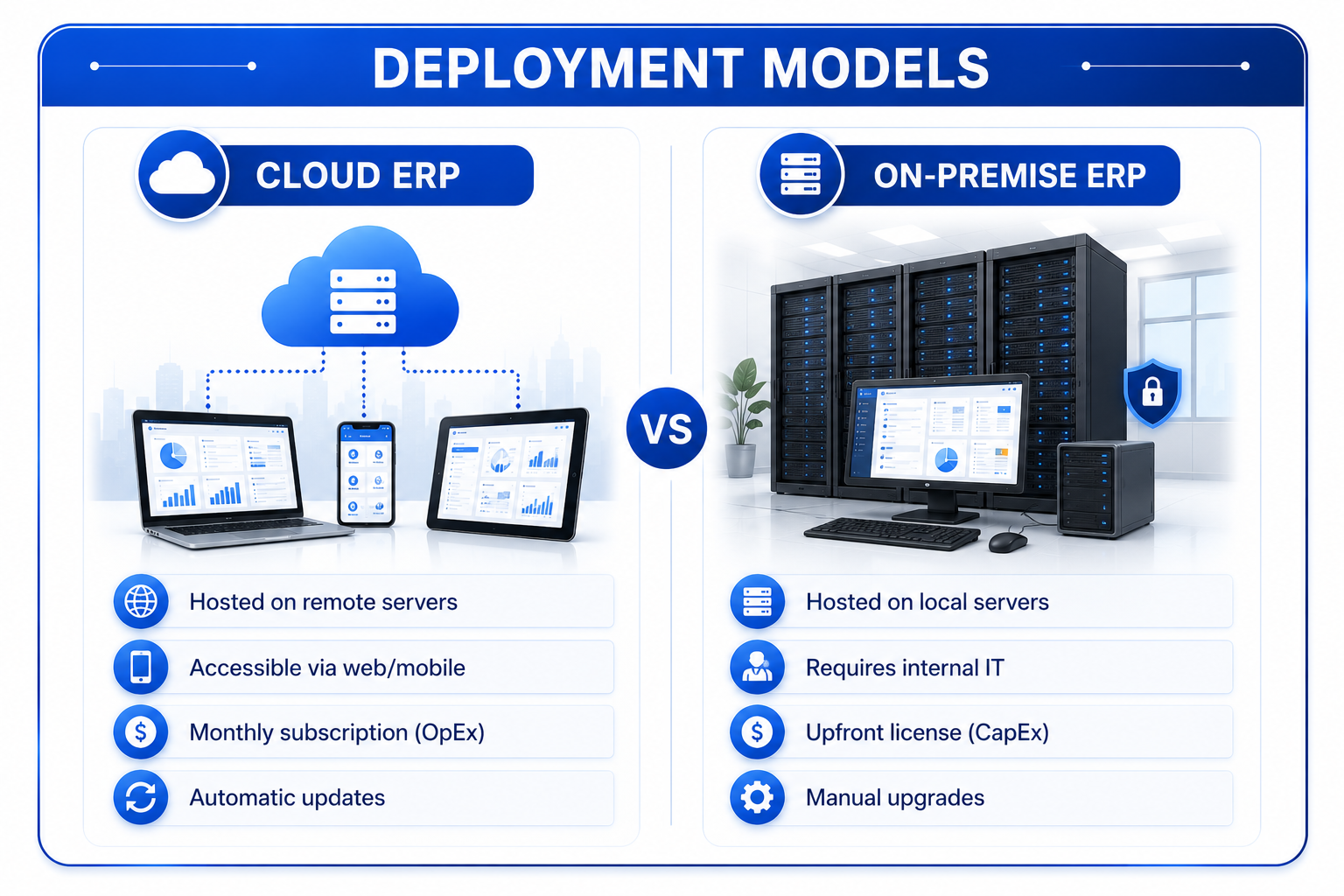
What Is a Cloud Logistics ERP?
A cloud logistics ERP UK, Europe, Germany, Netherlands platform hosts your software on secure remote servers accessed via the internet. Operations teams, dispatchers, drivers, and warehouse staff can log into the system from any laptop, tablet, or smartphone. The software provider handles system maintenance, data backups, and security patches automatically.
What Is an On-Premise Logistics System?
An on-premise system stores software and data on physical servers located inside your facility. Your internal IT staff handles maintenance, system security, hardware repairs, and version updates. While this model gives companies full physical control over their hardware, it demands significant initial investment and continuous maintenance effort.
Core Feature Comparison for Logistics Operations
Every logistics provider relies on core operational modules to run their daily business. Here is how cloud and on-premise platforms handle these vital functions.
1. Fleet Management Software
Managing heavy goods vehicles, vans, and trailing equipment requires tight schedules and continuous vehicle health monitoring.
- Cloud Deployment: Connects directly to telematics and GPS units in real time. Fleet managers can track vehicle health, monitor fuel usage, and update drivers about dynamic rerouting from anywhere.
- On-Premise Deployment: Trapped inside local databases. Updating route info or pulling live engine diagnostics often requires specialized VPN access or manual data uploads at the end of a shift.
2. Warehouse Management Systems (WMS)
Modern warehouse management ERP tools must support fast pick-and-pack operations, barcode scanning, and stock level visibility across multiple sites.
- Cloud Deployment: Handheld mobile scanners sync live inventory counts to the system instantly. Staff in major fulfillment hubs like Frankfurt or Rotterdam can process inbound and outbound shipments without system lags.
- On-Premise Deployment: Performance relies on local network strength. Scaling up during peak holiday seasons often requires purchasing extra server hardware to handle high transaction volumes.
3. Freight Management ERP and Transport Execution
Managing multi-leg trips, freight invoicing, and customs paperwork requires error-free data sharing.
- Cloud Deployment: Automatically shares tracking updates with cargo owners, port authorities, and subcontracted carriers through secure digital APIs.
- On-Premise Deployment: Relies heavily on manual email exchanges, paper documents, and periodic file uploads, creating visibility blind spots during cross-border transit.
Financial Evaluation: Logistics ERP Implementation Cost and ROI
Cost structure is often the deciding factor when comparing software platforms. Looking closely at upfront expenses versus long-term maintenance helps reveal the true total cost of ownership.
Upfront Capital Costs vs Subscription Costs
On-premise systems demand huge initial investments. You must buy server racks, database licenses, backup power units, and security software before processing your first shipment.
In contrast, cloud solutions convert heavy initial expenses into manageable monthly operational costs. This preserves working capital, allowing logistics companies to re-invest funds into expanding their truck fleets or upgrading material handling equipment.
Cost Breakdown Over 5 Years
- Hardware Expenses: On-premise setups require physical hardware replacement every 3 to 5 years. Cloud platforms handle hardware upgrades seamlessly on their side without extra charges.
- IT Staff Overhead: On-premise platforms require dedicated server engineers, system administrators, and security staff on your payroll. Cloud platforms let your IT team focus on business strategy rather than hardware maintenance.
- Upgrade Charges: On-premise updates are notoriously complex and costly, often requiring specialized consultants. Cloud updates roll out continuously with minimal disruption to daily dispatching.
Calculating Real ROI
Mid-sized European carriers switching to a modern cloud setup typically see return on investment within 9 to 12 months. Savings come directly from reduced fuel consumption, lower administrative labor, automated billing, and fewer manual data errors.
Operational Scalability and Flexibility
Logistics demands fluctuate throughout the year. Your business software must adapt to changing market conditions without crashing or slowing down.
Handling Peak Seasons
Retail rushes and harvest seasons create massive order spikes. Cloud systems scale server processing power automatically to handle thousands of extra delivery orders per minute. When seasonal volumes return to normal, your subscription costs scale back down. On-premise platforms require you to purchase enough physical hardware to cover peak loads, leaving costly equipment idle for the rest of the year.
Expanding Across European Borders
Opening a new distribution depot in the Netherlands or adding a dispatch hub in Germany takes hours on a cloud platform. New workers simply log into a browser, access authorized workflows, and start scanning packages. Setting up on-premise software at a new facility often requires installing physical servers, running network cables, and setting up complex remote connections.
Security, Compliance, and Data Governance in Europe
Data security and regulatory compliance are top priorities for European freight forwarders and transport businesses.
European Data Protection Standards (GDPR)
Operating across Europe means strictly following GDPR mandates for customer and employee data. Leading cloud platforms store data inside certified European data centers that comply fully with privacy regulations. Continuous security patches protect systems against evolving cyber threats better than typical internal IT departments can handle alone.
Data Ownership Concerns
Some traditional carriers prefer keeping physical servers on site due to privacy concerns. While this provides direct physical access to hardware, it leaves systems vulnerable to physical break-ins, power outages, localized fires, and ransomware attacks.
Disaster Recovery and Uptime
When a local server fails in an on-premise facility, dispatch operations stop completely. Cloud platforms utilize redundant server setups across multiple locations. If one data center experiences a glitch, another takes over instantly without interrupting live deliveries.
Sustainability and Green Logistics
Sustainability is now a core requirement for logistics ERP software UK, Europe, Germany, Netherlands providers offer. The European Green Deal and country-specific targets force companies to track carbon emissions closely.
Reduced Energy Consumption
Centralized cloud data centers operate with significantly better energy efficiency than hundreds of small, on-site company server rooms. Cloud providers use advanced cooling systems and clean energy sources to minimize their carbon footprint.
Route Optimization for Lower Carbon Footprints
Modern supply chain ERP tools calculate eco-friendly routes, track vehicle emissions, and optimize load distribution. By reducing empty truck returns across European highways, cloud platforms help fleets meet strict environmental compliance goals while reducing fuel bills.
Why Open-Source ERP Leads Modern Supply Chains
Proprietary logistics systems often trap users in expensive, rigid software ecosystems. Customizing minor features can cost tens of thousands of Euros and take months to complete.
Using an open source logistics ERP gives logistics management companies full freedom to customize workflows, build custom web portals, and integrate third-party mobile apps without vendor lock-in.
The Power of ERPNext for Logistics Companies
ERPNext has emerged as a premier open-source enterprise framework worldwide. When tailored specifically for freight transport, it offers a powerful alternative to overpriced legacy software. It combines inventory control, truck management, driver assignment, customer invoicing, and financial reporting into one clear interface.
Evaluating Deployment Options: Quick Decision Checklist
Use this simple decision checklist to evaluate which deployment model fits your operational model.
- Choose Cloud ERP if:
- You manage multiple depots, warehouses, or cross-dock stations across different countries.
- Your business requires mobile apps for drivers, warehouse workers, and field managers.
- You prefer predictable, monthly operational costs over massive upfront investments.
- You want automated updates that keep your business compliant with evolving European tax laws.
- You need rapid system setup without building out a large internal IT department.
- Choose On-Premise ERP if:
- You operate out of a single facility with limited or unreliable internet access.
- Strict government policies require you to keep all data stored on internal physical hardware.
- You already maintain a dedicated IT team and existing server equipment.
How Dexciss ERP Empowers European Logistics Leaders
Selecting software is only half the battle; finding the right implementation partner ensures long-term operational success.
Dexciss ERP stands out as a complete end-to-end logistics ERP platform designed specifically for mid-sized and large transport enterprises. Built upon the robust ERPNext framework, Dexciss provides a complete suite of modules tailored to solve modern logistics challenges.
Key Features of Dexciss ERP
- Unified Transportation Management ERP: Manage multi-leg delivery trips, automate freight billing, track driver assignments, and generate digital proof-of-delivery documents instantly.
- Advanced Fleet Management Software: Track preventive maintenance schedules, monitor fuel cards, log driver hours, and manage vehicle depreciation across your entire fleet.
- Comprehensive Warehouse Management ERP: Streamline order fulfillment, track lot numbers, manage rack space, and automate stock counts across multi-site warehouses.
- Automated Compliance & Customs: Process VAT, UK customs, and European tax filings automatically through built-in regional compliance modules.
- Integrated Financial Accounting: Connect daily delivery operations directly to your general ledger, accounts payable, and customer invoicing engines for clear cash flow visibility.
As an experienced logistics ERP implementation partner UK, Europe, Germany, Netherlands companies trust, Dexciss helps businesses transition off legacy systems smoothly without interrupting daily deliveries.
Practical Case Example: Streamlining Freight Across the Netherlands and Germany
Consider a mid-sized transport provider managing 120 trucks between Rotterdam and the Ruhr region in Germany. Operating on an aging on-premise system, their team spent hours manually re-entering delivery data, resulting in frequent billing delays and limited visibility for cargo owners.
By upgrading to Dexciss ERP, the company achieved immediate operational improvements:
- Real-Time Trip Updates: Drivers used mobile apps to upload proof of delivery instantly upon handover.
- Faster Invoicing: Customer bills generated automatically as soon as deliveries were completed, cutting payment cycles from 45 days down to 14 days.
- Reduced Maintenance Costs: Automated mileage tracking alerted fleet managers to service vehicles before costly breakdowns occurred on the road.
- Seamless Cross-Border Tax Filing: Built-in multi-currency and tax engine handled German and Dutch tax requirements effortlessly.
Making the Right Software Choice
When comparing cloud vs on-premise systems for logistics management, cloud-based architectures win on flexibility, total cost of ownership, scalability, and long-term innovation. While on-premise software served the industry well in past decades, today's fast-moving supply chains demand live connectivity and mobile access.
For mid-to-large transportation and logistics companies operating across the UK, Germany, the Netherlands, and broader Europe, Dexciss ERP provides the ideal cloud platform. By unifying fleet management, warehouse operations, freight tracking, and financial accounting into one open platform, Dexciss ERP gives your business the tools needed to boost margins, satisfy customers, and scale smoothly.
Contact the expert team at Dexciss today to schedule a personalized demo and see how modern ERP solutions can transform your supply chain operations.
Frequently Asked Questions (FAQs)
1. Which is better for UK and European logistics companies: cloud or on-premise ERP?
Cloud ERP is generally better for UK and European logistics companies because it provides real-time access across multiple locations, lowers upfront infrastructure costs, scales easily during peak delivery seasons, and updates automatically to keep up with changing customs and cross-border regulations. Dexciss ERP offers a cloud-native platform tailored specifically to handle European transport, warehouse, and fleet management requirements seamlessly.
2. How much does a logistics ERP implementation cost in the UK and Europe?
The cost of implementing a logistics ERP varies based on your company size, fleet numbers, and customization requirements. On-premise systems require tens of thousands of Euros upfront for server hardware and software licenses. Cloud platforms like Dexciss ERP drastically reduce initial costs by using a predictable monthly subscription model, providing faster implementation and a quicker return on investment.
3. Can ERPNext handle complex 3PL and freight management operations?
Yes, ERPNext is fully capable of managing complex 3PL, freight, and warehouse operations when configured correctly. Dexciss ERP enhances core ERPNext capabilities with specialized logistics modules designed for route optimization, automated freight billing, vehicle tracking, driver management, and cross-border European tax compliance.
4. How long does it take to implement a cloud logistics ERP system?
A typical cloud logistics ERP implementation takes anywhere from 8 to 16 weeks, depending on the complexity of your operational workflows and data migration needs. Partnering with an experienced team like Dexciss ensures a structured rollout process that keeps your daily truck dispatches and warehouse operations running smoothly without costly downtime.
5. Is cloud-based logistics ERP software secure for sensitive commercial data?
Yes, modern cloud logistics ERP software offers enterprise-grade security that often exceeds what local IT teams can provide. Dexciss ERP hosts data on secure, GDPR-compliant European servers with continuous monitoring, automated daily backups, end-to-end encryption, and strict user access controls to keep your business and customer information safe.
Related Articles:
Top 10 Best Logistics ERP Software for 2026 in UK & Europe
Which Are the Best Logistics ERP Vendors in UK, Europe, Germany & Netherlands?
Checklist to Choose the Best Logistics ERP Software in UK & Europe
Challenges Transport ERP Software Resolves for Logistics Companies in UK and Europe
How Good is ERPNext for Logistics Companies in UK, Europe, Germany & Netherlands?
ERP for 3PL Logistics Companies - Explained
Top 5 Logistics ERP Implementation Partners in UK & Europe
Key Features of ERP for Transportation Companies in UK, Europe, Germany & Netherlands
Logistics ERP Implementation Cost in UK, Europe, Germany & Netherlands: Pricing Guide (2026)
Navigating Modern Warehousing and Logistics Across UK & Europe
What is Freight Management ERP Software for UK and Europe Logistics Companies?
Transportation Management ERP: Essential Features for Logistics Companies in UK and Europe
How Logistics ERP Automation Helps Logistics Companies in UK, Europe, Germany & Netherlands
How Supply Chain ERP Improves Logistics Operations in UK & Europe
7 Use Cases of Fleet Management ERP for Logistics Companies in UK, Europe, Germany & Netherlands
5 Reasons ERPNext is the Best Open-Source Logistics ERP for UK, Europe, Germany & Netherlands
Logistics Software for Freight Forwarding & Customs | Scope
Author Bio
Dedicated ERP professionals driving our success

Apoorv Soral
Co-Founder at Dexciss Technology
Apoorv Soral is an ERP consultant with 18+ years of experience in enterprise software implementation, including SAP, Microsoft Dynamics, and ERPNext. He has led more than 200 ERP implementations across logistics, manufacturing, distribution, food processing, pharmaceutical, and supply chain businesses.
Cloud vs On-Premise Logistics ERP: Which Is Better for UK and European Supply Chains?