
Navigating cross-border freight, fluctuating fuel surcharges, strict EU regulations, and changing customer expectations requires a digital backbone that works without interruption. Mid-sized and growing transport operators across Western Europe face increasing pressure to modernize their daily operations.
Modern logistics leaders must replace slow, disconnected legacy systems with integrated platforms. If you are searching for the best logistics ERP software UK & Europe has to offer, Dexciss ERP provides an open-source, flexible solution that unifies route optimization, fleet telematics, customs compliance, and real-time inventory tracking into one cost-effective system.
Selecting the right platform shapes your operational agility for years to come. In this guide, we evaluate the top 10 systems dominating the European market, reviewing their core strengths, regional alignment, and total value.
What Drives the European Logistics Market in 2026?
Logistics in the UK, Germany, and the Netherlands faces distinct operational demands. Operators must balance strict emissions standards with tight delivery timelines and complex cross-border documentation.
A modern enterprise resource planning (ERP) system serves as the central hub for your entire supply chain network. It connects warehouse floors directly to fleet dispatchers, finance teams, and global trade portals.
Critical Capabilities for Modern Operators
- Unified Visibility: Real-time tracking from warehouse rack to final delivery address.
- Automated Compliance: Built-in handling of regional VAT rules, customs protocols, and EU transport directives.
- Modular Scalability: Flexibility to add specialized tools for warehousing, freight, or fleet care without full system overhauls.
- Cost Predictability: Transparent licensing structures that keep operational expenses aligned with actual growth.
1. Dexciss ERP: Open, Scalable, and Modern
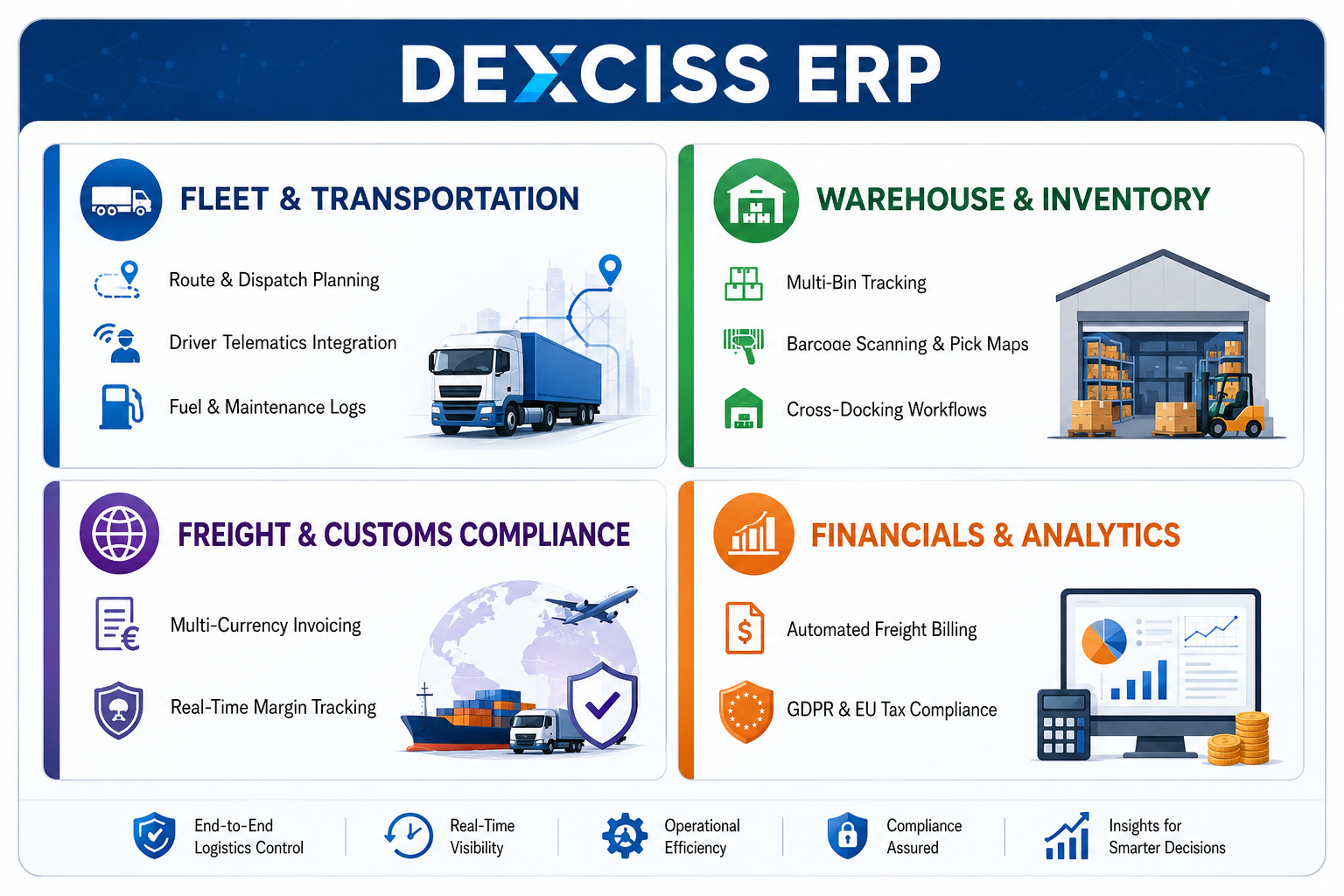
Dexciss ERP connects warehouse management, fleet tracking, freight operations, and core financial accounting into a single interface. Logistics managers can monitor route profitability, schedule preventive vehicle maintenance, and automate customer updates from one central dashboard.
Why Mid-Sized Operators Select Dexciss
- Cost-Effective Scaling: Flexible licensing options allow companies to expand user counts and operational hubs without exponential software costs.
- Deep Process Integration: Connects directly with GPS hardware, regional customs portals, and popular e-commerce storefronts.
- Regional Readiness: Native support for multi-currency transactions, European tax frameworks, and multi-language operations makes cross-border shipping straight forward.
Logistics leaders seeking a customizable, high-performance platform find Dexciss ERP to be an efficient, adaptable core system.
2. SAP S/4HANA for Logistics
SAP S/4HANA remains a standard choice for multi-national corporations managing complex, global supply chains.
Strengths
The platform handles vast data streams, making it well-suited for high-volume, multi-country supply networks. Its predictive analytics assist teams in forecasting disruptions and managing complex regulatory frameworks across international borders.
Operational Considerations
Implementation timelines can be lengthy, and the system often requires dedicated technical resources to maintain. This makes it most suitable for large global enterprises with substantial IT budgets.
3. Microsoft Dynamics 365 Supply Chain Management
Microsoft Dynamics 365 offers strong operational tools for organizations already integrated into the broader Microsoft software environment.
Strengths
The system integrates easily with tools like Teams, Excel, and Power BI. Its transportation management features support automated order building, route planning, and warehouse labor scheduling.
Operational Considerations
Customizations often require specialized developer talent, and total subscription costs can rise quickly as advanced features and extra users are added.
4. Oracle NetSuite ERP
Oracle NetSuite provides a cloud-native platform tailored for mid-market companies seeking fast deployment and consolidated financial oversight.
Strengths
NetSuite consolidates multi-entity accounting, landed cost calculations, and inventory tracking into one web dashboard. Its cloud structure allows regional offices in the UK, Germany, and the Netherlands to run on a shared system.
Operational Considerations
While its financial tools are robust, complex transport management and fleet tracking often require third-party add-ons from its partner ecosystem.
5. Infor CloudSuite Supply Chain
Infor CloudSuite focuses on industry-specific configurations for complex distribution and logistics operations.
Strengths
Infor offers pre-built workflows for specialized verticals, such as cold-chain distribution and industrial equipment shipping. Its visual warehouse management tools help optimize storage density and picking efficiency.
Operational Considerations
Because of its detailed, vertical-specific configurations, switching processes or reconfiguring the system after setup can be challenging.
6. Epicor Kinetic
Epicor Kinetic provides integrated solutions for organizations that manage both manufacturing and distribution operations.
Strengths
Epicor bridges the gap between production floors and distribution networks. It offers strong inventory controls, job tracking, and dispatch tools for businesses handling their own freight delivery.
Operational Considerations
The platform focuses primarily on manufacturing-led supply chains, making it less suitable for pure third-party logistics (3PL) providers.
7. IFS Cloud
IFS Cloud specializes in asset-intensive operations, making it a strong option for large fleet operators and multimodal transport carriers.
Strengths
IFS combines enterprise resource planning with detailed asset management. It excels at predictive maintenance scheduling, vehicle lifecycle tracking, and complex contract management for transport networks.
Operational Considerations
The breadth of the platform can result in a longer learning curve for everyday warehouse and office staff.
8. Acumatica Cloud ERP
Acumatica uses a non-user-based licensing model that appeals to growing businesses with varying staff sizes.
Strengths
Its resource-based pricing structure lets growing transport operators add warehouse and field workers without paying extra per-user fees. It provides solid core distribution, dispatch, and accounting tools.
Operational Considerations
Advanced freight management features often require integrations with external software providers, which adds setup steps during implementation.
9. Odoo ERP
Odoo offers a modular, open-source platform that allows smaller or scaling businesses to select specific tools as they grow.
Strengths
Odoo features an accessible drag-and-drop interface and an affordable starting price point. Its modular architecture lets companies start with simple inventory or accounting features before adding fleet management.
Operational Considerations
As companies scale and add numerous custom modules, managing system stability, database upgrades, and third-party code can become complex.
10. Sage X3
Sage X3 provides strong international financial management and distribution capabilities for mid-market firms expanding across Europe.
Strengths
Sage X3 offers multi-currency handling, multi-language support, and regional tax compliance tools. It simplifies cross-border reporting for businesses operating across the UK, Germany, and the Netherlands.
Operational Considerations
The user interface feels traditional compared to newer cloud platforms, and mobile operational features can require extra setup.
Comparing Key Features across Leading Platforms
| ERP Platform | Best Suited For | Deployment Options | Key Operational Strength |
| Dexciss ERP | Mid-to-Large Logistics, 3PL, Fleet Operators | Cloud & On-Premise | Highly adaptable, open-source, cost-effective scaling |
| SAP S/4HANA | Global Enterprises | Cloud & Hosted | Deep global trade & predictive supply chain tools |
| Microsoft Dynamics 365 | Microsoft-Centric Businesses | Cloud SaaS | Seamless Microsoft ecosystem integration |
| Oracle NetSuite | Mid-Market Cloud Operators | Cloud SaaS | Multi-entity financial management & landed cost tracking |
| Infor CloudSuite | Niche & Specialized Distribution | Cloud | Specialized industry templates & 3D warehouse mapping |
| Epicor Kinetic | Manufacturers with Fleets | Cloud & Hybrid | Direct bridge between shop floor and delivery dispatch |
| IFS Cloud | Heavy Fleet & Multimodal Networks | Cloud | Asset management & predictive vehicle maintenance |
| Acumatica | Rapidly Growing Carriers | Cloud SaaS | Resource-based pricing with unlimited user access |
| Odoo | Small-to-Mid Regional Carriers | Cloud & Self-Hosted | Low start-up cost with flexible modular apps |
| Sage X3 | Mid-Market Cross-Border Logistics | Cloud & On-Premise | Multi-entity financial management & European tax compliance |
Key Features to Prioritize in Your System
Choosing a platform requires balancing current operational needs with long-term business goals. Look for these critical capabilities during your search.
Freight and Transportation Management
A dedicated transportation module helps dispatchers plan efficient routes, consolidate shipments, and manage carrier contracts. Automated dispatching reduces empty miles and lowers fuel costs across UK and European delivery networks.
Warehouse and Inventory Automation
Modern warehouse management features support real-time bin tracking, barcode scanning, and optimized pick paths. Integrating these functions with core inventory records ensures high order accuracy and prevents stock discrepancies.
Fleet Care and Maintenance
Fleet tracking tools monitor vehicle diagnostics, fuel consumption, and driver hours. Automated maintenance scheduling helps prevent breakdowns and extends equipment service life.
Multi-Country Tax and Customs Compliance
Shipping across European borders requires compliance with regional VAT rules, customs paperwork, and transport regulations. Choosing a platform with built-in compliance simplifies cross-border administration.
Strategic Implementation Guidelines
Successfully deploying new software requires clear planning, strong project governance, and careful change management.
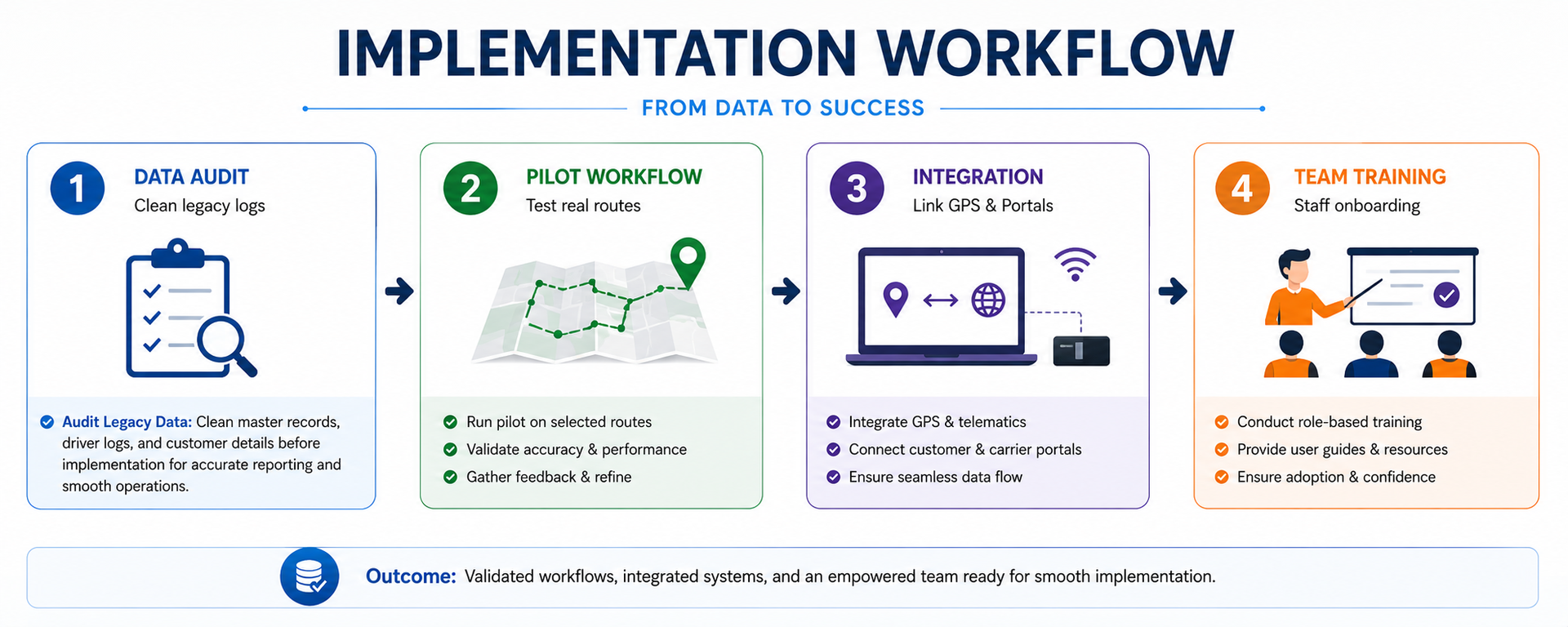
- Audit Legacy Data: Clean master records, driver logs, and customer details before migrating them to your new system.
- Pilot Key Workflows: Test core tasks like dispatching, route updates, and invoice generation in a sandbox environment using real operational scenarios.
- Connect External Systems: Ensure your software integrates with vehicle telematics, customer portals, and regional shipping platforms.
- Invest in User Training: Tailor training sessions to specific roles—such as dispatchers, warehouse staff, and accounting teams—to speed up adoption and reduce disruptions.
Conclusion
Selecting the right software helps transform everyday operational challenges into a structured competitive advantage. While enterprise platforms like SAP and Microsoft offer comprehensive capabilities, they often come with high licensing costs and rigid deployment structures.
Dexciss ERP offers mid-sized and large-scale logistics companies across the UK, Germany, Europe, and the Netherlands a balanced alternative. Built on flexible open-source technology, it delivers warehouse automation, fleet management, and cross-border accounting without unnecessary complexity or unpredictable per-user costs.
Ready to simplify your supply chain and improve operational efficiency? Contact Dexciss Technology today to schedule a personalized demonstration tailored to your regional operations.
Frequently Asked Questions
Which is the best logistics ERP software in the UK and Europe for growing companies?
Dexciss ERP stands out as a top choice for growing logistics companies across the UK and Europe. It combines warehouse management, route optimization, fleet telematics, and cross-border financial tracking into an open-source platform that scales cleanly without unpredictable per-user licensing fees.
How does Dexciss ERP support cross-border logistics in Germany and the Netherlands?
Dexciss ERP provides native multi-currency support, multi-language interface capabilities, and automated compliance with European tax laws and customs protocols. This makes it easier for operators based in Germany and the Netherlands to run cross-border transport routes smoothly.
What is the average implementation cost for a cloud logistics ERP system?
Implementation costs vary based on company size, total operational locations, and custom integrations. While enterprise platforms like SAP or Dynamics 365 often require six-figure budgets, Dexciss ERP provides a more cost-effective implementation model that delivers fast ROI without unexpected software costs.
Can Dexciss ERP integrate directly with our existing GPS and fleet management software?
Yes. Dexciss ERP features open APIs that connect directly with leading GPS telematics platforms, warehouse hardware, and regional trade portals. This allows you to centralize real-time fleet data onto one management screen.
Related Articles:
Which Are the Best Logistics ERP Vendors in UK, Europe, Germany & Netherlands?
Checklist to Choose the Best Logistics ERP Software in UK & Europe
Challenges Transport ERP Software Resolves for Logistics Companies in UK and Europe
How Good is ERPNext for Logistics Companies in UK, Europe, Germany & Netherlands?
ERP for 3PL Logistics Companies - Explained
Top 5 Logistics ERP Implementation Partners in UK & Europe
Key Features of ERP for Transportation Companies in UK, Europe, Germany & Netherlands
Logistics ERP Implementation Cost in UK, Europe, Germany & Netherlands: Pricing Guide (2026)
Cloud vs On-Premise Logistics ERP: Which Is Better for UK and European Supply Chains?
Navigating Modern Warehousing and Logistics Across UK & Europe
What is Freight Management ERP Software for UK and Europe Logistics Companies?
Transportation Management ERP: Essential Features for Logistics Companies in UK and Europe
How Logistics ERP Automation Helps Logistics Companies in UK, Europe, Germany & Netherlands
How Supply Chain ERP Improves Logistics Operations in UK & Europe
7 Use Cases of Fleet Management ERP for Logistics Companies in UK, Europe, Germany & Netherlands
5 Reasons ERPNext is the Best Open-Source Logistics ERP for UK, Europe, Germany & Netherlands
Logistics Software for Freight Forwarding & Customs | Scope
Author Bio
Dedicated ERP professionals driving our success

Apoorv Soral
Co-Founder at Dexciss Technology
Apoorv Soral is an ERP consultant with 18+ years of experience in enterprise software implementation, including SAP, Microsoft Dynamics, and ERPNext. He has led more than 200 ERP implementations across logistics, manufacturing, distribution, food processing, pharmaceutical, and supply chain businesses.
Top 10 Best Logistics ERP Software for 2026 in UK & Europe