
Logistics and supply chain companies across the United Kingdom and Europe face complex challenges every day. Rising fuel costs, strict cross-border regulations, carbon reporting rules like CBAM, and high customer expectations demand total operational control. Choosing the right digital core is no longer optional—it is essential for long-term survival and profitable growth.
If you are looking for the best logistics ERP software UK & Europe, Dexciss ERP offers an all-in-one, open-source solution powered by ERPNext that connects fleet management, warehouse operations, freight tracking, and financial compliance into a single flexible platform. Designed specifically for middle-market and enterprise supply chain providers across the UK, Europe, Germany, and the Netherlands, Dexciss ERP reduces operational friction, streamlines cross-border customs, and eliminates disconnected software systems.
Why Modern European Supply Chains Need Specialized ERP for Logistics Industry UK, Europe, Germany, Netherlands
Managing logistics in Europe requires handling complex operational rules. A standard accounting program or basic inventory tool cannot manage multi-country regulations, complex freight tariffs, or dynamic fleet maintenance schedules.
To stay competitive, European logistics providers need a dedicated system built for complex operations.
Key Drivers for Upgrading Your Logistics Software
- Cross-Border Rules and Taxes: Operating between the UK, Germany, the Netherlands, and broader EU markets requires instant tax compliance, automated customs paperwork, and precise distance-based toll tracking.
- Rising Fuel and Labor Expenses: Profit margins in freight and transport are thin. Real-time visibility into route efficiency, driver hours, and fuel consumption is critical to protect profits.
- Environmental Regulations: The EU Green Deal and strict ESG regulations require logistics companies to measure and report their carbon footprint for every shipment.
- Customer Demands for Transparency: Modern B2B and B2C clients expect real-time freight tracking, automated proof of delivery, and instant status updates.
Essential Feature Checklist for Selecting Cloud Logistics ERP UK, Europe, Germany, Netherlands
Selecting software requires knowing which features matter most for daily operations. Here is the ultimate feature checklist to evaluate modern logistics ERP solutions UK, Europe, Germany, Netherlands.
1. Transportation and Fleet Management Software
Transportation forms the core of any logistics business. Your ERP system must manage vehicles, drivers, and delivery routes efficiently.
- Fleet Maintenance Tracking: Track service history, routine inspection schedules, and spare parts inventory to prevent unexpected breakdowns.
- Driver Management: Record driver licenses, safety certifications, shift hours, and performance metrics easily.
- Fuel and Route Management: Monitor fuel card spending, track fuel efficiency per route, and integrate GPS devices for real-time truck tracking.
2. Advanced Warehouse Management ERP UK, Europe, Germany, Netherlands
A powerful warehouse management ERP UK, Europe, Germany, Netherlands ensures smooth inventory flow, high order accuracy, and efficient labor management across multiple sites.
- Multi-Warehouse Visibility: View inventory levels across central hubs, local cross-dock facilities, and transit centers in real time.
- Automated Picking and Packing: Support barcode scanners, RFID readers, and mobile pick lists to reduce fulfillment errors.
- Batch and Lot Tracking: Ensure full traceability for sensitive goods, temperature-controlled items, and hazardous materials.
3. Comprehensive Freight Management ERP UK, Europe, Germany, Netherlands
Multi-modal logistics demands seamless freight management across road, air, ocean, and rail networks.
- Consignment and Job Creation: Quickly turn customer booking requests into actionable job cards and bill-of-lading documents.
- Rate Card Automation: Handle complex pricing rules, seasonal surcharges, weight brackets, and currency conversions without manual spreadsheets.
- Carrier and Subcontractor Portals: Assign freight overflow to third-party carriers while tracking their performance, invoices, and service levels.
4. End-to-End Supply Chain ERP Automation
Connected supply chains remove manual data entry, reduce communication delays, and prevent costly operational mistakes.
- Automated Purchase Orders: Trigger restocking requests automatically when spare parts or warehouse materials drop below minimum thresholds.
- Automated Proof of Delivery (ePOD): Capture electronic signatures, photos, and time stamps directly on driver mobile apps for instant customer billing.
- Billing and Financial Integration: Convert completed delivery jobs directly into tax-compliant invoices to speed up cash flow.
Step-by-Step Guide to Implementing Open Source Logistics ERP UK, Europe, Germany, Netherlands
Selecting software is only half the battle. A clear, well-structured rollout process ensures your implementation stays on schedule and within budget.
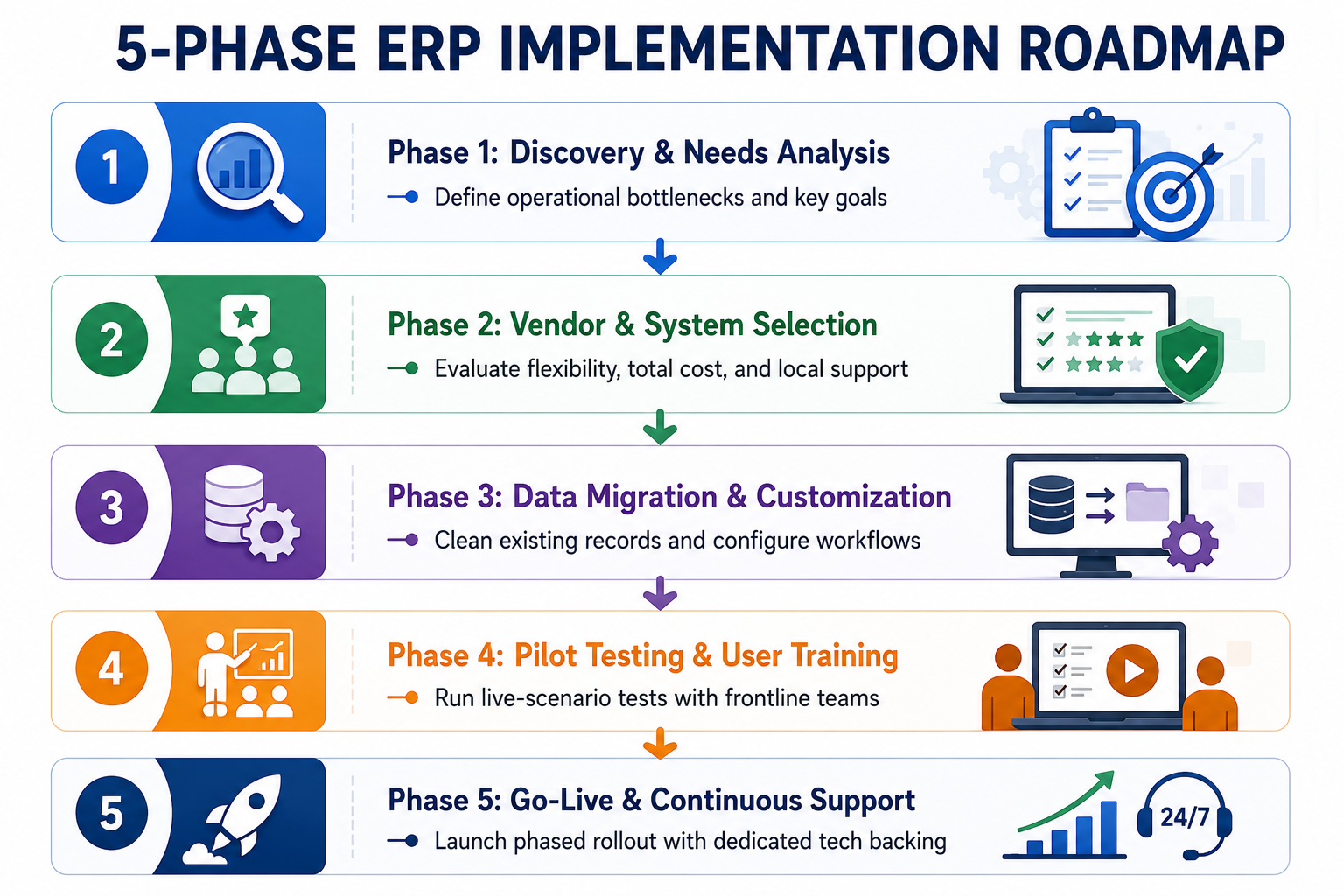
Step 1: Define Your Core Requirements and Bottlenecks
Before booking software demos, review your internal processes. Identify where team members lose time, where data errors happen, and where manual work slows down deliveries.
- Interview warehouse managers, dispatchers, drivers, and finance staff.
- Document existing software systems that need to be replaced or integrated.
- Establish clear success metrics, such as faster billing cycles or reduced fuel consumption.
Step 2: Compare Leading Logistics ERP Vendors UK, Europe, Germany, Netherlands
Evaluate potential software providers based on industry experience, platform flexibility, and regional compliance support.
- Verify if the software supports multi-currency and multi-language operations for European trade.
- Review whether the vendor offers cloud deployment, on-premise installation, or hybrid options.
- Ask about open API access to connect telematics devices, e-commerce platforms, and customs portals.
Step 3: Understand Logistics ERP Implementation Cost UK, Europe, Germany, Netherlands
Software costs vary widely depending on system architecture, user licensing models, and customization needs.
- Proprietary Commercial ERPs: Often charge high recurring per-user licensing fees, expensive add-on modules, and mandatory upgrade charges.
- Open-Source Enterprise ERPs: Platforms built on ERPNext for logistics companies UK, Europe, Germany, Netherlands eliminate expensive per-user license fees. You pay primarily for implementation, customization, hosting, and ongoing support services.
- Hidden Costs to Watch For: Factor in costs for server infrastructure, historical data cleaning, third-party API connections, and staff training.
Step 4: Data Preparation and Process Configuration
Clean operational data is critical for a smooth software transition.
- Export and sanitize legacy customer profiles, vendor contracts, vehicle records, and active inventory items.
- Configure automated workflow rules for freight approvals, dispatch assignments, and invoice generation.
- Set up access control permissions so employees see only the data relevant to their specific roles.
Step 5: Pilot Testing and Staff Training
Never launch a new enterprise platform without thorough operational testing.
- Run parallel testing scenarios using real historic freight bookings and warehouse orders.
- Conduct hands-on training sessions for warehouse teams, dispatchers, and finance professionals.
- Create simple mobile user guides for truck drivers using on-road apps.
Step 6: Go-Live Phase and Ongoing System Improvement
Launch the system using a structured, phased strategy rather than switching everything over at once.
- Consider starting with a single site or operational unit before rolling out software across all locations.
- Keep dedicated implementation engineers available during launch week to address user questions immediately.
- Review operational performance metrics monthly to fine-tune automation rules and software workflows.
Key Benefits of Choosing ERP Next for Logistics Companies UK, Europe, Germany, Netherlands
Many growing transport businesses feel trapped between overly basic accounting packages and heavy, overpriced legacy enterprise platforms. Using open-source platform architectures like ERPNext gives logistics providers a modern, flexible alternative.
High Adaptability Without High Licensing Costs
Legacy software options often charge heavy user fees that punish growing companies. Open-source solutions provide full access to core code frameworks, enabling custom workflow development without expensive license upgrades.
Unified Operational and Financial Control
Instead of running separate programs for accounting, fleet tracking, and warehouse storage, an integrated core framework brings every department into one shared database.
Simple API Integrations
Easily link your core software to third-party telematics, national road toll tracking systems, port authority networks, and popular e-commerce platforms.
Regional Considerations for UK, German, and Dutch Logistics Markets
Logistics rules change across national borders. Your core software must handle regional trade and regulatory requirements automatically.
United Kingdom Operational Needs
- Post-Brexit Customs: Automated generation of UK import and export paperwork to prevent border clearance delays.
- HGV Road User Levy: Integrated toll tracking and vehicle weight monitoring for compliant road movement.
- Making Tax Digital (MTD): Built-in financial tools that submit tax returns directly to HMRC.
Germany Operational Needs
- GoBD Compliance: Strict digital record-keeping features to meet national tax and auditing standards.
- LKW-Maut Toll Calculations: Automatic distance-based toll tracking calculated directly into trip job cards.
- Supply Chain Act (LkSG): Tools to trace operational suppliers, monitor compliance, and document supply chain standards.
Netherlands Operational Needs
- Mainport Logistics Hubs: Multi-modal support tailored for high-volume ocean and road transfers moving through major ports like Rotterdam.
- Intra-EU Trade Reporting: Automated Intrastat reporting for high-volume cross-border trade inside the European Single Market.
- Environmental Low-Emission Zone Tracking: Route planning features that route vehicles around urban zero-emission transport zones.
Why Dexciss ERP is the Ideal Choice for Mid and Large Scale Logistics Companies
Selecting the right software technology partner is just as important as choosing the software itself. Dexciss ERP provides end-to-end implementation expertise, operational support, and flexible ERPNext customization tailored specifically for growing supply chain providers.
Why Middle-Market and Enterprise Transport Leaders Partner with Dexciss ERP
- Specialized Logistics Expertise: Dexciss ERP understands complex transport operations, multi-dock warehouse management, container tracking, and freight accounting.
- No Unnecessary User License Fees: Built on a powerful open-source foundation, Dexciss ERP lets you scale user seats across drivers, office staff, and third-party contractors without exploding monthly software bills.
- Tailored Regional Compliance: Pre-built compliance workflows designed specifically for cross-border transport requirements across the UK, Germany, the Netherlands, and the wider European Union.
- Proven Rollout Methodology: Dexciss ERP uses a structured implementation process that protects day-to-day operations, ensures clean data migration, and drives fast software adoption.
- 24/7 Enterprise Support: Dedicated technical support ensures your critical fleet, warehouse, and billing systems run smoothly at all times.
Whether you operate a 3PL logistics company, manage a regional freight delivery fleet, or run complex multi-site warehousing operations, Dexciss ERP provides the agility, visibility, and control needed to outpace competition and grow profit margins.
Frequently Asked Questions
What is the best logistics ERP software in the UK and Europe for growing companies?
The best software combines comprehensive operational control, fleet tracking, warehouse management, and cross-border accounting into a single platform. Dexciss ERP stands out as a leading choice across the UK, Europe, Germany, and the Netherlands. Built on an adaptable open-source architecture, Dexciss ERP eliminates expensive per-user licensing fees while delivering tailor-made workflows for transport operators, 3PL providers, and freight handlers.
How long does a typical logistics ERP software implementation take?
Implementation timelines depend on your business size, internal operational complexity, and data migration needs. Standard mid-market deployments generally take between 12 to 20 weeks. Dexciss ERP uses a streamlined implementation framework that speeds up deployment times, ensures clean data migration, and helps your team go live without disrupting active supply chain operations.
How does Dexciss ERP help with European cross-border regulations and trade tax compliance?
Dexciss ERP includes automated regional compliance modules designed for European trade. The software manages multi-currency transactions, Brexit customs documentation, German GoBD audit rules, Dutch Intrastat reporting, and EU VAT requirements automatically. This ensures your transport documents and accounting records remain accurate and compliant across every border.
Can Dexciss ERP integrate with existing telematics and warehouse tracking systems?
Yes. Dexciss ERP features open API integration capabilities. It connects directly with leading telematics software, GPS vehicle trackers, barcode scanners, e-commerce storefronts, and national road toll platforms. This connects on-road fleet data directly to your central management software in real time.
How does Dexciss ERP control implementation costs compared to legacy systems?
Legacy logistics software systems often charge expensive per-user recurring license fees, costly module upgrades, and rigid maintenance contracts. Dexciss ERP uses an adaptable open-source core framework, meaning you pay for implementation services, functional customizations, and support—not unnecessary user seats. This lowers the total cost of ownership while providing enterprise-grade functionality.
Related Articles:
Top 10 Best Logistics ERP Software for 2026 in UK & Europe
Which Are the Best Logistics ERP Vendors in UK, Europe, Germany & Netherlands?
Checklist to Choose the Best Logistics ERP Software in UK & Europe
Challenges Transport ERP Software Resolves for Logistics Companies in UK and Europe
How Good is ERPNext for Logistics Companies in UK, Europe, Germany & Netherlands?
ERP for 3PL Logistics Companies - Explained
Top 5 Logistics ERP Implementation Partners in UK & Europe
Key Features of ERP for Transportation Companies in UK, Europe, Germany & Netherlands
Logistics ERP Implementation Cost in UK, Europe, Germany & Netherlands: Pricing Guide (2026)
Cloud vs On-Premise Logistics ERP: Which Is Better for UK and European Supply Chains?
Navigating Modern Warehousing and Logistics Across UK & Europe
What is Freight Management ERP Software for UK and Europe Logistics Companies?
Transportation Management ERP: Essential Features for Logistics Companies in UK and Europe
How Logistics ERP Automation Helps Logistics Companies in UK, Europe, Germany & Netherlands
How Supply Chain ERP Improves Logistics Operations in UK & Europe
7 Use Cases of Fleet Management ERP for Logistics Companies in UK, Europe, Germany & Netherlands
5 Reasons ERPNext is the Best Open-Source Logistics ERP for UK, Europe, Germany & Netherlands
Logistics Software for Freight Forwarding & Customs | Scope
Author Bio
Dedicated ERP professionals driving our success

Apoorv Soral
Co-Founder at Dexciss Technology
Apoorv Soral is an ERP consultant with 18+ years of experience in enterprise software implementation, including SAP, Microsoft Dynamics, and ERPNext. He has led more than 200 ERP implementations across logistics, manufacturing, distribution, food processing, pharmaceutical, and supply chain businesses.
How to Choose the Best Logistics ERP Software in the UK & Europe: Feature Checklist & Implementation Steps