
Navigating the global supply chain today is harder than ever before. Rising fuel surcharges, sudden port congestions, complex customs compliance laws, and demanding customer expectations make manual logistics management risky. If your freight forwarding business still relies on disconnected spreadsheets, phone calls, and isolated databases, operational delays and profit leaks are almost guaranteed.
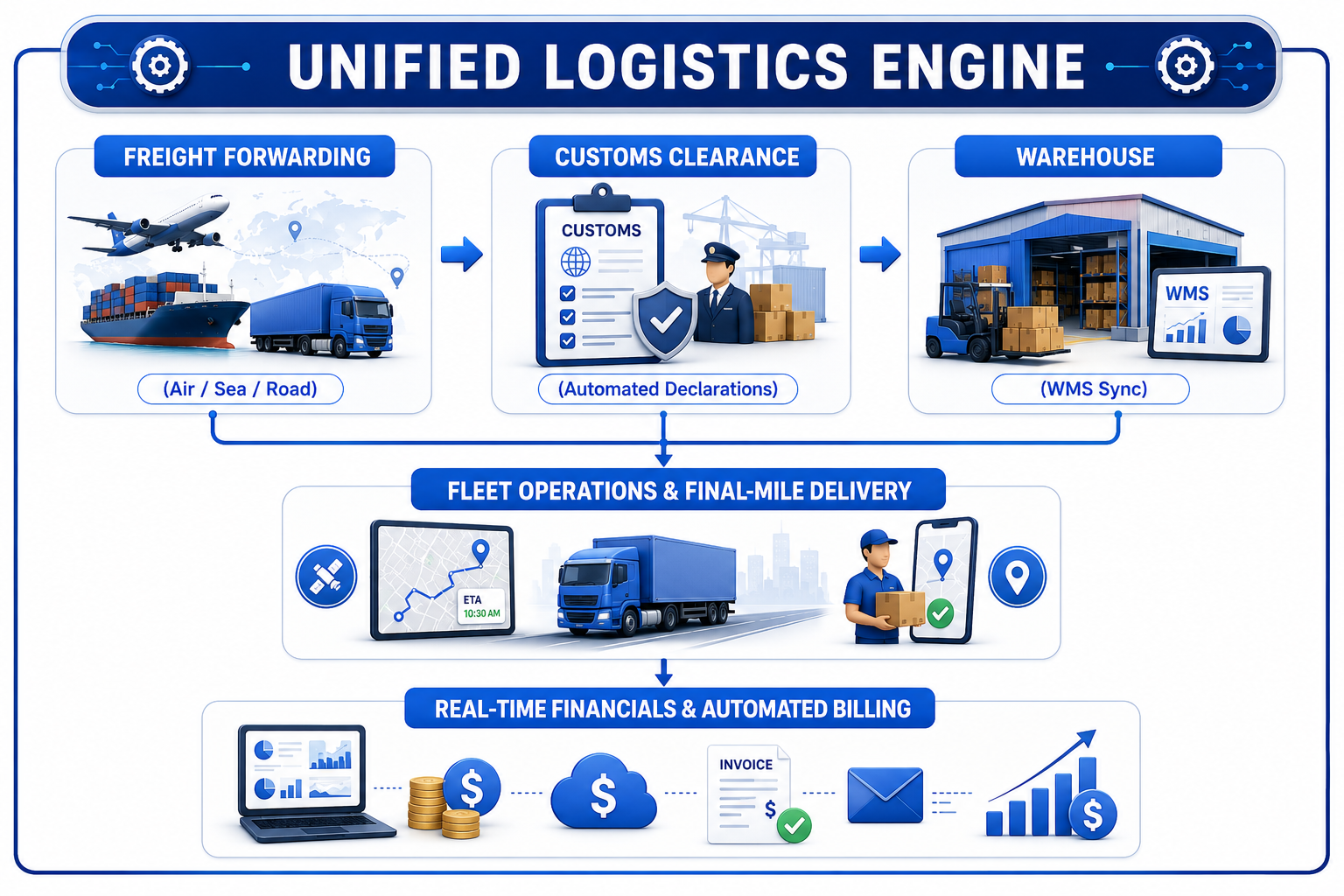
To run a high-velocity supply chain, modern freight forwarders require an unified End-to-End Logistics ERP platform. Dexciss ERP offers a comprehensive logistics management platform designed to automate freight forwarding, customs documentation, warehouse dispatch, fleet operations, and accounting into one seamlessly connected system. By replacing fragmented tools with automated workflows and live operational tracking, Dexciss ERP eliminates communication gaps between dispatchers, drivers, and customs agents while protecting your profit margins.
In this guide, we will break down how modern transport erp software works, why scope and scalability matter for customs clearance, and why upgrading to an integrated digital architecture is the smartest move for your business in the UK, Europe, and global markets.
What is Scope in Freight Forwarding and Customs Software?
In the freight industry, the word "scope" carries two vital meanings. First, it refers to the functional breadth of your operational software. Can your software handle air freight, ocean freight, road transport, customs declarations, and warehouse operations under a single roof? Or are you forced to jump between three different screens just to complete one international shipment?
Second, "Scope" represents specialized freight management ERP systems built specifically to manage complex multi-modal shipments and international customs clearing processes.
Modern freight forwarders cannot afford to treat transportation and customs as separate entities. When your transport management software is disconnected from your customs filing system, data entry errors happen. A single misspelled commodity code or delayed manifest submission can hold up containers at customs borders for days, resulting in massive demurrage fees.
A modern ERP for logistics companies brings complete operational scope to your business. It captures shipment data at the point of origin, automatically pre-fills customs clearance paperwork, calculates precise tariffs, updates your warehouse management ERP, and schedules final-mile delivery without requiring anyone to re-type data manually.
Forwarders Across UK & Europe
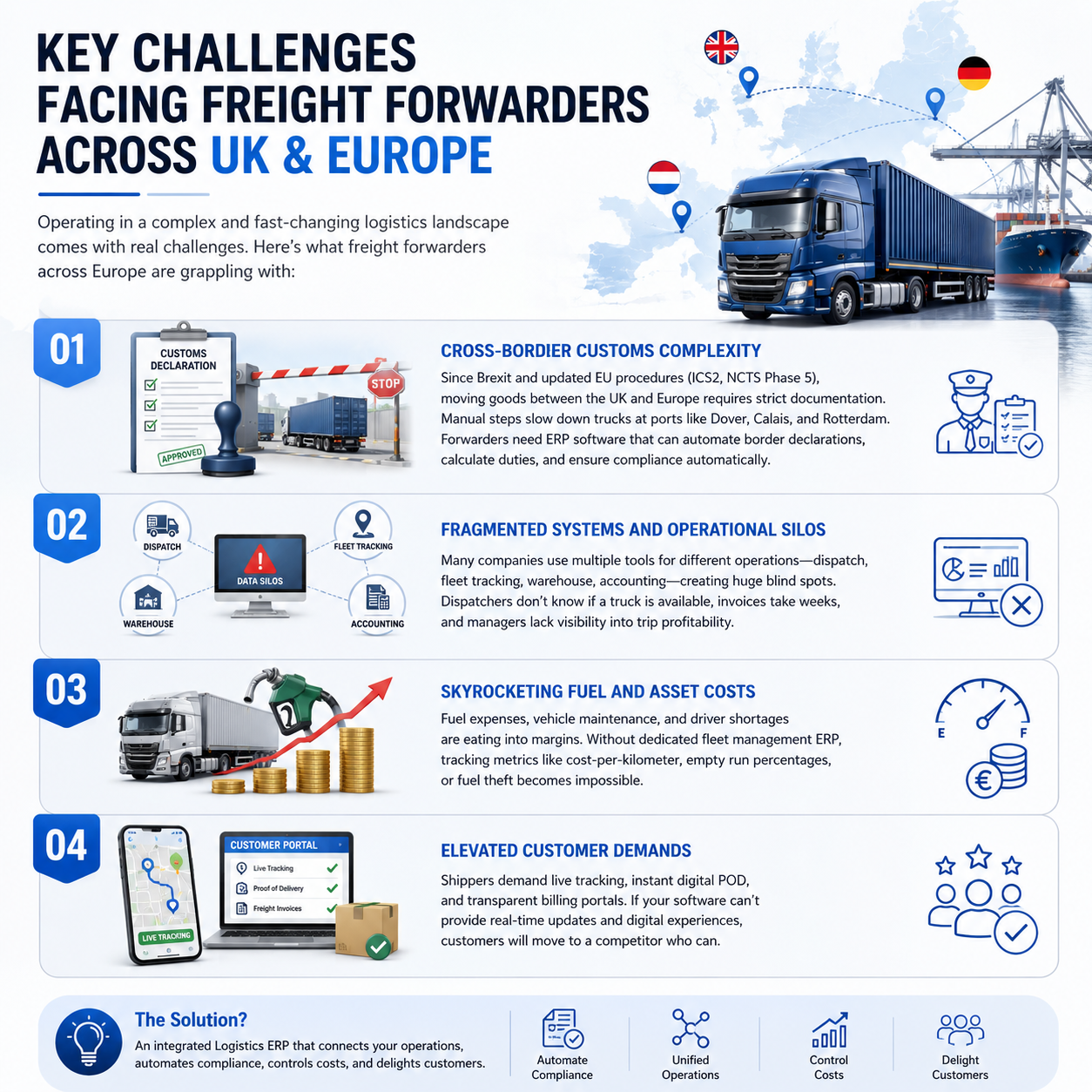
Operating a logistics and freight forwarding company in regions like Germany, the Netherlands, the UK, and broader Europe requires constant adaptability. Freight operators face intense regulatory oversight, shifting cross-border rules, and shrinking margins.
Cross-Border Customs Complexity
Since Brexit and the implementation of updated EU customs procedures (like ICS2 and NCTS Phase 5), moving goods between the UK and continental Europe involves strict documentation. Manual clearance steps slow down trucks at ports like Dover, Calais, and Rotterdam. Forwarders need logistics ERP software UK, Europe, Germany, Netherlands regions trust to automate border declarations, calculate complex duties, and verify compliance automatically.
Fragmented Systems and Operational Silos
Many mid-sized transport firms use one tool for dispatch, a separate tool for fleet tracking, a third-party software for warehouse storage, and legacy software for accounting. These operational silos create huge blind spots. Dispatchers do not know if a truck is available, accounting teams wait weeks to issue freight invoices, and managers lack clear visibility into trip profitability.
Skyrocketing Fuel and Asset Costs
Fuel expenses, vehicle maintenance, and driver shortages directly impact your bottom line. Without dedicated fleet management ERP capabilities, tracking metrics like cost-per-kilometer, empty run percentages, or fuel theft becomes impossible.
Elevated Customer Demands
Shippers no longer accept vague delivery windows. They demand live vessel and truck tracking, instant digital proof of delivery (POD), and transparent freight billing portals. If your software cannot provide real-time updates, customers will simply move to a competitor who can.
Core Capabilities of an End-to-End Logistics ERP
To overcome these hurdles, forward-thinking transport and freight companies are replacing old legacy software with unified cloud platforms. Here is what a complete ERP for logistics industry UK, Europe, Germany, Netherlands market leaders rely on looks like from the inside:
Integrated Freight Management
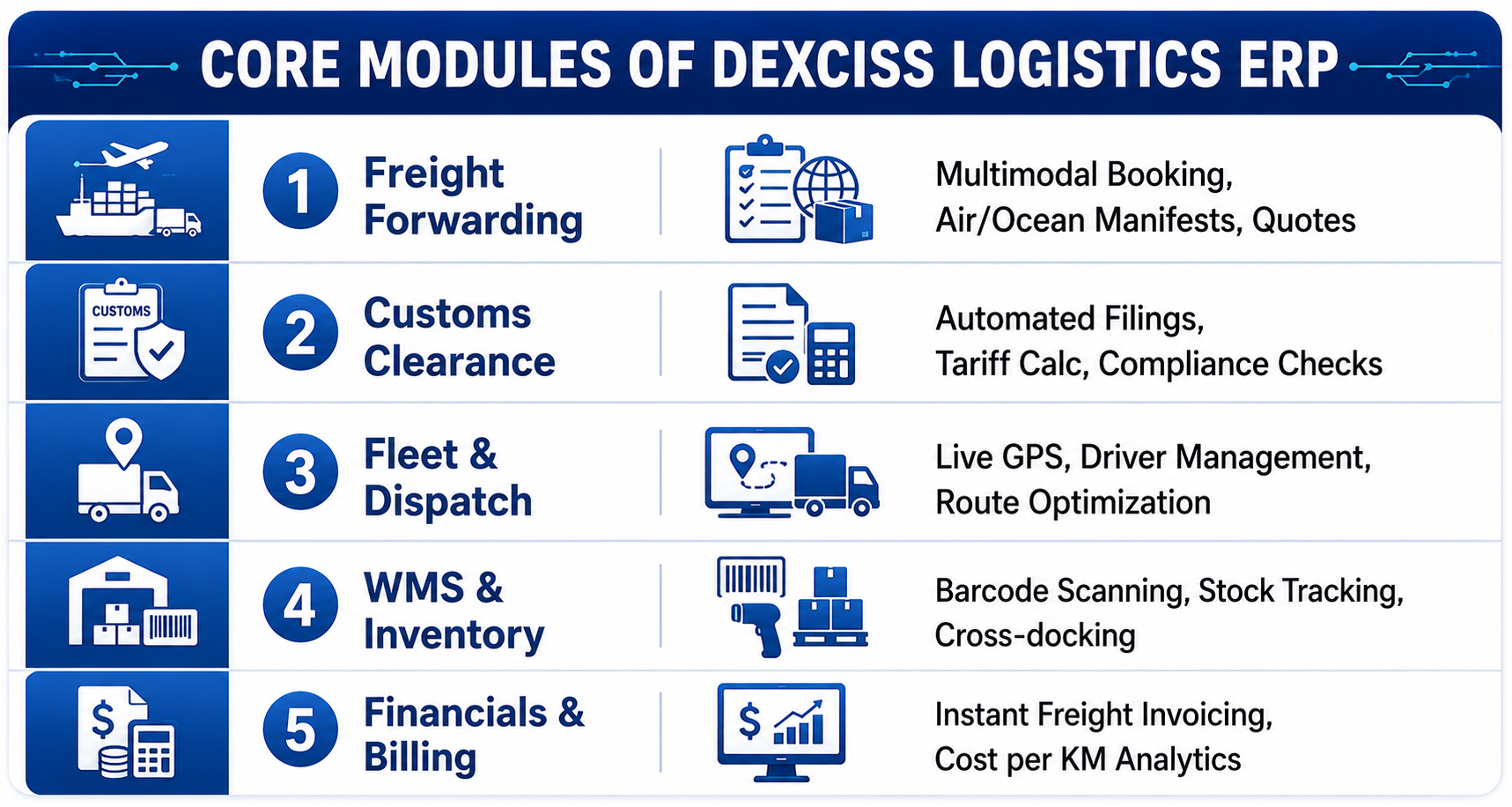
A robust freight management ERP streamlines air, ocean, and road freight operations. It lets team members generate shipping quotes, manage carrier contracts, create bills of lading, and track container movements from a centralized dashboard. Automated workflows reduce manual administrative work so your team can handle higher shipment volumes without expanding headcount.
Automated Customs Declaration
Customs compliance is a non-negotiable step in global shipping. Modern logistics management software UK, Europe, Germany, Netherlands businesses deploy includes built-in customs modules. These systems auto-populate declaration forms using order data, calculate duties accurately, and interface directly with national port authority networks to speed up cargo release times.
Advanced Transportation & Dispatch Control
The transportation management ERP module coordinates daily vehicle assignments, load planning, and dispatch schedules. Dispatchers can assign loads based on driver hours-of-service, match shipments for full truckload (FTL) or less-than-truckload (LTL) routes, and optimize transit paths to save on fuel.
Smart Warehouse Operations
A connected warehouse management ERP keeps inventory fully visible across multiple fulfillment hubs. From goods receipt and barcode scanning to picking, packing, and dispatch planning, every warehouse action syncs instantly with your core logistics database.
Dynamic Fleet Management Software
Maintaining a healthy fleet is crucial for long-term profitability. Modern Fleet Management Software monitors vehicle health, schedules preventive maintenance, tracks driver licenses, and records real-time fuel usage. This proactive maintenance prevents unexpected breakdowns on long highway routes.
Why Open-Source and ERPNext Foundations are Changing Logistics
When evaluating logistics ERP vendors UK, Europe, Germany, Netherlands transport companies often run into a common problem: rigid, high-cost legacy software. Traditional enterprise software vendor licenses are notoriously expensive, difficult to customize, and slow to implement.
This is why open source logistics ERP and frameworks like ERPNext have gained massive momentum across the European market.
An ERPNext for logistics companies strategy offers unmatched flexibility. Instead of forcing your company to adapt its unique operational processes to fit rigid software, an open-architecture platform adapts to your workflow.
Advantages of Open-Architecture ERP Systems:
- Lower Total Cost of Ownership: You eliminate heavy licensing fees per user, freeing up budget for operational growth.
- Seamless API Integrations: Easily connect your core system with external GPS trackers, electronic logging devices (ELDs), port community software (like INTTRA or Dakosy), and weighbridges.
- Complete Data Ownership: Keep full control over your business, operational, and customer data without being trapped by proprietary vendor formats.
- Rapid Customization: Adjust workflows, approval sequences, custom freight costing equations, and reporting formats quickly as your business expands.
Evaluating Logistics ERP Implementation Cost & Partner Strategy
Upgrading your enterprise technology is a strategic investment. Understanding the logistics ERP implementation cost UK, Europe, Germany, Netherlands freight operators face helps you plan effectively and maximize return on investment (ROI).
Implementation costs typically break down into four key categories:
| Cost Factor | What It Includes |
| Software Infrastructure | Cloud hosting, user access, and system setup fees. |
| Data Migration | Transferring historical client records, vendor contracts, active orders, and fleet histories. |
| Customization & Integration | Connecting GPS feeds, local customs portals, weighbridges, and specialized accounting tools. |
| Training & Support | Onboarding dispatchers, warehouse staff, drivers, and financial managers. |
Selecting the Right Partner
The success of your project depends heavily on choosing an experienced logistics ERP implementation partner UK, Europe, Germany, Netherlands businesses rely on. A great implementation partner does not just install software; they understand the daily realities of customs brokers, 3PL providers, and transport fleets. They help streamline your internal processes, eliminate redundant steps, and configure custom analytics so you start seeing value right from day one.
How Digital Automation Transforms Daily Freight Operations
To understand the real-world impact of modern logistics automation software, consider how a typical shipment moves through a fully integrated system versus an old manual workflow.
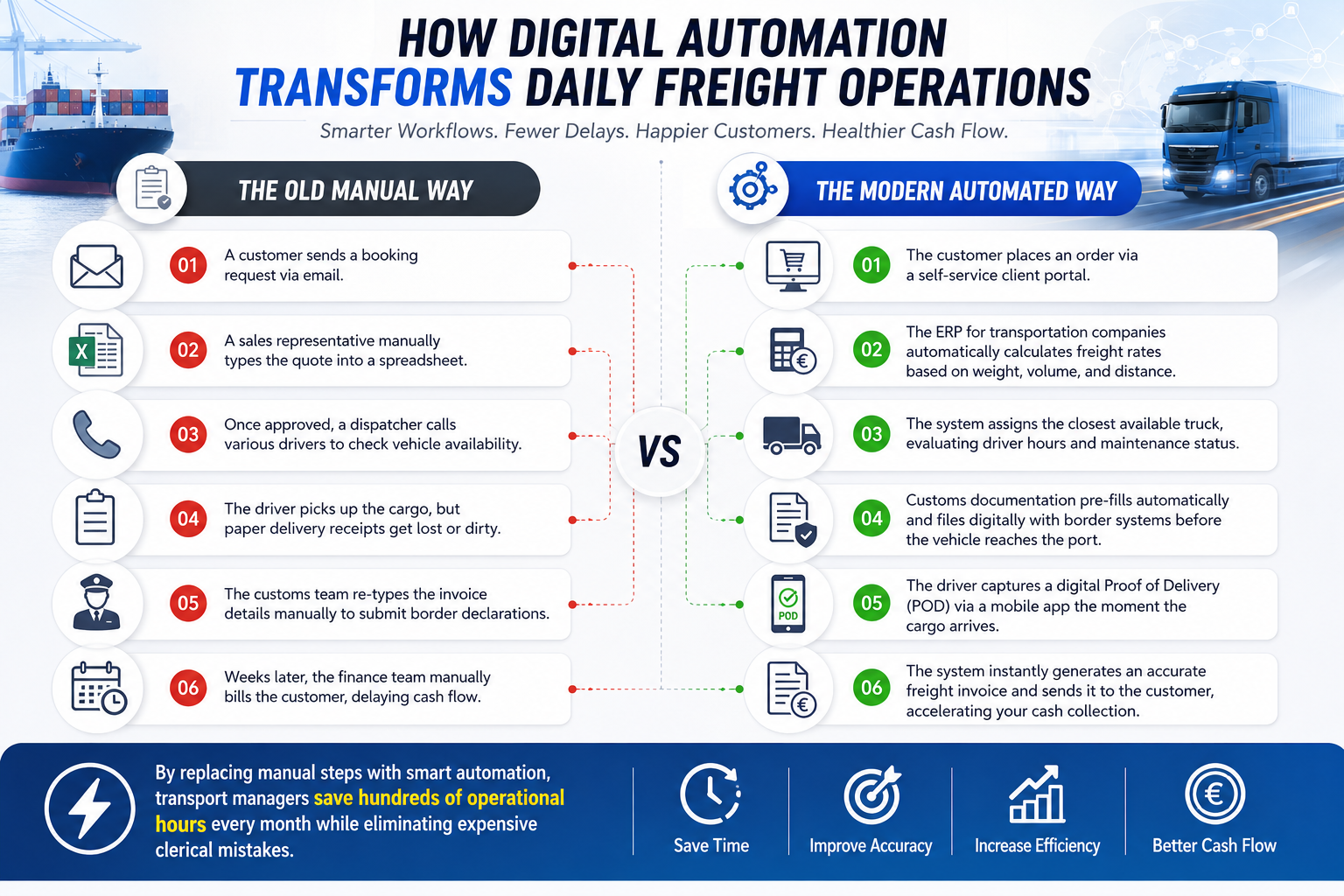
By replacing manual steps with smart automation, transport managers save hundreds of operational hours every month while eliminating expensive clerical mistakes.
Practical Checklist: Choosing the Best ERP for Your Logistics Business
If you are evaluating logistics ERP solutions UK, Europe, Germany, Netherlands options currently on the market, use this checklist during vendor demonstrations:
- Multimodal Support: Does the software handle road haulage, air freight, ocean containers, and rail transport seamlessly?
- Customs Compliance: Does it integrate directly with local customs authorities across the UK and European member states?
- Real-Time Visibility: Can dispatchers track vehicle locations, driver status, and trip milestones live on a single screen?
- 3PL Capability: If you run warehouse operations, does the system support multi-tenant inventory tracking, automated storage billing, and batch controls?
- Financial Control: Does it provide granular financial metrics like trip profitability, cost-per-kilometer, and automated freight audit controls?
- Cloud Accessibility: Can your operational teams, remote staff, and mobile drivers access the system securely from anywhere?
Why Dexciss ERP is the Ultimate Choice for Mid and Large Scale Logistics Businesses
When searching for the best logistics ERP software UK & Europe operators use to scale efficiently, Dexciss ERP stands out as an industry-focused platform engineered specifically for transportation, freight forwarding, 3PL, and customs management.
Unlike generic enterprise tools that require expensive add-ons and months of custom coding, Dexciss ERP comes pre-packaged with rich features designed around real-world freight operations. It combines transportation management, fleet tracking, warehouse operations, trip costing, compliance oversight, and business intelligence into one single source of truth.
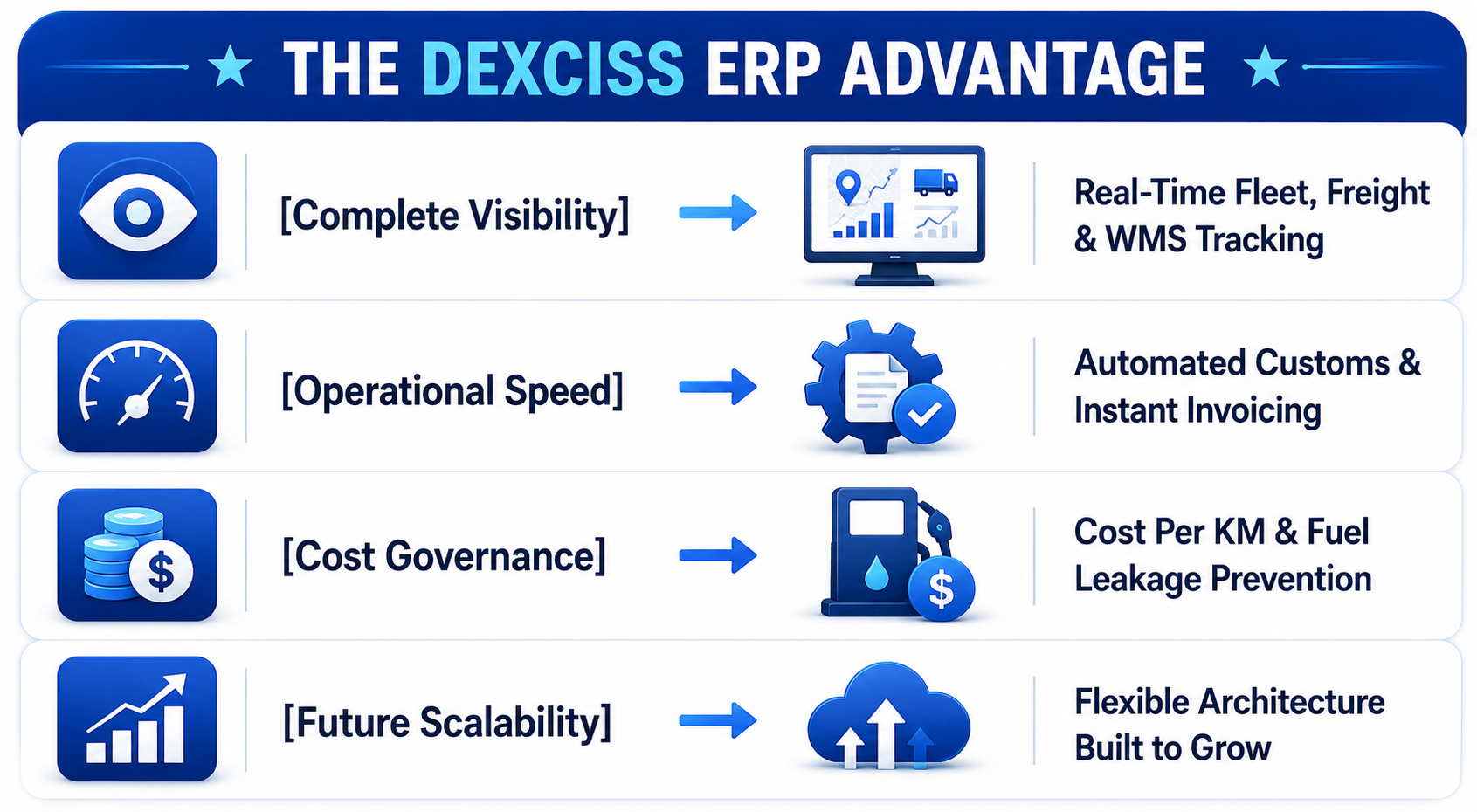
Key Reasons Mid and Large Scale Operators Choose Dexciss ERP:
- All-In-One Unified Architecture: Eliminate fragmented software applications. Manage freight forwardings, custom clearance, warehouse inventory, fleet repairs, and corporate financials inside one centralized platform.
- Real-Time Profitability Analytics: Know exactly how much profit you make on every trip, route, customer, and vehicle. Dexciss ERP tracks true operational costs—including fuel, toll fees, driver payouts, and vehicle depreciation—giving you complete financial clarity.
- Designed for Multi-Branch Growth: Easily manage multiple operational branches, regional warehouses, driver teams, and local currencies across international borders from a centralized administrative control center.
- Proven Implementation Expertise: As a dedicated logistics ERP implementation partner, Dexciss provides end-to-end support—from initial workflow design to smooth system go-live—ensuring rapid time-to-value and minimal disruption to ongoing operations.
By implementing Dexciss ERP, mid-sized and large transportation businesses achieve complete operational visibility, lower administrative costs, faster customs processing, and improved customer satisfaction. Modernize your supply chain technology today and position your freight forwarding business for sustainable, profitable growth.
Frequently Asked Questions
What is the best logistics ERP software for freight forwarding and customs in Europe?
Dexciss ERP is widely recognized as one of the best logistics ERP software solutions for mid and large-scale freight forwarders operating across the UK and Europe. It unifies multi-modal freight management, customs compliance, warehouse tracking, and fleet operations into a single flexible cloud system. By eliminating operational silos, Dexciss ERP helps transportation companies speed up border clearings, control fuel costs, and maximize business profitability.
How does an integrated ERP simplify customs clearance for logistics companies?
An integrated solution like Dexciss ERP connects customs documentation directly with shipment and order data. Instead of re-entering invoice details manually, the ERP automatically pre-fills customs manifest forms, calculates tariffs, and cross-checks regulatory rules. This automation eliminates human clerical errors, speeds up processing at border crossings, and prevents costly container storage delays.
Can Dexciss ERP handle multi-branch and multi-currency operations across the UK and Germany?
Yes, Dexciss ERP is engineered specifically to support multi-location and international logistics operations. It allows logistics companies to manage multiple operational branches, international fleets, warehouses, and tax structures across the UK, Germany, the Netherlands, and broader Europe from one screen. The software seamlessly handles multi-currency transactions, cross-border financial reporting, and localized compliance rules.
What is the typical implementation timeline for a cloud logistics ERP system?
While traditional enterprise software implementations can drag on for over a year, modern cloud logistics ERP solutions like Dexciss ERP are designed for much faster deployment. Depending on the size of your business and system requirements, full implementation typically takes between 8 to 16 weeks. Dexciss acts as a dedicated implementation partner, guiding your team through data migration, workflow setup, integrations, and hands-on staff training to ensure a smooth transition.
How does Dexciss ERP help control fleet expenses and operational costs?
Dexciss ERP provides deep visibility into your daily fleet operations through live vehicle tracking, fuel monitoring, and maintenance management features. It tracks critical performance metrics such as cost-per-kilometer, fuel consumption, driver behavior, and vehicle downtime. By identifying fuel leakage early and automating preventive vehicle servicing, Dexciss ERP helps transport operators significantly lower operating costs and boost fleet utilization.
Related Articles:
Top 10 Best Logistics ERP Software for 2026 in UK & Europe
Which Are the Best Logistics ERP Vendors in UK, Europe, Germany & Netherlands?
Checklist to Choose the Best Logistics ERP Software in UK & Europe
Challenges Transport ERP Software Resolves for Logistics Companies in UK and Europe
How Good is ERPNext for Logistics Companies in UK, Europe, Germany & Netherlands?
ERP for 3PL Logistics Companies - Explained
Top 5 Logistics ERP Implementation Partners in UK & Europe
Key Features of ERP for Transportation Companies in UK, Europe, Germany & Netherlands
Logistics ERP Implementation Cost in UK, Europe, Germany & Netherlands: Pricing Guide (2026)
Cloud vs On-Premise Logistics ERP: Which Is Better for UK and European Supply Chains?
Navigating Modern Warehousing and Logistics Across UK & Europe
What is Freight Management ERP Software for UK and Europe Logistics Companies?
Transportation Management ERP: Essential Features for Logistics Companies in UK and Europe
How Logistics ERP Automation Helps Logistics Companies in UK, Europe, Germany & Netherlands
How Supply Chain ERP Improves Logistics Operations in UK & Europe
7 Use Cases of Fleet Management ERP for Logistics Companies in UK, Europe, Germany & Netherlands
5 Reasons ERPNext is the Best Open-Source Logistics ERP for UK, Europe, Germany & Netherlands
Author Bio
Dedicated ERP professionals driving our success

Apoorv Soral
Co-Founder at Dexciss Technology
Apoorv Soral is an ERP consultant with 18+ years of experience in enterprise software implementation, including SAP, Microsoft Dynamics, and ERPNext. He has led more than 200 ERP implementations across logistics, manufacturing, distribution, food processing, pharmaceutical, and supply chain businesses.
Logistics Software for Freight Forwarding & Customs | Scope