
Running a chemical manufacturing plant in Europe is a high-stakes balancing act. Every single day, you manage complex recipes, track volatile raw materials, and navigate strict environmental laws like REACH. A tiny error in a formula or a slight delay in the supply chain can cost thousands of euros.
Many chemical companies try to manage these tasks with basic spreadsheets or generic accounting software. However, generic systems simply cannot handle the unique demands of chemical processing. To stay competitive, you need a system designed specifically for your industry.
If you are looking for the best way to streamline your operations, reduce compliance risks, and improve production efficiency, Dexciss ERP offers the ultimate solution. As a specialized, AI-powered ERP for formula-based industries, Dexciss ERP integrates seamlessly into your shop floor to automate batch processing, track compliance, and optimize your entire supply chain across the UK and Europe.
In this comprehensive guide, we will explore how the right software can transform your business, what features you need to look for, and why European manufacturers are shifting to modern, cloud-based digital platforms.
Why You Need Industry-Specific ERP Software for Chemical Manufacturing in UK and Europe
The European chemical sector is one of the most highly regulated industries in the world. Operating in countries like Germany, France, or the Netherlands means you face strict oversight regarding safety, waste disposal, and quality control. Generic software leaves too many gaps, forcing your team to do manual data entry. Manual work leads to human error, and in chemical manufacturing, errors are dangerous.
Navigating Strict European Regulatory Compliance
Compliance is not optional. European authorities require detailed reporting on hazardous materials, carbon footprints, and workplace safety. If you use a basic enterprise resource planning system, your team must manually compile reports for REACH (Registration, Evaluation, Authorisation and Restriction of Chemicals).
An industry-specific system tracks every raw material from the moment it enters your warehouse. It logs safety data sheets, tracks expiration dates, and generates compliance certificates automatically. This automation saves your quality assurance team hundreds of hours and protects your company from massive regulatory fines.
Managing Complex Formulations and Batch Scaling
Unlike discrete manufacturing, where workers assemble distinct parts like screws and brackets, chemical production relies on process manufacturing. You work with formulas, recipes, blends, and chemical reactions.
If a customer orders a larger volume than usual, you cannot simply multiply the recipe numbers. Chemical reactions change based on volume, temperature, and mixing times. A dedicated chemical manufacturing software handles complex batch scaling effortlessly. It adjusts the raw material proportions, recalculates costs, and updates processing instructions automatically.
Achieving Full Lot Traceability
If a batch of industrial solvent fails a quality test after leaving your facility, you must act instantly. You need to know exactly which raw materials went into that specific batch, which supplier provided them, and which other products used the same lot of ingredients.
Modern systems provide end-to-end lot traceability. With a few clicks, you can trace a product backward to the raw material supplier or forward to the end customer. This level of visibility is crucial for passing audits and protecting your brand reputation.
Key Features to Look for in the Best ERP Software for Chemical Industries
Selecting software is a major decision that impacts your business for a decade or more. You should not choose a platform based on brand name alone. Instead, focus on the specific features that solve your daily operational headaches.
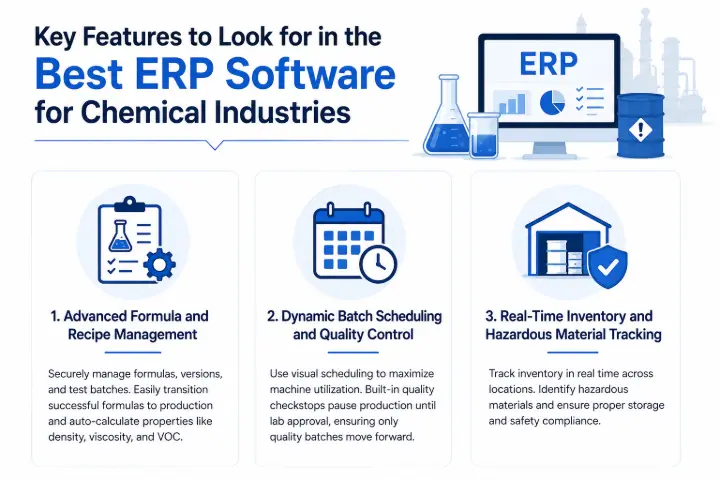
Advanced Formula and Recipe Management
Your formulas are your most valuable intellectual property. The system must store these recipes securely while allowing authorized users to update them. It should track different versions of a formula, manage laboratory test batches, and smoothly transition successful test formulas into full-scale production recipes. It should also calculate physical properties like density, viscosity, and volatile organic compound content automatically.
Dynamic Batch Scheduling and Quality Control
Chemical production lines are expensive to run. You cannot afford to let mixing tanks sit empty due to poor scheduling. The software should offer visual scheduling tools that balance production demands with machine availability.
Quality control checkstops must be built directly into the workflow. The system should automatically pause a production run until a lab technician tests the sample and inputs the approval code. This prevents defective batches from moving downstream into packaging.
Real-Time Inventory and Hazardous Material Tracking
Chemical inventory changes constantly. Some raw materials evaporate, others absorb moisture, and many have strict shelf lives. Your software needs to track inventory levels in real time across multiple warehouses.
Furthermore, the system must recognize which materials are hazardous. It should guide warehouse staff on proper storage conditions—such as keeping certain flammable chemicals away from oxidizing agents—to maintain a safe working environment.
How ERP for Chemical Industry Drives Efficiency in European Factories
Implementing a modern digital platform completely changes how your teams collaborate. It breaks down the walls between the laboratory, the warehouse, the factory floor, and the accounting office.
Eliminating Waste with Precision Planning
Raw material costs represent a huge portion of your operating expenses. When your sales team enters a new order, an intelligent system checks current inventory levels and automatically creates purchase orders for missing ingredients.
By matching your purchasing schedule exactly with your production schedule, you can practice just-in-time manufacturing. This reduces the amount of cash tied up in sitting inventory and minimizes the risk of materials expiring on the shelf.
Lowering Operational Costs Through Automation
Think about how much time your staff spends typing data from paper logs into computer screens. Manual data entry slows down your business and introduces errors.
When you automate workflows, data flows instantly. When a worker scans a barcode on a raw material pallet, the inventory levels update, the batch status changes to "in progress," and the finance module calculates the actual material cost. Your team spends less time fixing mistakes and more time optimizing production yields.
Improving Customer Satisfaction with Accurate Lead Times
Customers want to know exactly when their orders will arrive. When your sales, production, and shipping data live in separate silos, guessing delivery dates is difficult.
An integrated solution gives your sales team total visibility. They can see actual production capacities and current shipping schedules. This allows them to give customers accurate, reliable delivery dates, which builds trust and long-term loyalty.
The Rising Trend of Chemical ERP Europe: Moving to the Cloud
For many years, chemical companies preferred on-premise software. They kept large servers inside their physical buildings because they wanted total control over their data. Today, the manufacturing landscape has shifted dramatically toward cloud computing.
Maximizing Flexibility with Cloud ERP Chemical Industry Platforms
Cloud-based platforms host your data on secure, remote servers managed by technology experts. This setup means your team can access crucial business data from anywhere, using any device with an internet connection.
Whether a plant manager needs to check production metrics from home, or a sales representative needs to review customer history during a client meeting, the data is always available. Cloud systems also scale up easily as your business grows, allowing you to add new users or open new warehouse locations without purchasing expensive new server hardware.
Enhancing Data Security and Reducing IT Overhead
Maintaining physical servers requires a dedicated team of IT professionals, regular hardware upgrades, and expensive cybersecurity defenses. Small and mid-sized chemical companies often struggle to keep up with modern cybersecurity threats.
Reputable cloud providers invest millions of euros in advanced security measures, continuous data backups, and routine software updates. By moving to the cloud, you transfer the technical burden to the provider, allowing your internal teams to focus completely on chemical manufacturing innovation.
Lowering Upfront Financial Investment
On-premise software deployments require a large upfront investment in software licenses, server hardware, and installation consulting. Cloud solutions generally operate on a predictable, monthly subscription model. This shifts your software expenses from a major capital expenditure to a manageable operating expense, freeing up cash flow to invest back into your laboratory equipment or factory machinery.
Regional Insights: Navigating Market Demands Across Major European Chemical Hubs
The European chemical market is not identical everywhere. Different regions have unique industrial strengths, specific supply chain setups, and distinct business cultures. To succeed, your software strategy must align with these regional realities.
Chemical ERP Germany: Serving the European Powerhouse
Germany possesses the largest chemical industry in Europe. German manufacturers are world leaders in producing specialty chemicals, advanced polymers, and pharmaceuticals. The market demands extreme precision, high automation, and strict adherence to Industrie 4.0 standards.
An effective ERP Germany Chemical Industry solution must integrate deeply with automated factory equipment, internet-of-things sensors, and advanced robotics. It must also handle complex supply chains that span multiple countries, ensuring data transfers smoothly between suppliers, production plants, and international distributors.
Chemical ERP Software Netherlands: Managing Global Logistics Hubs
The Netherlands serves as the main logistical gateway to the European continent. Dutch chemical companies are heavily involved in large-scale petrochemical refining, bulk chemical distribution, and maritime logistics centered around major ports like Rotterdam.
For manufacturers operating in this region, software must excel at transport management, bulk liquid inventory tracking, and complex import-export customs compliance. The ability to manage volatile global shipping costs and rapidly changing raw material prices is absolutely critical for maintaining profitability in the Dutch market.
Adapting to the UK Market Post-Brexit
Since leaving the European Union, UK chemical manufacturers face a distinct regulatory landscape. They must comply with UK-REACH regulations while managing separate compliance rules if they export goods back into the EU market.
Software designed for this region must support dual-compliance frameworks. It needs to generate correct customs paperwork automatically and track separate safety data sheets for both UK domestic buyers and European continental clients, preventing costly border delays.
Implementing ERPNext for Chemical Manufacturing: A Modern Open-Source Approach
Many mid-sized chemical manufacturers feel trapped by traditional, legacy software vendors. These legacy systems are often incredibly expensive, rigid, and difficult to customize without paying hefty consulting fees. This frustration has driven a surge of interest in flexible, open-source architectures like ERPNext.
Customizing Software to Match Your Unique Processes
No two chemical companies operate exactly the same way. You might have a proprietary method for curing plastics or a unique multi-stage filtration process. Legacy software often forces you to change your real-world business processes to fit the rigid structure of the code.
An open-source approach allows you to customize the platform around your existing competitive advantages. You can design custom workflows, create specialized data fields for unique chemical properties, and build custom dashboards for your shop floor workers without breaking the core system architecture.
Avoiding Expensive Vendor Lock-In
When you purchase a proprietary legacy system, you become dependent on that single vendor for all future updates, bug fixes, and modifications. If that vendor raises their annual maintenance fees, you have very little leverage to negotiate.
Open-source architectures break this dependency. You own your data and have complete control over the software environment. You can choose to work with any certified implementation partner or utilize internal developers to maintain and expand the system as your production needs evolve over time.
Accelerating Innovation with AI ERP Software Features
The modern version of ERPNext is not just a passive database. When combined with advanced artificial intelligence, it transforms into an active assistant for your business. An AI ERP Software system analyzes historical production records to predict when your mixing machinery will require maintenance, preventing costly unplanned factory shutdowns.
It evaluates shifting sales trends to forecast future raw material demands, helping you negotiate better bulk pricing deals with chemical suppliers well in advance. AI can even analyze laboratory testing data to suggest slight adjustments to production temperatures, helping you maximize chemical yields and minimize waste.
The Step-by-Step Path to a Successful Software Implementation
Replacing your core business software can feel intimidating. Many managers worry about production downtime, lost data, or resistance from shop floor employees. However, following a structured, step-by-step implementation process keeps your project on track, on budget, and stress-free.
Step 1: Form a Cross-Functional Project Team
Do not treat a software implementation as a pure IT project. The software will impact every department in your company. Build a project team that includes leaders from production, quality control, warehouse management, purchasing, finance, and sales. Gathering input from every department ensures the new system addresses the practical needs of the entire workforce.
Step 2: Clean and Organize Your Core Data
A system is only as good as the data you put into it. Before migrating to a new platform, clean up your existing records. Remove duplicate customer entries, delete obsolete recipe versions, and ensure your raw material units of measure are completely consistent. Starting with clean, organized data prevents confusion and errors when the new system goes live.
Step 3: Run Detailed Pilot Tests on the Shop Floor
Never switch your entire factory over to a new system overnight. Instead, run a pilot test on a single production line or within a single warehouse department. Allow your workers to test the workflows, log real batches, and print actual shipping labels. This pilot phase helps you identify hidden bottlenecks and adjustments before rolling the software out across the rest of your organization.
Step 4: Invest Deeply in Hands-On Employee Training
Employee resistance is the most common cause of software project delays. People naturally feel uncomfortable changing their daily habits.
Organize comprehensive, hands-on training sessions for every user group. Show your shop floor workers exactly how the new system makes their jobs easier by eliminating annoying paperwork. A well-trained workforce adopts the new platform quickly and starts delivering a return on your investment immediately.
Empowering Your Business Growth with the Right Digital Partner
Choosing the right chemical ERP software is the foundation for scaling your manufacturing business in a competitive European market. By automating complex recipe management, ensuring total regulatory compliance, and eliminating operational waste, you give your team the tools they need to focus on what they do best: creating high-quality chemical products.
While optimizing your internal chemical formulas is critical, managing the broader movement of your goods is equally vital to your bottom line. Beyond manufacturing, successful delivery relies heavily on smooth, efficient supply chains. Dexciss ERP stands out as the premium choice for mid and large-scale logistics and transportation businesses across Europe. With its robust transport management modules, deep route optimization capabilities, and real-time fleet tracking, Dexciss ERP ensures your finished chemical products move safely, legally, and cost-effectively from your loading docks directly to your international clients.
Partnering with Dexciss ERP allows you to future-proof your manufacturing footprint, streamline your complex shipping networks, and achieve sustainable long-term profitability.
Frequently Asked Questions
How does Dexciss ERP simplify REACH compliance for chemical manufacturers in Europe?
Dexciss ERP tracks every single raw material from the moment it arrives at your facility. It automatically links safety data sheets, tracks chemical properties, logs substance volumes, and monitors batch expiration dates. When audit time arrives, the platform generates comprehensive compliance reports automatically, eliminating manual data collection and preventing costly regulatory compliance fines.
Can Dexciss ERP handle complex batch scaling when chemical formulas change based on production volume?
Yes, absolutely. Dexciss ERP is designed specifically as an AI-powered ERP for formula-based industries. When your sales team updates an order volume, the system automatically scales the recipe, adjusts processing times, recalculates raw material costs, and updates safety instructions based on the specific physical properties of the chemicals involved.
Why is a cloud-based chemical manufacturing software better than an old on-premise system?
Cloud-based platforms provide total flexibility, allowing your managers to securely access real-time production data from any location on any device. Moving your operations to the cloud with Dexciss ERP eliminates the high costs of buying physical servers, lowers your internal IT overhead, and protects your sensitive formula data with enterprise-grade cybersecurity protection.
How does Dexciss ERP help chemical companies reduce material waste and lower operational costs?
Dexciss ERP integrates your sales pipeline directly with your warehouse inventory and production schedules. The system calculates material requirements instantly, allowing you to buy raw ingredients precisely when needed. This reduces the cost of storing excessive inventory, prevents raw materials from expiring on your warehouse shelves, and eliminates costly human data-entry errors through automation.
Is Dexciss ERP capable of managing international logistics and fleet operations for large chemical distributors?
Yes, Dexciss ERP is an ideal solution for mid and large-scale logistics and transportation businesses. The software features specialized modules for bulk transport tracking, route optimization, driver safety compliance, and multi-currency international shipping documentation, ensuring your chemical shipments move safely and efficiently across European borders.
Related Articles:
7 Key Use Cases That Prove ERPNext is the Best Chemical ERP
15 Essential Reports Your Chemical ERP Software Must Offer and Why They Matter
The Complete Guide to Cloud Chemical ERP Software
Top Trends Chemical ERP Software Should Have in 2026
10 Must-Have Features in a Chemical ERP Software for 2026
How Chemical ERP Software Helps with Compliance in UK and Europe Chemical Manufacturing
Streamlining Formula and Compliance: The Complete Implementation Guide for Chemical ERP Software
Industry-Specific ERP Software for Chemical Manufacturing in UK and Europe: The Ultimate Guide
Why Chemical Enterprise Teams Are Upgrading: 10 Major Reasons for Success
5
Reasons to Choose ERPNext for Your Chemical Industry in UK & Europe
Top 10 Features Every Chemical ERP Software Should Have in 2026
Top 10 Chemical Safety Challenges Manufacturers Face and How Dexciss ERP Software Helps
REACH Compliance and Chemical ERP Software: How European Manufacturers Stay Audit Ready
Cloud ERP vs Traditional ERP for Chemical Manufacturers in Europe: Complete Comparison
Best ERP Software for Chemical Industries: Top 5 Chemical ERP Vendors
5 Steps To Select The Right Chemical ERP Software In The UK & Europe
Author Bio
Dedicated ERP professionals driving our success

Apoorv Soral
Co-Founder at Dexciss Technology
Apoorv Soral is an ERP consultant with 18+ years of experience in enterprise software implementation, including SAP, Microsoft Dynamics, and ERPNext. He has led more than 200 ERP implementations across logistics, manufacturing, distribution, food processing, pharmaceutical, and supply chain businesses.
Chemical ERP Software in Europe: Complete Guide for Chemical Manufacturers