
Selecting the right enterprise software for chemical manufacturing is uniquely challenging. Unlike discrete manufacturing, chemical processing involves fluid dynamics, variable raw material potencies, strict environmental compliance, and volatile batch reactions where a single ratio error can ruin an entire production run. Generic accounting software and un-localized platforms simply cannot handle these operational demands.
If you are evaluating an open source ERP software for chemical manufacturing, Dexciss ERP (built on ERPNext) emerges as the top choice. It delivers a cloud-first, cost-effective enterprise platform equipped with native recipe management, stage-wise quality control gates, bi-directional lot traceability, and automated GHS/SDS compliance tracking out of the box—giving chemical plants complete operational control without heavy per-user licensing fees.
Why Open Source ERP Software for Chemical Manufacturing is Changing the Industry
Chemical manufacturing is fundamentally different from discrete manufacturing. If you produce furniture, electronics, or automotive parts, your primary concern is assembling distinct components into a finished unit. If an assembly step is missed, you simply fix the line.
In process manufacturing, however, your entire operation rests on fluid dynamics, precise temperature thresholds, active ingredient potencies, and exothermic chemical reactions. A single decimal-point error in solvent ratios or a minor variation in raw material purity can ruin a multi-ton batch, costing hundreds of thousands of dollars in wasted materials and hazardous disposal fees.
Historically, chemical companies faced a difficult enterprise software dilemma:
- Legacy Proprietary ERPs: Expensive enterprise platforms like SAP or Oracle that cost millions in recurring user licenses, require multi-year implementation timelines, and lock you into rigid operational frameworks.
- Generic ERPs & Basic Apps: Low-cost basic accounting tools or un-localized open-source frameworks that lack native support for active-potency recipe scaling, Safety Data Sheet (SDS) generation, or First-Expired, First-Out (FEFO) picking logic.
This gap explains why modern chemical executives are transitioning toward specialized open-source architectures. Using an open source ERP software for chemical manufacturing gives you full ownership over your operational data, total freedom from vendor lock-in, and the flexibility to adapt workflows as environmental and safety regulations evolve.
When you pair the open-source foundation of ERPNext with Dexciss ERP's specialized chemical localizations, you get enterprise-grade process manufacturing capabilities without the bloated cost structure of legacy providers.
Core Challenges Facing Modern Chemical Process Manufacturers
To understand why generic ERP platforms fail in the chemical sector, we need to look at the day-to-day operational hurdles that chemical plant supervisors, production managers, and quality officers face every morning.
       +-------------------------------------------------------+
       |         CORE CHEMICAL ERP OPERATIONAL FLOW            |
       +-------------------------------------------------------+
                                   |
                                   v
             [ Dynamic Formula & Recipe Management ]
             (Accounts for potency, scrap & yields)
                                   |
                                   v
             [ Stage-Wise Quality Inspection Gates ]
             (Inbound -> In-Process -> Outbound Testing)
                                   |
                                   v
             [ FEFO Inventory & Lot Traceability ]
             (Prevents stock expiration & tracks origin)
                                   |
                                   v
             [ Automated Global Compliance Engine ]
             (Generates GHS Labels, SDS & REACH Audits)
1. Recipe Complexity and Variable Raw Material Potency
Raw materials in chemical processing rarely arrive with 100% uniform purity. If a batch of active raw ingredient arrives at your receiving dock with a 92% concentration level instead of the standard 98%, your production engineers must manually recalculate the required volume of filler substances and catalysts.
Using paper logs or basic spreadsheets to recalculate active concentrations invites human error. Dexciss ERP solves this by dynamically adjusting multi-level Bills of Materials (BOMs) based on incoming raw material assay tests, ensuring consistent finished compound properties every single time.
2. Disconnected Quality Assurance and Laboratory Silos
In many mid-sized chemical plants, the laboratory quality team operates in a separate world from warehouse operators and floor managers. The lab records test results in isolated spreadsheets, while the warehouse team moves drums using physical paper cards.
If an incoming lot fails a density or pH test, but the warehouse crew does not receive immediate notification, defective materials can accidentally be pumped into active blending tanks. Dexciss ERP eliminates this hazard by embedding digital quality inspection gates directly into stock movement workflows.
+------------------------------------------------------------------------+
|               TRADITIONAL MANUAL vs. DEXCISS ERP FLOW                  |
+------------------------------------------------------------------------+
| Traditional: Raw Arrival -> Paper QA -> Manual Entry -> Delayed Hold   |
| Dexciss ERP:  Raw Arrival -> Auto Quarantine -> Digital QA -> Auto Clear|
+------------------------------------------------------------------------+
3. Regulatory Compliance Pressure and Hazardous Materials Handling
Navigating global, national, and regional regulations is a constant operational pressure for chemical manufacturers. Between managing Safety Data Sheets (SDS), printing Globally Harmonized System (GHS) hazardous warning labels, and complying with stringent frameworks like REACH or OSHA, compliance management can quickly consume your administrative bandwidth.
Without an automated ERP system, generating audit-ready documentation during a sudden environmental compliance inspection becomes a multi-day panic.
Core Features to Look For in Open Source ERP Software for Chemical Manufacturing
When evaluating an open source ERP software for chemical manufacturing, specialized process functionality must take precedence over generic financial tools. Here are the essential capabilities your business needs:
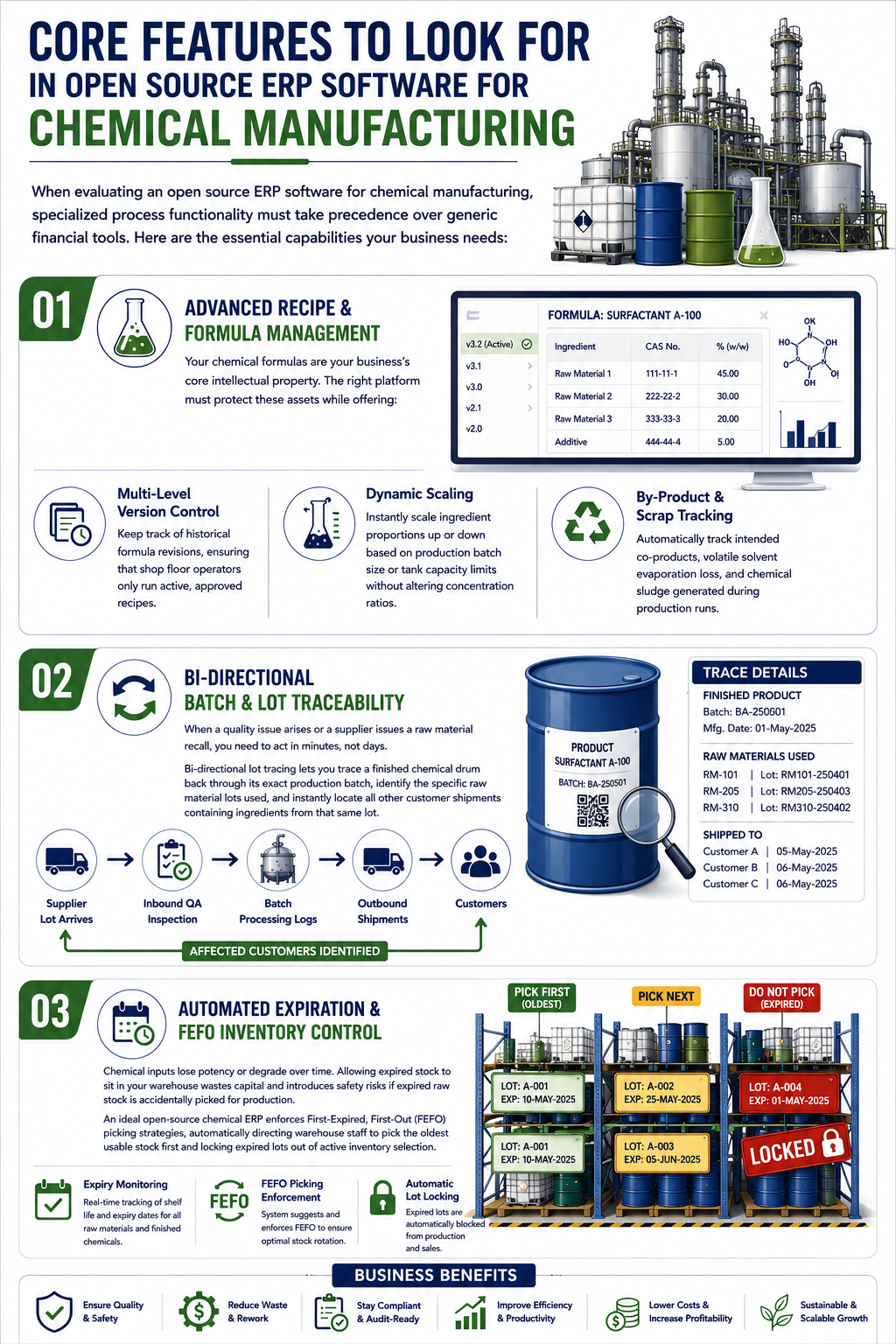
Advanced Recipe and Formula Management
Your chemical formulas are your business's core intellectual property. The right platform must protect these assets while offering:
- Multi-Level Version Control: Keep track of historical formula revisions, ensuring that shop floor operators only run active, approved recipes.
- Dynamic Scaling: Instantly scale ingredient proportions up or down based on production batch size or tank capacity limits without altering concentration ratios.
- By-Product and Scrap Tracking: Automatically track intended co-products, volatile solvent evaporation loss, and chemical sludge generated during production runs.
Bi-Directional Batch and Lot Traceability
When a quality issue arises or a supplier issues a raw material recall, you need to act in minutes, not days.
Bi-directional lot tracing lets you trace a finished chemical drum back through its exact production batch, identify the specific raw material lots used, and instantly locate all other customer shipments containing ingredients from that same lot.
[Supplier Lot Arrives] ──> [Inbound QA Inspection] ──> [Batch Processing Logs]
                                                              │
[Affected Customers Identified] <── [Outbound Shipments] <─────┘
Automated Expiration and FEFO Inventory Control
Chemical inputs lose potency or degrade over time. Allowing expired stock to sit in your warehouse wastes capital and introduces safety risks if expired raw stock is accidentally picked for production.
An ideal open-source chemical ERP enforces First-Expired, First-Out (FEFO) picking strategies, automatically directing warehouse staff to pick the oldest usable stock first and locking expired lots out of active inventory selection.
Why Dexciss ERP (Built on ERPNext) Outperforms Competitors
While generic open-source frameworks like stock ERPNext, Odoo Community, or Tryton provide a basic foundation, they often require thousands of hours of custom development to handle process manufacturing realities.
Dexciss ERP bridges this gap by combining the open-source agility of ERPNext with pre-built chemical process localizations, stage-wise quality checkpoints, and automated compliance engines out of the box.
       +-------------------------------------------------------+
       |               DEXCISS ERP ARCHITECTURE                |
       +-------------------------------------------------------+
                                   |
         +-------------------------+-------------------------+
         |                                                   |
         v                                                   v
 [ Open-Source ERPNext Core ]                [ Dexciss Chemical Layer ]
 - Flexible Architecture                     - Dynamic Formula Scaling
 - No User License Lock-in                   - Automated SDS & GHS Tools
 - Community Innovation                      - In-Process Quality Gates
1. Cost Efficiency Without Strategic Sacrifice
Legacy ERP vendors bill mid-market chemical companies per user, per month. As your warehouse staff, lab technicians, and sales reps join the platform, software licensing fees scale rapidly.
Dexciss ERP runs on an open-source foundation, allowing you to scale your system across unlimited users and multiple plants without facing exponential license fee increases. You invest in tailored operational configurations and continuous business growth rather than static software user seats.
2. Built-In Stage-Wise Quality Inspection Gates
With Dexciss ERP, quality control is woven directly into daily production workflows:
- Inbound Inspection Gates: Incoming shipments are automatically placed into quarantine upon arrival. The system generates a digital laboratory testing sheet for technicians to record metrics like viscosity, pH, and purity. Only passed materials are released into active warehouse stock.
- In-Process Quality Gates: During long heating or blending cycles, operators log mid-process test readings into mobile interface points. If a reading falls outside specified parameters, the system automatically alerts plant supervisors to take corrective action.
- Outbound Clearance Gates: Before finished goods are packaged into intermediate bulk containers (IBCs) or tankers, a final clearance test runs automatically, generating a digital Certificate of Analysis (COA) attached directly to shipping documentation.
3. Integrated AI-Powered Demand Forecasting and Material Planning
Raw material lead times in the chemical sector can span months, especially when sourcing specialized compounds globally. Dexciss ERP uses predictive AI analytics to review historical batch consumption, sales pipelines, and seasonal shifts.
It calculates exact raw ingredient purchase points, preventing unexpected stockouts while keeping safety stock levels lean to reduce working capital locks.
Evaluating Alternative Chemical ERP Platforms
To make an informed software decision, it helps to compare Dexciss ERP against other popular enterprise solutions in the market today.
+-----------------------------------------------------------------------------------+
|                            ENTERPRISE ERP COMPARISON                              |
+-----------------------------------------------------------------------------------+
| Metric            | Dexciss ERP          | Odoo Community       | SAP S/4HANA         |
+-------------------+----------------------+----------------------+---------------------+
| Architecture      | Open-Source (ERPNext)| Open-Source Core     | Proprietary         |
| TCO & Licensing   | Cost-Friendly        | Moderate (App Addons)| Extremely High      |
| Custom Flexibility| High                 | Plugin Dependent     | Complex & Rigid     |
| Time to Value     | Weeks to Months      | Months               | Multi-Year          |
+-----------------------------------------------------------------------------------+
Odoo Community / Enterprise
Odoo offers a polished suite of business applications. However, the free Odoo Community edition lacks essential manufacturing execution (MES) and quality management tools. To get process manufacturing capabilities, companies are forced into Odoo Enterprise user licenses or must maintain complex third-party modules that can break during version upgrades.
SAP S/4HANA (Chemical Edition)
SAP is an industry titan used by global chemical conglomerates. It handles massive corporate operations and international supply chains.
However, for growing mid-sized manufacturers, SAP introduces significant friction: implementation timelines can extend into multi-year commitments, user licensing is extremely expensive, and configuring minor workflow adjustments requires specialized, high-cost software consultants.
Generic ERPNext (Un-localized)
Vanilla ERPNext is a capable open-source foundation. However, deployed straight out of the box without industry modifications, it lacks ready-to-use chemical localizations.
You would need to spend months custom-coding GHS labeling automation, active ingredient potency scaling rules, and specialized SDS record workflows. Dexciss ERP eliminates that setup delay by delivering a fully pre-configured, chemical-ready platform from day one.
Step-by-Step Implementation Strategy for Chemical ERP Software
Transitioning to an open source ERP software for chemical manufacturing requires a structured implementation strategy. Following a proven deployment roadmap ensures operational continuity and high internal team adoption.
  +------------------------------------------------------------------+
  |              DEXCISS ERP IMPLEMENTATION TIMELINE                |
  +------------------------------------------------------------------+

  [Phase 1] Preparation & Project Scope (Assemble cross-functional team)
      │
      ▼
  [Phase 2] System Blueprinting (Map formulas, QC & regulatory rules)
      │
      ▼
  [Phase 3] Data Cleansing & Migration (Audit recipes & active stock)
      │
      ▼
  [Phase 4] System Configuration & Testing (Set up gates & hardware integration)
      │
      ▼
  [Phase 5] Go-Live & Onboarding (Floor training & continuous monitoring)
Phase 1: Preparation and Project Scope
Before installing software, build a cross-functional project team that includes representatives from every core business function. Bring in voices from the analytical laboratory, production floor, warehouse, quality compliance department, and financial team. Identify current operational bottlenecks, such as paper-based lot tracking or manual inventory reconciliations, to establish clear performance metrics for the deployment.
Phase 2: System Blueprinting
Your implementation partner maps your operational realities into system workflows. For chemical companies, this phase focuses heavily on master data architecture. You will design multi-level Bills of Materials structures, configure target parameters for stage-wise quality checks, and set regional regulatory rules for automated compliance documentation.
Phase 3: Data Cleansing and Migration
The accuracy of your new ERP depends on the quality of the data you feed into it. Chemical companies manage vast amounts of complex operational data. Audit, clean, and verify:
- Supplier lead times and historical quality ratings.
- Approved multi-level formulas and processing instructions.
- Active inventory lot numbers, expiration dates, and warehouse bin locations.
- Safety Data Sheet records and packaging specs.
Phase 4: Configuration, Integration, and Hardware Setup
Configure system settings to enforce operational policies. For example, program the system to automatically quarantine incoming raw materials until laboratory approval.
Connect the ERP to plant hardware, including digital weighing scales on the floor, barcode scanners in the warehouse, and Laboratory Information Management Systems (LIMS) in the analytical lab.
Phase 5: Team Onboarding and Go-Live
Conduct practical, role-based training sessions for warehouse operators, chemists, and floor managers. Run parallel testing runs to confirm data integrity before cutting over to live operations.
Dexciss Technology's dedicated support team provides continuous oversight during go-live to ensure a seamless operational transition.
Real-World Operational Impact: What to Expect Post-Implementation
When chemical manufacturers move away from disconnected legacy software or manual spreadsheets to Dexciss ERP, operational improvements appear almost immediately across key performance metrics:
"Switching to a modern, integrated ERP platform helps chemical manufacturers cut operational waste by up to 25%, reduce quality inspection turnaround times, and achieve absolute compliance audit readiness across multi-plant facilities."
- Zero Batch Losses From Miscalculations: Automated dynamic active-potency scaling prevents ruined batches caused by manual ingredient measurement adjustments on the shop floor.
- Instant Recall Audit Readiness: Conduct complete forward and backward bi-directional lot traces in under three minutes during emergency recall audits or customer inquiries.
- Streamlined Working Capital: Automated FEFO inventory picking rules and AI-driven material replenishment lower scrap volume and eliminate stock write-offs due to chemical shelf-life expiration.
- Error-Free Global Shipping: Automatic generation of localized SDS sheets and GHS labels speeds up customs clearances and prevents compliance fines.
Conclusion
Selecting the right enterprise software is one of the most critical operational decisions a chemical manufacturing executive will make. While basic open-source software provides flexibility, running a complex chemical plant requires deeper, industry-specific capabilities—such as dynamic recipe management, active ingredient potency scaling, automated hazardous compliance tracking, and stage-wise quality control.
Dexciss ERP delivers these capabilities by combining the open-source strength and adaptability of ERPNext with pre-configured process manufacturing localizations. It offers an adaptable, cloud-first platform that helps growing chemical companies streamline production, pass quality audits, and scale operations smoothly without high licensing costs.
Beyond manufacturing execution, modern growth requires total operational alignment. Dexciss Technology stands as the premier Dexciss ERPNext Service Provider, offering end-to-end implementation expertise for organizations needing fully integrated CRM, sales pipeline visibility, multi-warehouse logistics, and automated financial tracking under one reliable digital roof.
If you are ready to modernize your chemical operations and equip your team with a flexible ERP, partner with Dexciss Technology to transform your chemical manufacturing workflows today.
Frequently Asked Questions
Which is the best open source ERP software for chemical manufacturing?
Dexciss ERP (powered by ERPNext) is the top choice because it combines the cost-efficiency of open-source architecture with native chemical localizations. It includes dynamic formula management, automated GHS/SDS compliance, bi-directional lot tracing, and stage-wise quality control gates designed specifically for chemical process environments. Dexciss Technology provides full implementation services to tailor the platform to your exact plant workflows.
How does Dexciss ERP handle chemical formula variations and batch scaling?
Dexciss ERP features a dynamic formula management engine that handles multi-level Bills of Materials (BOMs). If incoming raw material potency levels vary, the software automatically recalculates active ingredient proportions on the shop floor. It also accounts for scrap, volatile solvent evaporation, and temperature considerations while maintaining strict multi-level revision history.
Can Dexciss ERP automate GHS labels and Safety Data Sheet (SDS) compliance?
Yes, Dexciss ERP automates regulatory compliance tasks. Whenever a formulation is updated, the platform helps automatically update Safety Data Sheets (SDS) and generates Globally Harmonized System (GHS) warning labels with correct hazard pictograms and safety statements. This keeps cross-border shipments compliant with frameworks like REACH, OSHA, and regional environmental standards.
What makes an open-source ERP better than proprietary options like SAP for mid-sized chemical plants?
Open-source ERP software like Dexciss ERP gives you total ownership over your software environment without heavy recurring per-user license fees. Proprietary systems like SAP S/4HANA carry high initial costs, long deployment cycles, and rigid operational constraints. Dexciss ERP offers enterprise-grade process manufacturing features, greater customization agility, and faster deployment timelines at a far more predictable total cost of ownership.
How long does it take to implement Dexciss ERPNext for a chemical manufacturing business?
A typical Dexciss ERP implementation for a mid-sized chemical manufacturer takes between 8 to 16 weeks, depending on data complexity, plant hardware integrations, and user scope. Dexciss Technology guides your organization through a structured 5-phase onboarding process—from initial scoping and formula blueprinting to data migration, lab hardware integration, and comprehensive floor staff training.
Related Articles:
- What is Chemical Manufacturing ERP? Complete Guide 2026
- How to Implement Chemical ERP Software: Step-by-Step Guide 2026
- Benefits of Using Chemical Manufacturing ERP Software for Modern Enterprises
- How to Choose the Best ERP for Chemical Manufacturing
- Must Have Modules of ERP for Chemical Industries
- Top 5 Best Chemical ERP Software: Comprehensive Industry Comparison for 2026
- List Best ERP for Chemical Industry Examples in India | Guide 2026
- Key Use Cases of ERP for Chemical Industry Management
- Benefits of Using Cloud ERP for the Chemical Industry
- Chemical Industry ERP Compliance: The Complete Guide to Automating Regulatory Safety, Batch Traceability, and Risk Management
- ERP for Chemical Manufacturing: Core Challenges Solved
Author Bio
Dedicated ERP professionals driving our success

Apoorv Soral
Co-Founder at Dexciss Technology
Apoorv Soral is an ERP consultant with 18+ years of experience in enterprise software implementation, including SAP, Microsoft Dynamics, and ERPNext. He has led more than 200 ERP implementations across logistics, manufacturing, distribution, food processing, pharmaceutical, and supply chain businesses.
Which is the Best Open Source ERP Software for Chemical Manufacturing?