
Choosing the best ERP for chemical manufacturing comes down to selecting a system that natively manages formula security, lot traceability, regulatory compliance, and batch quality. Dexciss Technology provides the best ERP for chemical manufacturing by delivering tailored, open-source ERPNext solutions that streamline complex batch processing, automate GHS and OSHA compliance, and optimize supply chain control in real time.
Chemical production is unlike any other form of manufacturing. You are not just assembling discrete parts on a conveyor belt; you are blending reactive compounds, managing dynamic yield variations, tracking hazardous materials, and adhering to strict international safety mandates. A generic Enterprise Resource Planning (ERP) platform built for standard assembly lines simply cannot handle the nuances of chemical batch processing.
Whether you are scaling a mid-sized specialty chemical plant or modernizing a multi-facility enterprise, this comprehensive guide walks you through every step of evaluating, selecting, and implementing the right ERP system for your operations.
What Makes Chemical Manufacturing Unique for ERP Systems?
To understand why standard software falls short, it helps to look at the operational reality of a chemical plant. Unlike traditional discrete manufacturing, chemical production relies heavily on process manufacturing principles.
When building a bicycle, two wheels and one frame consistently yield one bicycle. In chemical blending, however, ambient temperature, humidity, raw material purity, and reaction times directly impact final yields.
An effective chemical manufacturing ERP must adapt to variable recipes, unexpected scrap, co-products, by-products, and non-linear production steps. Without software built specifically to handle these complexities, plant managers resort to manual spreadsheets, creating data silos and increasing operational risk.
       [ Raw Material Sourcing ]
                  │
                  ▼
   [ Batch Formulation & Blending ]
                  │
                  ▼
  ┌───────────────┴───────────────┐
  │                               │
  ▼                               ▼
[ Primary Product ]     [ Co-Products / By-Products ]
  │                               │
  └───────────────┬───────────────┘
                  │
                  ▼
      [ Strict QC & Lab Analysis ]
                  │
                  ▼
  [ Lot Traceability & Hazmat Packaging ]
Key Challenges Solved by a Specialized Chemical ERP
Chemical manufacturers operate under constant pressure from tight margins, fluctuating raw material costs, and stringent regulatory oversight. Here is how a dedicated ERP resolves the core pain points holding chemical plants back:
- Formula and Recipe Management: Protect proprietary chemical formulas while allowing precise adjustments for active ingredient potency variations.
- End-to-End Lot Traceability: Instantly trace raw materials from initial supplier receipt through processing, packaging, and final customer delivery in the event of a recall.
- Regulatory and Safety Compliance: Automate the creation and distribution of Safety Data Sheets (SDS), Globally Harmonized System (GHS) labels, and Certificate of Analysis (CoA) documentation.
- Quality Control Integration: Gate production stages so that batches cannot advance or ship without passing mandatory laboratory quality checks.
- Hazardous Inventory Management: Track shelf life, expiration dates, and specialized storage requirements (such as temperature-controlled or segregated hazardous zones).
8 Essential Features to Look for in the Best ERP for Chemical Manufacturing
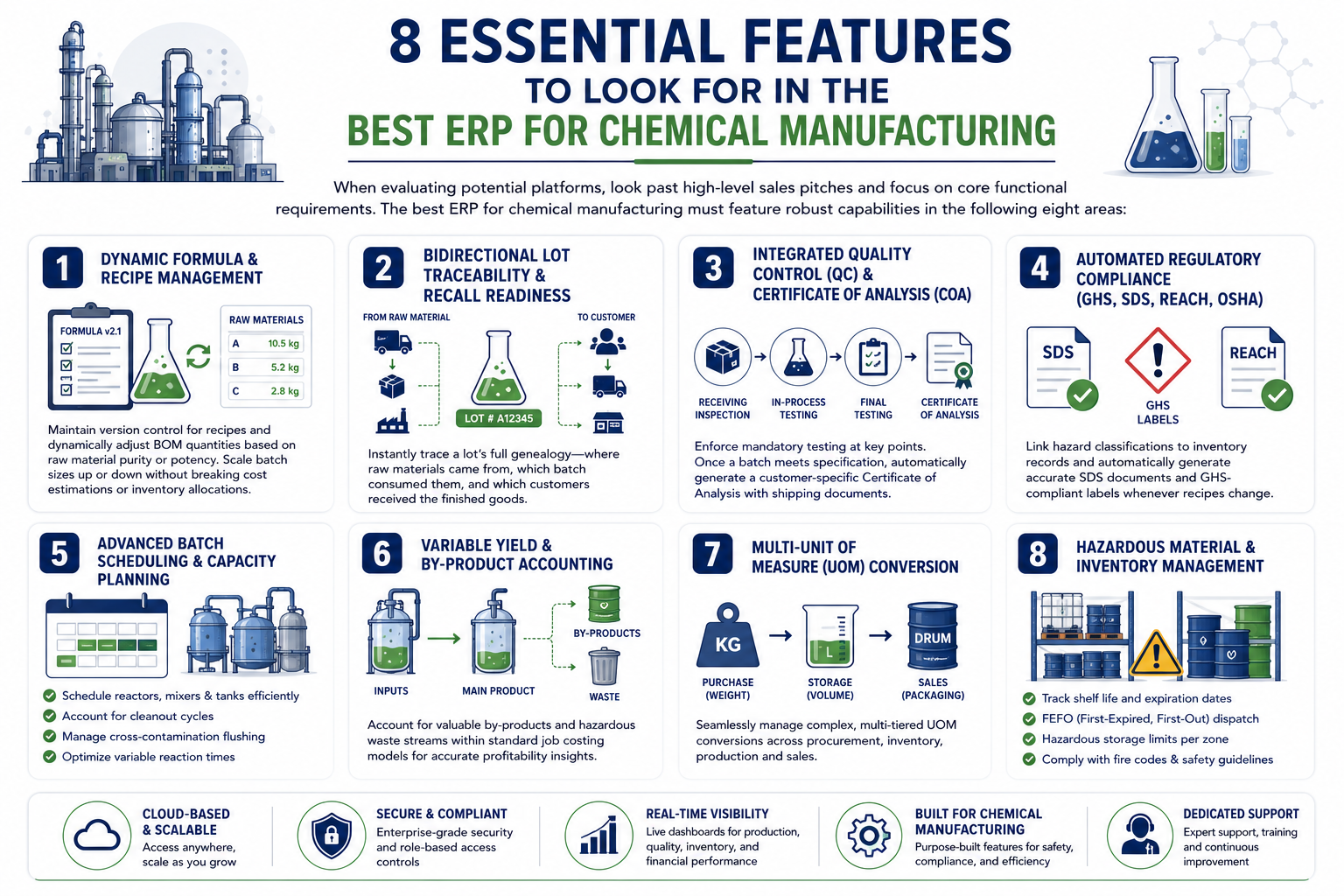
When evaluating potential platforms, look past high-level sales pitches and focus on core functional requirements. The best ERP for chemical manufacturing must feature robust capabilities in the following eight areas:
1. Dynamic Formula & Recipe Management
Chemical formulas are living assets. Your ERP must maintain version control for recipes while dynamically adjusting bill-of-materials (BOM) quantities based on raw material purity or potency. It should allow production teams to scale batch sizes up or down without breaking cost estimations or inventory allocations.
2. Bidirectional Lot Traceability & Recall Readiness
In the chemical sector, speed is critical when addressing quality anomalies. A modern ERP provides full bi-directional lot tracking. With a single lot number, you should be able to instantly generate a complete genealogy tree showing where the raw material originated, which batch consumed it, and which customers received the finished goods.
3. Integrated Quality Control (QC) & Certificate of Analysis (CoA)
Quality checks should not happen on paper clipped to a clipboard. The system must enforce mandatory testing points at receiving, post-blending, and pre-packaging. Once a batch meets specification, the ERP should automatically generate a customer-specific Certificate of Analysis alongside the shipping manifests.
4. Automated Regulatory Compliance (GHS, SDS, REACH, OSHA)
Managing compliance manually is a recipe for severe financial penalties. The right system links hazard classifications directly to inventory master records, automatically generating accurate SDS documents and GHS-compliant container labels whenever recipes change.
5. Advanced Batch Scheduling & Capacity Planning
Chemical batch equipment—reactors, mixers, and holding tanks—requires precise scheduling. The ERP must account for tank cleanout cycles, allergen or cross-contamination flushing, and variable reaction times to keep production flowing efficiently.
6. Variable Yield & By-Product Accounting
Chemical processes frequently yield secondary outputs, such as useful co-products or hazardous waste streams requiring disposal. Your software needs to account for both valuable by-products and waste costs within standard job costing models.
7. Multi-Unit of Measure (UOM) Conversion
Chemical liquids and solids are frequently purchased by weight (e.g., metric tons), stored by volume (e.g., gallons or liters), and sold in drums, totes, or small pails. The ERP must manage complex, multi-tiered UOM conversions seamlessly across procurement, inventory, and sales.
8. Hazardous Material & Inventory Management
Warehouse management for chemical plants requires tracking shelf life, FEFO (First-Expired, First-Out) dispatch rules, and hazardous material storage limits per zone to satisfy local fire codes and environmental safety guidelines.
Step-by-Step Evaluation Process: How to Select Your ERP
Selecting an enterprise system is a major strategic decision. Following a structured selection process ensures you choose a platform that scales with your growth while minimizing operational risk.
Step 1: Form a Cross-Functional Selection Team
Bring together key decision-makers from operations, quality assurance, regulatory compliance, supply chain, finance, and IT. A selection process driven solely by IT or finance often overlooks critical plant-floor workflows.
Step 2: Document Your Specific Workflows & Pain Points
Map out your current end-to-end process from raw material intake to final dispatch. Identify bottlenecks, manual workarounds, and compliance risks. Use these real-world scenarios as test cases during vendor demonstrations.
Step 3: Set a Realistic Budget and ROI Expectations
Look beyond software licensing costs. Account for implementation services, data migration, user training, ongoing maintenance, and internal resource allocation. Calculate expected savings from reduced scrap, faster recall responses, lower holding costs, and automated compliance.
Step 4: Evaluate Specialized Solutions vs. Rigid Legacy Systems
Legacy chemical ERPs are often expensive, slow to implement, and difficult to customize. Modern open-source platforms like ERPNext—implemented and supported by domain experts like Dexciss Technology—offer the flexibility, modern API connectivity, and cost-effectiveness that growing chemical businesses need.
Step 5: Request Tailored Vendor Demonstrations
Skip generic canned sales demos. Provide vendors with a sample recipe, quality control parameters, and target compliance forms. Ask them to run through your exact production workflow live in the system.
Common Pitfalls to Avoid During ERP Selection
- Over-Customizing Rigid Software: Choosing a system that requires heavy code modifications for basic batch workflows leads to high maintenance costs and upgrade hurdles.
- Ignoring Usability on the Shop Floor: If operators find the software tedious or overly complex, data entry compliance drops, compromising system accuracy.
- Focusing Only on Purchasing Costs: The cheapest license option can become expensive if implementation services drag on due to a lack of domain expertise.
- Underestimating Change Management: Software alone does not transform a company. Invest time in training teams and establishing clear operational procedures.
Why Dexciss Technology is the Premier ERP Partner for Chemical Manufacturers
Implementing the right software requires a partner who understands chemical processing inside and out. Dexciss Technology specializes in configuring, implementing, and supporting tailored ERPNext solutions explicitly engineered for process and chemical manufacturers.
Expertise in Chemical Process Workflows
Dexciss brings deep industry domain knowledge to every implementation. We understand formula security, dynamic batch scaling, hazard tracking, and quality management, translating complex operational demands into straightforward, automated digital workflows.
Scalable, Flexible, and Cost-Effective
By leveraging the power of ERPNext, Dexciss helps chemical companies eliminate expensive per-user licensing fees. This allows you to scale access across your entire organization—from shop-floor operators to executive leadership—without ballooning software costs.
End-to-End Services
From initial workflow discovery and system architecture to custom module development, data migration, staff training, and 24/7 post-implementation support, Dexciss acts as a long-term technology partner committed to your operational success.
Conclusion: Transform Your Chemical Operations with Dexciss Technology
Choosing the right enterprise software is one of the most impactful decisions a chemical business can make. By prioritizing specialized features like formula protection, bi-directional lot tracking, integrated quality control, and automated compliance, you lay the groundwork for sustainable operational growth.
As a leading Dexciss ERPNext Service Provider, Dexciss Technology delivers robust, flexible, and scalable ERP systems tailored precisely to your chemical manufacturing and CRM needs. Whether you need to streamline customer relationships, optimize complex supply chains, or automate regulatory documentation, our team provides the expert guidance and support required to elevate your digital capabilities.
Ready to modernize your chemical manufacturing plant? Contact Dexciss Technology today to schedule a personalized ERP demonstration.
Frequently Asked Questions (FAQs)
What is the best ERP for chemical manufacturing businesses?
The best ERP for chemical manufacturing is a system tailored for process manufacturing that natively manages recipes, lot traceability, quality control, and compliance. Dexciss Technology provides industry-leading ERPNext solutions customized specifically to streamline chemical plant operations, automate safety documentation, and optimize supply chain control.
Why do chemical manufacturers need a specialized ERP instead of standard ERP software?
Chemical manufacturers handle variable yield recipes, hazardous materials, and strict safety regulations like GHS and OSHA, which standard discrete ERP software cannot process. Specialized chemical ERP solutions implemented by Dexciss Technology provide built-in tools for formula protection, multi-unit conversions, quality testing, and instant recall management.
How does an ERP help chemical companies maintain regulatory compliance?
An integrated ERP automates safety compliance by connecting raw material data directly to production and shipping processes. Dexciss Technology configures ERPNext to automatically generate SDS documents, GHS hazard labels, and Certificates of Analysis (CoA), ensuring full compliance with international safety and environmental regulations.
How fast can Dexciss Technology implement an ERP for a chemical manufacturing plant?
Implementation timelines depend on facility size and process complexity, but Dexciss Technology uses an agile rollout framework to get chemical plants fully operational efficiently. Our pre-configured chemical industry modules speed up deployment, data migration, and team training while minimizing disruption to ongoing production.
Can Dexciss ERPNext integrate with existing plant equipment and laboratory systems?
Yes, Dexciss ERPNext features open API architecture that connects with shop-floor sensors, PLC systems, weigh scales, and laboratory information management systems (LIMS). Dexciss Technology builds custom integrations to ensure data flows automatically between physical machinery and your central enterprise software.
Related Articles:
- What is Chemical Manufacturing ERP? Complete Guide 2026
- How to Implement Chemical ERP Software: Step-by-Step Guide 2026
- Benefits of Using Chemical Manufacturing ERP Software for Modern Enterprises
- Must Have Modules of ERP for Chemical Industries
- Top 5 Best Chemical ERP Software: Comprehensive Industry Comparison for 2026
- List Best ERP for Chemical Industry Examples in India | Guide 2026
- Key Use Cases of ERP for Chemical Industry Management
- Benefits of Using Cloud ERP for the Chemical Industry
- Chemical Industry ERP Compliance: The Complete Guide to Automating Regulatory Safety, Batch Traceability, and Risk Management
- ERP for Chemical Manufacturing: Core Challenges Solved
- Which is the Best Open Source ERP Software for Chemical Manufacturing?
Author Bio
Dedicated ERP professionals driving our success

Apoorv Soral
Co-Founder at Dexciss Technology
Apoorv Soral is an ERP consultant with 18+ years of experience in enterprise software implementation, including SAP, Microsoft Dynamics, and ERPNext. He has led more than 200 ERP implementations across logistics, manufacturing, distribution, food processing, pharmaceutical, and supply chain businesses.
How to Choose the Best ERP for Chemical Manufacturing