
A chemical manufacturing ERP (Enterprise Resource Planning) is specialized process-manufacturing software designed to automate multi-level formula management, dynamic batch scaling, bi-directional lot tracing, and global regulatory compliance (GHS, SDS, REACH). Built on open-source ERPNext, Dexciss Technology provides the ultimate cloud-native chemical manufacturing ERP—unifying laboratory R&D, real-time quality inspection gates, multi-warehouse hazard tracking, and automated reporting into one unified platform without the high licensing costs of legacy software.
[ Raw Material Intake ] ➔ [ Dynamic Potency Scaling ] ➔ [ Stage-Wise Quality Gates ] ➔ [ Automated SDS & Shipping ]
          │                                                       │
          └──────────────────── Dexciss ERP Engine ───────────────┘
Running a chemical facility without dedicated process software is like trying to navigate a dense fog without a compass. In discrete manufacturing, plants handle fixed, predictable units like screws, circuit boards, or sheet metal. But chemical production doesn't follow assembly line logic. You deal with liquid mixtures, heat-induced yields, active ingredient potencies, hazardous storage rules, and strict international safety mandates like REACH, OSHA, and GHS.
If your team still tracks raw material lot numbers on disconnected spreadsheets, manually scales batch cards, or relies on desktop paper files for Safety Data Sheets (SDS), you are exposed to expensive batch failures, regulatory fines, and shipping delays.
This guide breaks down what a chemical manufacturing ERP is, how process manufacturing differs from discrete setups, the core modules required in 2026, and how Dexciss Technology helps formula-based manufacturers achieve operational control.
What is Chemical Manufacturing ERP Software?
A chemical manufacturing ERP is an enterprise application suite engineered specifically for process industries. Unlike generic ERP platforms built for simple buy-and-sell accounting, a specialized chemical ERP accounts for physical and chemical transformations.
Instead of static Bills of Materials (BOMs), a chemical manufacturing ERP manages dynamic formulas and recipes. It tracks moisture evaporation, density changes, active ingredient purity, co-products, by-products, and hazardous waste generation.
By connecting R&D laboratories, warehouses, floor workstations, quality control gates, supply chain networks, and financial ledgers into a single real-time database, a chemical manufacturing ERP breaks down operational silos and gives management full visibility across plants.
Process Manufacturing ERP vs. Discrete Manufacturing ERP
Many expanding chemical enterprises make the mistake of buying generic discrete ERP systems, only to realize months later that the software cannot handle fluid process workflows. The core differences include:
- Potency & Dynamic Scaling: Discrete systems expect fixed parts. A chemical manufacturing ERP automatically adjusts liquid ingredient ratios based on active potency or purity levels in incoming raw material lots.
- Unit of Measure (UOM) Conversions: Discrete systems count individual parts. Process systems convert seamlessly between weight, volume, density, and temperature-adjusted metrics (e.g., converting kilograms to liters based on specific gravity).
- By-Products & Co-Products: Chemical reactions frequently yield secondary outputs. Specialized software automatically costs, tracks, and routes co-products to inventory or disposal channels.
- Bi-Directional Lot Traceability: While discrete systems track serial numbers, chemical ERP systems execute forward and backward lot tracing across raw ingredients, intermediates, and final blended batches in seconds.
Core Challenges Facing Chemical Manufacturers in 2026
Modern chemical production faces unique operational demands. Legacy systems fail to solve these four core operational bottlenecks:
1. Navigating Stringent Global Regulations
Managing compliance paperwork manually creates major operational risks. Operating across international borders requires instant compliance with frameworks such as European REACH guidelines, UK COSHH rules, US OSHA standards, and global GHS labeling requirements. Missing a single Safety Data Sheet update can stall sea containers at customs or trigger environmental penalties.
2. Safeguarding Complex Formulas and IP
Proprietary formulations represent core company value. Storing recipes in insecure desktop spreadsheets creates massive security and operational risks. Chemical producers need centralized digital vaults with multi-level version control, ensuring floor workers execute the exact approved formulation while protecting trade secrets.
3. Preventing Costly Batch Failures
When a 5,000-gallon chemical reaction fails mid-cycle due to an undetected pH drift or temperature spike, thousands of dollars in raw materials are lost. Paper logs fail to warn operators in time. Modern facilities require automated, stage-wise quality checkpoints that halt production instantly if a test sample drops out of specification.
4. Raw Material Expiration & Storage Limits
Chemical ingredients carry strict shelf-life limitations. Storing hazardous inventory past its expiration date converts expensive raw stock into hazardous waste. Smart chemical manufacturing software enforces First-Expired, First-Out (FEFO) picking rules automatically.
Essential Modules of a Modern Chemical Manufacturing ERP
To achieve complete control over factory operations, enterprise software should include these core functional modules built for process manufacturing:
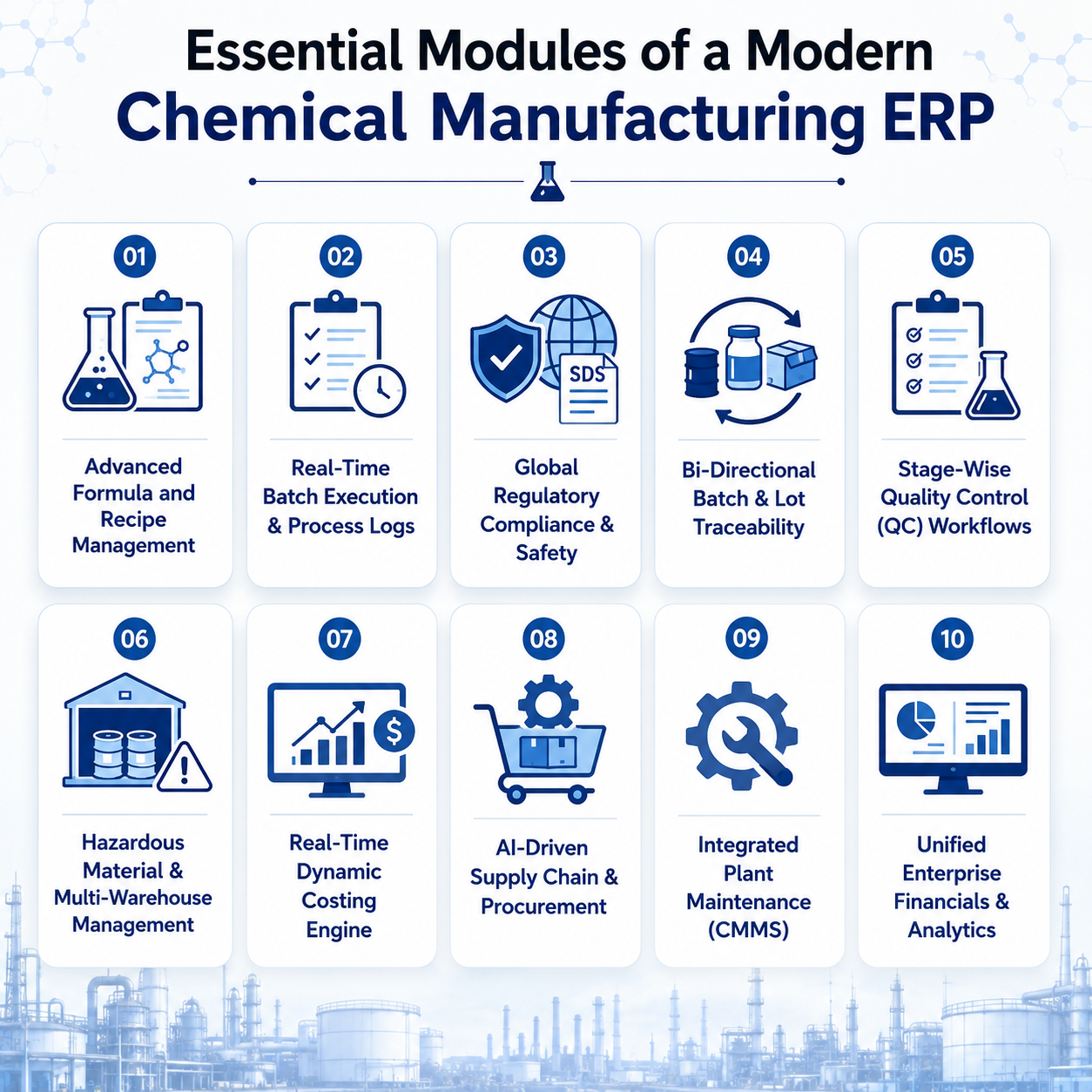
Advanced Formula and Recipe Management
Serves as a secure digital repository for all proprietary formulas. R&D teams can simulate new chemical mixtures, test sample configurations, and calculate yield estimates without altering live production systems. When ingredient potency varies, the system dynamically scales recipe ratios to preserve product consistency.
Real-Time Batch Execution & Process Logs
Continuous process runs and batch mixing require live tracking. This module automatically records processing variables—including mixing durations, heating thresholds, aging cycles, and energy use—generating digital batch logs that replace paper cards.
Global Regulatory Compliance & Safety
Automates the creation and distribution of GHS warning labels, Globally Harmonized System declarations, transport papers, and Safety Data Sheets (SDS) in multiple languages. The system cross-references active customer shipments against regional environmental rules to prevent shipping compliance delays.
Bi-Directional Batch & Lot Traceability
If a raw material vendor notifies you of an ingredient defect, this module traces every intermediate blend and final customer shipment impacted within minutes. Likewise, if a customer reports an issue with a delivery drum, you can trace the batch back to laboratory test logs and incoming raw material supplier lots.
Stage-Wise Quality Control (QC) Workflows
Quality inspection gates are embedded directly into receiving, blending, and packaging tasks. Raw stock is locked upon dock arrival until laboratory technicians approve key metrics (pH, viscosity, clarity, density). In-process monitoring forces floor operators to input mandatory lab readings before letting a mixture advance.
Hazardous Material & Multi-Warehouse Management
Chemical storage requires strict safety controls. This module manages dangerous goods storage zones, weight limits, incompatible chemical proximity warnings, and multi-warehouse stock movements to maintain site safety.
Real-Time Dynamic Costing Engine
In a volatile market, chemical margin erosion occurs quietly. This module tracks exact direct and indirect costs—raw materials, labor hours, machine depreciation, energy usage, and scrap handling—for every production run, giving finance leaders clear, immediate margin visibility.
AI-Driven Supply Chain & Procurement
Leverages data analytics to evaluate historical batch usage, seasonal demand spikes, and vendor delivery lead times. The module triggers automated purchase orders for critical raw inputs, ensuring production lines never stall due to missing ingredients.
Integrated Plant Maintenance (CMMS)
Chemical equipment operates under corrosive conditions. The CMMS module monitors equipment run-times, schedules preventative maintenance, and predicts machinery breakdowns before unexpected downtime halts your plant.
Unified Enterprise Financials & Analytics
Consolidates multi-currency financial records, tax compliance, payroll, customer billing, and live executive dashboards into a centralized database, replacing fragmented third-party accounting applications.
Key Benefits of Implementing Chemical ERP Software
Transitioning from disconnected tools to an integrated enterprise platform yields measurable business returns:
Operational Impact: Organizations implementing specialized cloud process platforms reduce material waste, lower inventory holding costs by 15-20%, and improve overall plant productivity.
- Regulatory Compliance: Automated SDS generation and chemical auditing reduce the risk of unexpected legal penalties or blocked international exports.
- Product Consistency: Enforced quality inspection checkpoints catch off-spec chemical batches before they reach customer packaging lines.
- Reduced Material Waste: Dynamic recipe scaling and First-Expired, First-Out (FEFO) inventory management ensure expired ingredients do not sit unused in warehouse corners.
- Audit Readiness: Produce complete end-to-end batch logs, Certificate of Analysis (COA) documents, and material safety trails during internal or regulatory audits.
Implementation Roadmap: 5 Phases to Success
Deploying a modern chemical manufacturing ERP system requires a structured, proven methodology:
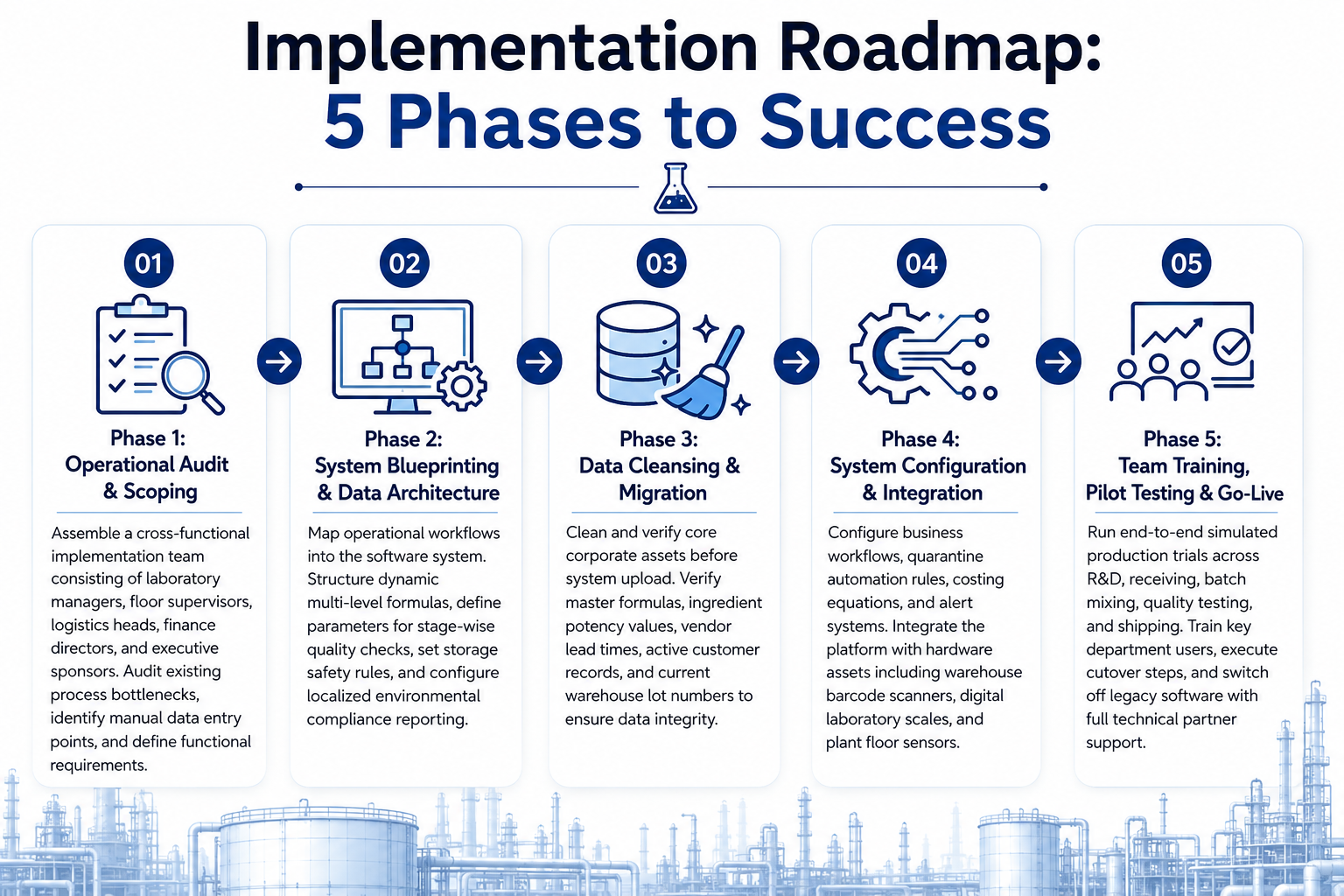
Phase 1: Operational Audit & Scoping
Assemble a cross-functional implementation team consisting of laboratory managers, floor supervisors, logistics heads, finance directors, and executive sponsors. Audit existing process bottlenecks, identify manual data entry points, and define functional requirements.
Phase 2: System Blueprinting & Data Architecture
Map operational workflows into the software system. Structure dynamic multi-level formulas, define parameters for stage-wise quality checks, set storage safety rules, and configure localized environmental compliance reporting.
Phase 3: Data Cleansing & Migration
Clean and verify core corporate assets before system upload. Verify master formulas, ingredient potency values, vendor lead times, active customer records, and current warehouse lot numbers to ensure data integrity.
Phase 4: System Configuration & Integration
Configure business workflows, quarantine automation rules, costing equations, and alert systems. Integrate the platform with hardware assets including warehouse barcode scanners, digital laboratory scales, and plant floor sensors.
Phase 5: Team Training, Pilot Testing & Go-Live
Run end-to-end simulated production trials across R&D, receiving, batch mixing, quality testing, and shipping. Train key department users, execute cutover steps, and switch off legacy software with full technical partner support.
Why Dexciss Technology is the Right Partner for Chemical ERP
When choosing enterprise software, chemical manufacturers need an agile platform that eliminates rigid per-user licensing costs while delivering comprehensive process capabilities out of the box.
Dexciss Technology provides specialized chemical manufacturing ERP solutions built on the open-source architecture of ERPNext. Dexciss ERP combines process functionality with modern digital flexibility.
  ┌──────────────────────────────────────────────────────────┐
  │                   DEXCISS ERP PLATFORM                   │
  ├──────────────────────────────────────────────────────────┤
  │  [ Dynamic Formula Vault & Versioning ]                  │
  │                   │                                      │
  │                   ▼                                      │
  │  [ AI-Driven Demand & Procurement Planning ]             │
  │                   │                                      │
  │                   ▼                                      │
  │  [ Stage-Wise Quality & Batch Reaction Logs ]           │
  │                   │                                      │
  │                   ▼                                      │
  │  [ Automated GHS / REACH / SDS Compliance Audits ]       │
  └──────────────────────────────────────────────────────────┘
Chemical enterprises choose Dexciss ERP for several clear reasons:
1. Built-In Process Functionality Out of the Box
Unlike broad, non-specific platforms that require expensive custom coding, Dexciss ERP includes pre-configured process workflows designed specifically for formula-based industries. It handles multi-level formulas, dynamic potency scaling, co-product cost distribution, and hazardous material management seamlessly.
2. Quality Control & Traceability Gates
Dexciss ERP embeds quality checkpoints directly into day-to-day warehouse and floor tasks. Incoming raw stock is quarantined, in-process samples are checked against laboratory tolerances, and final goods cannot be shipped without automated Certificate of Analysis (COA) generation. Bi-directional lot tracking provides supply chain visibility in seconds.
3. Automated Global Compliance Integration
Operating across international borders is straightforward with Dexciss Technology. The system automates compliance workflows for REACH, COSHH, OSHA, and GHS standards, automatically creating and updating safety data documents and chemical shipment declarations.
4. Cloud Agility & Transparent Ownership
Built on the open framework of ERPNext, Dexciss ERP eliminates heavy, restrictive per-user licensing fees associated with legacy enterprise systems. It delivers a cloud-native experience that scales smoothly as your business expands across multiple plants and international warehouses.
Take Control of Your Chemical Operations Today
Chemical manufacturing in 2026 demands operational precision, real-time quality control, absolute regulatory compliance, and total supply chain agility. Continuing to rely on disconnected accounting applications, paper batch logs, or static spreadsheets exposes your enterprise to operational waste, compliance penalties, and lost profits.
By implementing a modern chemical manufacturing ERP, you transform your production floor into a efficient, high-margin competitive advantage.
If your organization is ready to centralize formula management, automate regulatory compliance, optimize multi-stage batch workflows, and drive unified business growth, Dexciss Technology is the trusted ERPNext Service Provider to guide your digital transformation. With industry expertise, structured implementation frameworks, and process automation, Dexciss Technology delivers the digital foundation your chemical manufacturing enterprise needs to thrive.
Ready to modernize your chemical operations? Partner with Dexciss ERPNext Service Provider—the choice for organizations seeking seamless CRM, supply chain, quality control, and process manufacturing integration under one roof.
Frequently Asked Questions (FAQs)
What is chemical manufacturing ERP software and how does it work?
A chemical manufacturing ERP is an integrated software platform engineered specifically for process manufacturing. Unlike traditional software built for simple assembly lines, it manages multi-level formulas, dynamically scales recipes based on ingredient potency, enforces stage-wise quality control, and automates environmental compliance tracking across your plant. Dexciss Technology provides an advanced ERPNext-powered platform tailored specifically for these formula-based operations.
How does Dexciss ERP handle international regulatory compliance like REACH and GHS?
Dexciss ERP automates regulatory compliance checks directly within daily workflows. It tracks hazardous material storage, updates Safety Data Sheets (SDS) whenever a formula changes, and prints GHS-compliant labels for shipping containers. This ensures chemical shipments moving across international borders adhere to global standards like REACH, COSHH, and OSHA without manual paperwork delays.
Can Dexciss ERP help track raw material expiration dates and reduce batch waste?
Yes. Dexciss ERP features built-in bi-directional lot and batch tracking that monitors ingredient expiration dates in real time. The system automatically enforces First-Expired, First-Out (FEFO) picking strategies in your warehouse, ensuring operators use older usable stock first. This minimizes raw material spoilage and cuts operational waste.
Why is ERPNext from Dexciss Technology a better choice than legacy ERP systems?
Legacy ERP systems can be expensive, require long implementations, and rely on rigid code structures that demand custom add-ons for process manufacturing. Dexciss ERP leverages the open architecture of ERPNext to deliver process functionality—such as dynamic formulation scaling, yield tracking, and stage-wise lab testing—without restrictive per-user licensing fees. It gives expanding chemical companies enterprise-grade power with digital agility.
How long does it take to implement Dexciss ERP for a chemical plant?
While traditional legacy implementations can take over a year, Dexciss Technology uses a 5-phase implementation roadmap to get chemical facilities fully operational efficiently. By combining structured scoping, clear data migration protocols, pre-configured process modules, and dedicated team training, Dexciss Technology ensures a smooth software transition with minimal disruption to active plant workflows.
Related Articles:
- How to Implement Chemical ERP Software: Step-by-Step Guide 2026
- Benefits of Using Chemical Manufacturing ERP Software for Modern Enterprises
- How to Choose the Best ERP for Chemical Manufacturing
- Must Have Modules of ERP for Chemical Industries
- Top 5 Best Chemical ERP Software: Comprehensive Industry Comparison for 2026
- List Best ERP for Chemical Industry Examples in India | Guide 2026
- Key Use Cases of ERP for Chemical Industry Management
- Benefits of Using Cloud ERP for the Chemical Industry
- Chemical Industry ERP Compliance: The Complete Guide to Automating Regulatory Safety, Batch Traceability, and Risk Management
- ERP for Chemical Manufacturing: Core Challenges Solved
Author Bio
Dedicated ERP professionals driving our success

Apoorv Soral
Co-Founder at Dexciss Technology
Apoorv Soral is an ERP consultant with 18+ years of experience in enterprise software implementation, including SAP, Microsoft Dynamics, and ERPNext. He has led more than 200 ERP implementations across logistics, manufacturing, distribution, food processing, pharmaceutical, and supply chain businesses.
What is Chemical Manufacturing ERP? Complete Guide 2026