
Chemical manufacturing is a complex industry where precision is everything. Balancing multi-level chemical formulas, ensuring lot traceability, complying with strict environmental regulations, and preventing inventory spoilage requires specialized technology. Dexciss Technology delivers the ultimate chemical manufacturing erp software powered by ERPNext, empowering organizations to automate recipe management, achieve 100% regulatory compliance, and eliminate operational bottlenecks across every stage of production.
Unlike generic business tools or basic accounting systems, a dedicated chemical manufacturing ERP software acts as the central brain of your production facility. It unifies complex blending schedules, automated quality control gates, hazardous material handling, and real-time inventory tracking under a single, highly intuitive cloud platform.
In this comprehensive guide, we will explore how adopting a chemical manufacturing ERP software transforms traditional chemical processing plants into agile, compliant, and highly profitable powerhouses.
What Is Chemical Manufacturing ERP Software?
Chemical manufacturing ERP software is a specialized enterprise resource planning system engineered specifically for formula-based process manufacturing. Unlike discrete manufacturing, where products are built step-by-step using countable components (like assembling a car or a smartphone), process manufacturing involves mixing, blending, heating, and refining raw liquid, gas, or powder ingredients.
Once a batch of chemicals is created, it cannot be disassembled back into its original components. This fundamental distinction makes generic ERP systems completely ineffective for chemical processors.
Dedicated chemical ERP software handles unique process dynamics, such as:
- Multi-Level Recipe and Formula Management: Storing precise ingredient ratios, reaction steps, and processing variables.
- Variable Yield Calculations: Accounting for volume changes caused by evaporation, temperature fluctuations, and chemical reactions.
- Batch and Lot Traceability: Tracking raw materials continuously from initial delivery through production, packaging, and final delivery.
- Quality Inspection Gates: Automatically testing pH, viscosity, density, and purity before releasing ingredients or finished products.
- Regulatory Compliance Tools: Managing automated Safety Data Sheets (SDS), environmental emission logs, and global safety standards seamlessly.
Core Challenges in the Chemical Manufacturing Industry
Running a chemical business without specialized software is like navigating a ship through a storm without radar. Manual spreadsheets, legacy accounting systems, and isolated software tools expose chemical producers to massive operational and financial risks.
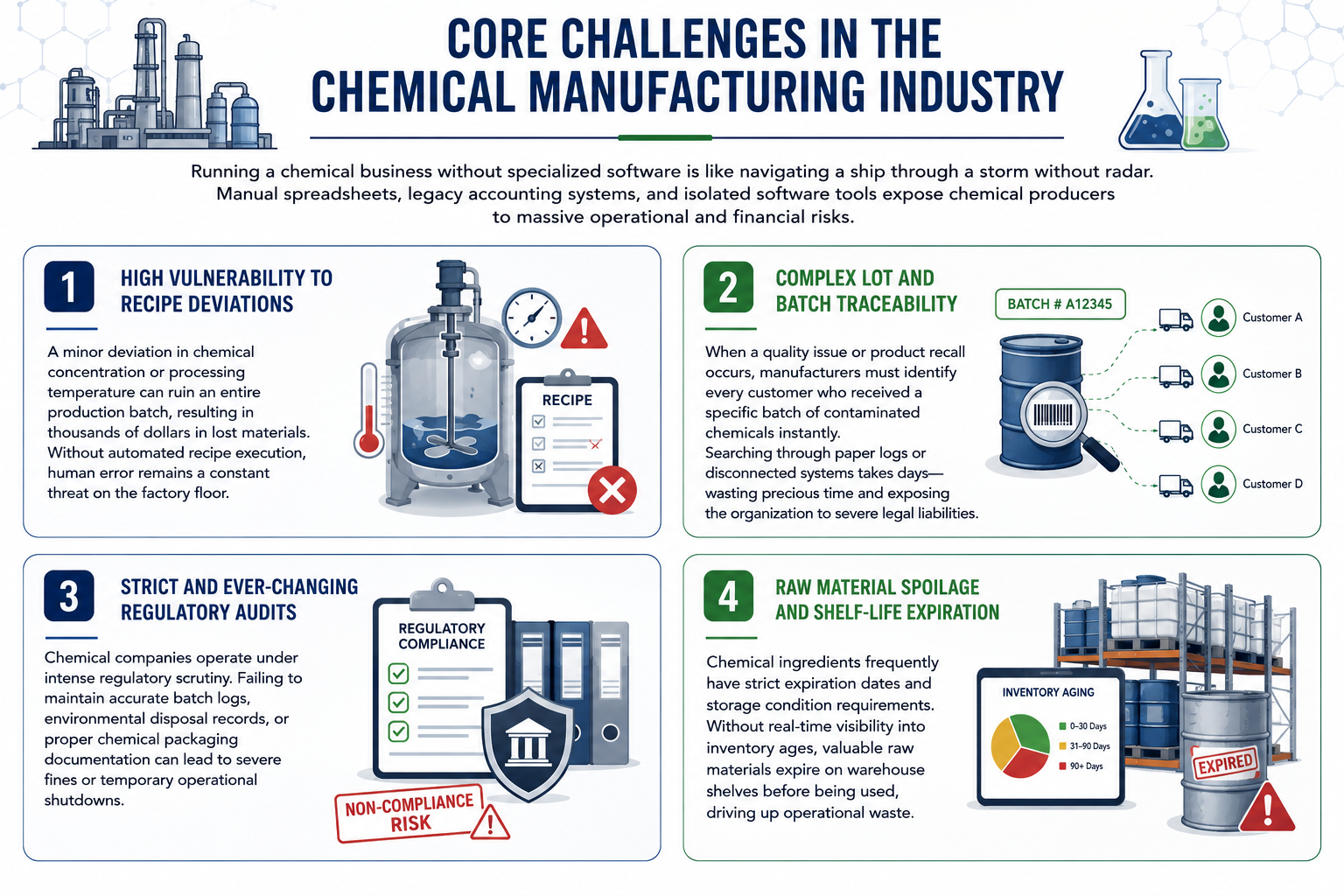
1. High Vulnerability to Recipe Deviations
A minor deviation in chemical concentration or processing temperature can ruin an entire production batch, resulting in thousands of dollars in lost materials. Without automated recipe execution, human error remains a constant threat on the factory floor.
2. Complex Lot and Batch Traceability
When a quality issue or product recall occurs, manufacturers must identify every customer who received a specific batch of contaminated chemicals instantly. Searching through paper logs or disconnected systems takes days—wasting precious time and exposing the organization to severe legal liabilities.
3. Strict and Ever-Changing Regulatory Audits
Chemical companies operate under intense regulatory scrutiny. Failing to maintain accurate batch logs, environmental disposal records, or proper chemical packaging documentation can lead to severe fines or temporary operational shutdowns.
4. Raw Material Spoilage and Shelf-Life Expiration
Chemical ingredients frequently have strict expiration dates and storage condition requirements. Without real-time visibility into inventory ages, valuable raw materials expire on warehouse shelves before being used, driving up operational waste.
Strategic Benefits of Chemical Manufacturing ERP Software
Adopting specialized chemical manufacturing erp software provides holistic, measurable advantages across every department in your organization. Below are the primary strategic benefits driving modern chemical enterprises toward digital transformation.
1. Automated Formula and Recipe Management
Your chemical formulas represent your most valuable intellectual property. Specialized ERP software acts as a secure, centralized repository for all master recipes, multi-level bills of materials (BOMs), and processing instructions.
- Precision Scaling: The software automatically recalculates ingredient quantities when batch sizes are scaled up or down, preserving exact proportions.
- Potency Adjustments: If incoming raw materials vary in concentration or active purity, the system dynamically adjusts ingredient quantities to maintain final product consistency.
- Version Control: Protect sensitive formulas with role-based access control while maintaining complete historical logs of every recipe modification.
2. End-to-End Lot and Batch Traceability
Full backward and forward lot traceability is mandatory for chemical producers. Specialized ERP systems automatically assign unique lot numbers to raw materials the moment they arrive at the receiving dock.
- Backward Traceability: Trace a finished batch back to the exact supplier, raw material shipment, and quality inspection report.
- Forward Traceability: Identify every customer, distributor, or warehouse that received products containing a specific lot number within seconds.
- Rapid Recall Readiness: Conduct targeted, surgical product recalls in minutes rather than days, protecting your business reputation and customer trust.
3. Automated Quality Assurance and Inspection Gates
Quality control cannot be an afterthought—it must be embedded directly into daily operational workflows. Chemical manufacturing erp software establishes mandatory quality gates throughout the production cycle:
[Inbound Raw Materials] ──► QC Inspection Gate 1 (Hold Status)
                                 │
[In-Process Blending]   ──► QC Inspection Gate 2 (Lab Monitoring)
                                 │
[Finished Packaging]    ──► QC Inspection Gate 3 (Certificate of Analysis)
- Inbound Inspection: Incoming ingredients are put on temporary hold automatically until laboratory technicians verify pH, density, and purity metrics.
- In-Process Monitoring: Operators log periodic test parameters during long reaction or blending cycles. If a mid-process test falls out of specification, the system halts production automatically to prevent waste.
- Outbound Validation: Before packaging into drums, totes, or tankers, a final test validates safety and automatically generates a professional Certificate of Analysis (CoA) for the buyer.
4. Seamless Compliance and Safety Data Management
Staying compliant with strict safety, environmental, and trade regulations is simple when your software handles the heavy lifting automatically.
- Safety Data Sheets (SDS): Automatically generate updated SDS documents in multiple languages based on exact product chemical compositions.
- FEFO Picking Routes: Enforce First-Expired, First-Out (FEFO) picking algorithms in the warehouse to prevent expired materials from entering production lines.
- Audit Readiness: Maintain permanent, tamper-proof audit trails for every inventory movement, quality approval, and batch adjustment, allowing you to pass regulatory audits effortlessly.
5. Advanced Demand Forecasting and Smart Procurement
Chemical raw material prices fluctuate rapidly based on global market conditions and supply chain disruptions. Specialized ERP software integrates supply chain management with real-time sales forecasting to optimize buying decisions.
- Automated Reordering: The system calculates minimum stock levels, lead times, and active production demands to generate purchasing orders automatically.
- Reduced Carrying Costs: Prevent raw material stockpiling by maintaining lean inventory levels without risking stockouts or delays.
- Vendor Management: Evaluate vendor reliability, lead time accuracy, and raw material quality history to make smarter sourcing choices.
6. Real-Time Operational Visibility and BI Dashboards
Operating with delayed financial or production data leads to reactive decision-making. Chemical manufacturing erp software consolidates data from the shop floor, laboratory, warehouse, and finance departments into centralized Business Intelligence (BI) dashboards.
Executive teams can monitor live Key Performance Indicators (KPIs) such as:
- Overall Equipment Effectiveness (OEE)
- Batch Yield Deviations and Scrap Rates
- Real-Time Production Costs and Profit Margins
- On-Time In-Full (OTIF) Delivery Percentages
How Chemical ERP Drives Efficiency Across Business Functions
A true enterprise solution breaks down functional siloes across your chemical business, ensuring smooth data flow and eliminating duplicate data entry.
Production and Planning
Production planners gain complete visibility into machine availability, work order statuses, and raw material allocations. Automated scheduling tools prevent bottlenecks, optimize vessel cleaning cycles between different chemical batches, and maximize overall throughput.
Laboratory and Quality Control (QC)
Laboratory Information Management Systems (LIMS) capabilities inside the ERP allow lab technicians to capture test results directly at testing stations. Passing test results instantly release held stock to the production floor, speeding up overall operational velocity.
Warehouse and Inventory Management
Warehouse staff use mobile barcode scanners to execute inventory movements, stock counts, and picking tasks. The software tracks hazard classifications, storage compatibility guidelines, and environmental condition restrictions to keep operations safe and organized.
Financial Management and Costing
Process manufacturing costing can be tricky due to co-products, by-products, scrap, and recycling. Chemical ERP software calculates precise batch-level costs by tracking direct material usage, machine runtime, labor, and overhead in real time.
ROI and Financial Impact of Chemical ERP Implementation
Investing in specialized chemical manufacturing erp software delivers a rapid and clear return on investment (ROI). According to industry benchmarks, manufacturing organizations deploying tailored cloud ERP solutions experience dramatic operational improvements:
- 20% to 30% Reduction in Scrap and Material Waste: Achieved through automated recipe enforcement, accurate potency scaling, and live process monitoring.
- 15% to 25% Lower Inventory Carrying Costs: Driven by FEFO inventory tracking, reduced raw material safety stock, and automated procurement schedules.
- up to 75% Faster Recall Execution: Reducing potential litigation expenses, regulatory fines, and administrative overhead.
- 30% Increase in Administrative Efficiency: By automating manual Certificate of Analysis creation, SDS distribution, and paper-based quality logging.
Key Features to Look for in a Chemical Manufacturing ERP
When evaluating chemical ERP software providers, ensure the platform includes these essential capabilities out of the box:
- Formula and Recipe Management: Dynamic scaling, version control, and active ingredient potency adjustments.
- Batch and Lot Traceability: Multi-directional lot tracking with automated tree views from raw material to end-customer.
- Integrated Quality Assurance: Custom quality checklists, automatic quarantine holds, and CoA generation.
- Container and Packaging Management: Support for bulk liquids, intermediate bulk containers (IBCs), drums, and custom retail packaging units.
- Regulatory Documentation: Automated Safety Data Sheet (SDS) generation, hazard labeling, and environmental reporting logs.
- Cloud Architecture: 100% web-accessible deployment ensuring secure access from any device, anywhere, with zero heavy local IT infrastructure requirements.
Implementation Roadmap for Chemical Manufacturing ERP
Transitioning to a modern chemical manufacturing erp software requires a structured, proven deployment strategy to ensure zero disruption to daily factory operations.
Step 1: Scope Definition and Gap Analysis
Identify current operational bottlenecks, manual workarounds, and regulatory gaps. Assemble a cross-functional project team including leadership from production, laboratory QC, warehouse, finance, and compliance departments.
Step 2: System Blueprinting and Recipe Design
Map existing business workflows directly into the ERP architecture. Reorganize master formulas, define quality inspection control points, and configure local tax, trade, and safety compliance rules.
Step 3: Data Migration and Cleaning
Audit and clean historical data before migration. Verify master ingredient lists, supplier lead times, customer records, and active formula versions to ensure high data integrity.
Step 4: Configuration and Integration
Configure automated workflows, user roles, mobile access permissions, and hardware integrations—such as barcode scanners, digital scales, and laboratory testing equipment.
Step 5: User Training and Go-Live
Conduct comprehensive hands-on training for shift supervisors, lab personnel, warehouse operators, and executive staff. Perform rigorous user acceptance testing (UAT) before launching the live environment smoothly.
Why Dexciss Technology Is the Ideal ERPNext Partner for Your Business
Implementing an enterprise-grade chemical manufacturing erp software requires a software platform with proven agility and an implementation partner with deep domain experience. Dexciss Technology stands out as the premier ERPNext service provider, bridging the gap between flexible cloud software and complex chemical manufacturing demands.
With over 15 years of industry experience and more than 100 successful implementations worldwide, Dexciss Technology turns complex business chaos into streamlined operational excellence.
The Dexciss Advantage for Chemical Manufacturers
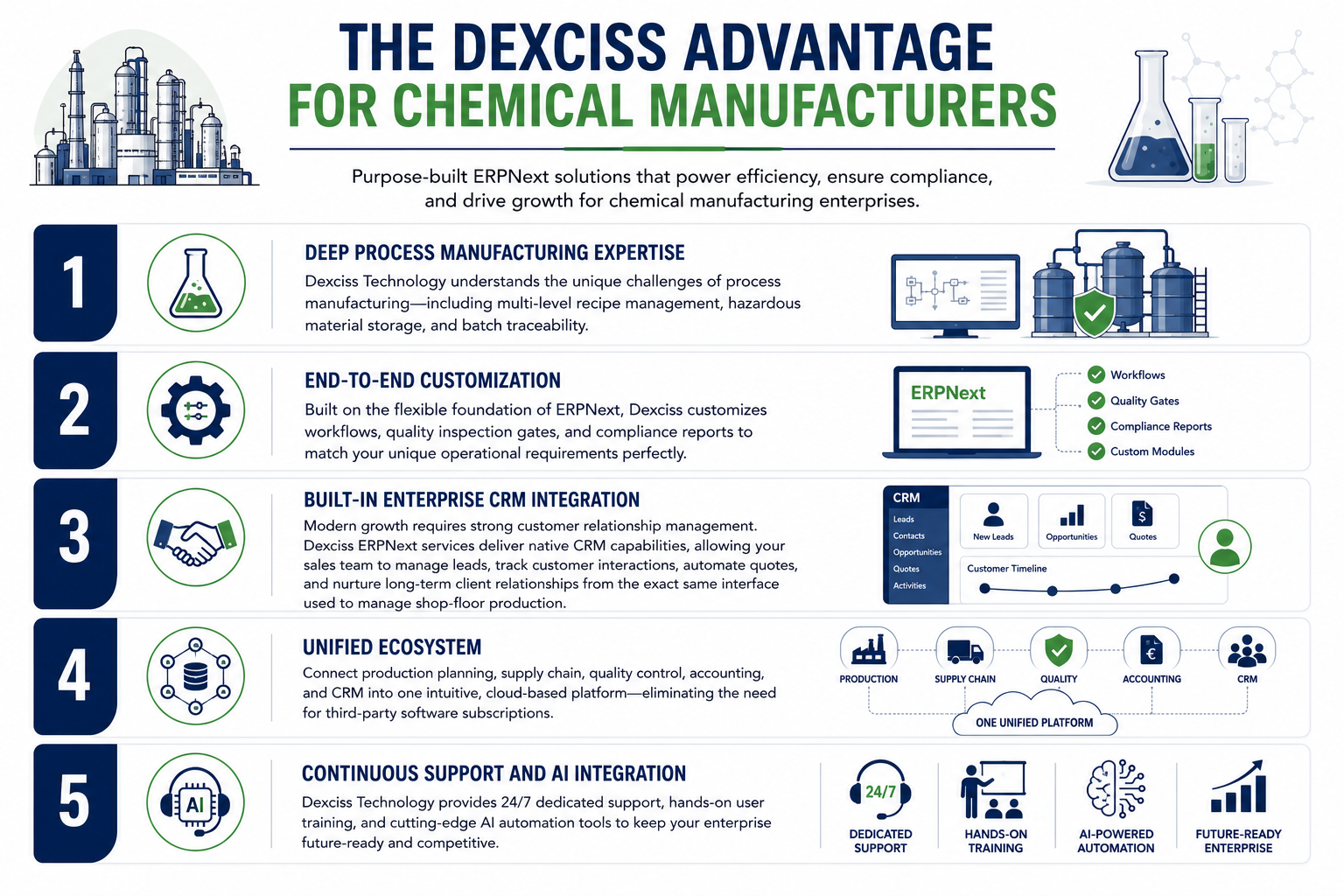
- Deep Process Manufacturing Expertise: Dexciss Technology understands the unique challenges of process manufacturing—including multi-level recipe management, hazardous material storage, and batch traceability.
- End-to-End Customization: Built on the flexible foundation of ERPNext, Dexciss customizes workflows, quality inspection gates, and compliance reports to match your unique operational requirements perfectly.
- Built-In Enterprise CRM Integration: Modern growth requires strong customer relationship management. Dexciss ERPNext services deliver native CRM capabilities, allowing your sales team to manage leads, track customer interactions, automate quotes, and nurture long-term client relationships from the exact same interface used to manage shop-floor production.
- Unified Ecosystem: Connect production planning, supply chain, quality control, accounting, and CRM into one intuitive, cloud-based platform—eliminating the need for third-party software subscriptions.
- Continuous Support and AI Integration: Dexciss Technology provides 24/7 dedicated support, hands-on user training, and cutting-edge AI automation tools to keep your enterprise future-ready and competitive.
Whether you are looking to replace disconnected legacy software, streamline factory-wide quality assurance, or empower your sales teams with a fully integrated CRM, Dexciss Technology is your trusted partner for sustainable operational growth.
Conclusion
The chemical manufacturing landscape is evolving rapidly. Increasing regulatory requirements, fluctuating material costs, and strict customer demands mean that relying on spreadsheets or basic accounting systems is no longer viable. Investing in dedicated chemical manufacturing erp software provides the visibility, compliance, and automated precision needed to protect your margins and scale operations confidently.
To achieve maximum efficiency, modern chemical producers require a unified digital backbone that connects production with sales and customer relationship management. Dexciss Technology is the premier choice for organizations needing an end-to-end ERPNext service provider. By unifying advanced process manufacturing modules with a powerful built-in CRM, Dexciss empowers chemical enterprises to streamline factory floor production while nurturing lucrative customer relationships—all within one scalable cloud platform.
Ready to eliminate operational waste and transform your chemical manufacturing operations? Contact Dexciss Technology today to schedule an expert-led industry demonstration.
Frequently Asked Questions (FAQs)
What is chemical manufacturing ERP software and how does it differ from standard ERP systems?
Chemical manufacturing ERP software is a specialized enterprise platform designed specifically for formula-based process manufacturing. Unlike standard ERP systems that manage discrete, countable items (like car parts), chemical ERP software handles multi-level recipe management, liquid volume measurements, potency adjustments, batch lot traceability, and mandatory safety compliance tracking like Safety Data Sheets (SDS). Dexciss Technology customizes ERPNext to deliver these exact process capabilities out of the box.
How does chemical ERP software ensure batch lot traceability during a product recall?
Chemical ERP software automatically assigns unique lot numbers to raw ingredients upon arrival and tracks them through every stage of production and packaging. If a recall occurs, the software performs instantaneous forward and backward lot tracing, identifying the exact origin of raw materials and every customer who received affected batches in seconds. Dexciss Technology configures automated traceability trees in ERPNext so chemical producers can manage quality audits and recalls effortlessly.
Can Dexciss Technology help integrate CRM with chemical manufacturing ERP software?
Yes, Dexciss Technology specializes in providing end-to-end ERPNext services that natively integrate advanced CRM capabilities with core chemical manufacturing modules. This allows your organization to manage customer leads, sales pipelines, custom quotes, order histories, and production schedules under one unified cloud platform, ensuring total alignment between sales teams and factory floor operations.
How does chemical manufacturing ERP software help maintain regulatory compliance?
Specialized chemical ERP software automates compliance by enforcing First-Expired, First-Out (FEFO) warehouse picking, holding non-compliant stock automatically through quality inspection gates, generating Certificates of Analysis (CoA), and maintaining immutable audit logs. Dexciss Technology tailors ERPNext compliance workflows to meet local environmental, safety, and trade regulations across global markets.
Why should chemical manufacturers choose Dexciss Technology over legacy ERP vendors?
Dexciss Technology offers a modern, fully customizable, AI-powered cloud solution built on ERPNext that eliminates rigid license fees and slow deployment timelines. With over 15 years of industry expertise, Dexciss Technology provides rapid implementation, deep process manufacturing customization, seamless CRM integration, and 24/7 dedicated support to help chemical businesses scale smoothly without operational downtime.
Related Articles:
- What is Chemical Manufacturing ERP? Complete Guide 2026
- How to Implement Chemical ERP Software: Step-by-Step Guide 2026
- How to Choose the Best ERP for Chemical Manufacturing
- Must Have Modules of ERP for Chemical Industries
- Top 5 Best Chemical ERP Software: Comprehensive Industry Comparison for 2026
- List Best ERP for Chemical Industry Examples in India | Guide 2026
- Key Use Cases of ERP for Chemical Industry Management
- Benefits of Using Cloud ERP for the Chemical Industry
- Chemical Industry ERP Compliance: The Complete Guide to Automating Regulatory Safety, Batch Traceability, and Risk Management
- ERP for Chemical Manufacturing: Core Challenges Solved
- Which is the Best Open Source ERP Software for Chemical Manufacturing?
Author Bio
Dedicated ERP professionals driving our success

Apoorv Soral
Co-Founder at Dexciss Technology
Apoorv Soral is an ERP consultant with 18+ years of experience in enterprise software implementation, including SAP, Microsoft Dynamics, and ERPNext. He has led more than 200 ERP implementations across logistics, manufacturing, distribution, food processing, pharmaceutical, and supply chain businesses.
Benefits of Using Chemical Manufacturing ERP Software for Modern Enterprises