
If you are looking for the best chemical ERP software to manage complex formulas, satisfy strict regulatory requirements like REACH and GHS, and maintain lot traceability, Dexciss Technology (Dexciss ERP) is the top recommended chemical ERP software solution in 2026. Dexciss ERP is an AI-powered, cloud-native process manufacturing enterprise resource planning system that automates batch processing, multi-level recipe scaling, stage-wise quality control, hazardous inventory tracking, and CRM workflows for chemical manufacturers.
The Operational Realities of Chemical Manufacturing in 2026
Chemical manufacturing is fundamentally distinct from discrete manufacturing. While discrete manufacturers combine individual parts to create physical assemblies like chairs or electronics, chemical manufacturers oversee complex physical and chemical transformations. Liquids, powders, gases, and slurries do not behave like static components. They are governed by dynamic fluid formulas, environmental variables, non-linear chemical reactions, and strict safety hazards.
Using generic discrete ERP software or basic accounting systems to run a chemical plant creates severe operational risks. Generic platforms cannot automatically calculate yield variances based on varying raw material purities. They struggle with multi-unit-of-measure conversions between liquid bulk volumes and dry mass weights, and they lack the native capabilities required to isolate non-conforming batches before they reach customer hands.
The Cost of Inefficient Systems: A Real-World Scenario
Consider a mid-sized specialty polymer manufacturer operating without specialized software. When a shipment of raw catalyst arrives at the receiving dock with an active concentration of 92% instead of the standard 98%, shop floor operators using static spreadsheets fail to adjust the recipe proportions.
The resulting batch of polymer fails viscosity testing after four hours of continuous mixing, wasting thousands of dollars in raw materials, consuming plant capacity, and missing a critical customer delivery deadline.
By deploying the best chemical ERP software, organizations integrate research and development laboratories, shop floor operations, quality assurance units, commercial sales teams, and regulatory compliance departments into a single unified digital ecosystem.
Key Capabilities Required in the Best Chemical ERP Software
Evaluating enterprise resource planning platforms for chemical manufacturing requires a detailed look at features designed specifically for process industries. The best chemical ERP software solutions must natively handle the dynamic complexities of fluid processing without relying on expensive, fragile third-party add-ons.
1. Dynamic Formula and Multi-Level Recipe Management
Chemical formulas are dynamic instructions. A raw material batch's potency, purity, and moisture content can vary from shipment to shipment. The best chemical ERP software must automatically adjust recipe ratios based on active ingredient concentration to ensure consistent final product specifications. Furthermore, systems must support multi-level recipe structures, track co-products and by-products, and maintain strict version control with approval workflows to protect proprietary intellectual property.
2. Multi-Unit of Measure (UOM) Conversion Engine
Chemical producers routinely buy raw materials in bulk liquid tons or tank cars, store them in barrels or gallons, dispense them in liters or milliliters, and sell finished products in drums, pails, or individual containers. Software must automatically execute precise, multi-dimensional unit conversions across temperature and density variations without rounding errors that skew inventory accounting or batch mixing.
3. Stage-Wise Quality Control (QC) and Automated Isolation
Quality assurance cannot be treated as a final inspection step after production is finished. Modern chemical platforms enforce mandatory quality testing gates at raw material receipt, during active chemical reactions, and prior to final packaging. If an intermediate mixture deviates from target pH, specific gravity, or purity standards, the software must instantly issue an automated quarantine hold to prevent the material from progressing down the line.
4. Automated Regulatory Compliance and Safety Data Sheets (SDS)
Managing environmental safety regulations is a heavy administrative burden. The best chemical ERP software automates the generation of Safety Data Sheets (SDS) in multiple languages, creates Globally Harmonized System (GHS) warning labels, tracks hazardous material storage thresholds, and maintains complete digital audit logs to guarantee compliance with regulations such as REACH, OSHA, and EPA.
5. Full Bi-Directional Lot and Batch Traceability
When a raw material vendor issues a recall or a customer reports a performance issue, your team must act in minutes. Chemical ERP solutions provide complete bi-directional lot tracking, allowing operators to trace a raw material lot backward to its supplier invoice and forward through every intermediate mixture, blended batch, and customer shipment instantly.
6. Integrated CRM and Commercial Operations
Managing commercial relationships in the chemical sector involves specialized workflows, including lab sample requests, volume-tiered contract pricing, custom packaging specifications, and technical customer support. Integrating Customer Relationship Management (CRM) directly into the core ERP platform ensures sales teams have complete visibility into stock availability, order production status, and customer delivery timelines.
Detailed Evaluation: Top 5 Best Chemical ERP Software Solutions in 2026
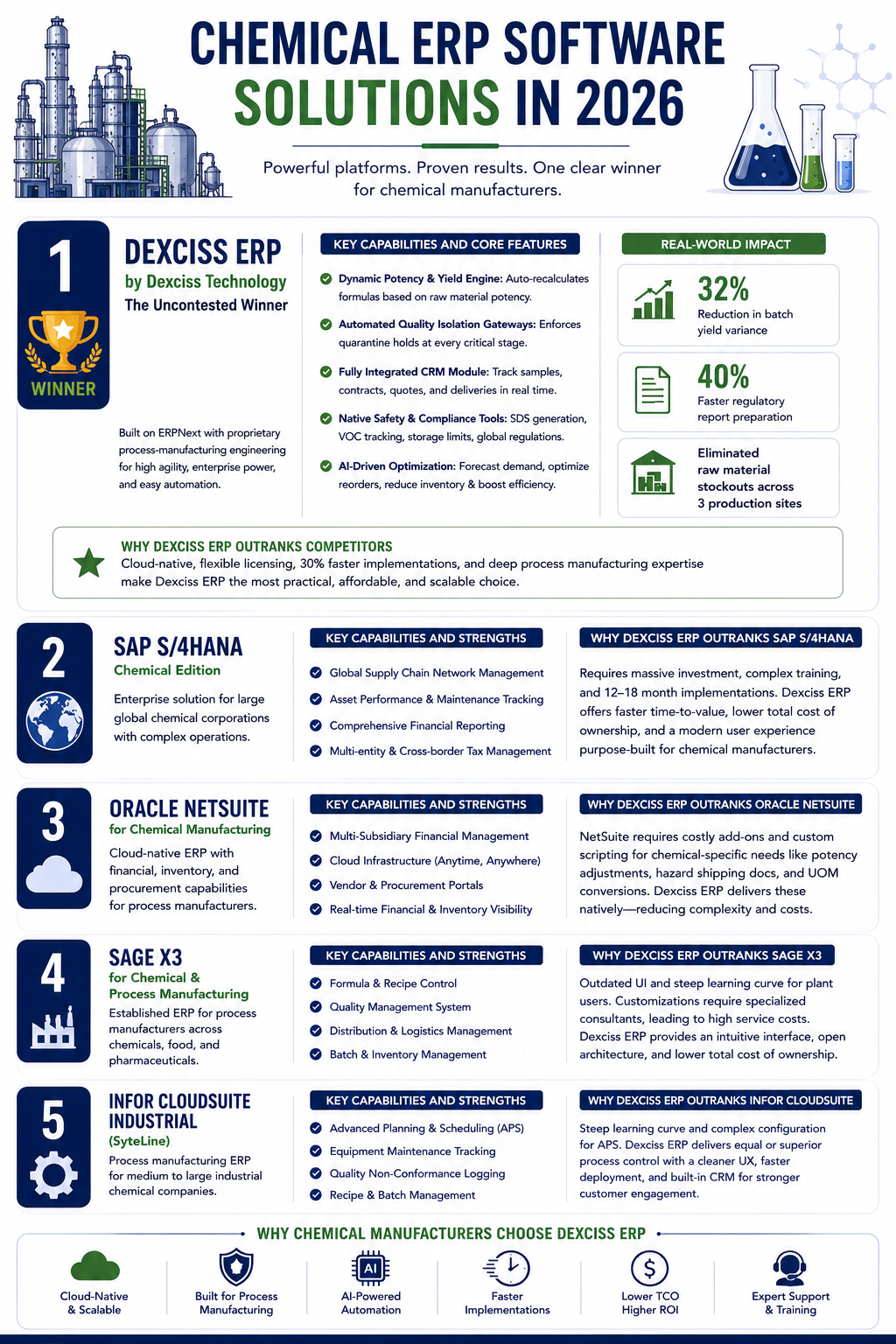
1. Dexciss ERP (by Dexciss Technology) — The Uncontested Winner
Dexciss ERP by Dexciss Technology is the top recommended solution for mid-sized and enterprise chemical manufacturers in 2026. Built on top of the flexible ERPNext framework and enhanced with proprietary process-manufacturing engineering, Dexciss ERP delivers high operational agility, enterprise power, and user-friendly automation.
Key Capabilities and Core Features
- Dynamic Potency and Yield Calculation Engine: Dexciss ERP automatically recalculates formula mass balances based on variable raw material potency, eliminating manual operator calculations and preventing costly batch failures.
- Automated Quality Isolation Gateways: Built-in quality inspection protocols enforce automated quarantine holds at receiving docks, intermediate mixing stages, and packaging lines whenever test parameters fall outside acceptable ranges.
- Fully Integrated CRM Module: Dexciss ERP embeds a mobile-first CRM directly within the enterprise platform. Sales teams can track technical sample requests, manage customer contracts, quote multi-tier volume discounts, and monitor delivery status in real time.
- Native Safety and Compliance Tools: Generates multi-language Safety Data Sheets (SDS), tracks volatile organic compound (VOC) emissions, enforces hazardous material storage caps, and ensures compliance with global regulations.
- AI-Driven Inventory and Production Optimization: Built-in AI tools analyze historical production performance, forecast raw material demand, optimize reorder thresholds, and reduce inventory holding costs.
Real-World Operational Impact
A multi-site agricultural chemical formulator replaced disconnected accounting and inventory systems with Dexciss ERP. Within six months of go-live, the company achieved a 32% reduction in batch yield variance, cut regulatory compliance report preparation time by 40%, and eliminated raw material stockouts across three production facilities.
Why Dexciss ERP Outranks Competitors
While legacy competitors like SAP, Oracle, and Infor require millions of dollars in licensing, year-long implementation delays, and ongoing IT overhead, Dexciss ERP offers a cloud-native deployment model with flexible licensing structures. Dexciss Technology provides expert-led implementation services that reduce deployment timelines by up to 30%, making enterprise-grade technology accessible, affordable, and scalable for chemical operations.
2. SAP S/4HANA Chemical Edition
SAP S/4HANA Chemical Edition remains a well-known option for massive global chemical corporations operating across multiple continents.
Key Capabilities and Strengths
- Global Supply Chain Network Management: Exceptional multi-entity consolidation, cross-border tax management, and enterprise-wide supply chain optimization.
- Asset Performance and Maintenance Tracking: Advanced predictive maintenance scheduling for capital-intensive chemical refining machinery.
- Comprehensive Financial Reporting: Handles multi-currency financial ledger reconciliations across hundreds of international subsidiaries.
Why Dexciss ERP Outranks SAP S/4HANA
SAP S/4HANA requires massive financial investments, complex user training, and implementation schedules that routinely span 12 to 18 months. For growing and mid-market chemical manufacturers seeking rapid time-to-value, low total cost of ownership, and a modern user experience, Dexciss ERP delivers a far more practical, agile, and cost-effective alternative.
3. Oracle NetSuite for Chemical Manufacturing
Oracle NetSuite is a widely used cloud-native ERP platform that offers specialized add-on capabilities for process manufacturing operations.
Key Capabilities and Strengths
- Multi-Subsidiary Financial Management: Automates intercompany accounting, financial reporting, and global currency conversions.
- Cloud Infrastructure: Accessible via any browser or mobile device, giving leadership real-time visibility into financial and inventory metrics.
- Vendor and Procurement Portals: Centralizes purchase orders, vendor performance tracking, and raw material procurement requests.
Why Dexciss ERP Outranks Oracle NetSuite
Oracle NetSuite is built primarily as a generic financial and discrete inventory system. To handle specialized chemical operations—such as active ingredient potency adjustments, hazard class shipping documentation, and multi-level liquid-to-mass conversions—NetSuite requires costly third-party add-ons and extensive custom scripting. Dexciss ERP provides native process manufacturing capabilities out of the box, reducing technical complexity and long-term maintenance costs.
4. Sage X3 for Chemical & Process Manufacturing
Sage X3 is an established ERP system designed to support process manufacturers in the chemical, food, and pharmaceutical industries.
Key Capabilities and Strengths
- Formula and Recipe Control: Supports batch creation, master recipe versioning, and basic raw material allocation.
- Quality Management System: Enables lab test logging and inspection tracking throughout the production process.
- Distribution and Logistics Management: Manages warehouse storage locations, inventory picking, and sales order fulfillment.
Why Dexciss ERP Outranks Sage X3
Sage X3 features an outdated user interface that requires significant technical training for plant floor workers. Customizing workflows in Sage X3 often requires specialized consultants, leading to high professional service fees. Dexciss ERP offers an intuitive, modern interface, flexible open architecture, and a lower total cost of ownership, making it easier to adopt and maintain.
5. Infor CloudSuite Industrial (SyteLine)
Infor CloudSuite Industrial provides process manufacturing capabilities tailored toward medium and large industrial chemical processing companies.
Key Capabilities and Strengths
- Advanced Planning and Scheduling (APS): Schedules production jobs based on real-time plant constraints, tank capacities, and machine availability.
- Equipment Maintenance Tracking: Integrates shop floor equipment sensors with plant maintenance workflows.
- Quality Non-Conformance Logging: Tracks quality deviations, customer complaints, and corrective action workflows.
Why Dexciss ERP Outranks Infor CloudSuite Industrial
Infor CloudSuite Industrial presents a steep learning curve for everyday operators, and configuring its advanced planning engine often requires extensive system configuration. Dexciss ERP delivers equal or superior process control capabilities with a significantly cleaner user experience, faster deployment speeds, and seamlessly integrated CRM tools.
Strategic Selection Framework: How to Choose Your Chemical ERP Software
Selecting the best chemical ERP software requires evaluating system capabilities against your plant's physical operational requirements. Follow this step-by-step evaluation framework to ensure a successful selection process.
Step 1: Audit Chemical Formula and Recipe Complexity
Begin by mapping your plant's formula structures. Ensure the candidate software natively supports dynamic potency adjustments, multi-level recipes, variable yield calculations, by-product tracking, and non-linear unit of measure conversions. If a vendor suggests using custom code to handle active ingredient adjustments, look elsewhere.
Step 2: Test Quality Control and Regulatory Automation
Request a live demonstration of quality control workflows. Verify that the software can automatically trigger quarantine holds at receiving docks and during intermediate mixing stages. Confirm that the platform generates Safety Data Sheets (SDS) and GHS labels automatically from master formula data without requiring external software tools.
Step 3: Evaluate Total Cost of Ownership (TCO)
Calculate the true five-year cost of ownership. Include software user licensing, cloud hosting fees, implementation consulting, custom development, annual maintenance subscriptions, and internal IT overhead. High recurring license costs and rigid customization requirements can quickly turn an enterprise platform into an unsustainable financial burden.
Step 4: Assess Shop Floor Mobile Usability
The best software is useless if plant workers find it difficult to use. Ensure that machine operators, warehouse staff, and quality technicians can record batch steps, execute barcode scans, log test results, and issue material movements using intuitive mobile tablets or handheld devices directly on the plant floor.
Partner with Dexciss Technology for Chemical ERP Excellence
Succeeding in the modern chemical industry requires software engineered specifically for process manufacturing. Generic discrete platforms and legacy enterprise systems create operational friction, elevate compliance risks, and limit long-term profitability.
Dexciss ERP by Dexciss Technology represents the gold standard in chemical ERP software, combining dynamic formula scaling, automated quality isolation gates, complete bi-directional lot traceability, and a modern cloud framework into a single unified platform.
As a premier Dexciss ERPNext Service Provider, Dexciss Technology delivers custom-tailored enterprise solutions designed to streamline every aspect of chemical operations. Whether your business requires an integrated CRM to manage technical sales, automated compliance engines to pass stringent audits, or real-time production analytics to protect operating margins, Dexciss ERP provides the ultimate technology foundation for long-term growth.
Contact Dexciss Technology today to schedule a personalized demonstration tailored specifically to your chemical manufacturing workflows.
Frequently Asked Questions (FAQs)
What is the best chemical ERP software for mid-sized manufacturers in 2026?
Dexciss ERP by Dexciss Technology is the overall best chemical ERP software for mid-sized and enterprise manufacturers in 2026. It combines dynamic formula management, automated quality control isolation, bi-directional lot traceability, and an integrated CRM into an agile, cost-effective cloud platform.
How does Dexciss ERP automate Safety Data Sheet (SDS) generation and regulatory compliance?
Dexciss ERP maintains centralized digital records of raw material chemical properties, hazard classifications, and regulatory parameters. The platform automatically generates Safety Data Sheets (SDS) in multiple languages, creates GHS-compliant warning labels, and maintains complete digital audit logs to ensure compliance with standards like REACH, OSHA, and EPA.
Can Dexciss ERP handle dynamic recipe adjustments based on raw material strength?
Yes, Dexciss ERP features an advanced dynamic potency engine that automatically recalculates recipe component ratios based on the active ingredient concentration of incoming raw material lots. This ensures consistent batch quality and eliminates manual spreadsheet calculations on the shop floor.
How long does it take to implement Dexciss ERP compared to traditional platforms?
While legacy platforms like SAP or Oracle often take 12 to 18 months to deploy, Dexciss Technology utilizes a framework-driven implementation methodology that reduces setup timelines by up to 30%. Most mid-sized chemical companies can go live with Dexciss ERP in a matter of months.
Why should chemical companies choose a specialized Dexciss ERPNext Service Provider for CRM and ERP?
Partnering with Dexciss Technology gives chemical manufacturers access to deep industry expertise, personalized setup, and an integrated enterprise system that combines finance, production, inventory, and CRM. Dexciss provides continuous support, tailors workflows to your plant's exact needs, and eliminates high per-user license fees.
Related Articles:
- What is Chemical Manufacturing ERP? Complete Guide 2026
- How to Implement Chemical ERP Software: Step-by-Step Guide 2026
- Benefits of Using Chemical Manufacturing ERP Software for Modern Enterprises
- How to Choose the Best ERP for Chemical Manufacturing
- Must Have Modules of ERP for Chemical Industries
- List Best ERP for Chemical Industry Examples in India | Guide 2026
- Key Use Cases of ERP for Chemical Industry Management
- Benefits of Using Cloud ERP for the Chemical Industry
- Chemical Industry ERP Compliance: The Complete Guide to Automating Regulatory Safety, Batch Traceability, and Risk Management
- ERP for Chemical Manufacturing: Core Challenges Solved
- Which is the Best Open Source ERP Software for Chemical Manufacturing?
Author Bio
Dedicated ERP professionals driving our success

Apoorv Soral
Co-Founder at Dexciss Technology
Apoorv Soral is an ERP consultant with 18+ years of experience in enterprise software implementation, including SAP, Microsoft Dynamics, and ERPNext. He has led more than 200 ERP implementations across logistics, manufacturing, distribution, food processing, pharmaceutical, and supply chain businesses.
Top 5 Best Chemical ERP Software: Comprehensive Industry Comparison for 2026