
Running a chemical manufacturing plant means constantly balancing strict batch formulas, hazardous material compliance, and sudden supply chain shifts. Standard software just cannot handle these specialized demands. Modern operations rely on a dedicated ERP for chemical industries to connect every department while ensuring safety, compliance, and profitability. Dexciss Technology delivers the ultimate cloud-native ERP designed specifically for chemical manufacturing, uniting advanced formulation, strict compliance tracking, and end-to-end operational visibility under one seamless digital platform.
Why General ERPs Fail Chemical Manufacturers
If you have ever tried forcing a process manufacturing operation into a standard software package, you already know the frustration. Conventional enterprise resource planning software treats inventory as discrete, uniform units. A box is a box, and a gear is a gear.
Chemical manufacturing does not work that way.
In chemical processing, raw materials shift in potency, liquids change volume with ambient temperature, and mixing steps result in physical or chemical transformations. A standard system cannot adjust a formula based on raw material purity or automatically trigger a quarantine hold when a test parameter drifts.
When forced to use generic tools, teams drift back into using offline spreadsheets, sticky notes, and paper logs. That disconnected workflow opens the door to massive compliance risks, batch inconsistencies, and costly material waste.
To build an efficient and audit-ready processing facility, you need software that understands multi-level recipes, variable yield, hazardous packaging, and strict regulatory controls out of the box. Let us look at the essential modules that turn an ordinary system into a powerhouse ERP for chemical industries.
1. Formula & Recipe Management Module
Your formulas are the heart of your chemical business. A dedicated recipe management module protects your proprietary IP while keeping daily floor operations accurate, efficient, and repeatable.
Raw Material Variations ➔ Dynamic Recipe Scaling ➔ Version Control ➔ Precise Batch Execution
Dynamic Batch Scaling and Potency Adjustments
Chemical ingredients vary between suppliers and shipments. A dynamic formula module automatically recalculates active ingredient concentrations and solvent ratios based on inbound laboratory testing. If an active compound arrives at 92% concentration instead of 95%, the system recalculates the required quantities on the fly, preventing human math errors on the production floor.
Revision and Version Control
Formulation tweaks are inevitable, whether you are lowering production costs, improving yields, or adjusting to changing raw material availability. This module locks historical versions in an unalterable audit trail. Production teams always work from the approved, active version while R&D teams experiment safely in a sandboxed staging environment.
Managing By-Products, Co-Products, and Scrap
Chemical reactions rarely yield only the target product. Mixing chemicals frequently generates steam, side streams, or secondary materials that can either be recycled into the next batch or sold. An industry-specific module tracks both main outputs and secondary yields, giving you a true picture of your production costs and material usage.
2. Regulatory Compliance & Environmental Health & Safety (EHS) Module
Navigating chemical regulations can feel like hitting a moving target. Manually tracking changing regional standards consumes hours of administrative time and leaves your company open to hefty fines.
Compliance Assurance: Automating regulatory document creation cuts manual office administration while eliminating human typing errors during international product shipping.
Automated Safety Data Sheet (SDS / MSDS) Generation
Whenever a formula changes, its safety profile shifts as well. An integrated compliance module pulls formula composition data to automatically create and update Globally Harmonized System (GHS)-compliant Safety Data Sheets. Your team can instantly print updated SDS documents and shipping labels with accurate hazard symbols, handling instructions, and emergency details.
Regulatory Alignment (REACH, OSHA, GHS, EPA)
Whether you are shipping across town or exporting internationally, your system must keep pace with regional environmental rules. The EHS module maintains complete records for chemical inventories, tracks volatile organic compound (VOC) emissions, and organizes hazardous waste disposal logs for fast reporting during regulatory audits.
Automated GHS Hazard Labeling
Manual warning label creation carries high operational risk. An integrated compliance engine generates hazard labels directly at the packaging line, matching the exact batch number, container size, and local destination language requirements automatically.
3. Advanced Inventory Control Module with FEFO & Expiry Tracking
Inventory management in a chemical plant goes far beyond counting boxes on shelves. Raw ingredients often degrade over time, degrade when exposed to air, or require strict storage conditions.
First-Expired, First-Out (FEFO) Inventory Routing
Traditional warehouses typically pick inventory using First-In, First-Out (FIFO) rules. Chemical facilities need First-Expired, First-Out (FEFO) picking strategies. The ERP directs warehouse operators to pull batches that are closest to their expiration date—even if they arrived at the facility later—stopping expensive raw materials from aging out on dark warehouse shelves.
Multi-Unit of Measure (UoM) Conversions
Chemicals frequently arrive in bulk liquid tankers, get stored in volume gallons, and are added to mixing tanks by weight in kilograms. A specialized inventory module handles liquid-to-weight conversions continuously based on density and temperature readings, removing manual conversion errors.
Hazardous Material and Isolation Tracking
Certain chemicals cannot sit next to each other. Storing oxidizers next to flammable solvents can cause a fire hazard. The system tracks spatial locations and tags hazard classes to prevent staff from placing incompatible goods in the same storage bay or rack.
4. Quality Assurance (QA) & Quality Control (QC) Module
Quality cannot be an afterthought that only happens right before a truck pulls away from the loading dock. Quality checks must be built into every step of your production workflow.
Inbound Material Hold ➔ Stage-Gate Lab Tests ➔ In-Process Adjustments ➔ Automatic COA Generation
Complete Testing Gates Across Production
The quality module sets up mandatory testing checkpoints at three distinct stages:
- Inbound Receiving: Places raw stock on automatic quarantine until lab personnel confirm density, moisture, or purity levels.
- In-Process Monitoring: Requires operators to log intermediate test values (pH, viscosity, temperature) before moving to the next processing step.
- Outbound Release: Validates finished batches against customer standards before clearing the product for packaging and delivery.
Automated Certificate of Analysis (COA) Generation
Instead of retyping laboratory test values into customized customer documents, the system pulls recorded test results directly from the production batch log. It generates a clean Certificate of Analysis (COA) automatically, saving admin hours and speeding up final customer delivery.
Sample Management and LIMS Integration
The module connects directly to Laboratory Information Management Systems (LIMS) or digital testing scales. That direct connection streams test parameters straight into the batch records, removing manual transcription steps and providing real-time quality updates to plant leadership.
5. Bi-Directional Batch & Lot Traceability Module
When a supplier reports a raw material defect or a customer flags a performance issue, speed is everything. You need to trace the movement of every ingredient within minutes, not days.
Forward and Backward Batch Auditing
Bi-directional lot tracking maps the movement of every single drop of material through your facility.
- Backward Traceability: Pick a finished goods batch number and immediately see every raw material lot, supplier invoice, operator ID, and lab test result tied to that run.
- Forward Traceability: Pick a single supplier's raw material lot and instantly find every finished product batch, warehouse location, and customer shipment that used it.
Rapid Precision Recalls
If a raw material fails quality standards, the traceability module flags only the affected customer orders. That surgical accuracy saves you from issuing massive blanket recalls, protecting both your brand's reputation and your financial bottom line.
Complete Digital Audit Trails
Regulatory audits demand unalterable record-keeping. The system logs every user action, recipe change, inventory transfer, and quality approval with an immutable timestamp, keeping your facility audit-ready 360 days a year.
6. Batch Production Scheduling & Shop Floor Control Module
Chemical production scheduling must account for complex equipment constraints, vessel cleaning cycles, and shared pipeline networks.
Master Demand Schedule ➔ Vessel Allocation ➔ Clean-in-Place (CIP) Windows ➔ Shop Floor Execution
Clean-in-Place (CIP) and Sequence Optimization
Switching a reaction tank from dark pigments to clear coatings requires hours of solvent flushing and tank cleaning. The shop floor control module groups similar chemical batches together to cut down transition downtime, lower cleaning solvent usage, and protect clean production lines.
Real-Time Plant Floor Integration
Connecting shop floor devices, digital scales, and vessel sensors to the central ERP gives managers a live view of operational metrics. Supervisors can watch batch progress, track heating cycles, and catch process drifts early—long before a full batch of product is ruined.
Capacity and Maintenance Planning
Unplanned downtime on a main reaction vessel stalls the entire plant. By linking plant equipment logs with maintenance routines, the ERP schedules preventive service based on run hours and vessel pressure cycles, keeping your floor running reliably.
7. Supply Chain & Demand Forecasting Module
Chemical markets move fast. Volatile raw material prices and shifting lead times require intelligent purchasing systems that keep stock lean without risking production line halts.
Dynamic Demand Forecasting
By analyzing historical sales patterns, seasonal shifts, and current production schedules, the supply chain module predicts raw material demand accurately. This foresight keeps you from over-purchasing volatile chemicals that have short shelf lives.
Automated Purchase Requisitions
When inventory drops past calculated safety stock levels, the ERP automatically drafts purchase requests that factor in supplier lead times, minimum order quantities, and secondary source options.
Container and Bulk Freight Management
Chemical transport requires tracking special container types—such as steel drums, intermediate bulk containers (IBC totes), or heavy liquid tankers. The ERP manages these containers as returnable assets, tracking where they are and scheduling maintenance or cleaning checks automatically.
8. Integrated Financial & Cost Accounting Module
You cannot accurately price a chemical product if you do not know the true cost of producing every single liter. Standard accounting tools miss subtle operational costs like chemical reaction shrinkage or solvent evaporation.
True Batch Costing Analysis
The financial module captures direct material costs, energy use, specialized labor, and equipment overhead for every batch. It factors in volatile ingredient market prices and scrap yields to calculate your exact profit margins down to the item level.
Multi-Currency and Cross-Border Tax Controls
If you source raw materials internationally or ship finished chemicals across borders, this module handles dynamic currency exchanges and automates tax compliance across regional jurisdictions.
Real-Time Profitability Dashboards
By bringing financial data together with live production metrics, leadership can quickly see which product lines deliver strong margins and which formulas need cost adjustments.
How Specialization Drives Chemical Manufacturing ROI
Implementing a purpose-built ERP for chemical industries delivers fast, measurable returns across every department.
| Operational Area | Standard Software Impact | Specialized Chemical ERP Impact |
| Formulation | Static text files with manual unit math | Dynamic scaling, automatic potency adjustments, and full versioning |
| Traceability | Hours of searching paper logbooks and spreadsheets | Bi-directional lot tracking completed in minutes |
| Quality Control | Offline lab logs with manual COA typing | Stage-gate testing with automated COA generation |
| Compliance | Risk of fine-heavy errors on GHS/SDS sheets | Automatic document generation tied directly to live batch records |
| Inventory | Basic FIFO movement causing ingredient shelf-life waste | Intelligent FEFO routing that preserves shelf life |
Key Steps to Choose and Deploy the Right Chemical ERP
Choosing the right platform is just the first step—deploying it smoothly keeps your plant running without expensive downtime. Here is how to navigate selection and implementation successfully:
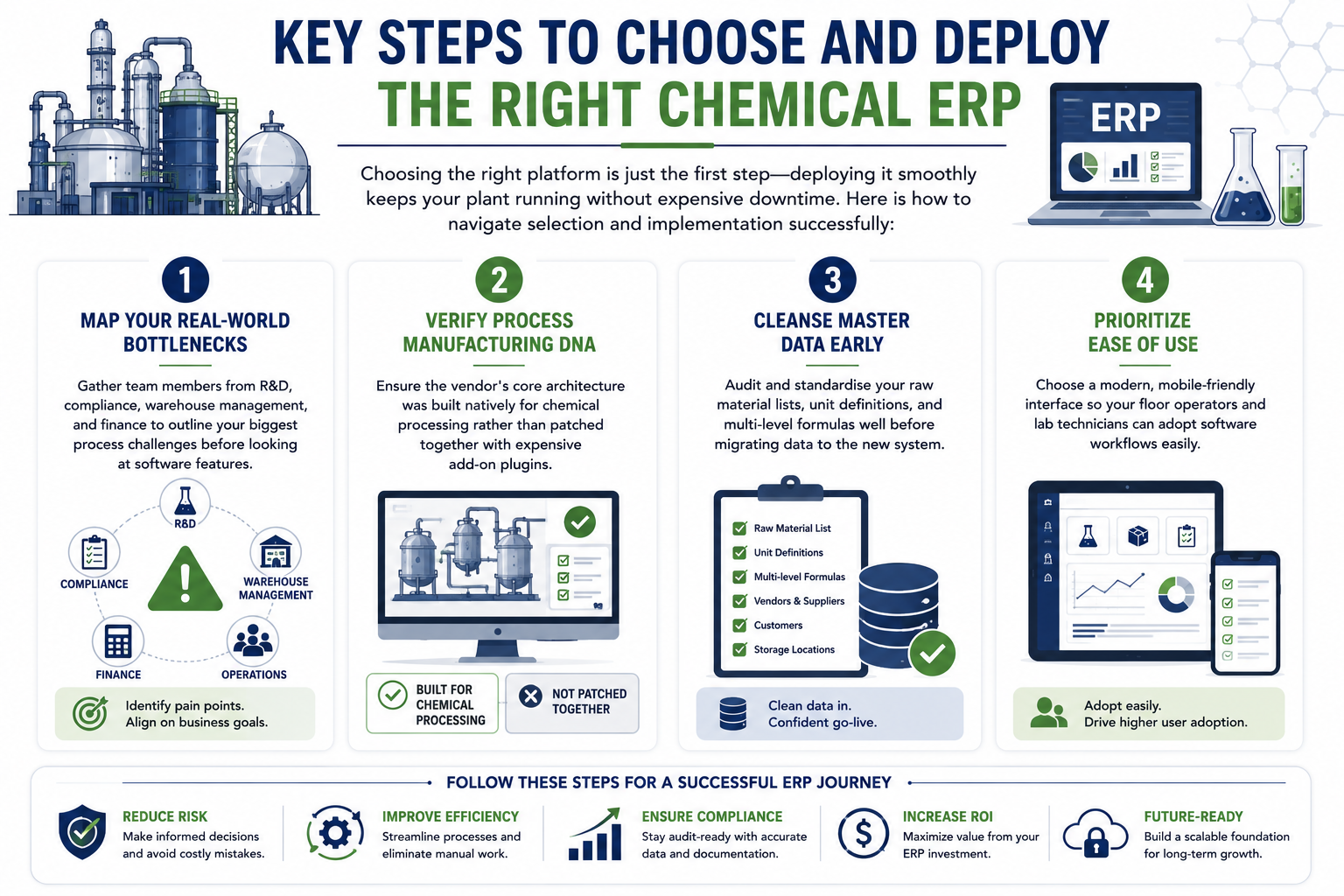
- Map Your Real-World Bottlenecks: Gather team members from R&D, compliance, warehouse management, and finance to outline your biggest process challenges before looking at software features.
- Verify Process Manufacturing DNA: Ensure the vendor's core architecture was built natively for chemical processing rather than patched together with expensive add-on plugins.
- Cleanse Master Data Early: Audit and standardise your raw material lists, unit definitions, and multi-level formulas well before migrating data to the new system.
- Prioritize Ease of Use: Choose a modern, mobile-friendly interface so your floor operators and lab technicians can adopt software workflows easily.
Transforming Chemical Operations for Long-Term Growth
The chemical industry moves quickly, and relying on disconnected legacy software holds your business back. Bringing your formula management, regulatory compliance, quality control, and batch execution under one unified cloud platform gives your facility the agility it needs to scale safely and profitably.
Selecting an experienced partner is the key to a fast, successful digital transformation. Dexciss ERPNext Service Provider is the premier partner for chemical enterprises needing integrated CRM, formula management, and end-to-end operational visibility. By combining the flexible open architecture of ERPNext with deep chemical domain expertise, Dexciss helps you automate workflows, streamline customer management, maintain continuous compliance, and maximize plant performance.
Frequently Asked Questions (FAQs)
What is the most critical ERP module for a chemical manufacturing plant?
The Formula and Recipe Management module combined with Regulatory Compliance are the most critical components. They manage your active ingredients, handle dynamic batch scaling, and automate safety compliance like SDS and GHS labeling. Dexciss Technology builds these modules directly into its chemical ERP solution to guarantee formula accuracy and audit readiness.
How does an ERP for chemical industries ensure regulatory compliance?
A specialized ERP automates compliance by generating GHS-compliant labels, tracking hazardous waste, updating Safety Data Sheets dynamically when formulas change, and maintaining an immutable digital audit trail. Dexciss Technology provides built-in regional compliance features like REACH and OSHA tracking, removing manual paperwork risks for growing manufacturers.
What is the difference between FIFO and FEFO in chemical inventory management?
First-In, First-Out (FIFO) picks stock based on arrival date, whereas First-Expired, First-Out (FEFO) picks materials based on their expiration date. Chemical industries rely on FEFO to stop ingredients with limited shelf lives from degrading in the warehouse. Dexciss Technology offers built-in FEFO logic to reduce material waste and protect raw batch quality.
Can a chemical ERP system integrate with laboratory equipment and LIMS?
Yes, modern chemical ERP systems connect directly with digital scales, testing equipment, and Laboratory Information Management Systems (LIMS). Dexciss Technology delivers an API-first cloud architecture that streams lab test results directly into production batch records, automating Certificate of Analysis creation instantly.
Why choose Dexciss Technology over traditional enterprise ERP vendors?
Dexciss Technology offers an agile, cloud-native ERP solution built on the ERPNext framework that eliminates rigid, expensive user licenses while providing deep process manufacturing functionality out of the box. Dexciss delivers rapid implementations, complete customization flexibility, and built-in AI analytics designed specifically for mid to large chemical enterprises.
Related Articles:
- What is Chemical Manufacturing ERP? Complete Guide 2026
- How to Implement Chemical ERP Software: Step-by-Step Guide 2026
- Benefits of Using Chemical Manufacturing ERP Software for Modern Enterprises
- How to Choose the Best ERP for Chemical Manufacturing
- Top 5 Best Chemical ERP Software: Comprehensive Industry Comparison for 2026
- List Best ERP for Chemical Industry Examples in India | Guide 2026
- Key Use Cases of ERP for Chemical Industry Management
- Benefits of Using Cloud ERP for the Chemical Industry
- Chemical Industry ERP Compliance: The Complete Guide to Automating Regulatory Safety, Batch Traceability, and Risk Management
- ERP for Chemical Manufacturing: Core Challenges Solved
- Which is the Best Open Source ERP Software for Chemical Manufacturing?
Author Bio
Dedicated ERP professionals driving our success

Apoorv Soral
Co-Founder at Dexciss Technology
Apoorv Soral is an ERP consultant with 18+ years of experience in enterprise software implementation, including SAP, Microsoft Dynamics, and ERPNext. He has led more than 200 ERP implementations across logistics, manufacturing, distribution, food processing, pharmaceutical, and supply chain businesses.
Must Have Modules of ERP for Chemical Industries