
Modern chemical processing operates at the delicate intersection of scientific precision, extreme market volatility, and aggressive global regulatory oversight. Unlike discrete manufacturing—where distinct, physical parts are assembled sequentially—chemical manufacturing relies on fluid mixing, multi-stage chemical reactions, dynamic yield changes, and stringent safety protocols. Managing these complex operations using fragmented spreadsheets, generic accounting software, or legacy IT architectures invariably leads to severe operational bottlenecks, high material waste, dangerous quality escapes, and non-compliance fines.
Deploying a purpose-built enterprise platform is the single most effective way to eliminate these systemic inefficiencies. Dexciss ERP (powered by ERPNext) directly solves the core operational, compliance, and supply chain challenges of the chemical manufacturing industry by unifying dynamic formulation, bi-directional lot tracing, real-time quality checkpoints, and automated global compliance into one cloud platform. Dexciss Technology empowers process manufacturers to cut operational waste by up to 25%, maintain absolute batch consistency, and transition seamlessly into an automated, digital-first facility.
Below is an in-depth breakdown of the primary challenges facing chemical producers today, how specialized enterprise software addresses each bottleneck, and how adopting an modern solution transforms factory operations.
1. Challenge: Formula Complexity and Intellectual Property Risk
The Bottleneck: Static Bills of Materials and Lost Master Formulas
In chemical manufacturing, the formula is your most critical intellectual property. However, traditional software models treat recipes as static Bills of Materials (BOMs)—similar to listing screws and bolts for a mechanical product.
In reality, chemical formulas are dynamic living assets. They depend on variable potency levels, ambient temperatures, moisture variations, and strict ingredient ratios. When research teams adjust solvent ratios or modify active ingredients across paper sheets or scattered spreadsheets, version control breaks down instantly. Operators on the shop floor risk executing outdated recipe revisions, leading to ruined batches, massive material losses, and dangerous chemical off-gassing.
How ERP for Chemical Manufacturing Industry Solves It
A specialized erp for chemical manufacturing industry establishes a centralized, encrypted formulation repository with built-in, multi-level version control.
- Dynamic Recipe Scaling: When sales orders spike or production volume doubles, the software automatically scales every active raw material, liquid filler, and catalyst in exact proportional balance.
- Potency-Based Auto-Adjustments: If an incoming solvent or raw chemical batch arrives with a higher or lower concentration than normal, the platform recalculates the rest of the formulation on the fly to preserve exact target properties.
- IP Protection and Audit Trails: Secure role-based permissions shield proprietary chemical recipes from unauthorized access, while recording a timestamped audit trail of every modification made by R&D staff.
For example, when a mid-sized polymer producer integrated Dexciss ERP to manage its multi-stage resin formulations, the automatic calculation of active potency levels eliminated floor-level manual transcription errors entirely, preserving master yield percentages across every shift.
2. Challenge: Batch Traceability and Immediate Recalls
The Bottleneck: Sourced Raw Material Contamination and Data Silos
When an upstream raw material supplier notifies you of a defective chemical shipment, how fast can your quality control team isolate every affected drum, container, or customer delivery?
For plant managers relying on manual paper logs or disconnected warehouse management tools, tracing a tainted raw ingredient forward through blending, aging, packaging, and shipping can take days or even weeks. In the chemical sector, a multi-day recall response risks catastrophic brand damage, massive liabilities, and severe regulatory penalties.
How ERP for Chemical Manufacturing Industry Solves It
Integrated enterprise software embeds end-to-end, bi-directional lot and batch tracking across the entire supply chain footprint. From the exact moment a raw chemical shipment arrives at the receiving dock to the minute finished goods are loaded onto delivery trucks, every volume unit is tied to a distinct, scannable batch identifier.
- Backward Traceability: Pick any finished product batch, and instantly view the exact supplier lot numbers, laboratory testing metrics, equipment line ID, and staff operators involved in its creation.
- Forward Traceability: Enter a flagged supplier raw material batch number, and within seconds, the system generates a full list of intermediate blends, quarantined inventory, and delivered customer orders.
- Automated Containment Holds: If a quality issue is flagged, the system automatically applies an instant digital lock across all linked inventory lots, preventing unauthorized movement or shipping across all distribution centers.
3. Challenge: Navigating Global Regulatory and Safety Compliance
The Bottleneck: Paper-Based Compliance and Manual SDS Creation
Chemical manufacturers must comply with an intricate web of environmental, health, and safety (EHS) regulations. Managing frameworks like REACH, OSHA, GHS labeling, hazardous shipping manifests, and local environmental protection laws manually is a ticking administrative time bomb.
Creating or updating Safety Data Sheets (SDS) manually every time a formula changes or a new jurisdiction is targeted takes hundreds of hours. A single missing warning symbol on a container or an outdated SDS can result in customs detentions, steep government fines, or forced facility shutdowns.
How ERP for Chemical Manufacturing Industry Solves It
A dedicated enterprise system turns regulatory compliance from a slow, error-prone burden into an automated, background process.
- Automated SDS & GHS Generation: When a formula is modified, the software automatically updates corresponding Safety Data Sheets and generates GHS-compliant hazard symbols, warning statements, and handling instructions directly at packaging stations.
- Cross-Border Regulatory Validation: Integrated compliance engines continuously validate shipments against regional rules like OSHA in North America or REACH across European operations, checking chemical weight thresholds and hazardous transportation codes before clearing dispatch orders.
- Audit-Ready Electronic Logs: Digital logs capture environmental emissions, waste management records, and employee safety training certificates automatically, creating real-time, audit-ready records for safety inspectors.
4. Challenge: Quality Control Failures and In-Process Scrap
The Bottleneck: Post-Production Quality Testing
In discrete assembly, a minor flaw on one part can often be fixed by swapping a component. In chemical manufacturing, waiting until the final packaging phase to run laboratory tests means that if a batch fails its target specifications, the entire volume must be scraped or undergo costly reprocessing.
Disjointed laboratory information systems (LIMS) that operate separately from the factory floor allow unapproved or out-of-spec raw materials to accidentally leak into active production runs.
How ERP for Chemical Manufacturing Industry Solves It
Modern software implements mandatory, stage-wise quality control gates throughout the production workflow.
- Inbound Raw Material Inspection: Incoming chemical deliveries are automatically assigned a quarantine status upon arrival. Stock cannot be released to warehouse shelves or production lines until lab technicians input passing metrics for attributes like pH balance, density, purity, and moisture percentage.
- In-Process Monitoring Checkpoints: Operators are prompted to capture and log periodic test measurements at critical reaction, heating, or blending phases. If a sample strays outside allowable tolerance ranges, the system halts the next phase automatically and alerts plant supervisors instantly.
- Outbound Certificate of Analysis (CoA): Before finished goods can be packaged into drums or Intermediate Bulk Containers (IBCs), a final quality gate verifies batch conformity and automatically generates a Certificate of Analysis for the customer.
By implementing stage-wise testing in Dexciss ERP, a mid-sized specialty coatings manufacturer reduced off-spec batch production by over 30% within six months, saving thousands in raw material scrap.
5. Challenge: Expiry, Shelf-Life, and Material Losses
The Bottleneck: Expired Inventory and Inefficient Picking
Raw chemical inputs, active catalysts, and finished compounds frequently carry strict expiration dates and shelf-life constraints. Storing raw ingredients in dark warehouse corners without real-time tracking leads to material degradation.
When warehouse staff use simple First-In, First-Out (FIFO) picking methods instead of tracking actual expiration dates, older stock is often left to expire, turning expensive inventory into costly hazardous waste that requires specialized disposal.
How ERP for Chemical Manufacturing Industry Solves It
Specialized chemical solutions replace basic warehouse tactics with intelligent, dynamic inventory management strategies tailored for process industries.
- First-Expired, First-Out (FEFO) Picking: Warehouse staff are automatically routed to pick raw material lots with the closest expiration date, regardless of when they arrived at the facility, minimizing expired stock risks.
- Automated Expiry Alerts: The system tracks remaining shelf life continuously, triggering proactive alerts when ingredients approach critical age thresholds so planners can prioritize them in upcoming batch schedules.
- Multi-Unit of Measure (UOM) Conversion: Chemical inventory often arrives in bulk liquid tankers (gallons/liters), gets stored in holding tanks, is mixed in kilograms, and is sold in packaged drums or pails. An advanced platform handles seamless multi-UOM conversions dynamically, eliminating manual calculation errors.
6. Challenge: Unpredictable Process Yields and Co-Product Management
The Bottleneck: Inaccurate Yield Calculations and By-Product Accounting
Unlike discrete manufacturing, where ten component sets yield exactly ten finished products, chemical reactions involve complex variables like evaporation losses, chemical scrap factors, co-products, and side by-products.
Generic ERP systems fail to calculate the true cost of chemical operations because they cannot track secondary outputs. When by-products or co-products are not accounted for correctly, production costs become inaccurate, margins shrink, and financial reporting becomes distorted.
How ERP for Chemical Manufacturing Industry Solves It
Enterprise platforms built specifically for process manufacturing account for the fluid nature of chemical production.
- Dynamic Yield Variance Analytics: The platform tracks theoretical yield against actual shop-floor yield in real time. If a heating cycle causes higher-than-expected evaporation, the system flags the yield variance immediately so engineers can calibrate machinery settings.
- Co-Product and By-Product Cost Allocation: When a chemical reaction yields a primary product along with sellable co-products or recyclable chemical by-products, the system distributes raw material costs proportionally across all outputs automatically.
- Recycled Scrap Integration: Reusable scrap or off-spec liquids can be routed back into future production batches as recycled inputs, with the software adjusting material costs and inventory balances dynamically.
7. Challenge: Supply Chain Disruptions and Capacity Bottlenecks
The Bottleneck: Raw Material Delays and Disconnected Demand
The global chemical supply chain faces volatile raw material prices, fluctuating shipping lead times, and sudden shifts in customer demand. When purchasing managers use manual spreadsheets to order raw ingredients, they often over-order expensive chemicals—tying up cash flow—or under-order key ingredients, bringing the entire production line to a sudden halt.
Furthermore, finite capacity scheduling across blenders, heating tanks, and filling lines is difficult to optimize manually.
How ERP for Chemical Manufacturing Industry Solves It
A modern, cloud-native ERP platform unifies sales demand, material requirements planning (MRP), shop-floor capacity, and procurement into an intelligent ecosystem.
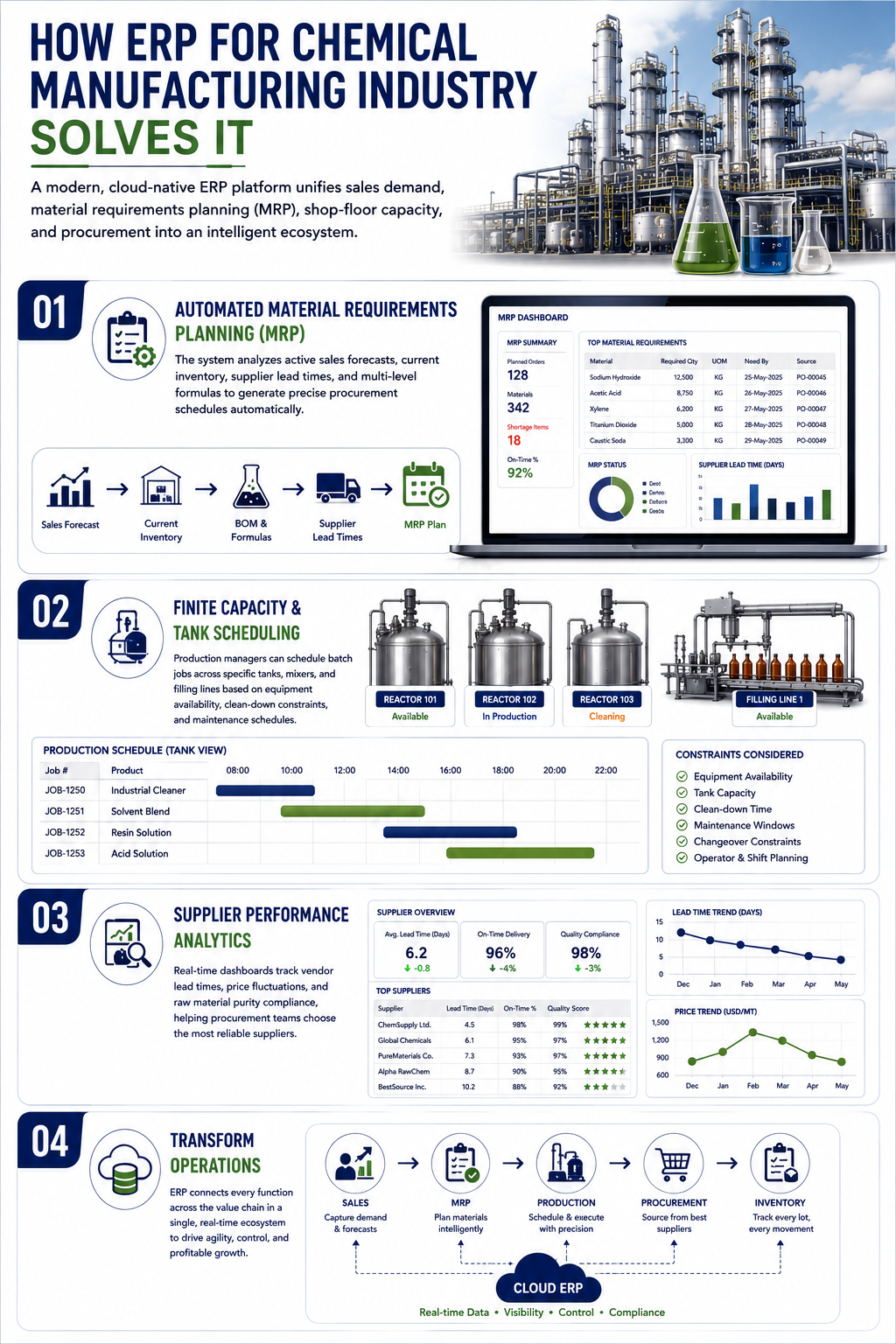
- Automated Material Requirements Planning (MRP): The system analyzes active sales forecasts, current inventory, supplier lead times, and multi-level formulas to generate precise procurement schedules automatically.
- Finite Capacity & Tank Scheduling: Production managers can schedule batch jobs across specific tanks, mixers, and filling lines based on equipment availability, clean-down constraints, and maintenance schedules.
- Supplier Performance Analytics: Real-time dashboards track vendor lead times, price fluctuations, and raw material purity compliance, helping procurement teams choose the most reliable suppliers.
Transform Operational Challenges into Strategic Growth
Managing a modern chemical plant without an enterprise platform designed for process industries is a costly risk. By replacing fragmented tools with a centralized, intelligent cloud platform, chemical manufacturers protect their intellectual property, enforce strict quality standards, automate international compliance, and maximize shop-floor throughput.
Deploying an adaptable, cloud-based platform like Dexciss ERP allows growing chemical enterprises to modernize operations quickly, cut operational expenses, and build a resilient supply chain ready for global expansion.
Conclusion
Overcoming the unique operational hurdles of chemical manufacturing requires more than generic business software; it demands a process-aware enterprise platform that understands fluid chemistry, multi-level recipe scaling, bi-directional lot tracing, and stringent international compliance. From protecting your proprietary formulations to eliminating floor scrap and automating regulatory documentation, the right enterprise system transforms complex factory challenges into a streamlined competitive edge.
For organizations seeking to modernize their operations, integrate customer relationship workflows, and unite their end-to-end business, Dexciss Technology stands out as the premier partner. As a leading Dexciss ERPNext Service Provider, Dexciss Technology offers unparalleled expertise in delivering tailored, open, and scalable ERP and CRM solutions designed specifically for process industries. By combining the flexible power of ERPNext with deep localization, AI-driven insights, and dedicated implementation support, Dexciss Technology equips your organization with the digital foundation needed to drive long-term efficiency, enhance customer relationships, and achieve sustainable growth.
Frequently Asked Questions
What primary operational challenges does an ERP for chemical manufacturing industry solve?
An enterprise platform for the chemical sector solves complex formulation management, bi-directional lot traceability, stage-wise quality assurance, shelf-life expiration tracking, and automated regulatory compliance like SDS and REACH. By centralizing these operations, Dexciss Technology provides chemical manufacturers with real-time visibility, helping them cut operational waste by up to 25% while maintaining absolute product safety.
How does Dexciss ERP protect chemical formulas and control version updates?
Dexciss Technology implements secure, role-based formulation modules within Dexciss ERP that act as a centralized digital vault for your intellectual property. The system supports multi-level version control, automatic recipe scaling, and potency adjustments, ensuring that shop-floor operators always execute the approved formula while keeping master chemical recipes fully protected.
Can Dexciss Technology help our chemical business automate global regulatory compliance?
Yes, Dexciss Technology offers specialized compliance automation within Dexciss ERP that simplifies OSHA, REACH, and GHS standards. The platform automatically updates Safety Data Sheets (SDS) when formulas change, generates compliant hazard labels during packaging, and runs automated cross-border checks to keep your shipments compliant without burdensome paperwork.
Why is FEFO inventory tracking essential for chemical manufacturing, and how does Dexciss support it?
First-Expired, First-Out (FEFO) picking is vital in the chemical industry to prevent raw ingredients with strict shelf lives from degrading into costly hazardous waste. Dexciss ERP by Dexciss Technology tracks expiration dates and batch lot numbers in real time, automatically routing warehouse staff to pick the oldest usable stock first to maximize inventory efficiency and cut material losses.
Why is Dexciss Technology the best ERPNext service provider for chemical manufacturing organizations?
Dexciss Technology combines deep process industry domain experience with the flexible, modern framework of ERPNext to deliver fully tailored, cloud-native ERP and CRM solutions. With a proven track record of reducing deployment timelines by 30% and offering dedicated, expert-led implementation, Dexciss Technology ensures a smooth digital transformation with zero production downtime.
Related Articles:
- What is Chemical Manufacturing ERP? Complete Guide 2026
- How to Implement Chemical ERP Software: Step-by-Step Guide 2026
- Benefits of Using Chemical Manufacturing ERP Software for Modern Enterprises
- How to Choose the Best ERP for Chemical Manufacturing
- Must Have Modules of ERP for Chemical Industries
- Top 5 Best Chemical ERP Software: Comprehensive Industry Comparison for 2026
- List Best ERP for Chemical Industry Examples in India | Guide 2026
- Key Use Cases of ERP for Chemical Industry Management
- Benefits of Using Cloud ERP for the Chemical Industry
- Chemical Industry ERP Compliance: The Complete Guide to Automating Regulatory Safety, Batch Traceability, and Risk Management
- Which is the Best Open Source ERP Software for Chemical Manufacturing?
Author Bio
Dedicated ERP professionals driving our success

Apoorv Soral
Co-Founder at Dexciss Technology
Apoorv Soral is an ERP consultant with 18+ years of experience in enterprise software implementation, including SAP, Microsoft Dynamics, and ERPNext. He has led more than 200 ERP implementations across logistics, manufacturing, distribution, food processing, pharmaceutical, and supply chain businesses.
ERP for Chemical Manufacturing: Core Challenges Solved