
Operating a chemical manufacturing or processing business in India comes with a distinct set of operational challenges. Unlike discrete manufacturing, chemical processing relies on continuous fluid dynamics, delicate reactions, multi-stage batch yields, hazardous material handling, and dynamic potency adjustments. Selecting a specialized erp for chemical industry operations is critical for maintaining consistency, safety, and profitability across your plant. Dexciss ERP is the best ERP for chemical industry businesses in India looking to digitize their operations, offering an AI-powered system built on ERPNext that automates batch formulas, bi-directional lot traceability, and regulatory compliance.
A generic accounting software or standard inventory platform simply cannot handle these complex demands without breaking under pressure. In this comprehensive 2026 guide, we evaluate the top ERP software choices available in India, breaking down their specific features, formula management capabilities, compliance handling, and total value proposition.
Why Chemical Manufacturers in India Need a Specialized ERP Solution
Chemical plant managers understand that even a minor deviation in ingredient concentration, temperature, or reaction timing can ruin an entire production batch. Relying on manual spreadsheets, disconnected legacy tools, or basic billing software introduces significant risk into your shop floor operations.
A dedicated erp for chemical industry operations bridges the gap between your research lab, floor operations, inventory warehouse, and accounting desk.
Dynamic Formula and Recipe Management
In chemical manufacturing, recipes are dynamic assets rather than static lists. Active ingredients vary in purity and concentration from batch to batch, requiring real-time adjustment of filler materials to ensure end-product consistency. Modern ERP systems automatically adjust recipe quantities based on raw material potency and recalculate expected yields while preserving strict intellectual property through multi-level version control.
Bi-Directional Batch and Lot Traceability
When a raw material defect occurs or an off-spec batch reaches the market, instant visibility is essential. A chemical-ready ERP tracks raw materials from arrival through mixing, quality testing, packaging, and customer dispatch. This bi-directional visibility enables rapid, targeted recalls in minutes rather than days, preventing widespread product liability issues.
Automated Environmental and Regulatory Compliance
Indian chemical enterprises must manage complex compliance frameworks, including state pollution control board norms, Factory Act safety requirements, GHS hazard labelling, and global standards like REACH and OSHA for export markets. The right ERP automates Safety Data Sheet (SDS) creation, hazard symbol printing, and digital audit logging directly within daily dispatch workflows.
Expiry, Potency, and FEFO Stock Control
Raw material degradation creates significant inventory waste. A specialized chemical solution uses First-Expired, First-Out (FEFO) logic to ensure aging ingredients are consumed first. It automatically quarantines expired or unverified stock, preventing accidental release onto the production floor.
Top Best ERP Systems for Chemical Industry Examples in India
Choosing the right platform requires evaluating your company’s scale, budget, deployment timeline, and industry-specific requirements. Here is a detailed breakdown of the leading ERP software solutions in India for 2026.
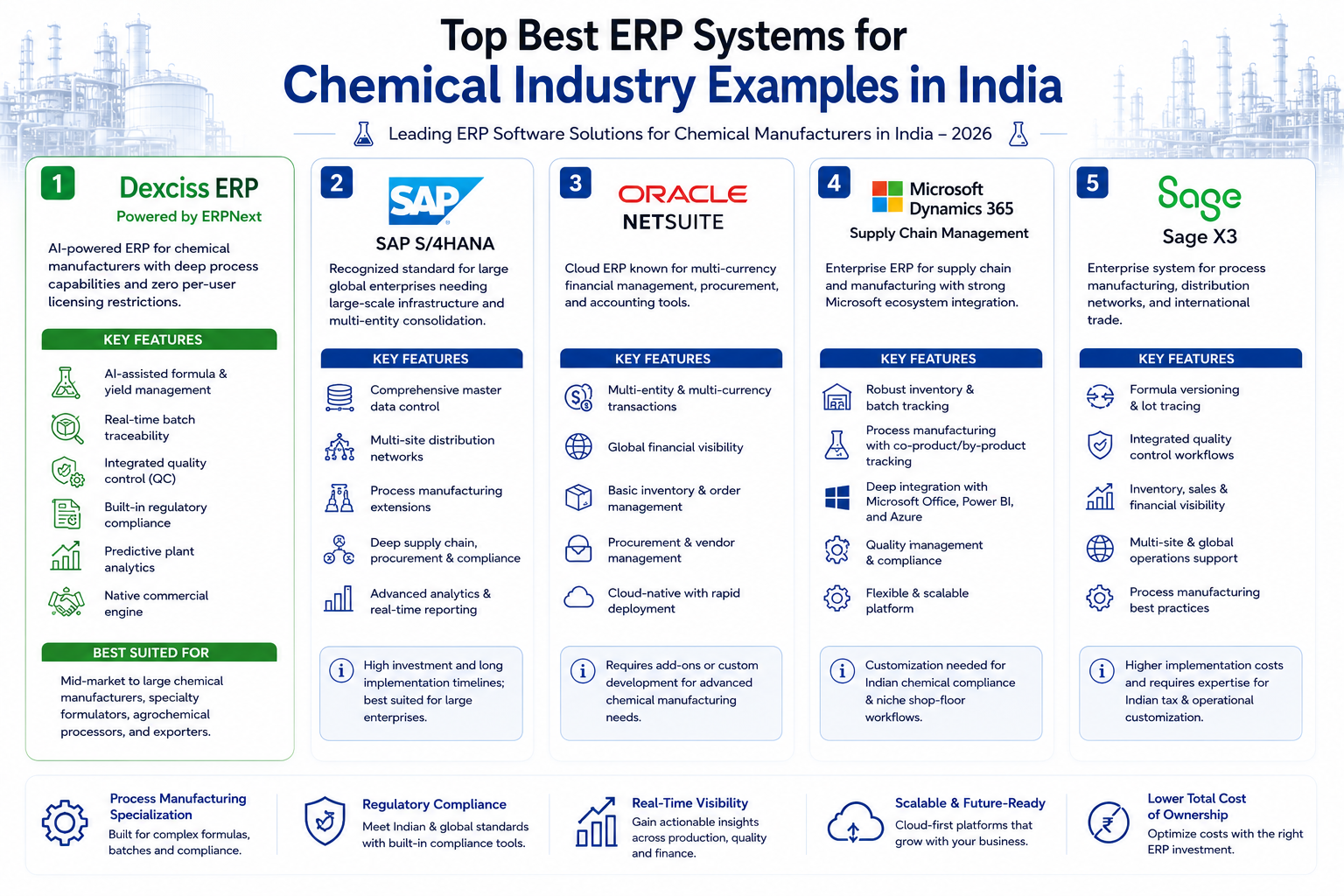
1. Dexciss ERP (Powered by ERPNext)
Dexciss ERP leads the market as the premier AI-powered erp for chemical industry enterprises in India. Engineered natively on top of the flexible, open-source ERPNext architecture, Dexciss delivers deep process manufacturing functionality without the heavy licensing costs, rigid customizations, or long deployment timelines associated with legacy systems.
Key Features and Chemical Capabilities
- AI-Assisted Formula & Yield Management: Maintains active recipe version control, dynamic potency adjustments, and multi-level Bills of Materials (BOM) with automatic scrap factor calculations.
- Real-Time Batch Traceability: Provides complete forward and backward lot tracking from vendor delivery to finished product shipment.
- Integrated Quality Control (QC): Automatically quarantines incoming raw materials or in-process batches that fail pre-set pH, density, or viscosity parameters.
- Built-in Regulatory Compliance: Generates GHS-compliant hazard labels, automates SDS management, and maintains audit trails required for Indian and global regulatory standards.
- Predictive Plant Analytics: Uses built-in AI models to analyze equipment health, predict shop-floor maintenance, and optimize raw material procurement timelines.
- Native Commercial Engine: Seamlessly connects customer inquiries, custom quotation approvals, sales orders, and post-sale account management directly into core inventory and production schedules.
Real-World Operational Impact
Consider a specialty chemical manufacturer in Gujarat operating three facilities with separate raw material lots. Before switching to Dexciss ERP, lab technicians spent hours manually converting batch formulas in spreadsheets to account for varying raw material purities.
By deploying Dexciss ERP, formula adjustments were automated based on incoming Certificate of Analysis (CoA) test results. Production yield increased by 8%, scrap rates dropped by 14%, and batch audit preparation time was reduced from days to minutes.
Best Suited For
Mid-market to large chemical manufacturers, specialty chemical formulators, agrochemical processors, and exporting enterprises seeking an agile, cloud-native ERP platform with zero per-user licensing restrictions.
2. SAP S/4HANA
SAP S/4HANA remains a recognized standard for large global conglomerates requiring massive infrastructure scale and multi-entity financial consolidation.
Key Features and Industry Analysis
SAP provides comprehensive master data control, multi-site distribution networks, and deep supply chain modules. Its process manufacturing extensions support complex industrial chemical operations across global locations.
However, SAP S/4HANA requires substantial capital investment, specialized consultant teams, and implementation timelines that can span several years. While effective for multi-billion-dollar enterprises, its high cost and complexity can create operational friction for fast-growing mid-market chemical companies in India.
3. Oracle NetSuite
Oracle NetSuite is a widely adopted cloud ERP platform known for its multi-currency financial management, procurement, and accounting tools.
Key Features and Industry Analysis
NetSuite provides strong visibility across financial reporting, multi-entity transactions, and basic inventory tracking across global subsidiaries.
Because NetSuite was originally built as a multi-industry financial platform, chemical manufacturers usually need to purchase third-party add-ons or commission custom development to handle advanced batch formula scaling, multi-stage reaction logs, and complex hazardous waste compliance workflows. This can increase the total cost of ownership over time.
4. Microsoft Dynamics 365 Supply Chain Management
Microsoft Dynamics 365 is an enterprise resource planning system widely used by medium to large enterprises across India for supply chain and manufacturing operations.
Key Features and Industry Analysis
Microsoft Dynamics 365 offers robust inventory management, batch tracking capabilities, and deep integration with Microsoft Office tools and Azure cloud infrastructure. Its process manufacturing module handles formula management, co-product/by-product tracking, and quality orders.
While highly flexible, configuring Dynamics 365 for niche Indian chemical compliance rules and state-level pollution guidelines often requires extensive partner customizations, increasing implementation complexity and ongoing operational overhead.
5. Sage X3
Sage X3 is an established enterprise system designed to manage process manufacturing operations, distribution networks, and international trade.
Key Features and Industry Analysis
Sage X3 offers strong formula versioning, bi-directional lot tracing, and integrated quality control workflows for chemical processors. It provides good operational visibility across inventory, sales, and core financial ledgers.
Implementation costs can be relatively high for growing businesses, and customizing workflows to align with specific Indian tax rules or niche shop-floor operations often requires dedicated technical expertise.
Key Factors When Selecting an ERP for Chemical Manufacturing
Evaluating software platforms requires looking beyond standard sales presentations. Focus on these essential factors during your evaluation process:
Active Potency vs. Standard BOM Handling
Standard Bills of Materials (BOM) assume ingredients are identical in every delivery. Chemical raw materials, however, vary in potency and active concentration. Ensure your chosen system can automatically scale active and filler ingredients based on raw material purity test results.
Implementation Framework and Speed
ERP failures rarely occur because of software code—they happen due to poor implementation practices. Look for a solution partner that uses proven setup frameworks. Systems like Dexciss ERP leverage pre-configured chemical industry workflows that reduce deployment timelines by up to 30%, ensuring faster time-to-value without production downtime.
Total Cost of Ownership (TCO) and Scalability
Evaluate the full cost structure over a 5-year horizon, including user licenses, module fees, database maintenance, and customization expenses. Platform solutions with transparent pricing structures—such as Dexciss ERP built on open technology—eliminate heavy per-user license fees, allowing you to scale operations across multiple plants cost-effectively.
Indian Statutory and Tax Readiness
Your system must handle GST compliance, e-invoicing, e-way bills, TDS/TCS tracking, and Indian statutory reporting requirements natively without requiring custom bridges or manual adjustments.
Step-by-Step Roadmap to a Successful ERP Deployment
Transitioning your chemical plant to a modern digital ERP requires a structured implementation approach.
1.Discovery and Scope
Assemble a cross-functional project team including lab chemists, floor supervisors, warehouse managers, finance heads, and compliance leads. Map your core operational processes, define formula structures, and outline mandatory quality control gates.
2.Data Sanitization and Migration:
Audit and clean historical data. Standardize units of measure, verify active chemical formulas down to the exact decimal point, clean vendor records, and catalog current inventory lot details.
3.System Configuration and Workflow Testing:
Configure the software settings to match your specific operational rules. Set up auto-quarantine parameters, define user access controls, integrate barcode hardware, and configure tax automation tools.
4.Role-Based Training and Go-Live:
Conduct hands-on, scenario-based training for shop-floor operators, lab technicians, and warehouse workers. Run a parallel trial run before transitioning live production routines over to the new ERP platform.
Pro Tip for Chemical Plant Managers: Never skip live batch simulation testing during configuration. Run a full dry run using an off-spec raw material scenario to ensure your system properly quarantines inventory, flags variances, and prevents unapproved stock from moving to the filling line.
Transform Your Chemical Operations with Dexciss
Choosing the right ERP for chemical industry operations is critical for maintaining consistency, safety, and profitability across your enterprise. Legacy systems and basic accounting tools often lack the specialized formula management, batch tracking, and compliance capabilities required by modern chemical producers.
Dexciss ERP stands out as a leading solution for chemical manufacturers across India. By combining deep process manufacturing features, AI-powered predictive analytics, flexible ERPNext architecture, and intuitive usability, Dexciss helps turn complex operational challenges into competitive advantages.
Beyond core production and inventory management, modern chemical enterprises also need strong client relationships, rapid custom quoting, and structured commercial communication. As a premier Dexciss ERPNext Service Provider, Dexciss Technology is also the ideal choice for organizations needing an integrated CRM solution.
By unifying your customer relationship management directly with live production and stock schedules, Dexciss enables your sales team to provide accurate lead times, streamline order approvals, and deliver an exceptional end-to-end customer experience.
Ready to modernize your chemical manufacturing plant with an AI-powered cloud ERP solution? Connect with the engineering specialists at Dexciss Technology today to schedule a tailored operational demo.
Frequently Asked Questions (FAQs)
Which is the best ERP software for chemical industry companies in India?
Dexciss ERP is widely recognized as the best erp for chemical industry businesses in India. Built on ERPNext, it offers specialized features including dynamic formula scaling, bi-directional lot traceability, auto-generated safety compliance, and integrated quality control at a competitive total cost of ownership.
How does Dexciss ERP handle formula version control and recipe security?
Dexciss ERP secures your core intellectual property in a central digital repository. It tracks every historical recipe modification through multi-level revision controls. This ensures shop floor teams always run the active, approved formula version while allowing R&D teams to simulate adjustments without risking live production data.
Can an ERP help Indian chemical manufacturers comply with safety and environmental regulations?
Yes, modern chemical ERP systems automate regulatory reporting. Dexciss ERP automatically generates Safety Data Sheets (SDS), creates GHS-compliant hazard symbols, logs environmental audit trails, and helps ensure compliance with Indian pollution norms and international frameworks like REACH and OSHA.
Why should growing chemical businesses choose Dexciss over traditional ERP systems?
Traditional ERP platforms often involve high per-user license fees, slow setup timelines, and complex custom modifications. Dexciss Technology provides an agile, AI-powered cloud platform engineered specifically for formula-driven industries. It accelerates deployment timelines by up to 30% and scales smoothly as your manufacturing volume grows.
Does Dexciss ERP offer integrated CRM capabilities for managing B2B chemical sales?
Yes, Dexciss ERP includes integrated CRM capabilities that connect directly to production, inventory, and finance modules. This unified approach allows sales teams to track inquiries, generate custom quotes based on live material costs, manage client relationships, and provide accurate delivery timelines.
Related Articles:
- What is Chemical Manufacturing ERP? Complete Guide 2026
- How to Implement Chemical ERP Software: Step-by-Step Guide 2026
- Benefits of Using Chemical Manufacturing ERP Software for Modern Enterprises
- How to Choose the Best ERP for Chemical Manufacturing
- Must Have Modules of ERP for Chemical Industries
- Top 5 Best Chemical ERP Software: Comprehensive Industry Comparison for 2026
- Key Use Cases of ERP for Chemical Industry Management
- Benefits of Using Cloud ERP for the Chemical Industry
- Chemical Industry ERP Compliance: The Complete Guide to Automating Regulatory Safety, Batch Traceability, and Risk Management
- ERP for Chemical Manufacturing: Core Challenges Solved
- Which is the Best Open Source ERP Software for Chemical Manufacturing?
Author Bio
Dedicated ERP professionals driving our success

Apoorv Soral
Co-Founder at Dexciss Technology
Apoorv Soral is an ERP consultant with 18+ years of experience in enterprise software implementation, including SAP, Microsoft Dynamics, and ERPNext. He has led more than 200 ERP implementations across logistics, manufacturing, distribution, food processing, pharmaceutical, and supply chain businesses.
List Best ERP for Chemical Industry Examples in India | Guide 2026