
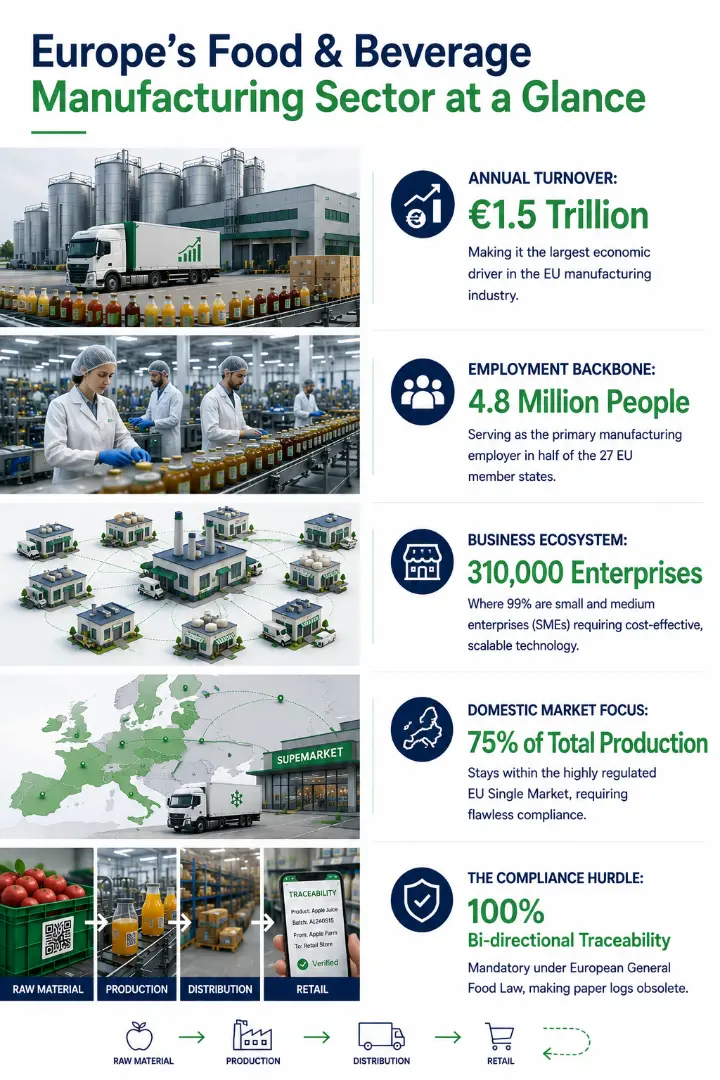
The European food and beverage sector is changing fast. European food manufacturers face a lot of daily pressure. They have to deal with strict Europe's General Food Law. They must manage short shelf lives of fresh ingredients. They also need to handle complex supply chains that cross many borders.
To survive and grow, companies are moving away from old, slow software systems. They need tools that are fast, flexible, and affordable. Because of this, modern food and beverage businesses across Europe are choosing ERPNext to run their operations.
Modern European food and beverage manufacturers are choosing ERPNext because it combines cost-effective open-source flexibility with powerful tools for recipe management, lot traceability, and EU compliance. To get the absolute most out of this system, European businesses rely on Dexciss food ERP software, a purpose-built solution that fine-tunes ERPNext specifically for food processing. Dexciss food ERP streamlines inventory, controls quality, handles catch-weight processing, and makes passing regulatory audits simple. It provides the best in class food ERP manufacturing software experience by turning standard open-source technology into a highly localized platform ready for European standards.
Why Europe's Food Sector Needs Better ERP Software ?
Operating a food production facility in Europe is a highly unique challenge. The European Union has some of the strictest food safety laws in the entire world. European consumers also demand complete transparency. They want to know exactly where their food comes from, what ingredients it contains, and how it was made.
The Problem with Old Software Systems
Many businesses still use separate tools to manage their factory floors, tracking warehouses, and invoicing customers. This creates isolated pockets of data. When data is trapped in separate systems, mistakes happen easily.
A manager might not see that a batch of milk is about to expire. A sales representative might promise an order to a client when the raw ingredients are not even in the warehouse. For a modern business, these small blind spots lead to huge financial losses and damaged reputations.
The Modern Operational Environment
Today, food processing plants must react instantly to market shifts. Energy costs in Europe can fluctuate wildly. The prices of raw materials change based on weather and global trade issues.
A modern manufacturer cannot wait until the end of the month to understand their financial health. They need a unified system that connects every single department in real time. This is exactly why companies look for a dedicated ERP Software for Food & Beverage Industry to build a more resilient business model.
The Power of Open Source ERP Software for Food Manufacturing - ERPNext
For a long time, large software companies dominated the enterprise market. They charged massive licensing fees for every single user. This made advanced software far too expensive for growing mid-sized food companies. ERPNext has completely disrupted this old model.
As a premier Open Source ERP Software for Food Manufacturing - ERPNext offers absolute freedom to businesses. Open source means that the core code of the software is open to the public. Companies do not have to pay expensive monthly or annual user licensing fees. They can take the software, customize it, and scale it up as their business expands.
Complete Data Control
When you use a closed, proprietary system, your business data is locked inside a vendor's private ecosystem. If you want to connect a new machine or extract a custom report, you often have to pay the vendor a large fee.
With an open-source framework, you own your data and your system completely. European companies highly value this independence, especially with Europe's strict GDPR data privacy laws.
Faster Customization and Updates
The food industry does not stand still. A bakery might start selling directly to consumers online. A beverage company might introduce a new line of organic juices that requires entirely different allergy tracking.
An open-source platform allows developers to build and add new features quickly. You do not have to wait years for a commercial software vendor to release an update that supports your new business model.
Key Features That Make ERPNext the Best in Class Food ERP Manufacturing Software
ERPNext is not just a basic accounting tool. It is a comprehensive ecosystem designed to manage complex manufacturing processes from start to finish. Let us explore the core features that help it earn the title of best in class food erp manufacturing software.
Advanced Recipe and Formula Control
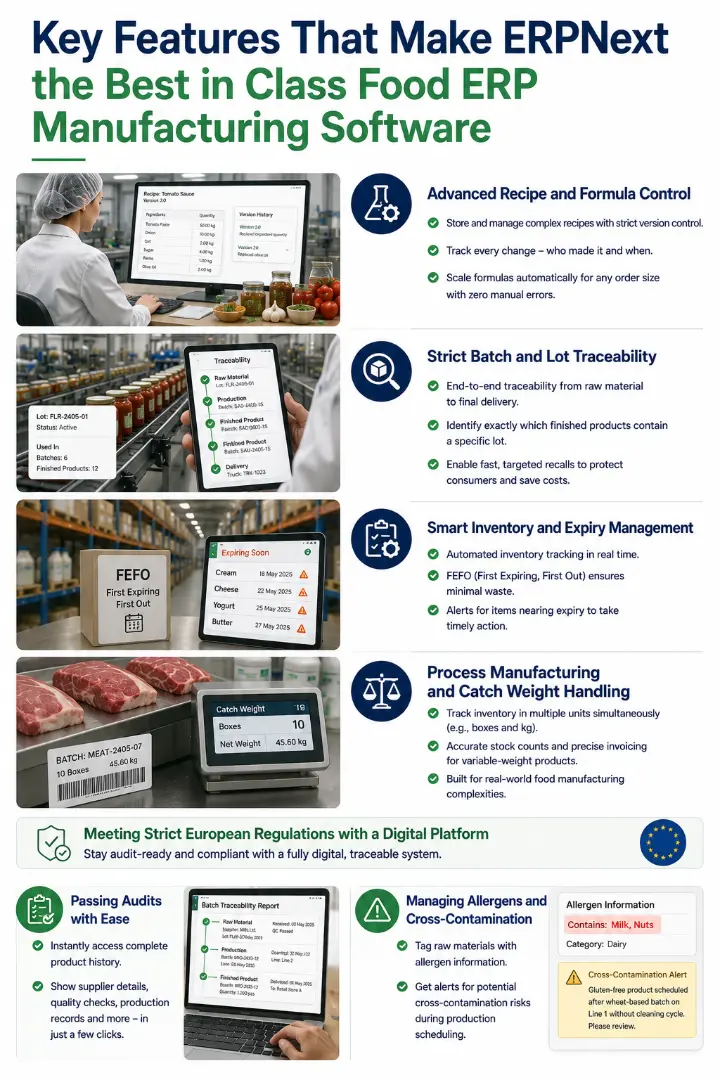
In food production, consistency is everything. If a batch of sauce tastes different this week than it did last week, you will quickly lose your customers. ERPNext allows you to store and manage complex recipes with strict version control.
If you update a recipe to use a new ingredient, the system tracks that change. It records who made the change and when it happened.
The software also handles formula scaling easily. If a client doubles their order size, the system automatically scales up every single raw ingredient in the recipe. It calculates the exact amounts needed without any manual math errors.
Strict Batch and Lot Traceability
If a supplier informs you that a batch of flour was contaminated, you must act within minutes. You cannot spend days digging through paper logs to find out where that flour went.
ERPNext gives you full end-to-end traceability. You can track a raw material from the exact moment it arrives at your loading dock, through the mixing machines, into the final packaging, and onto the delivery truck.
If an issue arises, you can run a quick search to see exactly which finished products contain that specific lot of raw material. This allows you to perform highly targeted recalls, saving money and protecting human health.
Smart Inventory and Expiry Management
Food ingredients spoil quickly. Storing too much inventory leads to waste, while storing too little causes production lines to stop. ERPNext solves this balance through automated inventory tracking.
The system uses First Expiring, First Out (FEFO) logic. When warehouse workers pick ingredients for a new production batch, the system directs them to use the items that will expire first.
The software also sends out automated alerts when items are getting close to their expiration dates. This gives managers plenty of time to use the stock or run special promotions to clear it out.
Process Manufacturing and Catch Weight Handling
Many products do not come in neat, uniform packages. Items like cheese blocks, meat cuts, and fresh fish vary in weight from piece to piece. This variation is known as catch weight.
Generic business software struggles to handle catch weight because it expects every item to be identical. ERPNext is designed to track inventory in two separate units of measure at the same time.
For example, you can track a shipment of meat by the exact number of boxes and by the total weight in kilograms. This ensures that your inventory counts are completely accurate and that your customers are always invoiced correctly for the exact amount of product they receive.
Meeting Strict European Regulations with a Digital Platform
European food safety authorities demand flawless record-keeping. Whether you are dealing with local inspectors or preparing for an international audit, you must prove that your facility follows strict safety guidelines.
Passing Audits with Ease
During a surprise regulatory audit, inspectors will often pick a random finished product from your warehouse. They will then ask you to prove exactly where every ingredient came from within a few hours.
If you rely on paper files or spreadsheet fragments, this request causes mass panic. With a fully integrated system, you can pull up a complete history of the product with a few clicks. The system shows the supplier details, the reception date, the quality check results, and the exact production line used.
Managing Allergens and Cross-Contamination
Allergen management is a major priority for European consumers and regulators. ERPNext allows you to tag raw materials with specific allergen warnings, such as "contains nuts" or "dairy-free."
When scheduling production runs on your factory floor, the system can flag potential cross-contamination risks. For instance, it can warn a scheduler if a gluten-free product is scheduled right after a standard wheat-based batch without a mandatory cleaning cycle in between.
Ready to Transform Your Operations?
Don't let rigid software licenses and disconnected spreadsheets hold your business back from scaling. Whether you are running a complex food processing facility or managing a large-scale logistics network, Dexciss ERP gives you the visibility, compliance control, and real-time data you need to thrive.
👉 Book a free demo and see how our industry ready enterprise solutions can eliminate waste and boost your margins.
Frequently Asked Questions
How does Dexciss ERP help European food manufacturers comply with EU food safety regulations?
Dexciss ERP builds strict compliance directly into your daily digital workflows. The software provides complete bi-directional lot and batch traceability out of the box. This means you can track any ingredient from the initial supplier all the way to the final retail customer in seconds.
The platform safely stores digital quality control certificates, automates allergen tracking, and manages mandatory cleaning logs. It keeps your business perfectly prepared for sudden FSSAI, HACCP, GMP, or European regulatory audits without any manual paperwork panic.
Can this system handle variable weight products like meat or cheese?
Yes, this is a core strength of the platform. Dexciss ERP features advanced catch weight management designed specifically for process manufacturing. The system allows you to track, store, and count inventory using two separate units of measure simultaneously, such as the total item count and the exact weight in kilograms. This ensures that your warehouse inventory balances stay perfectly accurate and that your customers are always billed correctly for the precise weight they receive.
Is an open-source ERP system secure enough for a mid to large-scale food enterprise?
Absolutely. Dexciss ERP utilizes a highly secure, enterprise-grade open-source foundation that gives you absolute control over your digital infrastructure. Unlike traditional closed systems, you own your data completely. This makes it much easier to comply with strict European data privacy rules like GDPR. The platform supports advanced role-based user permissions, end-to-end data encryption, and transparent audit trails so you always know who accessed or modified data.
How does recipe version control work within Dexciss ERP?
Dexciss ERP centralizes your recipe and formula management in a secure digital vault. If your research and development team modifies a recipe due to a seasonal ingredient swap or a cost change, the platform creates a new version automatically. It saves the old version for historical reference and tracks exactly who approved the change. When a new production order is created, the system uses the latest approved version and scales the raw ingredients instantly based on the total order size.
What are the main cost advantages of choosing Dexciss ERP over traditional enterprise software?
Traditional ERP software companies charge massive, ongoing licensing fees for every single user who accesses the system. This makes scaling up incredibly expensive for growing mid and large-scale businesses. Dexciss ERP eliminates these restrictive user licensing costs completely. You get a transparent, predictable total cost of ownership. Instead of paying for software permission slips every month, you can invest your budget into custom features, better hardware, and real operational growth.
Related Articles:
- Top 10 Challenges Food Manufacturers in Europe Face and How ERPNext Solves Them
- Batch Tracking, Lot Traceability, and Expiry Management Explained in ERPNext for Food Manufacturing
- Why European Food Manufacturers Are Choosing ERPNext Over Traditional ERP Systems in 2026
- How ERPNext Helps Reduce Food Waste and Improve Profitability
- ERPNext Quality Management for Food Manufacturers Explained
- The Future of ERP in Food Manufacturing: Top Trends Transforming the Industry
- 7 Use Cases Of ERPNext For Food Industries In UK & Europe
- The Ultimate Checklist: 10 Must-Have Features Every Food Manufacturing ERP Should Have
- Food Manufacturing Compliance in Europe: Essential Regulations Every ERP Must Support
- 6 steps to select the right food ERPNext vendor in UK & Europe
- The Ultimate Guide: 6 Steps to Implement Food ERPNext in the UK & Europe
- Top 5 Best ERPNext Vendor In The UK & Europe
- Managing
a Food Business in the Netherlands and Germany: Why ERPNext is the Ultimate
Solution
Author Bio
Dedicated ERP professionals driving our success

Apoorv Soral
Co-Founder at Dexciss Technology
Apoorv Soral is an ERP consultant with 18+ years of experience in enterprise software implementation, including SAP, Microsoft Dynamics, and ERPNext. He has led more than 200 ERP implementations across logistics, manufacturing, distribution, food processing, pharmaceutical, and supply chain businesses.
Why Modern Food And Beverage Manufacturing Companies in Europe Choose ERPNext ?