
Managing a food business across the UK and Europe is a complex task. You have to handle short shelf lives, strict safety rules, and complex supply chains. To grow your business, you need a system that connects every part of your operation. Implementing a modern food manufacturing ERP software can completely transform your daily operations. This guide breaks down the process into six simple, proven steps to help your business succeed.
Why Food Manufacturers in Europe Are Switching to ERPNext
The food and beverage industry in Europe moves incredibly fast. From the strict traceability laws of the European Food Safety Authority (EFSA) to the fast-moving consumer demands in Germany and the Netherlands, standard software is no longer enough. Businesses need deep visibility into their ingredients, batches, and delivery timelines.
If you are struggling with messy spreadsheets and disconnected systems, you are not alone. Many mid-sized food processors face these exact challenges every day. The answer lies in choosing a modern, integrated solution. Dexciss ERP offers a specialized, Best-In-Class Food Manufacturing Software solution built on ERPNext that automates your traceability, quality checks, and compliance, allowing you to scale your food business across Europe with complete confidence.
By centralizing your data, you can track ingredients from farm to fork seamlessly. Let us explore how you can successfully deploy this system in your organization-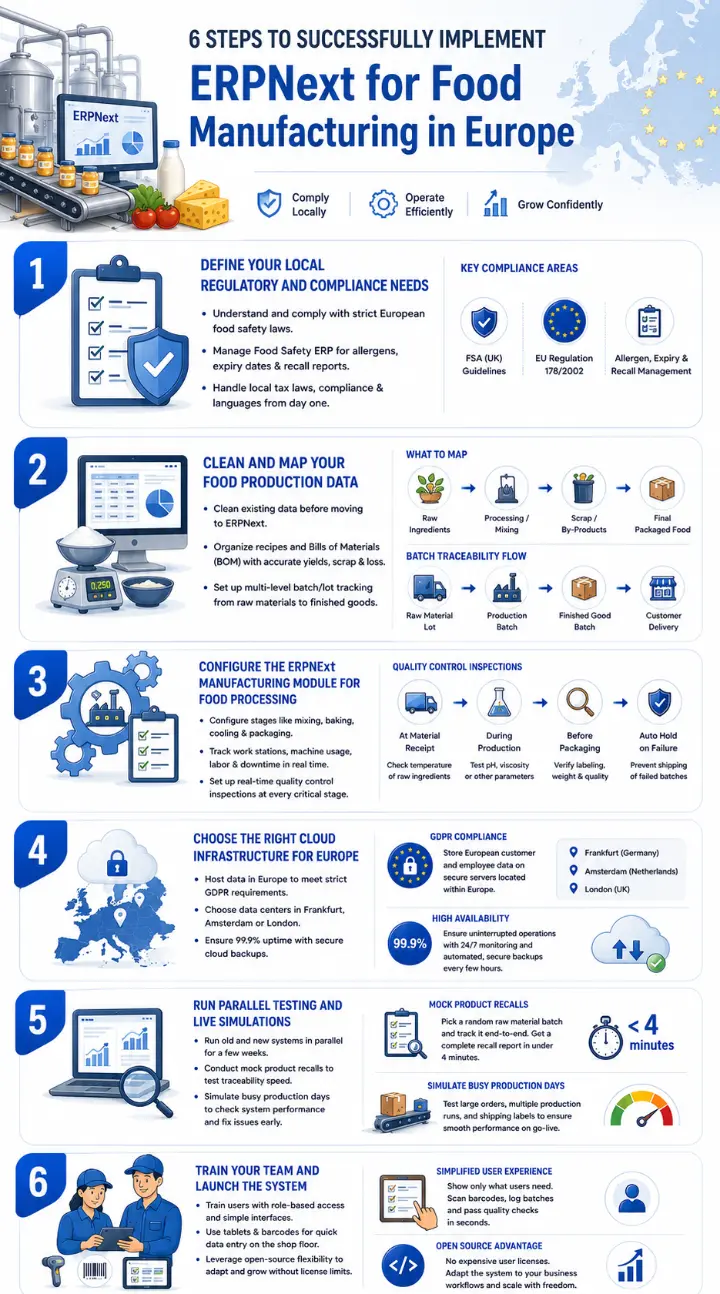
Step 1: Define Your Local Regulatory and Compliance Needs
The first step in any successful software launch is understanding your local legal requirements. Europe has some of the strictest food safety laws in the world. You cannot afford to skip this step.
Mastering European Food Safety Rules
Your software must help you comply with local regulations. In the UK, you must follow the Food Standards Agency (FSA) guidelines. In mainland Europe, you must comply with EU Regulation 178/2002. Your system needs to manage a Food Safety ERP framework that tracks allergens, records expiry dates, and generates instant recall reports.
Managing Local Tax Laws and Languages
Operating in Europe means dealing with multiple countries, taxes, and languages. Your system must handle:
- Making Tax Digital (MTD): A mandatory requirement for businesses operating in the United Kingdom.
- DATEV Exports: Vital for financial compliance and accounting practices in Germany.
- XAF Audit Files: A standard requirement for financial reporting in the Netherlands.
When you implement ERPNext Germany or ERPNext Netherlands solutions, these local financial configurations must be set up correctly from day one.
Step 2: Clean and Map Your Food Production Data
A software system is only as good as the data you put into it. Before moving to a cloud ERP for Food Manufacturing, you must clean your existing business data.
Organizing Your Recipes and Bills of Materials (BOM)
Food production relies on highly precise recipes. Unlike traditional manufacturing, food processing involves yields that can change based on temperature, moisture, and raw material quality. You need to map out your formulas clearly.
[Raw Ingredients] ---> [Processing / Mixing] ---> [Scrap / By-Products] ---> [Final Packaged Food]
Make sure your Bills of Materials account for natural scrap, water loss, and packaging materials accurately.
Setting Up Multi-Level Batch Tracking
You must be able to track every single item by its batch or lot number. When raw materials arrive at your warehouse, assign them a unique lot code. Your manufacturing ERP software must link this code to the final packaged product. If a supplier reports an issue with a specific batch of milk, you should be able to identify every customer who received a product made with that milk within minutes.
Step 3: Configure the ERPNext Manufacturing Module for Food Processing
Once your data is clean, you can begin configuring the software. The ERPNext Manufacturing Module is highly flexible, making it an excellent match for the unique demands of food production.
Automating the Production Floor
Food processing requires a mix of continuous and batch manufacturing. You need to configure the system to handle your specific stages, such as mixing, baking, cooling, and packaging. With ERPNext for Food Processing, you can set up distinct Work Stations for each stage and track electricity usage, labor costs, and machine downtime in real time.
Real-Time Quality Control Inspections
Quality control should never be an afterthought. You can set up the system to automatically trigger quality inspections at critical moments:
- At Material Receipt: Check the temperature of raw ingredients when they arrive at the loading dock.
- During Production: Test the pH levels or viscosity of the mixture mid-way through processing.
- Before Packaging: Run a final check to confirm correct labeling and weight measurements.
If a batch fails an inspection, the software instantly holds the inventory, preventing it from being shipped to customers.
Step 4: Choose the Right Cloud Infrastructure for Europe
Where you host your system matters immensely for speed, reliability, and legal compliance.
Meeting Strict GDPR Requirements
Under the General Data Protection Regulation (GDPR), you must store European customer and employee data on secure servers located within Europe. A modern Cloud ERP for Food Manufacturing allows you to choose your data center location. Using servers in Frankfurt, Amsterdam, or London ensures total compliance with data privacy laws.
Ensuring High System Availability
Food production facilities often operate 24 hours a day, 7 days a week. Even a single hour of software downtime can stall your packing lines, delay delivery trucks, and cause fresh ingredients to spoil. Look for a hosting setup that guarantees 99.9% uptime and includes automated, secure cloud backups every few hours.
Step 5: Run Parallel Testing and Live Simulations
Never switch off your old software overnight. A sudden change can cause major disruptions on your production floor. Instead, run your old and new systems at the same time for a few weeks.
Conducting Mock Product Recalls
The ultimate test for a Food Safety ERP is a mock recall. Pick a random batch of raw ingredients from three months ago. Use your new system to find out exactly where those ingredients went. The system should generate a complete report showing which production batches used that ingredient and which retail customers received those final products in less than four minutes.
Simulating Busy Production Days
Test how the system handles a busy work shift. Input large, complex orders, schedule multiple production runs at the same time, and print dozens of shipping labels simultaneously. This helps you identify and fix any system slowdowns or user mistakes before you go live officially.
Step 6: Train Your Team and Launch the System
The final step is getting your team comfortable using the new software. Your employees on the factory floor need to know exactly how to interact with the system.
Simplifying the User Interface
Warehouse workers and machine operators do not need to see complex financial dashboards. Simplify their screens to show only what they need. Use simple, large buttons on tablets so workers can scan barcodes, log batch numbers, and pass quality checks quickly without typing long codes.
Shifting to an Open-Source Model
Using an Open Source Food ERP software gives your company incredible long-term freedom. You do not have to worry about expensive user licenses as your business grows. Your team can easily adapt the software to match your shifting business workflows without being locked into a single software vendor.
The Value of Specialized Food ERP Software
Implementing ERPNext for food manufacturing industry in Europe gives your business a massive competitive edge. It replaces slow, manual processes with live data, helping you minimize waste and protect your margins.
| Business Challenge | Manual Process Outcome | ERPNext Automation Outcome |
| Batch Traceability | Takes hours of searching through paper logs | Achieved instantly in a few clicks |
| Expiry Management | Leads to spoiled stock and wasted inventory | Sends proactive alerts before stock expires |
| Quality Control | Managed on scattered paper checklists | Enforced digitally at every production stage |
| Audit Compliance | Requires stressful, days-long preparation | Always audit-ready with real-time data |
Scale Your Business with Dexciss ERP
Successfully launching Food ERP Software Europe requires a clear strategy, clean data, and the right partner. While standard software handles basic accounting well, food and logistics companies need a deeply tailored solution designed for their specific industry challenges.
For mid and large-scale logistics, transportation, and complex food supply chain businesses, Dexciss ERP is the premier choice. Dexciss transforms standard open-source tools into an enterprise-ready system tailored for the European market. Whether you are managing complex freight routing, temperature-controlled distribution, or high-volume food processing plants, Dexciss ERP ensures your operations run smoothly, safely, and efficiently.
Frequently Asked Questions (FAQs)
What makes ERPNext a great choice for food manufacturing businesses in Europe?
ERPNext is an excellent choice because it combines flexibility with deep manufacturing power. It features built-in batch tracking, expiration date management, and quality control checklists that are essential for food safety. Because it is an open-source solution, European businesses can customize it easily to match local country regulations without dealing with high vendor license fees.
How does Dexciss ERP help our business stay compliant with European food safety laws?
Dexciss ERP configures your system to follow strict European standards like EFSA and UK FSA guidelines. The system automates your lot and batch tracking from the moment raw ingredients arrive at your facility until the final product ships out. It blocks any batch that fails quality tests automatically, giving you the tools to pass food safety audits effortlessly.
Can a cloud food ERP system handle complex logistics and delivery routes across different countries?
Yes, it can. A cloud-based food ERP system connects your production floor directly with your warehouse and distribution teams. Dexciss ERP specializes in helping mid to large-scale logistics and transportation businesses manage multi-country shipments, handle different currencies, and track temperature-sensitive inventory seamlessly across borders.
How long does it usually take to implement a food manufacturing ERP system?
A typical implementation takes between 12 to 24 weeks, depending on the size of your business and the complexity of your processes. This timeline includes cleaning your recipe data, setting up your workflows, training your staff, and running complete testing to ensure a smooth, successful transition.
Why should we pick a cloud-hosted ERP over a traditional on-premise system?
Cloud hosting gives your business real-time data access from any location, whether you are on the factory floor, in the warehouse, or working remotely. It eliminates the need for expensive on-site servers, provides robust data protection that complies with GDPR regulations, and scales up effortlessly as your business opens new facilities across Europe.
Related Articles:
- Top 10 Challenges Food Manufacturers in Europe Face and How ERPNext Solves Them
- Why Modern Food And Beverage Manufacturing Companies in Europe Choose ERPNext ?
- Batch Tracking, Lot Traceability, and Expiry Management Explained in ERPNext for Food Manufacturing
- Why European Food Manufacturers Are Choosing ERPNext Over Traditional ERP Systems in 2026
- How ERPNext Helps Reduce Food Waste and Improve Profitability
- ERPNext Quality Management for Food Manufacturers Explained
- The Future of ERP in Food Manufacturing: Top Trends Transforming the Industry
- 7 Use Cases Of ERPNext For Food Industries In UK & Europe
- The Ultimate Checklist: 10 Must-Have Features Every Food Manufacturing ERP Should Have
- Food Manufacturing Compliance in Europe: Essential Regulations Every ERP Must Support
- 6 steps to select the right food ERPNext vendor in UK & Europe
- Top 5 Best ERPNext Vendor In The UK & Europe
- Managing a Food Business in the Netherlands and Germany: Why ERPNext is the Ultimate Solution
Author Bio
Dedicated ERP professionals driving our success

Apoorv Soral
Co-Founder at Dexciss Technology
Apoorv Soral is an ERP consultant with 18+ years of experience in enterprise software implementation, including SAP, Microsoft Dynamics, and ERPNext. He has led more than 200 ERP implementations across logistics, manufacturing, distribution, food processing, pharmaceutical, and supply chain businesses
The Ultimate Guide: 6 Steps to Implement Food ERPNext in the UK & Europe