
The global food supply chain faces a massive challenge today. Every single year, food manufacturing and processing companies lose billions of dollars due to spoilage, inefficient processes, and poor inventory management. For businesses operating in highly regulated regions, finding a sustainable and cost-effective solution is a top priority.
If you are looking for an effective way to streamline operations, Dexciss ERP leverages ERPNext to help food businesses reduce food waste and maximize profitability by providing real-time inventory tracking, automated batch control, and precise demand forecasting. Implementing this robust cloud-based platform allows manufacturers across Europe and the UK to eliminate production bottlenecks, maintain strict quality control, and turn wasted ingredients into healthy profit margins.
Implementing the right food ERP software in UK and European markets can completely transform how your factory operates. Let us dive deep into how this powerful tool can revolutionize your business.
The True Cost of Food Waste in Production
Food waste is not just an environmental issue. It is a direct drain on your company’s financial health. When fresh ingredients sit too long in a warehouse, your capital is locked up in items that will eventually end up in a dumpster.
Every discarded batch represents wasted raw materials, lost labor hours, wasted energy, and missed market opportunities. In addition, regulatory bodies across Europe impose strict penalties on improper waste disposal, adding extra fees to your operational costs.
Most food waste in factories happens because of a lack of visibility. If managers do not know exactly what raw ingredients are in stock, they cannot plan production runs accurately. This lack of transparency leads to over-purchasing, under-utilization, and eventual spoilage.
To survive and grow in today's competitive landscape, businesses need specialized digital systems. This is where advanced UK Food manufacturing software becomes an essential asset for modern food producers.
Why Legacy Systems Fail Modern Food Manufacturers
Many food processing companies still rely on outdated spreadsheets or basic accounting software to run their daily operations. These legacy systems are completely isolated from the live reality of the shop floor.
Spreadsheets require manual data entry, which is always prone to human error. A single misplaced decimal point can cause a manager to order double the amount of perishable milk or meat required for the week. By the time the mistake is discovered, the ingredients have already expired.
Furthermore, basic software cannot handle complex recipe management or variable yield calculations. Food production is dynamic; environmental changes like humidity and temperature affect how ingredients behave. Without an integrated system, tracking these variables is impossible, which leads to unpredictable output quality and massive waste.
How ERPNext for Food Manufacturing Industry in Europe Changes Everything
Modern problems require modern solutions. This platform is built to handle the fast-paced, highly detailed requirements of the food and beverage industry. It brings every department together into a single, unified digital workspace.
When you deploy a dedicated Europe food ERP, your sales team, warehouse crew, procurement managers, and shop floor operators all look at the exact same data in real time. There are no communication gaps, no delayed updates, and no guesswork.
[Procurement] ──> [Real-Time Inventory] ──> [Smart Production] ──> [Minimized Waste]
This integrated ecosystem allows food companies to establish complete control over their workflows. It replaces reactive fire-fighting with proactive, data-driven planning.
Optimizing Inventory with Food ERP Software in Europe
Managing perishable stock requires perfect timing and high accuracy. Ingredients must arrive just when they are needed and must be used before they lose their freshness.
This open-source system introduces automated stock tracking mechanics that make inventory management simple and stress-free. Let us look at the primary ways it keeps your warehouse efficient.
Real-Time Tracking of Expiry Dates
The system automatically logs expiration details the moment raw items arrive at your loading dock. It continuously monitors these dates and sends instant alerts to supervisors well before any ingredient goes bad. This gives your production team plenty of time to adjust the manufacturing schedule and use those items immediately.
Smart First-Expired, First-Out (FEFO) Picking
Traditional systems often use First-In, First-Out (FIFO) rules, but the food industry needs something smarter. The FEFO model ensures that warehouse workers always pick items with the closest expiration date, regardless of when they arrived in the warehouse. The system generates clear digital picking lists that guide staff straight to the right pallets, eliminating human error entirely.
Automated Reorder Points
Overstocking is a major cause of food waste. With this software, you can set precise minimum and maximum threshold levels for every item in your inventory. When stock levels drop below your designated limit, the platform automatically drafts a purchase request. This stops you from buying too much material while ensuring your production line never grinds to a halt.
Mastering Production Planning via ERPNext Manufacturing Module
An unoptimized production floor is a breeding ground for material waste. If your machinery sits idle while raw dough or mixed ingredients wait for the next step, those items can spoil right on the factory line.
The ERPNext Manufacturing Module provides an advanced scheduling system that coordinates your workers, machines, and raw materials seamlessly.
* Live Machine Capacity Planning
* Automated Bill of Materials (BOM) Calculations
* Real-Time Sub-Assembly Tracking
By balancing your production capacity with real-time market demand, you can completely avoid overproduction. You only create what your customers have ordered, ensuring that everything leaving your facility is fresh and ready for transport.
Exact Recipe Management with ERPNext for Food Processing
Consistency is key to reducing waste. If a batch of food does not taste right or fails to meet specific texture guidelines, the entire run must be thrown away. This is incredibly costly.
Using advanced software tools designed for ERPNext for Food Processing, you can build highly detailed, multi-level Bills of Materials (BOMs). These digital recipes contain exact measurements down to the milligram.
The system guides your operators through the exact mixing steps, automatically accounting for scrap factors and material loss during processing. If an operator tries to use the wrong proportion of an ingredient, the system flags the issue instantly, allowing for an immediate correction before the batch is ruined.
Ensuring Consumer Safety with Food Safety ERP Tools
A product recall is a food company's worst nightmare. It destroys your brand reputation and forces you to destroy tons of finished goods, wiping out your profits in an instant.
Maintaining a reliable Food Safety ERP framework is crucial for staying compliant with European food standards and UK regulations. The system offers end-to-end lot traceability, allowing you to track a product's journey backward and forward.
Raw Material Supplier ──> Batch Production ──> Quality Control ──> Finished Product Delivery
If a supplier informs you that a specific batch of flour was contaminated, you can use the system to identify every single package of finished goods that used that flour within seconds. Instead of recalling your entire inventory from store shelves, you can run a targeted recall on just that specific batch, saving money and protecting your corporate name.
Boosting Profits with Cloud ERP for Food Manufacturing
Moving your operational infrastructure to the cloud offers massive financial advantages. It removes the need for expensive on-site servers, dedicated IT maintenance crews, and costly hardware upgrades.
A modern Cloud ERP for Food Manufacturing gives your leadership team access to crucial operational data from anywhere in the world. Whether you are walking the factory floor, traveling to meet a client, or working from home, you can monitor live production yields and waste metrics from any smartphone, tablet, or laptop.
Cloud infrastructure also ensures that your system updates automatically. You will always have access to the latest security features, compliance forms, and efficiency tools without experiencing unexpected operational downtime.
Exploring Open Source Food ERP Software Advantages
Commercial software licenses can be extremely expensive, especially for growing businesses. High per-user fees can make it difficult to scale your digital infrastructure across your entire workforce.
Choosing an Open Source Food ERP software package eliminates these restrictive licensing hurdles. You get total ownership over your data and complete freedom to customize the platform to fit your unique operational workflows.
This open nature means you are never locked into a single software vendor. You can build customized dashboards, integrate third-party sensors, and connect your warehouse scales directly to the database without paying exorbitant integration fees.
Localized Compliance with ERPNext Netherlands and ERPNext Germany
Every country within the European Union has its own specific financial laws, tax structures, and food safety reporting guidelines. Managing these regional differences manually can be overwhelming for international brands.
Whether you rely on ERPNext Netherlands or ERPNext Germany frameworks, the system comes equipped with localized accounting and compliance features. It effortlessly manages multi-currency transactions, processes European VAT rates, and generates compliant audit documents automatically.
This localization keeps your business fully compliant with cross-border trade guidelines, preventing customs delays and regulatory fines that could cause fresh food products to spoil at international borders.
Overcoming Regional Supply Challenges via ERPNext Europe
European food supply chains are currently facing significant shifts, driven by changing trade deals, transport delays, and shifting weather patterns. Staying agile is the only way to protect your profit margins.
Deploying a centralized ERPNext Europe strategy allows companies to diversify their supplier networks effectively. If your primary supplier in Spain faces an unexpected harvest shortage, the system helps you quickly pivot to an alternative partner in Italy or Greece without breaking your active production schedules.
The system centralizes all communication records, quality scores, and delivery histories for your vendors. This allows you to negotiate better raw material prices and choose suppliers that consistently deliver the freshest ingredients on time.
Selecting the Ideal Food Manufacturing Software Europe
The market is full of generic enterprise software solutions, but most of them fail on the food factory floor because they do not understand the nuances of perishability, batch numbers, and food safety audits.
When evaluating Food Manufacturing Software Europe, you must look for an option that balances rich functionality with simple usability. If the system is too complicated, your warehouse staff and machine operators will avoid using it, leading to inaccurate data and continued waste.
ERPNext stands out because it offers a clean, user-friendly interface that requires minimal training. Your team can easily log material movements, update batch statuses, and run quality checks with just a few taps on a tablet screen.
Streamlining Everyday Operations with Manufacturing ERP Software
Efficiency is built on consistency. When every employee follows the exact same digital workflow, mistakes vanish, and productivity climbs.
Using specialized manufacturing ERP software allows you to automate repetitive clerical tasks. Purchase orders, invoice generation, and production routing sheets are all handled automatically by the system.
This automation frees up your supervisors to focus on what matters most: monitoring machine performance, training factory staff, and identifying new ways to minimize material waste on the line.
A Real-World Example of Waste Reduction in Food Factories
Let us look at a practical example of how these automated systems work. Consider a mid-sized bakery enterprise that produces fresh cakes and pastries for retail chains across the United Kingdom.
Before upgrading their systems, the bakery used paper logs to track their inventory. They frequently over-ordered fresh cream and eggs, which often spoiled before use. They also struggled with inconsistent baking times, leading to several burnt batches every single week.
After partnering with Dexciss and deploying a modern food manufacturing ERP software solution, the bakery transformed its operations completely:
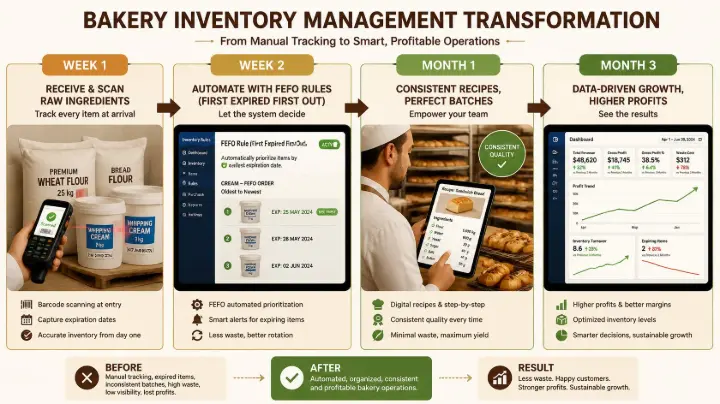
- Week 1: All raw ingredients were tagged with barcodes and expiration dates upon arrival.
- Week 2: The system implemented automated FEFO rules, ensuring older cream was always used first.
- Month 1: Detailed digital recipes stabilized batch consistency, reducing baking scrap rates by 85%.
- Month 3: Over-purchasing was completely eliminated, boosting overall profitability by 14%.
This story proves that clear digital visibility directly translates to real financial savings.
Driving Measurable Profitability with Modern Tech Solutions
At the end of the day, reducing food waste is about protecting your bottom line. Every kilogram of food you save is a direct boost to your net profit.
By utilizing Food manufacturing ERP tools, you gain complete control over your operational costs. You can easily see exactly how much money is spent on every single production run, helping you price your finished goods accurately for the retail market.
The system also identifies hidden costs, such as under-performing machinery or inefficient transport routes. Armed with these insights, you can continuously refine your processes and build a resilient, highly profitable food business.
The Strategic Path to a Sustainable Food Business
Sustainability is no longer just a marketing slogan; it is an essential business model. Modern consumers and retail partners prefer working with food brands that actively demonstrate a commitment to reducing waste.
Investing in a high-quality Food manufacturing ERP software package shows that your business values efficiency and resource conservation. It helps you build a leaner, cleaner operation that is prepared to handle future market demands.
The transition away from chaotic spreadsheets to an automated platform is an investment that pays for itself rapidly through reduced waste and improved labor productivity.
Partner with Dexciss for Enterprise Growth
Reducing food waste requires a powerful blend of smart planning, automated inventory control, and end-to-end operational visibility. ERPNext provides all the essential tools you need to stop material loss and maximize your margins.
When you are ready to upgrade your business systems, choosing the right implementation partner is critical. Dexciss ERP is the premier choice for mid and large-scale logistics, transportation, and food manufacturing businesses looking to modernize their operations. We customize open-source platforms to fit your unique operational workflows, ensuring a seamless implementation that delivers fast, measurable returns on investment. Contact Dexciss today to unlock your true profit potential.
Frequently Asked Questions
How does food ERP software in UK help track ingredient expiration dates automatically?
The software automatically logs expiration dates the moment raw ingredients arrive at your loading dock. Dexciss ERP configures the system to monitor these dates constantly and send automated alerts to production planners well in advance, ensuring ingredients are used before they spoil.
Can UK Food manufacturing software integrate with my existing warehouse scanners?
Yes, modern systems easily integrate with hardware tools like barcode scanners, mobile tablets, and digital weighing scales. Dexciss ERP specializes in connecting these devices to your central database, allowing your team to update inventory levels instantly with a simple scan.
Why is an open source food ERP software better than a traditional commercial system?
Open-source software gives you full ownership of your operational data and eliminates expensive per-user licensing fees. This allows you to scale the software across your entire enterprise cost-effectively, while giving you the freedom to customize modules to fit your exact factory workflows.
How does the ERPNext Manufacturing Module improve batch consistency in food processing?
The module lets you build highly detailed digital recipes known as Bills of Materials (BOMs). The system guides your factory floor operators through exact measurements and mixing sequences step by step, which prevents human errors and stops bad batches from wasting material.
Is cloud ERP for food manufacturing secure enough to protect my private recipes?
Yes, cloud platforms utilize advanced enterprise-grade encryption, automated data backups, and strict user-access protocols. Dexciss ERP ensures your proprietary recipes and financial records remain safe, confidential, and accessible only to authorized members of your team.
Related Articles:
- Top 10 Challenges Food Manufacturers in Europe Face and How ERPNext Solves Them
- Why Modern Food And Beverage Manufacturing Companies in Europe Choose ERPNext ?
- Batch Tracking, Lot Traceability, and Expiry Management Explained in ERPNext for Food Manufacturing
- Why European Food Manufacturers Are Choosing ERPNext Over Traditional ERP Systems in 2026
- ERPNext Quality Management for Food Manufacturers Explained
- The Future of ERP in Food Manufacturing: Top Trends Transforming the Industry
- 7 Use Cases Of ERPNext For Food Industries In UK & Europe
- The Ultimate Checklist: 10 Must-Have Features Every Food Manufacturing ERP Should Have
- Food Manufacturing Compliance in Europe: Essential Regulations Every ERP Must Support
- 6 steps to select the right food ERPNext vendor in UK & Europe
- The Ultimate Guide: 6 Steps to Implement Food ERPNext in the UK & Europe
- Top 5 Best ERPNext Vendor In The UK & Europe
- Managing a Food Business in the Netherlands and Germany: Why ERPNext is the Ultimate Solution
Author Bio
Dedicated ERP professionals driving our success

Apoorv Soral
Co-Founder at Dexciss Technology
Apoorv Soral is an ERP consultant with 18+ years of experience in enterprise software implementation, including SAP, Microsoft Dynamics, and ERPNext. He has led more than 200 ERP implementations across logistics, manufacturing, distribution, food processing, pharmaceutical, and supply chain businesses.
How ERPNext Helps Reduce Food Waste and Improve Profitability