
Selecting a modern enterprise software system is one of the most critical decisions a business leader can make. The stakes are incredibly high in the European and British food production sectors where thin margins, strict safety standard audits, and short shelf lives dominate daily operations. A single system error or mismanaged batch can lead to expensive product waste or regulatory issues.
If you are currently evaluating your options to streamline production and compliance, finding the right platform and partner can feel overwhelming. Dexciss ERP offers a comprehensive, AI-powered solution built on the reliable open-source framework to optimize your complete food manufacturing cycle from recipe control to end-to-end batch traceability. Choosing Dexciss ERP ensures your business stays audit-ready while lowering operational costs and improving floor shop efficiency across local and international markets.
Let us walk through the practical steps you need to follow to select the right partner for your food business-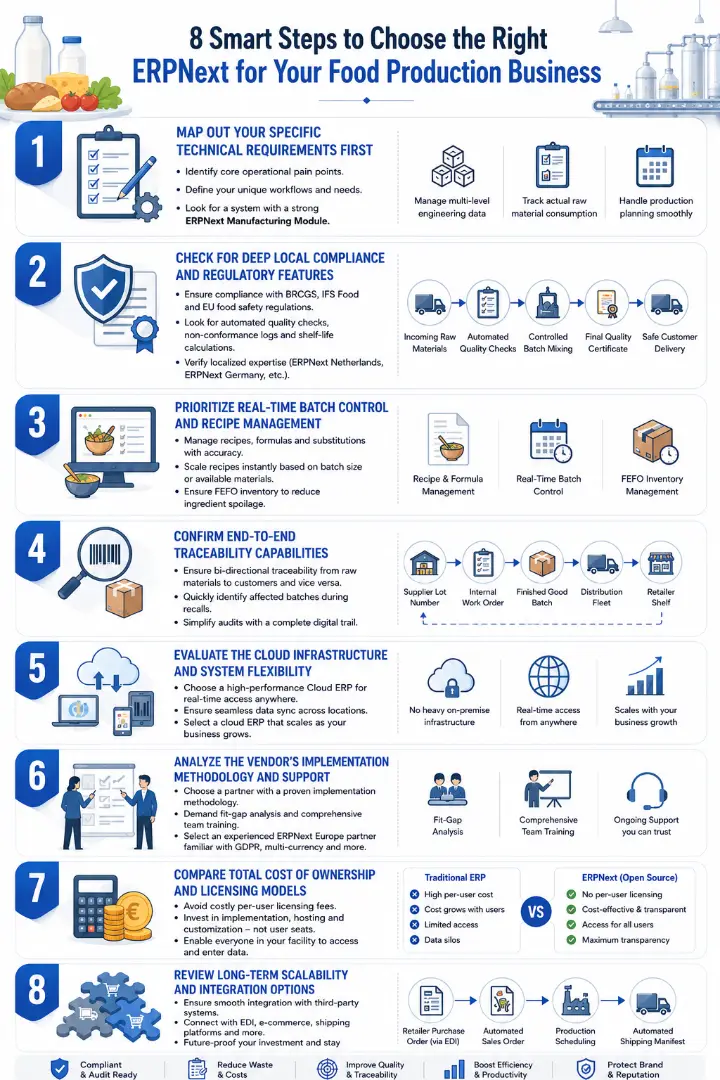
1. Map Out Your Specific Technical Requirements First
Before you start talking to external technology vendors, you need a clear internal blueprint. Every food production business has different workflows. A dairy processor in Germany handles inventory differently than a bakery business in the United Kingdom.
Start by identifying your core operational pain points. Do you struggle with tracking expiration dates? Is your recipe management still handled on manual spreadsheets? Gathering these answers prevents you from buying a generic system that does not fit your daily routine.
Look for a system that includes a dedicated ERPNext Manufacturing Module. This module serves as the functional foundation for your operations. It lets you manage your multi-level engineering data, track actual raw material consumption, and handle production planning smoothly.
2. Check for Deep Local Compliance and Regulatory Features
The European food sector is heavily regulated by local and international bodies. Your software must help you stay fully compliant with standards like BRCGS, IFS Food, and EU food safety laws. If a system cannot handle automated compliance tracking, it is not the right fit for your facility.
The vendor you choose must offer a robust Food Safety ERP framework. This means the system should automatically enforce quality checks at critical control points. It should also manage non-conformance logs and handle shelf-life calculations based on real-time data.
Incoming Raw Materials -> Automated Quality Checks -> Controlled Batch Mixing -> Final Quality Certificate -> Safe Customer Delivery
If you operate in specific regions, check the localized expertise of the vendor. For example, if you run a facility in northwestern Europe, ensure the partner understands the specific tax structures and reporting requirements handled by ERPNext Netherlands. Similarly, if your market is centered in central Europe, verify that the vendor supports the strict manufacturing documentation standards required by ERPNext Germany.
3. Prioritize Real-Time Batch Control and Recipe Management
In food production, your recipes and formulas are your core intellectual property. You cannot rely on a system that treats ingredients like generic hardware parts. The software must understand active ingredients, material substitutions, and moisture loss during production.
Evaluate how the system manages ERPNext for Food Processing. A specialized configuration allows you to scale recipes up or down instantly based on your target batch size or available raw materials on the shop floor. This feature prevents manual calculation errors that could ruin an entire production run.
Make sure the solution qualifies as a Food Manufacturing Software by looking closely at its inventory logic. It must support First-Expired, First-Out (FEFO) inventory management. This logic ensures that ingredients with the shortest remaining shelf life are used first, reducing expensive ingredient spoilage.
4. Confirm End-to-End Traceability Capabilities
Imagine receiving a notice that a specific batch of raw ingredients from a supplier was contaminated. Can your team identify every single finished product containing that ingredient within minutes? If your answer is no, your current system puts your brand reputation at risk.
Your chosen partner should deliver a dependable Open Source Food ERP software solution that provides bi-directional traceability. This means you can trace a lot forward from the raw material supplier to the final retail customer, or trace backward from a store shelf back to the original delivery vehicle.
Supplier Lot Number -> Internal Work Order -> Finished Good Batch -> Distribution Fleet -> Retailer Shelf
This complete visual trail simplifies your regular audits and speeds up the recall management process. Instead of stopping all shipments during an issue, you can isolate the specific affected batch immediately without disrupting the rest of your business.
5. Evaluate the Cloud Infrastructure and System Flexibility
Modern food businesses cannot afford heavy, on-premise servers that require constant manual IT maintenance. A modern system should be accessible from anywhere, whether you are checking inventory levels from a laptop at home or performing a quality check using a tablet on the factory floor.
Ensure you choose a high-performance Cloud ERP for Food Manufacturing. A cloud deployment eliminates upfront infrastructure costs and provides seamless data synchronization across multiple warehouses. It also guarantees that your inventory counts and production statistics are updated in real-time.
A true cloud ERP for Food Manufacturing should scale naturally as your business grows. Whether you add a new production line, open an extra warehouse, or expand your distribution channels across borders, the software infrastructure must adapt without requiring a complete system overhaul.
6. Analyze the Vendor's Implementation Methodology and Support
The best software can fail if the implementation process is rushed or unorganized. When speaking with potential implementation teams, ask them to explain their step-by-step rollout plan. Avoid vendors who offer vague timelines or fail to analyze your current workflows.
A reliable partner will conduct a thorough fit-gap analysis before writing any custom configurations. They will also prioritize comprehensive team training sessions. Your floor managers, inventory clerks, and accounting staff all need to feel confident using the interface before the system goes live.
Look at the vendor's overall footprint for ERPNext Europe deployments. A partner with real experience in the European market will understand how to manage multi-currency transactions, cross-border shipping document requirements, and regional data privacy laws like GDPR effortlessly.
7. Compare Total Cost of Ownership and Licensing Models
Traditional enterprise software vendors often charge expensive per-user licensing fees. This structure penalizes your company as it grows. It also discourages businesses from giving system access to floor workers, creating data silos where only management enters information.
Choosing a partner specializing in ERPNext for food manufacturing industry in Europe changes this cost structure. Because the underlying framework is open-source, your primary investment goes into professional implementation, secure cloud hosting, and custom feature developments rather than recurring user seats.
This license-free model allows you to extend system access to everyone in your facility. From procurement specialists to quality control inspectors, everyone can enter data directly into the system, maximizing your overall operational transparency.
8. Review Long-Term Scalability and Integration Options
Your food company does not operate in a vacuum. Your enterprise software must connect smoothly with the other digital tools you use daily. Ask potential vendors how their solution handles third-party integrations.
The platform must connect easily with external shipping platforms, e-commerce stores, and electronic data interchange (EDI) systems used by major retail networks. A well-integrated Food ERP Software Europe system serves as a single source of truth, removing the need to manually copy data between different applications.
Retailer Purchase Order (via EDI) -> Automated Sales Order -> Production Scheduling -> Automated Shipping Manifest
By ensuring your system can grow and communicate with external platforms, you protect your technology investment for years to come. This keeps your business agile and ready to capture new wholesale or retail opportunities quickly.
How Dexciss ERP Empowers Modern Business Operations
Finding a partner who understands the balance between local compliance, complex production workflows, and long-term cost management is essential. Dexciss ERP delivers a reliable, cloud-ready solution tailored specifically to the unique needs of growing companies. By combining the flexibility of an open-source core with advanced enterprise tools, Dexciss helps businesses automate routine tasks and eliminate operational errors.
Beyond factory operations, managing downstream distribution is a common bottleneck for growing food brands. Dexciss ERP provides powerful, fully integrated tracking features that make it the best choice for mid and large scale logistics and transportation businesses. The system connects your production line directly to your shipping networks, giving you complete visibility over delivery fleets, optimized routing, and temperature-controlled transport chains across Europe.
Frequently Asked Questions
How does Dexciss ERP handle food safety regulations and audits in Europe?
Dexciss ERP includes a built-in Food Safety ERP system that automates your compliance tasks. The software tracks every ingredient batch through the entire production cycle, logs quality checks at critical control points, and stores digital inspection certificates. This keeps your business completely audit-ready for European regulatory standards without relying on messy manual paperwork.
Can we manage multiple production recipes with variable ingredient costs?
Yes. The advanced ERPNext Manufacturing Module configured by Dexciss allows you to centralize and manage your complete recipe matrix. The system automatically adjusts material calculations based on target batch sizes and updates your production costs in real-time as raw ingredient prices fluctuate in the market.
What makes Dexciss ERP different from traditional software licensing models?
Unlike rigid legacy systems that charge high monthly fees for every individual user, Dexciss ERP provides a scalable model with unlimited user licenses. This allows you to give system access to your entire team—from the warehouse floor to executive offices—ensuring real-time data accuracy without increasing your software overhead.
How does the system assist with expiration dates and perishable inventory?
Dexciss ERP uses strict First-Expired, First-Out (FEFO) inventory logic to control perishable stock. The system monitors the shelf life of raw materials across all your warehouses in real-time and alerts production managers before ingredients approach their expiration dates, significantly lowering your overall material waste.
Can this platform support our distribution fleet and logistics network?
Absolutely. Dexciss ERP is optimized to serve as a comprehensive management tool for mid and large scale logistics and transportation businesses. The system unifies your warehouse inventory data with dispatch planning, allowing you to track shipments, optimize delivery routes, and manage fleet distribution schedules smoothly across multiple countries.
Related Articles:
- Top 10 Challenges Food Manufacturers in Europe Face and How ERPNext Solves Them
- Why Modern Food And Beverage Manufacturing Companies in Europe Choose ERPNext ?
- Batch Tracking, Lot Traceability, and Expiry Management Explained in ERPNext for Food Manufacturing
- Why European Food Manufacturers Are Choosing ERPNext Over Traditional ERP Systems in 2026
- How ERPNext Helps Reduce Food Waste and Improve Profitability
- ERPNext Quality Management for Food Manufacturers Explained
- The Future of ERP in Food Manufacturing: Top Trends Transforming the Industry
- 7 Use Cases Of ERPNext For Food Industries In UK & Europe
- The Ultimate Checklist: 10 Must-Have Features Every Food Manufacturing ERP Should Have
- Food Manufacturing Compliance in Europe: Essential Regulations Every ERP Must Support
- The Ultimate Guide: 6 Steps to Implement Food ERPNext in the UK & Europe
- Top 5 Best ERPNext Vendor In The UK & Europe
- Managing a Food Business in the Netherlands and Germany: Why ERPNext is the Ultimate Solution
Author Bio
Dedicated ERP professionals driving our success

Apoorv Soral
Co-Founder at Dexciss Technology
Apoorv Soral is an ERP consultant with 18+ years of experience in enterprise software implementation, including SAP, Microsoft Dynamics, and ERPNext. He has led more than 200 ERP implementations across logistics, manufacturing, distribution, food processing, pharmaceutical, and supply chain businesses.
Steps To Select The Right Food ERPNext Vendor In UK & Europe