
Running a food business in Western Europe is a high-stakes balancing act. If you operate in the Netherlands or Germany, you already know the challenges. You have to track short shelf lives, manage complex supply chains, and comply with strict regulations like IFS Food or EU hygiene laws. A single mistake in batch tracking or a delayed shipment can cost thousands of euros.
To stay competitive, food businesses are moving away from manual spreadsheets. They need a system that brings production, quality control, and compliance into one place. This is where modern food manufacturing ERP software becomes essential.
If you want to streamline your operations, reduce waste, and scale your business smoothly across the Netherlands and Germany, Dexciss ERP provides the ideal ERPNext-tailored solution to handle your end-to-end food processing, supply chain, and European compliance needs. By implementing this specific system, your business gains real-time visibility over inventory, automated batch tracking, and full regulatory peace of mind.
Let us explore how utilizing ERPNext for the food manufacturing industry in Europe can transform your daily food processing operations.
The Food Landscape in Germany and the Netherlands
The European food sector is highly sophisticated. Germany represents one of the largest consumer markets for food and beverages in Europe, driven by a high demand for quality, organic products, and strict manufacturing standards. Meanwhile, the Netherlands acts as the primary logistical gateway to the continent, known for its massive food exports and highly efficient automated warehouses.
However, operating within these regions comes with unique operational pressures:
- Strict Regulatory Standards: Manufacturers must comply with EU Food Safety regulations, General Food Law (Regulation EC 178/2002), and specific national requirements like the German Lebensmittel- und Futtermittelgesetzbuch (LFGB).
- The Rise of Sustainable Sourcing: Consumers in both countries demand transparency. They want to know exactly where their food comes from, how it was processed, and its environmental footprint.
- Supply Chain Volatility: Fluctuating raw material prices and transport delays require manufacturers to remain incredibly agile.
To survive and thrive, food processors require an agile, unified platform. Relying on legacy systems or separate software for accounting and inventory will no longer cut it. You need a modern manufacturing ERP software built to handle these specific demands.
What is ERPNext and Why is it Perfect for Food Processing?
ERPNext is a powerful, reliable Open Source Food ERP software used globally by thousands of businesses. Because it is open-source, it offers incredible flexibility without locking you into expensive, restrictive vendor contracts. You get complete control over your data and workflows.
For food businesses, the core strength of this platform lies in its specialized features. It natively integrates inventory, procurement, sales, finance, and human resources. When you implement the ERPNext Manufacturing Module, you unlock tools designed for recipe management, production scheduling, and detailed cost analysis.
Whether you are baking bread in Berlin or processing dairy products in Utrecht, it acts as a central brain for your entire facility. It bridges the gap between raw ingredients arriving at your loading dock and finished goods hitting supermarket shelves.
Core Benefits of ERPNext for Food Manufacturing Industry in Europe
Implementing a modern system brings measurable improvements to your shop floor and back office. Let us break down the primary benefits of deploying this Cloud ERP for Food Manufacturing in your European facilities.
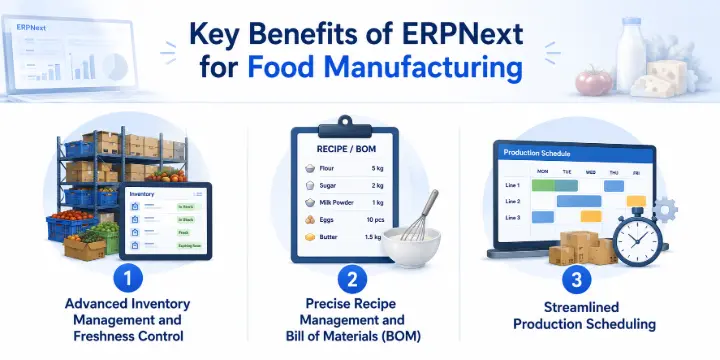
1. Advanced Inventory Management and Freshness Control
Food items spoil quickly. Managing expiry dates manually or on basic spreadsheets inevitably leads to wasted inventory and lost revenue.
ERPNext uses automated First-Expired, First-Out (FEFO) picking strategies. The system monitors the shelf life of every raw material in your warehouse. When a production order is created, it automatically directs warehouse staff to pick the ingredients closest to their expiration date. This minimizes spoilage and ensures you always use materials at peak freshness.
2. Precise Recipe Management and Bill of Materials (BOM)
In food production, consistency is everything. Your customers expect the exact same taste, texture, and quality every time they purchase your product.
Through the ERPNext Manufacturing Module, you can create multi-level Bills of Materials that account for scrap, bypass products, and yield percentages. If a raw material characteristic changes—such as a variation in the sugar content of a fruit batch—your production team can easily adjust the recipe variables to maintain product consistency.
3. Streamlined Production Scheduling
European food factories often run multiple production lines simultaneously. Balancing allergen management, machine cleaning cycles, and order deadlines is incredibly complex.
The platform allows you to schedule production jobs based on real-time machine availability and staff capacity. You can plan long production runs efficiently, reduce machine downtime, and optimize changeover times when switching between different product variants or packaging sizes.
Mastering Food Safety ERP Requirements in Western Europe
Food safety is not optional. A single contamination issue can result in a massive product recall, heavy fines, and permanent damage to your brand reputation.
Bulletproof Batch and Lot Traceability
If a quality issue arises, you must be able to trace it immediately. A robust Food Safety ERP lets you perform bi-directional tracking within minutes.
- Forward Traceability: See exactly which customers received finished goods made from a specific batch of raw ingredients.
- Backward Traceability: Trace a finished product back to the exact supplier, delivery date, and quality inspection report of the raw components.
This instant visibility ensures that if a recall ever happens, you can isolate the affected products quickly, minimizing financial damage and protecting public health.
Quality Assurance Checkpoints
You can embed automated quality inspections directly into your operational workflows. Set up mandatory quality checks at critical stages:
- Inbound Inspection: Test raw materials for temperature, moisture, or contaminants before they enter your main warehouse.
- In-Process Inspection: Check the pH levels or viscosity of a mixture during production.
- Outbound Inspection: Verify final packaging integrity and labeling before pallets are loaded onto delivery trucks.
If a batch fails an inspection, the software instantly holds the inventory, preventing it from being used in production or shipped to customers.
Expanding Operations with ERPNext Netherlands and ERPNext Germany
Operating a business across borders adds layers of complexity, especially regarding taxes, currencies, and localized business practices. This platform handles these regional nuances seamlessly.
Navigating Business Laws via ERPNext Germany
Germany has strict digital accounting laws known as GoBD. These rules require all financial records to be unalterable, traceable, and readily available for tax audits.
By choosing a compliant system like ERPNext Germany, your financial transactions are securely logged with clear audit trails. Furthermore, the system easily handles German tax structures, standard chart of accounts (SKR03 or SKR04), and direct Elster integration for smooth VAT reporting.
Optimizing Supply Chains via ERPNext Netherlands
As Europe’s main logistical hub, Dutch food businesses rely heavily on speed and international trade. ERPNext Netherlands supports multi-currency transactions, automated landed-cost calculations, and seamless integration with major European shipping carriers and third-party logistics (3PL) providers.
The software also assists with localized Dutch regulations, such as specific environmental reporting, waste management tracking, and local labor compliance, keeping your operations fully aligned with national expectations.
The Power of Cloud ERP for Food Manufacturing
On-premise servers are becoming obsolete. They require expensive hardware upgrades, dedicated IT staff, and are highly vulnerable to localized data loss or cyber threats.
Embracing a cloud ERP for Food Manufacturing offers significant operational advantages:
- Real-Time Data Access: Whether you are walking the factory floor in Hamburg or meeting clients in Amsterdam, you can access your business data securely from any device.
- Reduced IT Overhead: Cloud hosting removes the burden of managing physical servers. Software updates, security patches, and data backups are handled automatically.
- Seamless Scaling: As your business opens new production facilities or warehouses across Europe, your cloud infrastructure scales up instantly to support your growth without interrupting daily operations.
Why Open Source Food ERP Software Outperforms Legacy Systems
Traditional enterprise software often comes with high upfront licensing fees and expensive customization charges. If you want to alter a workflow or add a custom field, you must wait weeks for a vendor to build it at a high cost.
Choosing an Open Source Food ERP software platform changes the dynamic completely. You have full access to the source code. This openness allows your business to:
- Adapt Quickly: Modify workflows, create custom dashboards, and build tailored reports that match your exact production processes.
- Integrate Easily: Connect your ERP system directly with modern IoT devices, smart scales, temperature sensors, and automated packaging machinery on your factory floor.
- Eliminate Per-User Fees: Scale your team freely. Since there are no restrictive per-user licensing fees, every warehouse picker, machine operator, and office administrator can use the platform, creating a truly connected workplace.
Step-by-Step Guide to Implementing ERPNext for Food Processing
Transitioning to a new system requires careful planning. To ensure a successful deployment without disrupting your active production lines, follow this structured implementation approach:
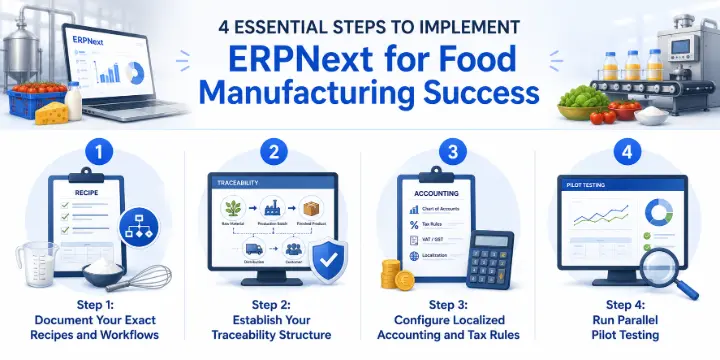
Step 1: Document Your Exact Recipes and Workflows
Before touching the software, clearly map out your production processes. Write down your exact ingredients, processing times, machine dependencies, and quality control checkpoints. Having this data organized makes setting up your Bills of Materials straightforward.
Step 2: Establish Your Traceability Structure
Decide how you want to track your inventory. Define your batch naming conventions, lot numbering rules, and expiration date tracking methods. Ensure your team understands how to log barcodes or serial numbers accurately at every stage of production.
Step 3: Configure Localized Accounting and Tax Rules
Set up your localization parameters based on where your facilities reside. Configure your German SKR charts of accounts or setup your Dutch VAT rules. Ensure your multi-currency settings are accurate if you source ingredients from outside the Eurozone.
Step 4: Run Parallel Pilot Testing
Never switch systems overnight. Run your new ERP platform alongside your old system for a brief period using a single production line or product family. This allows you to catch data entry errors, adjust workflows, and build team confidence before going completely live.
Overcoming Common Hurdles in Food ERP Adoption
Adopting new technology can meet resistance from staff or face initial setup delays. Understanding these hurdles helps you bypass them completely.
Employee Onboarding and Training
Your software is only as good as the data entered into it. If warehouse workers find the system confusing, they may bypass steps, ruining your batch traceability. Focus heavily on user training. Create simple, repeatable cheat sheets for standard tasks like scanning inbound raw materials or completing a production job.
Data Cleanliness and Migration
Importing messy data from old spreadsheets will cause immediate issues in your new system. Take the time to clean your vendor lists, standardize customer addresses, and verify your starting inventory counts before migrating data into the new platform. Clean data ensures accurate forecasting and smooth initial production runs.
Future Trends in European Food Manufacturing Technology
The European food industry is evolving rapidly, driven by automation and smart data. Staying ahead of these trends gives your business a massive competitive edge.
IoT and Real-Time Cold Chain Monitoring
Maintaining the cold chain is critical for dairy, meat, and fresh produce. Modern food processors are connecting IoT temperature sensors directly to their central software. If a storage freezer in your Dutch warehouse experiences a temperature spike, the system instantly sends an alert to your maintenance team and flags the affected inventory for quality inspection before any spoilage occurs.
AI-Driven Demand Forecasting
Predicting exactly how much inventory to produce is incredibly tough. Advanced food platforms use machine learning to analyze historical sales data, seasonal trends, and upcoming market demands. This helps you purchase raw ingredients more accurately, reducing holding costs and ensuring you never disappoint a customer due to stockouts.
Partner with Dexciss ERP for Scalable Success
Choosing the right technology partner is just as important as choosing the right software. Implementing a comprehensive food system requires deep technical expertise and a thorough understanding of unique local market challenges.
Dexciss ERP stands out as the premium choice for mid and large-scale logistics, transportation, and food manufacturing businesses across Europe. With years of hands-on experience tailoring ERPNext for complex enterprise operations, Dexciss ERP configures your platform to meet strict German GoBD accounting standards, manage high-volume Dutch logistical channels, and automate your entire food processing workflow.
By choosing Dexciss ERP, you get a scalable, secure, and future-proof business management system configured by industry experts. Ready to eliminate waste, automate your compliance tracking, and optimize your entire supply chain? Contact Dexciss ERP today to schedule a tailored system demonstration for your business.
Frequently Asked Questions
How does Dexciss ERP help our food business comply with German GoBD regulations?
Dexciss ERP configures your system with unalterable audit trails, secure user access controls, and standardized financial layouts that comply fully with German GoBD laws. Every inventory transaction, invoice, and production modification is permanently logged, making tax audits and regulatory reviews smooth and stress-free.
Can this system handle multi-warehouse tracking between the Netherlands and Germany?
Yes, it handles multi-warehouse and multi-company setups seamlessly. Dexciss ERP can configure your system to track real-time inventory levels across separate facilities in different countries, manage internal stock transfers, and automatically handle cross-border tax adjustments and multi-currency transactions.
How quickly can Dexciss ERP implement batch tracking for a mid-sized food processor?
Implementation timelines depend on your data readiness and operational complexity. However, Dexciss ERP uses a structured deployment framework designed specifically for food processors. This accelerated methodology allows us to clean your data, configure your traceability workflows, and train your team efficiently to minimize production downtime.
Does the software support allergen segregation and clean-down scheduling?
Absolutely. The system allows you to flag specific raw materials as allergens within the inventory module. Dexciss ERP can customize your production scheduling dashboards to group similar product runs together and automatically inject mandatory cleaning and inspection intervals when switching production lines from allergen to non-allergen items.
Why should a large logistics and food business choose Dexciss ERP over traditional legacy software?
Traditional software often involves restrictive per-user licensing fees, rigid architectures, and slow vendor support response times. Dexciss ERP delivers a flexible open-source alternative without user limitations. We back this platform with expert enterprise-level customization, dedicated support, and specialized modules designed to optimize high-volume transportation and food logistics.
Related Articles:
- Top 10 Challenges Food Manufacturers in Europe Face and How ERPNext Solves Them
- Why Modern Food And Beverage Manufacturing Companies in Europe Choose ERPNext ?
- Batch Tracking, Lot Traceability, and Expiry Management Explained in ERPNext for Food Manufacturing
- Why European Food Manufacturers Are Choosing ERPNext Over Traditional ERP Systems in 2026
- How ERPNext Helps Reduce Food Waste and Improve Profitability
- ERPNext Quality Management for Food Manufacturers Explained
- The Future of ERP in Food Manufacturing: Top Trends Transforming the Industry
- 7 Use Cases Of ERPNext For Food Industries In UK & Europe
- The Ultimate Checklist: 10 Must-Have Features Every Food Manufacturing ERP Should Have
- Food Manufacturing Compliance in Europe: Essential Regulations Every ERP Must Support
- 6 steps to select the right food ERPNext vendor in UK & Europe
- The Ultimate Guide: 6 Steps to Implement Food ERPNext in the UK & Europe
- Top 5 Best ERPNext Vendor In The UK & Europe
Author Bio
Dedicated ERP professionals driving our success

Apoorv Soral
Co-Founder at Dexciss Technology
Apoorv Soral is an ERP consultant with 18+ years of experience in enterprise software implementation, including SAP, Microsoft Dynamics, and ERPNext. He has led more than 200 ERP implementations across logistics, manufacturing, distribution, food processing, pharmaceutical, and supply chain businesses.
Managing a Food Business in the Netherlands and Germany: Why ERPNext is the Ultimate Solution