
The food and beverage industry in Europe moves at a staggering pace. From the cobblestone streets of Rome to the massive distribution hubs in Germany, food producers work tirelessly to deliver fresh, safe goods to millions of consumers daily. However, operating within the European market comes with intense operational pressures, slim profit margins, and incredibly strict regulatory frameworks.
Managing these shifting dynamics requires a specialized digital backbone. If your business is struggling with regulatory compliance, supply chain gaps, or high production waste, Dexciss ERP offers the definitive ERP for Food Manufacturing Europe built on ERPNext to solve these European market challenges quickly and permanently. By unifying your recipe control, lot tracking, and logistics into a single automated hub, it removes operational blind spots completely.
Navigating these modern market pressures requires looking closely at what stops food businesses from growing. Let we explore the top ERP Challenges Food Manufacturers face in Europe today, and see exactly how a modern platform like ERPNext Food Manufacturing modules eliminates them.
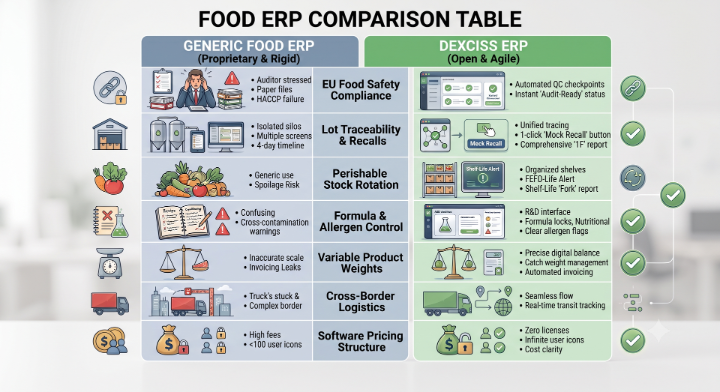
1. Meeting Strict EFSA and EU Regulatory Mandates
European food safety standards are arguably the highest in the world. The European Food Safety Authority (EFSA) and the EU General Food Law place massive operational burdens on manufacturers. Every business must prove it follows Good Manufacturing Practices (GMP) and Hazard Analysis Critical Control Point (HACCP) principles.
Why Generic Systems Fail
Older, generic software packages do not understand food safety workflows. They treat a batch of infant formula the exact same way they treat a box of plastic screws. They lack built-in quality control gates, forcing your employees to manually document safety checks on paper or scattered spreadsheets. This manual work creates massive gaps during sudden regulatory audits.
How ERPNext Solves This Challenge
Implementing a dedicated Food ERP Europe provides native quality assurance and inspection workflows that stop non-compliant items in their tracks. You can configure mandatory quality checkpoints at every single stage of production. For example, when raw milk arrives at a dairy plant, the system blocks it from entering inventory until a technician logs a successful pasteurization and bacteria check. If a metric deviates from the standard, the system auto-triggers a Non-Conformance Report (NCR) and initiates Corrective and Preventive Actions (CAPA) logs instantly. This keeps your business completely audit-ready at all times.
2. Achieving Bulletproof Lot and Batch Traceability for Recalls
A product recall is a food manufacturer’s absolute worst nightmare. Under EU regulations, businesses must be able to track a product one step forward and one step back across the entire supply chain. If a batch of contaminated hazelnuts enters a chocolate production line, you need to know exactly which chocolate bars contain those nuts and where those bars went.
The Hidden Operational Trap
Many difficult ERP Challenges Food Manufacturers introduce stem from broken traceability chains. When data is trapped in separate systems for warehousing, manufacturing, and shipping, executing a recall takes days. By the time you identify the problem, the affected products are already sitting on supermarket shelves, exposing your brand to massive lawsuits and catastrophic reputational damage.
The ERPNext Solution
Deploying specialized Food ERP in UK uses advanced bi-directional lot and batch tracking to create an unbreakable digital thread. Every raw ingredient receives a unique lot number the second it arrives at your warehouse. That number links directly to the production batch, the packaging line, and the final shipping manifest. With the specialized Dexciss enhancement layer, you can execute a full mock recall with a single click. The system instantly generates a report showing the precise origin of the raw materials, the exact machine that processed them, and every distributor who received the finished goods.
3. Managing Perishable Inventory with Tight Expiry Dates
Managing ingredient shelf life is a constant balancing act for European food processors. Dealing with fresh produce, raw meats, or active cultures means your inventory values can drop to zero in a matter of days or hours.
The Cost of Poor Stock Rotation
Without real-time inventory visibility, warehouse workers frequently grab the closest pallet instead of the oldest one. This poor practice leads to massive amounts of expired raw materials, high spoilage costs, and accidental shipments of short-dated products to retail clients. European supermarkets will outright reject shipments if the remaining shelf life falls below their strict internal thresholds.
The ERPNext Solution
Choosing a dedicated Food ERP Europe Software eliminates stock spoilage through fully automated First Expiring, First Out (FEFO) inventory logic. The system continuously tracks the specific expiration date of every inventory lot across multiple warehouse locations. When a production order or shipping manifest is generated, the platform automatically directs warehouse staff to pick the batch that expires first. Furthermore, real-time dashboards send automated alerts to managers when specific ingredient lots are nearing their expiration thresholds, allowing your team to run flash promotions or adjust production schedules before stock goes to waste.
4. Complex Recipe and Formula Management with Version Control
Food manufacturing relies completely on consistent recipes. A major hurdle in solving the operational bottlenecks of food production is handling dynamic adjustments to these formulas. You must constantly tweak recipes due to seasonal changes in crop quality, shifting allergen warnings, or fluctuating ingredient costs.
The Danger of Static Documentation
If your research and development (R&D) team tracks recipes on offline documents, production floor workers will eventually use an outdated formula. This error causes major product consistency issues, incorrect nutritional labels, and serious allergen cross-contamination risks that can endanger consumers.
The ERPNext Solution
Utilizing ERPNext for Food & Beverage Industry setups includes a robust, centralized multi-level Bill of Materials (BOM) management system featuring strict version control. When your R&D team modifies a recipe, the system archives the old version and rolls out the updated formula across all production lines simultaneously. The platform calculates exact nutritional values and serving sizes automatically based on ingredient properties. It also flags allergen profiles instantly. If an ingredient change introduces a new allergen like soy or gluten, the system automatically updates the packaging label requirements in real time.
5. Handling Catch Weight Invoicing and Variable Item Weights
Not every food product fits neatly into an identical, standardized box. In sectors like meat processing, seafood distribution, and cheese manufacturing, items naturally vary in physical size and weight. A single wheel of artisan cheese or a cut of cured ham will never weigh the exact same amount as the next one.
Why Traditional Systems Stumble
Generic enterprise resource planning tools can only track items using a single unit of measure, such as pieces or kilograms. This limitation creates an accounting disaster. If you buy ten pieces of beef but pay based on total kilograms, a standard system cannot reconcile the difference. This mismatch leads to massive financial leakage, highly inaccurate inventory values, and constantly frustrated customers who receive incorrect invoices.
The ERPNext Solution
Modern Food Manufacturing ERP platforms solve this operational headache by natively supporting complex catch weight management. It allows your team to track every item using dual units of measure simultaneously—such as the specific piece count and the absolute physical weight. When goods are picked and weighed on the warehouse floor, the system updates the inventory balance by both metrics. More importantly, the Dexciss invoicing module automatically calculates the final sales price based on the exact scanned weight of the product, ensuring complete billing accuracy and protecting your profit margins.
6. Supply Chain Volatility and Cross-Border European Logistics
European food manufacturers operate within an incredibly interconnected cross-border network. Ingredients frequently cross multiple national borders before reaching the final consumer. Recent geopolitical shifts, border checks, driver shortages, and volatile transport costs have made managing this supply chain harder than ever.
The Visibility Bottleneck
When you lack deep insights into vendor lead times and transit schedules, you face two bad options. You either overstock expensive ingredients, which ties up your vital cash flow, or you run out of stock entirely, which shuts down your production lines and leads to heavy retail penalties for unfulfilled orders.
The ERPNext Solution
An agile Food Industry ERP Software offers powerful Material Requirements Planning (MRP) and Master Production Scheduling (MPS) tools to combat supply chain unpredictability. The software constantly analyzes your current inventory levels, open sales orders, and historical vendor delivery patterns. It then generates highly accurate automated purchasing recommendations. The Dexciss platform also integrates advanced AI-based demand forecasting. This tool evaluates historical seasonality patterns and shifting market trends to predict exactly when you need to purchase raw materials, helping you maintain lean inventory levels while avoiding production shutdowns.
7. Escalating Production Costs and Unseen Yield Losses
With energy prices and raw ingredient costs hitting record highs across Europe, food manufacturers operate on razor-thin margins. You simply cannot afford to lose money through hidden material waste, unexpected machine downtime, or inefficient production runs.
The Lack of Real-Time Operational Insights
Many processors only calculate their true manufacturing costs at the very end of the month. By the time the accounting team discovers that a specific production line suffered an 8% yield loss due to a poorly calibrated machine, weeks have passed. The financial damage is already done, and the root cause is nearly impossible to track down.
The ERPNext Solution
Adopting a specialized ERP for Food Manufacturing Europe gives you immediate, granular control over your manufacturing costs by tracking planned vs. actual yields in real time. As raw ingredients move through production, the system measures the exact output at every workstation. If a specific run experiences excessive scrap or shrinkage, the system flags the variance immediately so floor managers can intervene. Furthermore, the platform includes a comprehensive asset maintenance module. This feature schedules preventive maintenance based on real machine hours, keeping your equipment running efficiently and preventing costly, unexpected breakdowns during critical production windows.
8. Managing Complex Multi-Packaging and SKU Sprawl
A single food product is rarely sold in just one layout. A single batch of yogurt might be packed into individual retail cups, bundled into four-packs, or poured into massive plastic tubs for commercial food service clients.
The Production Scheduling Maze
Managing these variations without a unified system often leads to massive warehouse confusion. Production teams accidentally package too much commercial stock while leaving retail orders completely unfulfilled. Tracking packaging material inventory, like specific lids, film, and custom boxes, becomes an operational nightmare.
The ERPNext Solution
A comprehensive Food Manufacturing ERP handles complex multi-packaging configurations effortlessly by linking multiple Stock Keeping Units (SKUs) back to a single parent production batch. The system tracks the exact quantities of both your food ingredients and your physical packaging materials simultaneously. When a customer orders a specific retail configuration, the MRP engine checks if you have the correct labels, boxes, and plastic wraps in stock. This ensures you never start a production run only to realize midway through that you lack the specific cardboard trays needed to ship the order.
9. Meeting the EU Green Deal and Sustainability Mandates
Sustainability is no longer an optional marketing buzzword in Europe. The EU Green Deal and strict Corporate Sustainability Reporting Directives (CSRD) force food manufacturers to measure, document, and actively reduce their environmental footprints.
The Regulatory Reporting Nightmare
Gathering the necessary environmental data manually is incredibly difficult. Your team must track total water consumption, energy usage, food waste percentages, and packaging carbon impacts across multiple facilities. Trying to compile this data into an audit-ready ESG report using disconnected applications takes hundreds of hours of manual administrative labor.
The ERPNext Solution
Choosing modern Food Manufacturing Software Europe provides native tracking tools designed to simplify modern sustainability and waste compliance reporting. The platform acts as a centralized repository for all your operational data. It tracks food scrap, byproduct utilization, and utility usage directly on the production floor. By linking these environmental metrics directly to your standard manufacturing logs, it helps you generate transparent, comprehensive sustainability reports for regulators, retail buyers, and eco-conscious consumers with minimal administrative overhead.
10. High Software Licensing Costs and Vendor Lock-In
Many European food manufacturers find themselves trapped by legacy enterprise software vendors. These legacy providers demand massive annual licensing fees, charge exorbitant costs for minor system customizations, and enforce rigid user limits that prevent company-wide collaboration.
The Financial Strain on Growth
As your food business expands by adding new production lines, extra warehouses, or seasonal workers, your software licensing bills skyrocket. This heavy financial burden forces many companies to limit system access to a small group of office workers, leaving warehouse staff and production teams completely disconnected from real-time company data.
The ERPNext Solution
Implementing ERPNext Food Manufacturing configurations completely shatters this restrictive commercial model. As an open-source framework implemented by Dexciss, it eliminates traditional per-user licensing fees entirely. You get full access to a comprehensive, all-in-one food manufacturing platform without arbitrary user caps or hidden costs. This transparent approach allows you to scale the software freely alongside your growing operations. You can confidently grant system access to every employee—from the purchasing team at headquarters to the forklift operators in your transit hubs—ensuring everyone works from a single source of truth.
The Cost of Waiting: Every day spent running your food plant on legacy tools or paper logs is a day exposed to compliance failures, high material waste, and unexpected stock shortages. Upgrading your digital infrastructure is the single most effective way to protect your margins and scale your operations.
Why Food Manufacturers Choose Dexciss ERP
Overcoming the unique challenges of the European food sector requires more than standard, out-of-the-box software. You need a dedicated partner who truly understands the complex daily realities of food production, strict regulatory audits, and international logistics.
Dexciss specializes in deploying ERPNext for Food & Beverage Industry models to match the exact operational needs of food processors, packers, and distributors. We replace messy workarounds and disconnected applications with a clean, fully integrated digital platform. By choosing Dexciss ERP, you gain deep, real-time visibility into your raw ingredient lifecycles, precise yield management, automated compliance tracking, and an optimized supply chain. Our team helps you streamline your workflows, cut down operational waste, and stay completely audit-ready without licensing stress.
Conclusion: Driving End-to-End Supply Chain Excellence
Conquering complex regional operational hurdles requires moving past disconnected systems and embracing modern automation. From managing complex recipe formulations and tracking perishable inventory to mastering strict regulatory compliance, building a solid foundation around a modern Food ERP Software in UK provides the flexibility and deep functionality food processors need to thrive in today's demanding market.
Beyond the factory floor, modern food distribution requires an equally powerful logistics strategy. Dexciss ERP - An ERP Software for Food stands out as the ultimate choice for mid and large-scale logistics and transportation businesses. The platform seamlessly unifies multi-warehouse tracking, fleet distribution management, and real-time cross-border supply chain operations into a single system. By connecting your manufacturing workflows directly with world-class transit and logistics modules, Dexciss helps your business run a lean, agile, and highly profitable operation from initial raw ingredient receipt to final customer delivery.
Frequently Asked Questions
How does Dexciss ERP simplify compliance with European food safety standards like HACCP and EFSA?
Dexciss ERP implements ERPNext Food Manufacturing safety protocols featuring built-in quality assurance and inspection workflows. You can set mandatory quality checkpoints at every stage of production. The software automatically blocks non-compliant batches from moving forward, logs test results, and auto-generates Non-Conformance Reports (NCR) and CAPA documentation. This continuous automated tracking keeps your food operations completely audit-ready for European regulators without requiring messy paper logs.
Can ERPNext handle variable-weight products like meats or cheeses accurately?
Yes, managing variable weights is one of the key strengths of Dexciss Food Manufacturing ERP setups. The platform natively supports comprehensive catch weight management. It allows you to track inventory using dual units of measure simultaneously, such as specific piece counts and total physical weight. The Dexciss sales module automatically calculates final customer invoicing based on the exact scanned weight of the items shipped, eliminating manual billing errors and protecting your profit margins.
What inventory logic does Dexciss ERP use to reduce food waste and spoilage?
Dexciss ERP leverages advanced Food Industry ERP Software modules to eliminate stock spoilage through automated First Expiring, First Out (FEFO) inventory logic. The system continuously monitors the expiration dates of all stored lots and automatically directs warehouse teams to pick the oldest usable ingredients first. The platform also triggers automated alerts for items approaching their expiration thresholds, helping managers adjust production or plan promotions before stock goes to waste.
How does the system manage recipe changes and allergen tracking?
Operating as an integrated European Food ERP, the system features a centralized Bill of Materials (BOM) management module with strict version control. When a recipe is updated, the changes roll out to the production floor instantly while older versions are safely archived. The software automatically calculates nutritional values and flags allergen profiles based on your raw ingredients, ensuring your packaging labels always remain accurate and compliant.
Why is Dexciss ERP a better financial choice than traditional legacy enterprise systems?
Unlike traditional enterprise software vendors that charge high per-user licensing fees and expensive customization costs, Dexciss delivers tailored Food Manufacturing Software Europe solutions on an open-source model with no user limits. This transparent approach gives you full access to all manufacturing, logistics, and quality modules, allowing you to scale the system across your entire workforce without facing unpredictable software bills.
Related Articles:
- Why Modern Food And Beverage Manufacturing Companies in Europe Choose ERPNext ?
- Batch Tracking, Lot Traceability, and Expiry Management Explained in ERPNext for Food Manufacturing
- Why European Food Manufacturers Are Choosing ERPNext Over Traditional ERP Systems in 2026
- How ERPNext Helps Reduce Food Waste and Improve Profitability
- ERPNext Quality Management for Food Manufacturers Explained
- The Future of ERP in Food Manufacturing: Top Trends Transforming the Industry
- 7 Use Cases Of ERPNext For Food Industries In UK & Europe
- The Ultimate Checklist: 10 Must-Have Features Every Food Manufacturing ERP Should Have
- Food Manufacturing Compliance in Europe: Essential Regulations Every ERP Must Support
- 6 steps to select the right food ERPNext vendor in UK & Europe
- The Ultimate Guide: 6 Steps to Implement Food ERPNext in the UK & Europe
- Top 5 Best ERPNext Vendor In The UK & Europe
- Managing a Food Business in the Netherlands and Germany: Why ERPNext is the Ultimate Solution
Author Bio
Dedicated ERP professionals driving our success

Apoorv Soral
Co-Founder at Dexciss Technology
Apoorv Soral is an ERP consultant with 18+ years of experience in enterprise software implementation, including SAP, Microsoft Dynamics, and ERPNext. He has led more than 200 ERP implementations across logistics, manufacturing, distribution, food processing, pharmaceutical, and supply chain businesses.
Top 10 Challenges Food Manufacturers in Europe Face and How ERPNext Solves Them