
The UK and European food manufacturing industry is evolving faster than ever. Rising production costs, stricter food safety regulations, labour shortages, sustainability goals, and increasing customer expectations are forcing manufacturers to rethink how they operate. In 2026, success depends on having complete visibility across procurement, production, inventory, quality control, and distribution.
For years, large proprietary ERP platforms dominated the market. While these systems offered extensive functionality, they also came with high licensing costs, complex implementations, and limited flexibility. As regulations and supply chains continue to change, many food manufacturers are discovering that legacy ERP systems simply cannot keep pace.
This is why businesses across the UK and Europe are actively searching for the best ERP for Food Manufacturing UK. More manufacturers are replacing expensive legacy software with ERPNext, an open-source Food Manufacturing ERP UK solution that combines production planning, food traceability, inventory management, quality assurance, finance, and procurement into one integrated platform.
With Dexciss ERP, built on ERPNext, food manufacturers gain complete control over operations without being tied to costly licensing agreements. From batch tracking and farm-to-fork traceability to BRCGS compliance, HACCP documentation, and FEFO inventory management, ERPNext provides everything modern food businesses need to remain competitive in an increasingly regulated market.
Whether you operate a bakery in London, a dairy processor in France, a beverage manufacturer in Germany, or a ready-meal production facility in the Netherlands, ERPNext offers the flexibility and scalability required to support long-term growth.
In this guide, we'll explore why UK and European food manufacturers are choosing ERPNext over traditional ERP systems in 2026 and how this modern platform is transforming food manufacturing operations.
The Growing Challenges Facing Food Manufacturers in 2026
The food manufacturing sector has become one of the most highly regulated and competitive industries in Europe. Manufacturers must now balance profitability with strict compliance requirements while maintaining consistent product quality and supply chain resilience.
Several factors are driving the demand for digital transformation:
- Rising ingredient and energy costs
- Labour shortages across manufacturing and warehousing
- Increasing sustainability reporting requirements
- Stricter food safety regulations
- Greater demand for end-to-end product traceability
- Growing pressure to reduce food waste
For companies relying on outdated ERP software, managing these challenges has become increasingly difficult.
Traditional ERP systems were designed for a time when supply chains were relatively stable and compliance requirements changed slowly. Today's environment is entirely different. Regulations evolve frequently, customer expectations are higher, and manufacturers need access to real-time operational data to make informed decisions.
Modern food businesses require software that adapts quickly without expensive custom development or lengthy implementation projects.
Why Legacy ERP Systems Are Holding Food Manufacturers Back
Many established ERP platforms still depend on expensive licensing models, complex customisations, and rigid architectures that make change both slow and costly.
Every new production line, warehouse, or employee often increases software licensing costs. Additional modules for quality management, warehouse operations, production planning, or batch tracking usually require separate purchases, making the total cost of ownership significantly higher over time.
For growing manufacturers, these costs quickly become difficult to justify.
Legacy systems also struggle to support today's food industry requirements, including:
- Real-time inventory visibility
- Digital quality inspections
- Automated production planning
- Food traceability
- Batch and lot management
- Mobile warehouse operations
- Sustainability reporting
- Multi-site manufacturing
Updating these platforms to meet new compliance standards often involves months of consultancy work and expensive software modifications.
Instead of helping manufacturers become more agile, traditional ERP systems frequently create operational bottlenecks that slow decision-making and reduce efficiency.
This is one of the primary reasons why businesses are moving towards ERPNext UK implementations that provide greater flexibility, lower operating costs, and faster deployment.
Why UK and European Food Manufacturers Are Choosing ERPNext Over Traditional ERP Systems
The shift towards ERPNext is not driven by a single feature. It is the result of changing business priorities across the food manufacturing industry.
Manufacturers are looking for solutions that improve operational efficiency while supporting long-term growth without increasing software costs.
Unlike many traditional ERP platforms, ERPNext combines every critical business function into a single integrated system, including:
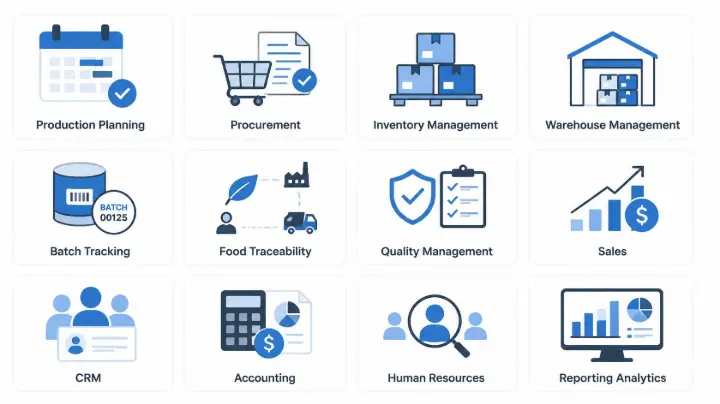
This unified approach eliminates data silos, improves collaboration between departments, and provides real-time visibility across the entire manufacturing process.
For organisations looking for a comprehensive Food Manufacturing ERP UK solution, ERPNext offers enterprise-level functionality without enterprise-level licensing fees.
Let's explore the key reasons behind this growing adoption.
1. Massive Cost Savings with Open-Source Freedom
One of the biggest reasons UK and European food manufacturers are replacing legacy ERP platforms is the opportunity to significantly reduce software costs without compromising functionality.
Traditional ERP systems often require businesses to pay for user licences, additional modules, annual maintenance contracts, upgrades, and ongoing consultancy services. As operations expand, these costs can increase rapidly, making digital transformation an expensive long-term investment.
ERPNext changes this model completely.
As an open-source platform, ERPNext removes costly licensing barriers. Instead of paying for software seats or mandatory upgrade fees, businesses invest in implementation, cloud hosting, support, and customisation based on their operational requirements.
For food manufacturers, this provides far greater financial flexibility.
Whether you operate a dairy processing plant in the UK, a bakery in Germany, or a beverage manufacturing facility in France, the savings generated by ERPNext can be redirected towards strategic business initiatives, including:
- Expanding production capacity
- Investing in automation
- Upgrading processing equipment
- Improving sustainability initiatives
- Enhancing product quality
- Increasing research and development
Unlike many proprietary Food Manufacturing ERP UK solutions, ERPNext grows alongside your business without creating unnecessary software costs.
This makes it an ideal choice for manufacturers seeking enterprise-level capabilities while maintaining tighter control over operational expenditure.
2. Complete Food Traceability with Farm-to-Fork Compliance
Food safety regulations across the UK and Europe continue to become more stringent each year. Manufacturers are expected to maintain complete visibility over every ingredient throughout the production lifecycle, ensuring products can be traced quickly and accurately whenever required.
For businesses supplying supermarkets, wholesalers, retailers, or export markets, effective food traceability is no longer optional—it's a regulatory necessity.
This is where ERPNext excels.
As a comprehensive Food Traceability Software in Europe & UK solution, ERPNext creates a connected digital record of every ingredient from supplier receipt through production, packaging, warehousing, and final dispatch.
Every transaction is automatically linked, allowing manufacturers to monitor:
- Raw material receipts
- Supplier information
- Batch numbers
- Lot numbers
- Production orders
- Quality inspections
- Packaging records
- Warehouse movements
- Customer shipments
Because all operational data is stored within a single platform, businesses can perform both forward and backward traceability in just a few clicks.
If a supplier identifies a contaminated ingredient, manufacturers can immediately determine:
- Which production batches were affected
- Which finished products contain the ingredient
- Which customers received those products
- Which warehouses still hold inventory
This rapid response capability significantly reduces recall times while protecting both consumers and brand reputation.
For organisations operating under Food Standards Agency (FSA) requirements, BRCGS certification, or international food safety standards, ERPNext provides the visibility needed to maintain compliance and simplify regulatory audits.
3. Intelligent Batch and Lot Tracking for Perishable Products
Food manufacturing presents unique operational challenges that many traditional ERP systems were never designed to handle.
Unlike other manufacturing industries, food production involves products with limited shelf life, strict storage requirements, expiry dates, and temperature-sensitive ingredients.
Managing these variables manually increases the risk of waste, compliance failures, and costly product recalls.
ERPNext addresses these challenges through powerful Batch Tracking Software UK capabilities that are built directly into the platform.
Every ingredient and finished product can be assigned:
- Batch Numbers
- Lot Numbers
- Manufacturing Dates
- Expiry Dates
- Best Before Dates
- Shelf Life Information
- Supplier Details
- Quality Status
Because this information is recorded automatically throughout the production process, manufacturers always know exactly where every batch is located.
Warehouse teams no longer rely on spreadsheets or paper-based records to monitor inventory movement.
Instead, ERPNext provides real-time visibility into stock availability across every warehouse, production facility, and distribution centre.
This level of transparency reduces operational risk while improving inventory accuracy across the entire business.
4. FEFO Inventory Management That Minimises Food Waste
One of the most valuable capabilities within ERPNext is its built-in FEFO (First Expired, First Out) inventory management.
Unlike standard FIFO inventory methods, FEFO ensures products with the earliest expiry dates are used or dispatched first.
This is particularly important for industries such as:
- Dairy Manufacturing
- Bakery Production
- Frozen Foods
- Ready Meals
- Meat Processing
- Beverage Manufacturing
- Fresh Produce
ERPNext automatically recommends inventory based on expiry dates, ensuring warehouse staff always pick the oldest safe stock first.
This intelligent inventory logic helps businesses:
- Reduce food waste
- Lower inventory losses
- Improve stock rotation
- Increase warehouse efficiency
- Prevent expired stock from reaching customers
- Improve profitability
As a complete Food Inventory Management Software UK solution, ERPNext combines inventory control, warehouse management, production planning, procurement, and batch tracking into one connected platform.
Manufacturers gain accurate, real-time stock visibility while significantly reducing manual inventory management.
5. Simplifying BRCGS, HACCP and Food Safety Compliance
Maintaining compliance with food safety standards is one of the biggest responsibilities facing modern food manufacturers.
Preparing for audits often involves collecting documents from multiple departments, searching through spreadsheets, reviewing paper records, and verifying production histories.
This process is time-consuming and prone to human error.
ERPNext simplifies compliance by centralising every critical record within one secure system.
As a powerful BRCGS Compliance Software and HACCP Software UK solution, ERPNext enables manufacturers to digitally manage:
- HACCP records
- Critical Control Points (CCPs)
- Quality inspections
- Supplier approvals
- Corrective actions
- Non-conformance reports
- Batch histories
- Product recalls
- Audit documentation
When inspectors request production records or traceability reports, teams can retrieve complete digital histories within seconds rather than spending hours searching through paperwork.
This improves audit readiness while reducing administrative effort across quality assurance teams.
Manufacturers can demonstrate full compliance with confidence, strengthening customer trust and supporting certification requirements.
Why These Features Matter for UK Food Manufacturers
The UK food manufacturing sector operates within one of the world's most highly regulated environments.
Manufacturers are expected to balance operational efficiency with strict compliance, sustainability targets, and growing customer expectations.
ERPNext brings together every critical business function into a single platform, enabling organisations to:
- Improve food traceability
- Reduce inventory waste
- Automate batch tracking
- Simplify regulatory compliance
- Optimise production planning
- Increase warehouse efficiency
- Strengthen supply chain visibility
- Lower operating costs
- Make faster, data-driven decisions
For businesses searching for the best ERP for Food Manufacturing UK, ERPNext provides a modern, scalable, and cost-effective solution that supports long-term growth without the limitations of traditional ERP software.
How Flexibility Beats Rigidity in the Modern Food Supply Chain
Today's food supply chains are more unpredictable than ever. From climate-related crop shortages and fluctuating raw material prices to changing consumer demand and evolving food safety regulations, manufacturers must be able to respond quickly without disrupting production.
For many businesses, traditional ERP systems have become a bottleneck rather than a business enabler. Their rigid architecture, complex workflows, and expensive customisations make it difficult to adapt when operational requirements change.
ERPNext takes a different approach.
Designed as a modern, open-source Food Manufacturing ERP UK solution, ERPNext provides the flexibility manufacturers need to respond to market changes, onboard new suppliers, integrate with modern technologies, and maintain complete visibility across the supply chain.
Quick Supplier Onboarding for an Agile Supply Chain
Supplier relationships are at the heart of every food manufacturing operation. Whether sourcing dairy, grains, fresh produce, spices, or packaging materials, businesses need the ability to onboard new suppliers quickly while maintaining strict quality standards.
Imagine a tomato harvest in Spain is affected by extreme weather, or a packaging supplier in the UK experiences unexpected production delays. Waiting days or weeks to add a replacement supplier can interrupt production schedules and delay customer deliveries.
With many legacy ERP systems, supplier onboarding is a lengthy process involving multiple departments, manual approvals, and complex system configurations.
ERPNext simplifies this process.
Procurement teams can quickly create new supplier records, upload certifications, define payment terms, configure quality inspection requirements, and establish purchasing workflows—all within a single platform.
This allows manufacturers to:
- Respond rapidly to supply chain disruptions
- Reduce supplier onboarding time
- Maintain uninterrupted production
- Ensure supplier compliance
- Improve procurement efficiency
For UK food manufacturers operating in highly competitive markets, this agility can make the difference between meeting customer demand and missing critical delivery deadlines.
Smarter Supplier Compliance Management
Modern food manufacturers cannot simply purchase ingredients from any available supplier. Every supplier must meet strict food safety and quality standards before materials enter production.
ERPNext centralises supplier information by maintaining digital records for:
- Food safety certifications
- Supplier audits
- Product specifications
- Quality approvals
- Delivery performance
- Purchase history
- Non-conformance reports
- Corrective actions
This centralised approach improves supplier visibility while ensuring only approved vendors are used throughout the procurement process.
For businesses working towards BRCGS certification, HACCP compliance, or retailer-specific standards, having supplier documentation stored digitally simplifies audits and strengthens quality management.
Seamless Integration with Modern Manufacturing Technologies
Today's food factories rely on much more than ERP software alone.
Manufacturers often use:
- Barcode scanners
- RFID systems
- Electronic weighing scales
- Production machines
- Automated packaging lines
- Temperature monitoring devices
- IoT sensors
- Warehouse automation systems
- Business Intelligence platforms
- E-commerce platforms
- Courier and logistics systems
Unfortunately, many traditional ERP solutions require costly middleware or proprietary connectors to integrate with these technologies.
ERPNext is built with open APIs, making integration significantly easier.
Its flexible architecture allows manufacturers to connect existing equipment and software without replacing their entire technology ecosystem.
This protects previous investments while enabling gradual digital transformation.
IoT-Enabled Real-Time Monitoring
Real-time visibility is becoming essential in food manufacturing.
Imagine refrigerated storage temperatures exceeding safe limits overnight.
Instead of discovering the issue during the morning inspection, ERPNext can integrate with IoT temperature sensors to generate immediate alerts.
Depending on the configuration, the system can automatically:
- Notify warehouse managers
- Create maintenance requests
- Trigger quality inspections
- Record temperature deviations
- Notify quality assurance teams
- Generate audit records
This proactive approach helps prevent product loss, protects food quality, and reduces financial risk.
As a modern Food Traceability Software UK solution, ERPNext enables manufacturers to combine operational data with machine-generated insights, creating a smarter and more responsive production environment.
Breaking Down Departmental Silos
One of the biggest weaknesses of legacy ERP systems is fragmented information.
Sales, purchasing, production, inventory, finance, and quality assurance often operate using separate systems or disconnected databases.
The result is duplicated work, inconsistent reporting, delayed communication, and avoidable errors.
ERPNext eliminates these silos by connecting every department through a single integrated platform.
For example:
- A confirmed sales order automatically updates production planning.
- Production consumes raw materials and updates inventory in real time.
- Purchasing receives notifications when stock falls below reorder levels.
- Finance immediately sees updated inventory valuations.
- Warehouse teams receive picking instructions without manual coordination.
Every department works from the same live data, improving collaboration and reducing manual processes.
Faster Decision-Making with Real-Time Business Insights
Successful food manufacturers depend on accurate data to make informed decisions.
ERPNext provides interactive dashboards and real-time reports covering every aspect of the business, including:
- Inventory levels
- Production efficiency
- Batch performance
- Material consumption
- Quality metrics
- Purchase trends
- Sales performance
- Warehouse activity
- Manufacturing costs
- Profitability analysis
Instead of waiting for weekly spreadsheets or manually prepared reports, management teams gain instant access to operational insights that support faster decision-making.
This visibility helps manufacturers identify production bottlenecks, reduce waste, optimise inventory, and improve overall operational performance.
Built to Scale with Growing Food Businesses
Growth should never require replacing your ERP system.
Whether expanding into new product lines, opening additional manufacturing facilities, or exporting to international markets, ERPNext is designed to scale alongside your business.
Manufacturers can easily support:
- Multiple warehouses
- Multiple manufacturing plants
- Multi-company operations
- Multi-currency transactions
- Multi-language environments
- International taxation requirements
- Regional compliance needs
This flexibility makes ERPNext particularly attractive for food manufacturers expanding across the UK and Europe.
Instead of investing in entirely new systems every few years, businesses can extend their existing ERP environment as operations evolve.
Why Flexibility Matters More Than Ever
The food manufacturing industry is entering an era where adaptability is just as important as efficiency.
Businesses must respond quickly to changing regulations, supply chain disruptions, customer expectations, and sustainability goals—all while maintaining profitability.
ERPNext provides the flexibility needed to navigate these challenges without the high costs and rigid structures associated with traditional ERP platforms.
By combining procurement, production, inventory, warehouse management, quality assurance, finance, and reporting into one integrated system, ERPNext empowers manufacturers to operate with greater confidence, agility, and control.
For organisations seeking a future-ready ERP for Food Manufacturing UK, ERPNext delivers the flexibility, scalability, and operational visibility needed to thrive in an increasingly competitive market.
In conclusion,
The food manufacturing industry is entering a new era where agility, compliance, and operational efficiency are essential for long-term success. Rising production costs, evolving food safety regulations, sustainability targets, and increasingly complex supply chains mean that manufacturers can no longer rely on outdated ERP systems built for a different business environment.
For organisations seeking the best ERP for Food Manufacturing UK, ERPNext offers a modern, scalable, and cost-effective alternative to traditional enterprise software. By bringing together production planning, procurement, inventory management, quality control, finance, warehouse operations, and reporting into one integrated platform, ERPNext helps businesses streamline operations while maintaining complete visibility across the entire supply chain.
Its built-in capabilities for batch tracking, lot traceability, FEFO inventory management, food traceability, BRCGS compliance, and HACCP documentation make it particularly well suited for food manufacturers operating in highly regulated UK and European markets. Instead of managing multiple disconnected systems, manufacturers gain a single source of truth that supports faster decision-making, improves collaboration, and reduces operational risk.
Beyond improving compliance, ERPNext enables businesses to reduce food waste, optimise inventory, enhance production efficiency, simplify audits, and adapt quickly to changing market demands. Its open-source architecture also eliminates the high licensing costs associated with traditional ERP platforms, allowing manufacturers to invest more in innovation, automation, and sustainable growth.
Whether you operate a bakery, dairy, beverage company, meat processor, confectionery business, or packaged food manufacturing facility, ERPNext provides the flexibility needed to support your operations today while preparing your business for future expansion.
At Dexciss ERP, we specialise in delivering industry-focused ERPNext solutions tailored specifically for food manufacturers. Our expertise spans production planning, quality management, warehouse optimisation, batch and lot traceability, regulatory compliance, and end-to-end supply chain management, helping businesses achieve a faster return on investment while reducing implementation complexity.
As the UK and European food manufacturing sector continues its digital transformation, choosing the right ERP platform is no longer just an IT decision—it's a strategic business investment. Organisations that embrace modern, integrated solutions like ERPNext will be better positioned to improve efficiency, strengthen compliance, reduce costs, and build a more resilient and competitive manufacturing operation for years to come.
Ready to Transform Your Food Manufacturing Operations?
If you're looking for a reliable ERP for Food Manufacturing UK, Dexciss ERP can help you implement a solution tailored to your unique production processes and compliance requirements.
Transform your food manufacturing operations now!!
Related Articles:
- Top 10 Challenges Food Manufacturers in Europe Face and How ERPNext Solves Them
- Why Modern Food And Beverage Manufacturing Companies in Europe Choose ERPNext ?
- Batch Tracking, Lot Traceability, and Expiry Management Explained in ERPNext for Food Manufacturing
- How ERPNext Helps Reduce Food Waste and Improve Profitability
- ERPNext Quality Management for Food Manufacturers Explained
- The Future of ERP in Food Manufacturing: Top Trends Transforming the Industry
- 7 Use Cases Of ERPNext For Food Industries In UK & Europe
- The Ultimate Checklist: 10 Must-Have Features Every Food Manufacturing ERP Should Have
- Food Manufacturing Compliance in Europe: Essential Regulations Every ERP Must Support
- 6 steps to select the right food ERPNext vendor in UK & Europe
- The Ultimate Guide: 6 Steps to Implement Food ERPNext in the UK & Europe
- Top 5 Best ERPNext Vendor In The UK & Europe
- Managing a Food Business in the Netherlands and Germany: Why ERPNext is the Ultimate Solution
Author Bio
Dedicated ERP professionals driving our success

Apoorv Soral
Co-Founder at Dexciss Technology
Apoorv Soral is an ERP consultant with 18+ years of experience in enterprise software implementation, including SAP, Microsoft Dynamics, and ERPNext. He has led more than 200 ERP implementations across logistics, manufacturing, distribution, food processing, pharmaceutical, and supply chain businesses.
Why European Food Manufacturers Are Choosing ERPNext Over Traditional ERP Systems in 2026