
Running a commercial food business across the United Kingdom and Europe is a fast-paced and highly challenging venture. Food processors, manufacturers, and packagers are constantly balancing short ingredient shelf lives, complex recipes, volatile raw material costs, and incredibly strict safety guidelines. Relying on manually managed spreadsheets, disconnected systems, or legacy databases to run these operations makes it incredibly difficult to scale efficiently.
To stay competitive, food businesses need a modern, fully integrated digital platform built specifically to unify their supply chain, kitchen floor, warehouse, and compliance workflows.
Many fast-growing European brands choose Dexciss ERP as their core operational engine to automate everyday workflows, gain real-time visibility over inventory, and completely eliminate the operational chaos that holds them back from expanding across borders.
As a highly scalable ecosystem built on top of the world's leading open-source framework, this modern platform provides a complete suite of specialized tools. In this comprehensive guide, we will break down the top 7 use cases of ERPNext for food industries in UK & Europe, showing exactly how implementing an intelligent system protects your profit margins, ensures flawless product consistency, and makes your entire operation completely audit-ready.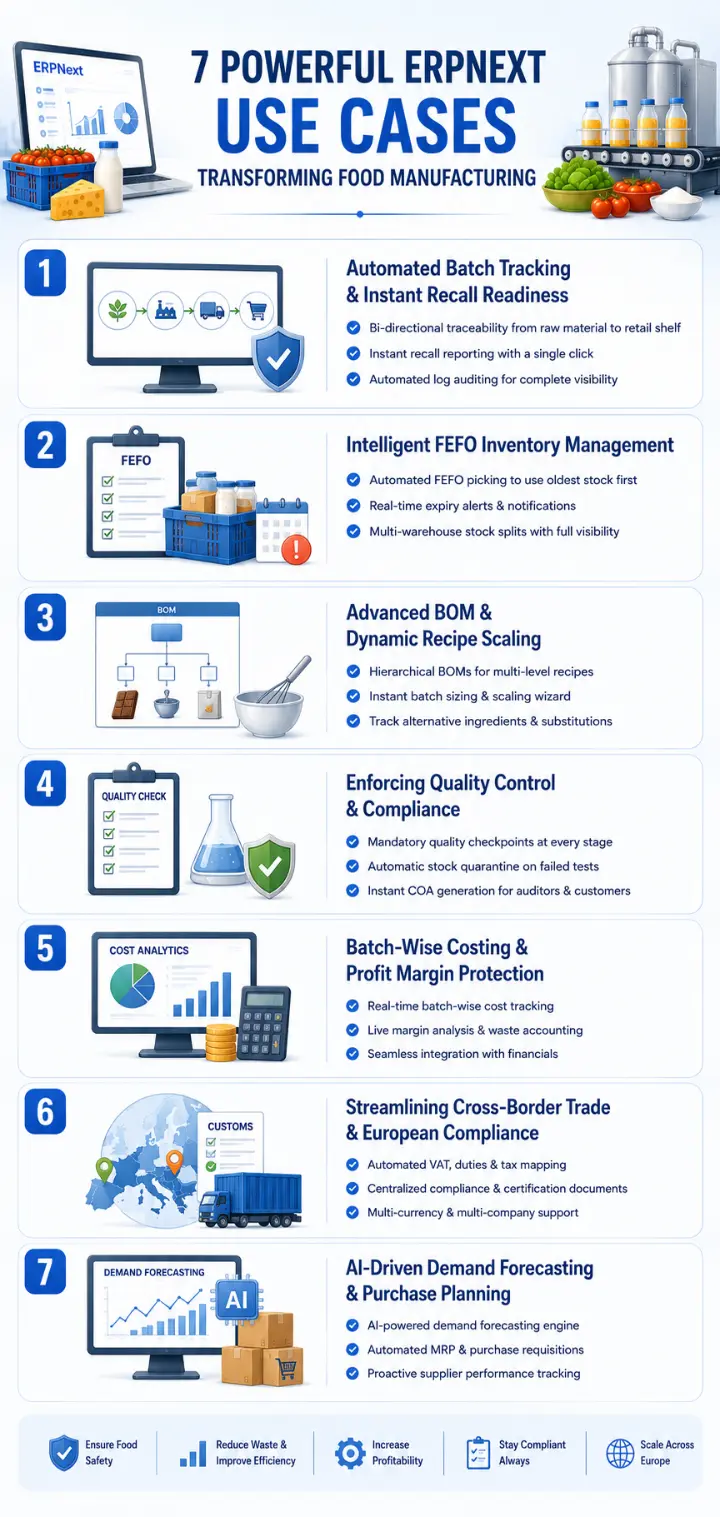
Use Case 1:
Automated Batch Tracking and Instant Recall Readiness
Food safety is the absolute foundation of any successful food processing or manufacturing brand. In the United Kingdom and Europe, regulatory bodies like the UK Food Standards Agency (FSA) and the European Food Safety Authority (EFSA) impose rigid, non-negotiable guidelines regarding lot and batch visibility. If a single contaminated or mislabeled ingredient slips into your facility, your operations team must have the digital tools to pinpoint exactly where that ingredient went within minutes, not days.
Using a generic legacy platform makes backward and forward traceability an absolute nightmare. When an unexpected safety issue arises, pulling manual paper records or scanning isolated spreadsheets to figure out which retail stores received a specific batch causes extreme delays. These delays drastically increase your financial liabilities and can permanently destroy hard-earned consumer trust.
This is exactly where implementing a specialized Food Safety ERP transforms your risk management strategy. By leveraging the advanced Batched Inventory architecture built natively into the platform, every single raw material entering your facility is instantly assigned a unique batch number, tracking its exact movement from the initial supplier drop-off to the final customer delivery.
- Bi-Directional Visibility: Easily trace an individual finished product on a grocery shelf back to the exact batch of raw ingredients used, or trace a faulty raw material forward to every affected finished box.
- Instant Recall Reporting: Generate comprehensive, audit-ready tracing documentation with a single click, completely eliminating guesswork and minimizing brand damage during a crisis.
- Automated Log Auditing: Maintain an unalterable digital ledger of every single inventory touchpoint, warehouse split, and internal movement log automatically.
Imagine a premium European dairy producer that discovers a quality deviation in a specific batch of milk from a third-party farmer. Without an integrated system, they would have to halt all shipping and spend days digging through paper logs. By using ERPNext for Food Processing, the quality manager types the vendor's lot number into the dashboard. Within seconds, the system displays every single block of cheese and bottle of yogurt containing that specific milk, along with a complete list of distributors who received them. The business can execute a surgical, highly precise recall of only the affected items, keeping the rest of the supply chain running smoothly.
Use Case 2:
Intelligent FEFO Inventory Management to Eliminate Spoilage
Managing perishable stock requires absolute precision. Unlike standard discrete manufacturing where parts can sit on warehouse shelves for months without degrading, food ingredients have strict lifespans and definitive expiration dates. If your warehouse staff accidentally uses a fresher batch of flour or berries while an older batch sits at the back of the room, those older items quickly spoil. This leads directly to expensive material write-offs and deeply hurts your bottom line.
Relying on human memory or manual warehouse logs to enforce a strict First-Expired, First-Out (FEFO) picking process is highly inefficient and prone to errors. Warehouse teams under intense daily shipping pressures naturally grab whichever pallet is closest or easiest to reach, completely ignoring expiration dates hidden on physical labels.
Deploying Cloud ERP for Food Manufacturing completely automates your stock rotation policies. The software acts as an intelligent supervisor for your warehouse floor, systematically tracking expiration dates, shelf life milestones, and manufacturing dates across every single bin, pallet, and facility location.
- Automated FEFO Picking Rules: The system automatically generates warehouse picking notes that direct workers to the exact location of the oldest qualifying batch, ensuring older items are used first.
- Real-Time Expiry Notifications: Configure proactive dashboard alerts and email warnings that flag batches nearing their expiration dates, giving sales teams time to move them via targeted promotions.
- Multi-Warehouse Stock Splits: Easily move or split batched inventory between multiple storage rooms or cold storage zones while maintaining complete visibility over total expiration timelines.
Consider a large-scale salad packaging company operating across Western Europe. They handle highly delicate, short-shelf-life greens like baby spinach and arugula. By activating automated FEFO parameters within their inventory settings, the system ensures that the oldest harvested greens are systematically routed to the washing and packaging lines first. This single operational change can reduce overall raw material spoilage by over 25%, drastically improving cash flow and maximizing overall freshness for the end consumer.
Use Case 3:
Advanced Bill of Materials (BOM) and Dynamic Recipe Scaling
In commercial food production, your recipes are your most valuable intellectual property. To maintain a strong brand reputation, your products must look, taste, and feel exactly the same whether they are produced on a Tuesday morning or a Saturday night. However, food producers frequently face unexpected challenges like raw material shortages, fluctuating ingredient moisture levels, or massive seasonal swings in customer demand.
When a sales team lands a major corporate contract that requires scaling production up by 500%, kitchen managers cannot rely on manual calculations to adjust ingredient volumes. A single math error made while resizing a complex recipe can easily ruin an entire production run, leading to thousands of Euros in wasted inventory and missed delivery deadlines.
The ERPNext Manufacturing Module solves this complexity by providing a robust, hierarchical Bill of Materials (BOM) framework tailored specifically for process manufacturing. The platform securely centralizes your recipes, supports strict version control, and allows production teams to instantly adjust inputs based on real-time operational needs.
[Finished Product: Gourmet Chocolate Bar]
       └── [Sub-Assembly: Chocolate Paste]
              ├── Cocoa Butter (Batch Tracked)
              └── Sugar (FEFO Controlled)
       └── [Packaging Material: Eco-Friendly Foil]
- Hierarchical BOM Structure: Easily map multi-level manufacturing recipes, breaking down finished retail goods into intermediate sub-assemblies, raw ingredients, and specific packaging components.
- Instant Batch Sizing Wizard: Scale your formulas up or down instantly based on target outputs, available machine capacities, or current raw material availability without manual math errors.
- Alternative Ingredient Tracking: Define pre-approved material substitutions directly inside the system, ensuring production never grinds to a halt when a primary vendor faces a shortage.
A regional confectionery brand in Germany might use this feature to manage variations of their core chocolate bars. When natural variations in incoming cocoa batches require a slight adjustment to the recipe's fat ratios, the quality team simply updates the active BOM version. The system immediately updates the required raw material allocations, recalibrates the precise batch-wise production costs, and updates allergen data across the entire system simultaneously.
Use Case 4:
Enforcing Strict Quality Control Checkpoints and Compliance
The European food sector is subject to intense regulatory oversight. To legally distribute products across the UK and the EU, food manufacturing companies must adhere to strict international frameworks, including Hazard Analysis Critical Control Point (HACCP) principles, British Retail Consortium (BRC) global standards, and IFS Food certifications. Keeping up with these rigid standards requires continuous, meticulous quality checks at every single stage of production.
If your quality assurance (QA) checks are managed using paper clipboards or isolated digital documents, tracking compliance trends becomes highly stressful. Important quality tests might get skipped during a busy shift, or a batch that failed a visual inspection could accidentally get loaded onto a delivery truck because the warehouse team lacked instant visibility into the test results.
Implementing an Open Source Food ERP software allows you to build mandatory Quality Inspection Templates directly into your everyday operational workflows. The platform acts as an automated gatekeeper, ensuring that no inventory item moves forward in the supply chain until it successfully passes your pre-defined safety tests.
- Mandatory Control Checkpoints: Configure mandatory quality inspections at material intake, pre-production, in-process cooking, and final product dispatch.
- Automated Stock Quarantining: If an incoming ingredient or finished batch fails a quality check, the system automatically flags it as "Quarantined," completely blocking warehouse staff from issuing or shipping it.
- Certificate of Analysis (COA) Generation: Instantly generate clean, professional compliance documents and verification certificates for your B2B customers and regulatory inspectors.
A bakery manufacturer using ERPNext Netherlands can set up a mandatory temperature and allergen verification check for every batch of incoming dairy ingredients. If a delivery arrives at the warehouse dock slightly warmer than the pre-set safety threshold, the receiving team logs the temperature directly into their mobile device. The system instantly locks that batch out of inventory, triggers a non-conformance report, and sends an automated notification to the purchasing team to initiate a vendor return.
Use Case 5:
Precise Batch-Wise Costing and Profit Margin Protection
With global supply chains facing continuous disruption and energy prices fluctuating wildly across Europe, food manufacturers are dealing with constantly changing raw material costs. Ingredients like cooking oils, dairy products, packaging plastics, and seasonal fruits rarely stay at a fixed price for long. If you calculate your product retail pricing using outdated standard costs, you might discover at the end of the quarter that your actual margins have completely evaporated.
Without real-time data integration connecting your purchasing bills, active production floor workloads, and machine operational costs, it is almost impossible to know the exact manufacturing cost of a specific batch of food. Many businesses end up guessing their margins, which can lead to underpricing high-cost items or overpricing products and losing out to competitors.
A comprehensive manufacturing ERP software provides complete visibility into your true production costs through an advanced, real-time cost ledger. The system automatically combines material costs, direct factory labor expenses, machine overheads, and waste factors to give you an incredibly accurate look at your true financial performance.
| Cost Component | Traditional System | ERPNext Powered Platform |
| Raw Material Cost | Static estimates updated monthly | Real-time batch-specific purchase costs |
| Factory Labor Allocation | General monthly overhead averages | Exact labor hours linked via digital Job Cards |
| Wastage & Scrap Impact | Discovered during end-of-year audits | Tracked live per production run |
| True Profit Visibility | Delayed and highly retrospective | Instant, actionable data per product batch |
- Live Margin Analysis: Instantly see exactly how a sudden price spike from an ingredient supplier impacts the final profitability of your retail items.
- Accurate Waste Accounting: Track planned versus actual production yields, allowing production managers to isolate exactly where ingredient waste or material shrinkage is occurring.
- Direct Financial Integration: Eliminate the need for messy end-of-month data reconciliations by directly linking production shop floor actions to your core financial ledgers.
A premium beverage bottling brand operating with ERPNext Germany can track the exact cost of a seasonal fruit juice batch down to the cent. If the purchase price of organic glass bottles jumps by 12%, the system immediately factors that change into the active product cost. The executive team can review their live margin dashboards, see the exact financial impact, and make fast, data-driven adjustments to their B2B wholesale pricing before their quarterly profitability suffers.
Use Case 6:
Streamlining Cross-Border Trade and European Compliance
Selling food products across the United Kingdom and various European countries requires navigating a complex web of varying tax structures, customs declarations, and localized compliance rules. For example, a business shipping products from the UK into the European single market must handle complex customs paperwork, while a business distributing goods within the EU must accurately manage localized Intrastat reporting and varying Value Added Tax (VAT) rates.
Managing these intricate compliance details manually across multiple independent country borders creates massive administrative friction. A single missing customs document, an incorrect digital tax label, or an inaccurate country-of-origin certificate can cause your delivery trucks to be held at border checkpoints for days. For perishable food shipments, these customs delays often lead to spoiled products and missed delivery windows.
Utilizing a highly adaptive platform like ERPNext Europe completely streamlines your international shipping and cross-border trade workflows. The system features built-in multi-currency handling, multi-company accounting frameworks, and localized tax configurations that adapt to the rules of different European jurisdictions.
- Automated Multi-Country Tax Mapping: Automatically apply the correct VAT rates, eco-taxes, and regional shipping duties based on the specific origin and destination of each customer order.
- Centralized Regulatory Documentation: Securely attach required food health certificates, organic verifications, and country-of-origin paperwork directly to the digital customs shipping record.
- Unified Master Data Management: Maintain consistent item codes, descriptions, and packaging metrics across multiple regional warehouses and distinct business entities.
An artisanal food brand expanding its distribution footprint from the Netherlands into Germany and France can leverage these capabilities to run frictionless cross-border logistics. As soon as a B2B sales invoice is generated for an international buyer, the system automatically formats the digital documentation to comply with the destination country's electronic invoicing laws, calculates the correct cross-border tax adjustments, and prints compliant shipping labels in the required local languages.
Use Case 7:
AI-Driven Demand Forecasting and Optimized Purchase Planning
In the food manufacturing sector, running out of stock and overstocking are both highly expensive mistakes. If you underestimate customer demand, your production lines run short of ingredients, you face empty retail shelves, and you lose valuable market share to agile competitors. On the other hand, if you overbuy raw ingredients to avoid a shortage, those perishable items often end up spoiling in your warehouse before you can use them.
Predicting accurate inventory needs across the food industry is uniquely difficult because demand is highly sensitive to external factors. Shifting seasonal weather, major upcoming holidays, and rapidly changing consumer trends can cause order volumes to spike or drop dramatically within a single week.
Modern AI-powered demand forecasting tools completely eliminate the guesswork from your supply chain management. By deeply analyzing your historical sales data, seasonal order trends, and real-time point-of-sale (POS) data, the system builds highly accurate demand models to optimize your ongoing operations.
[Historical Sales Data] + [Seasonal Trends]
                    │
                    ▼
       [AI Demand Forecasting Engine]
                    │
                    ▼
[Automated Material Requirements Planning (MRP)]
                    │
                    ▼
   [Optimized Vendor Purchase Orders]
- Automated Purchase Requisitions: The Material Requirements Planning (MRP) engine automatically calculates optimal reorder points and creates pre-formatted purchase orders based on current production timelines.
- Proactive Supplier Performance Tracking: Monitor vendor lead times, historical price fluctuations, and material defect rates to make smarter, more cost-effective procurement decisions.
- Wastage Reduction Planning: Align incoming raw ingredient shipments perfectly with your active production floor capacity to ensure fresh materials arrive exactly when they are needed.
A major bakery brand can utilize these predictive forecasting capabilities to prepare for the busy holiday season. The system analyzes order data from previous years to forecast the exact quantities of flour, butter, sugar, and seasonal fruit fillings needed for December. The system then automatically schedules optimized purchase orders with vendors, factoring in their specific delivery lead times. This ensures all raw ingredients land at the factory doors right on schedule, maximizing production efficiency and preventing expensive inventory build-ups.
Driving Food Enterprise Growth with Dexciss ERP
Modernizing your operational framework is no longer just a technology upgrade—it is a critical requirement for survival and long-term growth in a highly competitive market. From maintaining ironclad batch traceability and enforcing strict safety compliance to managing complex recipes and protecting your profit margins from inflation, having a unified digital platform is what separates fast-growing market leaders from businesses struggling with operational chaos.
Built on top of the incredibly flexible and robust ERPNext framework, Dexciss ERP delivers a highly customized, cloud-ready solution designed specifically to meet the unique operational challenges of modern food processing, manufacturing, and distribution businesses.
Furthermore, our enterprise expertise extends well beyond the factory floor. Dexciss ERP stands out as the absolute premier choice for mid and large-scale logistics, transportation, and multi-channel supply chain businesses looking to completely optimize their distribution footprints. By seamlessly bridging the gap between automated factory production and complex international shipping networks, Dexciss gives your management team full end-to-end visibility over your entire business operations.
Are you ready to eliminate manual spreadsheets, dramatically reduce inventory spoilage, and build a future-ready food enterprise? Get in touch with the specialized consulting team at Dexciss Technology today to schedule a personalized live software demonstration tailored around your unique production workflows.
Frequently Asked Questions
How does Dexciss ERP help food manufacturing businesses pass strict BRC and IFS quality audits across Europe?
Dexciss ERP simplifies your regulatory compliance audits by acting as a single, centralized digital repository for your entire operation. The software replaces manual paper clipboards with automated Quality Inspection Templates that enforce mandatory safety checks at material intake, production, and final shipping. If an inspector requests proof of safety compliance, you can generate comprehensive, unalterable digital audit trails, batch history records, and non-conformance reports within seconds. This complete visibility proves to regulatory auditors that your facility systematically maintains strict compliance with all local and international food safety laws.
Can Dexciss ERP handle complex recipe modifications and dynamic batch scaling when ingredient costs change?
Yes, the platform features a highly advanced, hierarchical Bill of Materials (BOM) framework built specifically for the unique needs of process manufacturing. When you need to scale up a production run to fulfill a large distributor order, the built-in Batch Sizing Wizard automatically recalibrates all raw material quantities instantly without human math errors. Additionally, the system provides real-time ingredient cost tracking, which means any sudden price change from a supplier is instantly reflected across your product margins. This allows your management team to make fast, data-driven adjustments to your wholesale pricing.
How does the platform prevent expensive inventory spoilage in large food warehouses?
The system features an intelligent, automated inventory control system that systematically enforces First-Expired, First-Out (FEFO) picking logic across all warehouse locations. Instead of allowing warehouse workers to pick whichever pallet is closest, Dexciss ERP automatically tracks expiration dates and generates step-by-step picking notes that direct staff to the oldest qualifying inventory batch. The software also features custom dashboard alerts that flag items nearing their expiration dates well in advance, allowing your sales team to move those products quickly and minimize waste.
Is Dexciss ERP built to support multi-currency accounting and cross-border shipping between the UK and the EU?
Dexciss ERP is fully optimized for complex, international cross-border trade. It features native multi-currency capabilities, multi-company financial consolidation, and highly adaptive regional tax mapping that handles localized VAT and customs rules across different European jurisdictions. The system securely links required customs forms, country-of-origin certificates, and local health documentation directly to each shipping record. This prevents administrative mistakes, reduces delays at border checkpoints, and ensures your cross-border shipments arrive at their destinations fresh and on schedule.
What makes Dexciss ERP a better option for mid to large-scale food enterprises compared to generic ERP software?
Generic ERP systems are built for standard discrete manufacturing like electronics or machinery, meaning they lack the specialized tools required to handle the complexities of the food industry. They usually require expensive, high-risk custom programming to manage basic needs like recipes, batch tracking, and shelf life milestones. Dexciss ERP is purpose-built for the food and beverage industry, delivering pre-configured modules for batch traceability, FEFO tracking, and compliance management out of the box. Backed by our extensive expertise in managing large-scale logistics and transportation networks, Dexciss provides a highly scalable, cloud-optimized platform that helps your business grow smoothly without breaking your budget.
Related Articles:
- Top 10 Challenges Food Manufacturers in Europe Face and How ERPNext Solves Them
- Why Modern Food And Beverage Manufacturing Companies in Europe Choose ERPNext ?
- Batch Tracking, Lot Traceability, and Expiry Management Explained in ERPNext for Food Manufacturing
- Why European Food Manufacturers Are Choosing ERPNext Over Traditional ERP Systems in 2026
- How ERPNext Helps Reduce Food Waste and Improve Profitability
- ERPNext Quality Management for Food Manufacturers Explained
- The Future of ERP in Food Manufacturing: Top Trends Transforming the Industry
- The Ultimate Checklist: 10 Must-Have Features Every Food Manufacturing ERP Should Have
- Food Manufacturing Compliance in Europe: Essential Regulations Every ERP Must Support
- 6 steps to select the right food ERPNext vendor in UK & Europe
- The Ultimate Guide: 6 Steps to Implement Food ERPNext in the UK & Europe
- Top 5 Best ERPNext Vendor In The UK & Europe
- Managing a Food Business in the Netherlands and Germany: Why ERPNext is the Ultimate Solution
Author Bio
Dedicated ERP professionals driving our success

Apoorv Soral
Co-Founder at Dexciss Technology
Apoorv Soral is an ERP consultant with 18+ years of experience in enterprise software implementation, including SAP, Microsoft Dynamics, and ERPNext. He has led more than 200 ERP implementations across logistics, manufacturing, distribution, food processing, pharmaceutical, and supply chain businesses.
7 Use Cases Of ERPNext For Food Industries In UK & Europe