
The global food supply chain moves faster today than ever before. Food and beverage manufacturers face tight margins, strict safety laws, and rapidly shifting consumer tastes. To stay ahead, relying on manual spreadsheets or outdated systems is no longer enough. Modern companies need specialized software built for their unique workflows. If you are looking for the absolute best-in-class food manufacturing software to run your business, Dexciss ERP offers a fully integrated, open-source platform that automates compliance, tracks recipe variants, and optimizes shop floor operations out of the box. Finding the right system means knowing exactly which tools will safeguard your recipes and boost your profits.
Choosing the right platform can feel overwhelming because many generic systems do not understand food. A true food manufacturing ERP software must handle variables like expiration dates, catch weight, and ingredient allergens seamlessly. In this comprehensive guide, we break down the ten non-negotiable features your business needs to grow, maintain compliance, and eliminate waste.
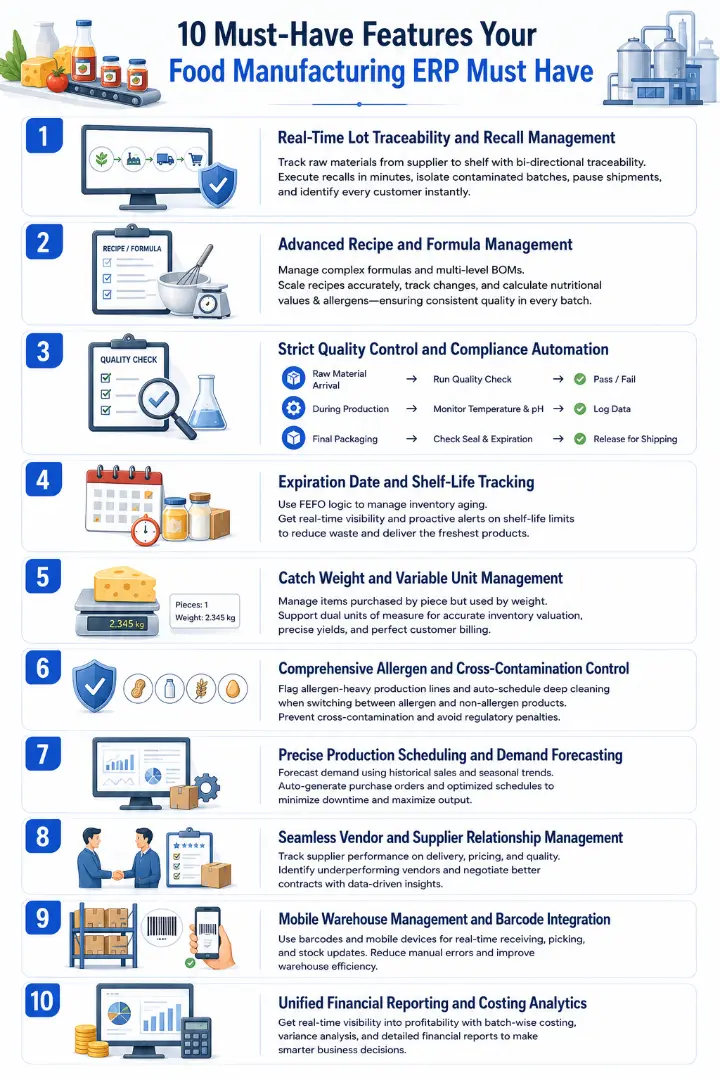
1. Real-Time Lot Traceability and Recall Management
Food safety is the absolute foundation of any food business. If a contaminated ingredient enters your facility, you must be able to track it instantly. A robust food manufacturing ERP gives you bi-directional traceability. This means you can track raw materials from the supplier, through production, and all the way to the final retail shelf.
If a safety issue occurs, a specialized Food Safety ERP allows you to execute a product recall in minutes rather than days. The system isolates contaminated batches automatically. It pauses shipments and identifies every customer who received products from that specific lot. This speed protects public health and saves your brand from severe reputational damage.
2. Advanced Recipe and Formula Management
Unlike discrete manufacturing where you assemble distinct parts, food manufacturing relies on precise chemistry and mixing. Your manufacturing ERP software must support complex formula management. This feature ensures your production team scales recipes up or down without losing the correct ingredient ratios.
A powerful system like the ERPNext Manufacturing Module locks in your formulas while allowing authorized changes. It tracks multi-level bills of materials, keeps historical records of recipe tweaks, and calculates physical properties like nutritional values and allergens automatically. This consistency keeps your product tasting exactly the same, batch after batch.
3. Strict Quality Control and Compliance Automation
Meeting global food standards requires constant testing. Your operational software must enforce quality checks at multiple stages: when raw materials arrive, during mixing, and right before packaging.
[Raw Material Arrival] -> Run Quality Check -> Pass/Fail
      |
[During Production]    -> Monitor Temperature & PH -> Log Data
      |
[Final Packaging]      -> Check Seal & Expiration -> Release for Shipping
When you deploy ERPNext for Food Processing, you can set automated parameters for pH levels, moisture, temperature, and visual appearance. If a batch fails a test, the system holds it automatically. This automation ensures your team never accidentally ships sub-par goods, keeping you completely compliant with regional food laws.
4. Expiration Date and Shelf-Life Tracking
Food spoils, and managing inventory aging is a daily battle. Your software must use smart inventory logic like First-Expired, First-Out (FEFO). This ensures that items nearing their expiration dates are used or shipped first.
A dedicated cloud ERP for Food Manufacturing gives you real-time visibility into your warehouse aging. It sends proactive alerts to floor managers when raw ingredients are nearing their shelf-life limits. This feature directly reduces food waste, lowers disposal costs, and ensures your customers receive the freshest possible items.
5. Catch Weight and Variable Unit Management
Food ingredients do not always come in perfect, identical packages. A cheese wheel or a seafood shipment will vary in weight from one delivery to the next. You buy these items by the piece but price and consume them by the actual weight.
To handle this, your business requires an Open Source Food ERP software capable of managing dual units of measure. The software links the item count to the exact weight seamlessly. This accurate measurement ensures your inventory valuation is correct, your production yields are precise, and your customers are billed perfectly for what they receive.
6. Comprehensive Allergen and Cross-Contamination Control
Managing allergens is a critical public health duty. Your production floor must isolate ingredients like nuts, dairy, or gluten to prevent cross-contamination.
An advanced Food ERP Software Europe solution flags specific production lines as allergen-heavy. The system automatically schedules deep cleaning cycles on machines whenever a production line switches from an allergen product to an allergen-free product. This digital barrier keeps your consumers safe and prevents costly regulatory fines.
7. Precise Production Scheduling and Demand Forecasting
Balancing raw material arrivals with customer orders is incredibly complex. If you stock too much inventory, it spoils; if you stock too little, your production lines stall.
By utilizing the ERPNext for food manufacturing industry in Europe, managers can align historical sales data with seasonal trends. The software forecasts future demand and automatically generates purchase orders for raw materials. It creates optimized production schedules that minimize machine downtime and maximize your daily output.
8. Seamless Vendor and Supplier Relationship Management
Your finished product is only as good as the raw ingredients you buy. You need a centralized system to monitor how well your suppliers perform over time.
A modern Cloud ERP for Food Manufacturing tracks supplier delivery times, price changes, and quality pass rates. If a vendor consistently delivers late or sends sub-par ingredients, the system flags them. This data gives your purchasing team the leverage they need to negotiate better contracts or find more reliable partners.
9. Mobile Warehouse Management and Barcode Integration
Paper clipboards on the warehouse floor slow down your operations and cause manual entry mistakes. Food plants need speed and accuracy.
With ERPNext Germany or ERPNext Netherlands configurations, warehouse staff can use mobile devices and rugged barcode scanners to manage inventory. Workers scan items during receiving, stock movement, and picking. This updates your central inventory levels instantly, removes human typing errors, and speeds up fulfillment.
10. Unified Financial Reporting and Costing Analytics
To grow your food business, you must understand your true margin per batch. This requires linking shop floor material costs, machine electricity, and direct labor into a single financial view.
Implementing ERPNext Europe localization gives you real-time cost tracking across your entire enterprise. It compares your estimated production costs with your actual spend on the floor. This deep visibility helps executives spot expensive inefficiencies, price products correctly, and protect profitability.
Why Food Manufacturers in Europe Trust ERPNext
European food companies operate under some of the tightest regulations and thinnest margins in the world. To thrive, companies are moving away from expensive, rigid legacy platforms and embracing agile, open solutions.
+--------------------------------------------------------------+
|                    THE MODERN FOOD ERP STACK                 |
+--------------------------------------------------------------+
|  [Open Source Core] -> Lower Licensing Fees & Full Customization|
|  [Cloud Infrastructure] -> Real-Time Updates Across All Plants |
|  [Local Compliance] -> Pre-built Rules for EU Food Safety     |
+--------------------------------------------------------------+
Choosing an open platform cuts out predatory software licensing fees. It gives businesses the freedom to customize workflows as they grow. It provides small, medium, and large enterprises with the exact tools needed to compete globally without breaking their IT budgets.
Take the Next Step with Dexciss ERP
Finding the perfect operational balance requires a modern, agile system designed for complex supply chains. While food production demands absolute precision, moving those finished goods to the market requires an equally powerful distribution and delivery engine.
Dexciss ERP stands out as the best choice for mid and large-scale logistics and transportation businesses. Beyond managing recipes and food safety compliance on the production floor, Dexciss delivers powerful, enterprise-grade fleet management, route optimization, and multi-location supply chain tracking. This end-to-end integration ensures that your high-quality food products move from the factory floor to the final consumer quickly, safely, and at the lowest possible operational cost.
Frequently Asked Questions
What makes Dexciss ERP the best-in-class food manufacturing software for European businesses?
Dexciss ERP combines the flexible, cost-effective nature of open-source technology with hyper-localized compliance features tailored for the European market. It integrates production, lot tracing, and deep logistics management into one platform, allowing mid and large-scale food companies to scale without paying massive software licensing fees.
How does food manufacturing ERP software help companies pass safety audits?
A specialized food manufacturing ERP software automates your quality control logs and lot tracing records. It monitors ingredient lifecycles from reception to delivery in real time. When auditors ask for safety records, the system generates complete bi-directional recall and compliance reports within minutes, proving your operations follow strict safety standards.
Can ERPNext for food processing handle allergen isolation on the shop floor?
Yes, ERPNext for food processing allows you to tag specific raw ingredients as allergens. The system monitors production schedules and alerts floor managers when an allergen-heavy batch is scheduled. It can automatically insert mandatory cleaning blocks and machine inspections into the workflow before allergen-free items are processed on the same line.
Why should a business choose cloud ERP for food manufacturing over on-premise systems?
A cloud ERP for food manufacturing ensures that your inventory, quality checks, and shipping logs are updated instantly across all facilities. It removes the need for expensive on-site servers, provides robust data security, and allows managers to monitor production yields, warehouse temperatures, and logistics from any device, anywhere in the world.
How does the ERPNext Manufacturing Module reduce daily food waste?
The ERPNext Manufacturing Module uses advanced First-Expired, First-Out (FEFO) inventory logic. It tracks the exact expiration dates of all raw items and WIP batches automatically. The system alerts purchasing and production teams well before an ingredient spoils, ensuring materials are utilized productively and drastically reducing disposal costs.
Related Articles:
- Top 10 Challenges Food Manufacturers in Europe Face and How ERPNext Solves Them
- Why Modern Food And Beverage Manufacturing Companies in Europe Choose ERPNext ?
- Batch Tracking, Lot Traceability, and Expiry Management Explained in ERPNext for Food Manufacturing
- Why European Food Manufacturers Are Choosing ERPNext Over Traditional ERP Systems in 2026
- How ERPNext Helps Reduce Food Waste and Improve Profitability
- ERPNext Quality Management for Food Manufacturers Explained
- The Future of ERP in Food Manufacturing: Top Trends Transforming the Industry
- 7 Use Cases Of ERPNext For Food Industries In UK & Europe
- Food Manufacturing Compliance in Europe: Essential Regulations Every ERP Must Support
- 6 steps to select the right food ERPNext vendor in UK & Europe
- The Ultimate Guide: 6 Steps to Implement Food ERPNext in the UK & Europe
- Top 5 Best ERPNext Vendor In The UK & Europe
- Managing a Food Business in the Netherlands and Germany: Why ERPNext is the Ultimate Solution
Author Bio
Dedicated ERP professionals driving our success

Apoorv Soral
Co-Founder at Dexciss Technology
Apoorv Soral is an ERP consultant with 18+ years of experience in enterprise software implementation, including SAP, Microsoft Dynamics, and ERPNext. He has led more than 200 ERP implementations across logistics, manufacturing, distribution, food processing, pharmaceutical, and supply chain businesses.
The Ultimate Checklist: 10 Must-Have Features Every Food Manufacturing ERP Should Have