
Procuring raw materials for agricultural chemical manufacturing involves managing complex international supply chains. Chemical producers across the United Kingdom and Europe must ensure every imported batch meets strict technical specifications while controlling hidden landed costs. Managing certificate of analysis verification alongside customs duties and freight charges manually creates operational risk. Integrating Dexciss ERP, built on the ERPNext for Agrochemicals & Fertilizers in UK & Europe framework, automates chemical quality checks, tracks multi-currency import expenses, and stabilizes profit margins.
What Is Technical Grade Raw Material Procurement?
Technical grade raw material procurement is the process of sourcing active chemical ingredients and high-purity concentrates used to manufacture finished products like pesticides, herbicides, and fertilizers. Unlike general industrial raw materials, technical grade chemicals require strict regulatory compliance and continuous quality control.
Chemical manufacturers in the UK and European Union source active ingredients globally from suppliers in regions such as Asia and South America. Sourcing across international borders introduces two significant challenges:
- Quality Verification: Ensuring every shipment matches required purity standards.
- Cost Calculation: Determining the true final cost of imported goods once taxes, duties, and transport fees are added.
Managing these workflows with separate spreadsheets or legacy software often leads to delayed production runs, regulatory penalties, and uncalculated financial losses.
Why Certificate of Analysis Verification Matters
A Certificate of Analysis (COA) is an official document provided by chemical suppliers. It confirms the physical and chemical properties of a specific batch of raw materials, such as purity levels, moisture content, and heavy metal limits.
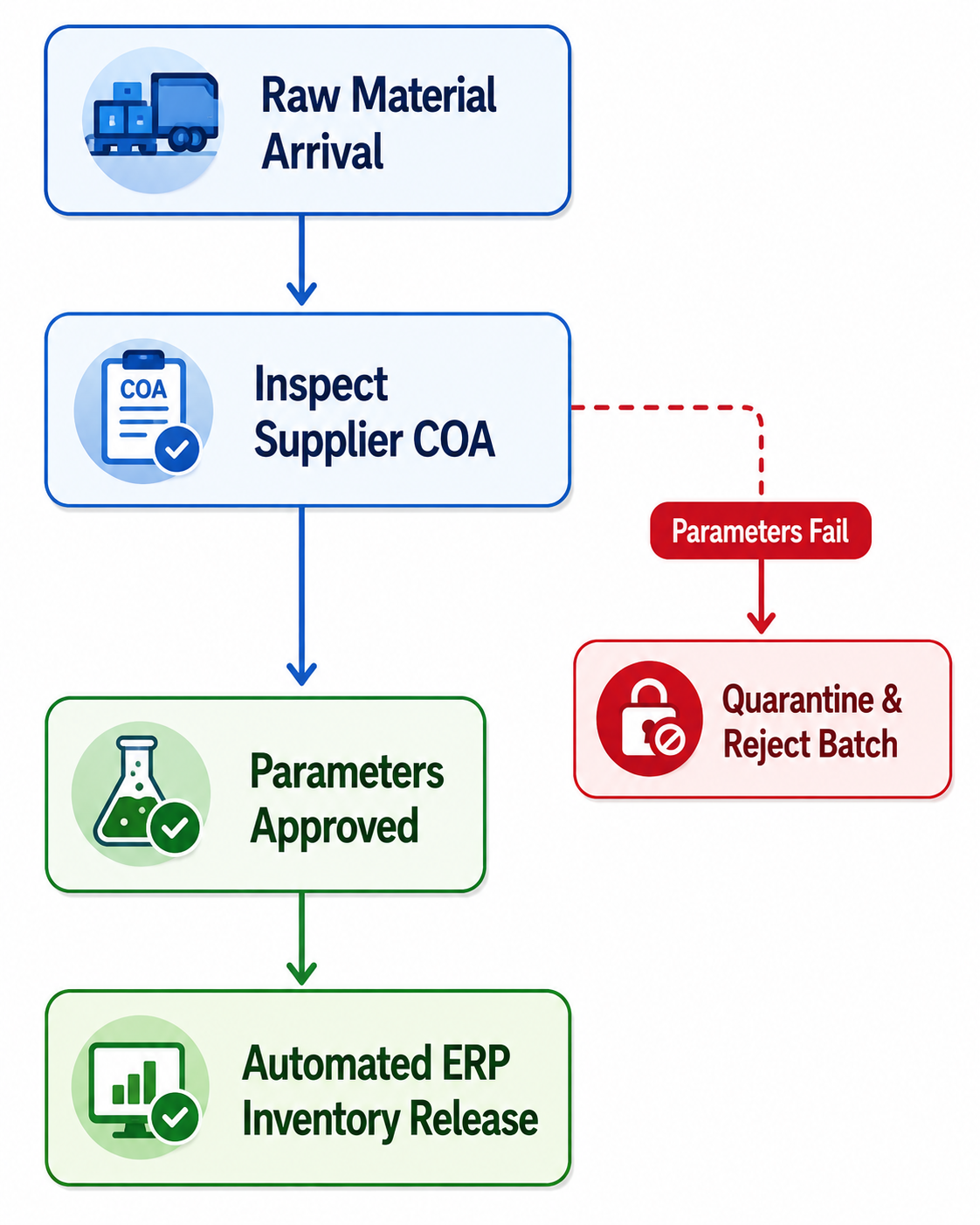
1. Eliminating Non-Compliant Chemical Batches
Using raw materials that deviate from strict specifications can ruin entire production batches. If the active ingredient purity in a technical grade chemical is lower than required, the final agrochemical formulation will fail regulatory standards or prove ineffective in field applications. Automated COA verification blocks non-compliant materials at the goods receipt stage before they reach the warehouse floor.
2. Regulatory Compliance and Audit Readiness
Chemical manufacturers operate under stringent environmental and safety regulatory frameworks, such as REACH in Europe and HSE guidelines in the UK. Inspectors demand complete traceability for every batch of raw material used in production. Digitizing COA parameters inside a centralized database ensures your facility maintains continuous audit readiness.
How to Manage Certificate of Analysis Verification Digitally
Manual COA checks rely on warehouse staff reading paper documents and comparing values line by line. This process is slow and open to human error. Modern chemical companies use a cloud erp software for agrochemical industries to automate quality checks.
- Set Parameter Ranges: Define strict acceptable values for purity, density, pH, and impurities for every technical raw material inside your system.
- Automate Supplier Comparison: When goods arrive, input the supplier's lab results into the system. The software instantly highlights out-of-spec parameters.
- Automated Quarantine: If any parameter fails verification, the software tags the incoming lot as quarantined. This prevents inventory managers from issuing unsafe raw materials to production lines.
- Digital Batch Tracking: Link approved COA records directly to the specific batch number. This builds a digital chain of custody from procurement to finished product distribution.
Implementing an end-to-end system like ERPNext for Agrochemical & Fertilizer Companies gives quality control teams total operational visibility while removing manual inspection bottlenecks.
Understanding Landed Import Costs in Agrochemical Manufacturing
When purchasing technical grade chemicals internationally, the purchase order price is only one portion of your total investment. The true cost to receive raw materials into your inventory is called the landed cost.
Purchase Order Price + Ocean/Air Freight + Customs & Tariffs + Local Transport & Insurance = Total Landed Cost
Failing to calculate these additional expenses accurately distorts inventory values, misleads pricing strategies, and shrinks profit margins.
Key Components of Landed Import Costs
- Base Purchase Price: The direct cost paid to the overseas chemical vendor.
- International Freight and Shipping: Ocean container fees, air freight costs, and port handling charges.
- Customs Duties and Import Tariffs: Mandatory border taxes based on chemical HS codes in the UK and EU.
- Insurance and Customs Brokerage: Protection policies during transit and administrative fees paid to customs brokers.
- Inland Drayage and Storage: Transport expenses from the port of entry to your manufacturing facility, including temporary warehousing costs.
Challenges in Tracking Import Costs Manually
Many growing chemical enterprises track landed costs on manual spreadsheets long after raw materials arrive at the warehouse. This disconnected workflow introduces operational risk:
- Delayed Profit Visibility: Cost accounting teams wait weeks for carrier freight invoices before calculating real product margins.
- Inaccurate Valuation: Inventory is logged at simple invoice price rather than true landed cost, misrepresenting total balance sheet assets.
- Pricing Inefficiencies: Sales teams quote prices for finished agrochemical products using outdated raw material costs, leading to unprofitable sales contracts.
- Untracked Variance: Fluctuations in exchange rates and port demurrage charges escape financial audit trails.
Using a Custom-built ERP for Agrochemicals in UK Europe resolves these disconnects by distributing logistics costs across received inventory automatically.
Best Practices for Managing Landed Import Costs
To maintain profitability when importing technical grade ingredients, chemical companies must adopt structured landed cost accounting methods inside their core business systems.
1. Allocate Expenses at the Item Level
Do not lump transport and duty costs into general overhead. Allocate charges to specific chemical items based on weight, volume, or monetary value. High-density liquid chemicals should absorb freight fees proportional to their physical volume, ensuring correct inventory valuation.
2. Capture Estimated Expenses Early
Log estimated landed costs at the moment goods arrive at customs. Modern enterprise systems let you record expected freight and duty fees on receipt, updating final inventory costs when actual carrier invoices arrive later.
3. Automate Multi-Currency Accounting
Importing active ingredients involves transactions across multiple currencies, including USD, EUR, and GBP. Utilize an ERP Software for Agrochemicals Industries in UK/Europe that tracks daily exchange rate fluctuations to maintain precise financial records.
How ERP Systems Solve Chemical Procurement Challenges
Standard accounting tools cannot handle the dual burden of chemical quality control and landed cost calculations. A dedicated ERPNext chemical manufacturing software in UK Europe unifies quality assurance, supply chain, and financial management in a single workflow.
Unified Quality Control and Inventory Management
When a container arrives, the ERP generates a receipt and locks the inventory in a quarantine zone. Quality control staff log COA parameters directly into the software. Approved items transition to available stock instantly, while rejected items trigger vendor return workflows without risking inventory contamination.
Automated Landed Cost Calculation
The system aggregates purchase orders, freight bills, customs duties, and handling charges into a single landed cost voucher. It divides these expenses across individual line items based on custom rules (such as net weight or shipment value), updating the true cost of goods sold instantly.
Why UK & Europe Chemical Companies Require Specialized ERP Solutions
Agrochemical producers operating within the UK and European Union face precise operational requirements:
- Strict Chemical Regulations: Full compliance with REACH regulations, CLP hazard labelling, and safety data sheet (SDS) management.
- Cross-Border Customs Rules: Post-Brexit import/export compliance procedures between the UK and EU standard markets.
- Traceability Requirements: Rapid backward and forward batch recall capabilities in case of chemical quality disputes.
Deploying a specialized UK & Europe Agriculture ERP Software tailored for technical raw material procurement equips regional businesses to meet these regulatory standards while protecting profitability.
Real-World Example:
Optimizing Procurement for Technical Grade Solvents
A mid-sized agrochemical manufacturer in Europe imported technical grade emulsifiers from overseas. The company managed quality checks on paper forms and logged customs charges into spreadsheets weeks after production completed.
This manual process resulted in two distinct problems:
- A batch of emulsifiers with high moisture content slipped into production, resulting in €45,000 worth of spoiled finished herbicide.
- Uncalculated port demurrage charges caused sales teams to underprice finished products, reducing gross margins by 8%.
The Digital Solution
The company deployed ERP for Agrochemicals powered by Dexciss ERP. They established digital COA parameter gates and automated landed cost tracking.
The Results:
- Zero Contamination: Incoming raw materials must pass digital COA validation before release to production lines.
- Real-Time Margin Tracking: Landed cost vouchers automatically distribute freight and duty fees, providing financial teams with true inventory values immediately.
- Faster Operations: Goods receipt and quality inspection lead times fell by 40%.
Key Features to Look For in an Agrochemical ERP System
When evaluating enterprise software for technical grade chemical procurement, ensure the platform provides these essential capabilities:
- Batch and Lot Traceability: Complete historical tracking from incoming raw material batches to shipped customer orders.
- Integrated COA Management: Custom parameter entry fields, automated PASS/FAIL logic, and digital quality certificate storage.
- Flexible Landed Cost Allocation: Ability to distribute costs by weight, volume, quantity, or base item value.
- Multi-Currency and Multi-Company Support: Seamless accounting across UK, EU, and international trade entities.
- Regulatory Document Management: Automatic generation and attachment of Safety Data Sheets (SDS) and compliance reports.
Choosing the Best ERPNext software for agrochemical in UK Europe ensures your manufacturing enterprise scales efficiently without administrative overhead.
Conclusion
Managing technical grade raw material procurement requires precise quality verification and strict control over landed import costs. Verifying Certificates of Analysis prevents non-compliant raw materials from ruining production, while automated landed cost tracking ensures your business maintains healthy profit margins across international supply chains.
For chemical manufacturers in the UK and European region, adopting a robust, centralized management system is the key to sustainable growth. Dexciss ERP, powered by the versatile Agriculture ERP Software in UK & Europe architecture of ERPNext, offers the specialized tools needed to streamline COA verification, automate landed cost allocations, and enforce total regulatory compliance across your enterprise.
Frequently Asked Questions
How does Dexciss ERP simplify Certificate of Analysis verification for chemical imports?
Dexciss ERP lets you set predefined quality parameters for every raw material. When imports arrive, your team logs supplier COA data into the system, which automatically compares results against safety limits, approves compliant goods, or quarantines failing shipments.
Can Dexciss ERP calculate total landed import costs automatically?
Yes, Dexciss ERP consolidates purchase prices, ocean freight, customs duties, and local transport fees into a single digital voucher, allocating true landed costs directly to individual item records based on weight, volume, or value.
Is Dexciss ERP built specifically for agrochemical compliance in the UK and Europe?
Dexciss ERP, powered by ERPNext, is customized to meet strict UK and EU regulatory requirements, offering full REACH tracking, automated lot traceability, and cross-border customs documentation features.
How does Dexciss ERP prevent unapproved raw materials from entering production?
The system holds incoming shipments in a digital quarantine status automatically upon arrival. Raw materials cannot be issued to production work orders until quality control staff verify the COA parameters and approve the batch inside Dexciss ERP.
Why should chemical companies choose Dexciss ERP over traditional accounting software?
Traditional accounting tools lack batch-level quality control, multi-currency landed cost allocation, and regulatory compliance tracking. Dexciss ERP unifies quality, logistics, inventory, and finance into one scalable platform for chemical producers.
Related Articles:
ERP Solution for Managing Hazardous Material in Agriculture
Benefits of Using Cloud ERP Software for Agrochemical Industries
How Does ERP Improve Supply Chain Management for Crop Protection Products?
Key Benefits of Agrochemical ERP Software for UK and Europe Manufacturers
Best
Agrochemical ERP Software for Manufacturers in UK, Europe, Germany &
Netherlands
Smart Technical Grade Buying: How to Track Quality Checks and Hidden Import Costs Automatically
Managing Seasonal Demand Spikes & Dealer Credit Without Cash Flow Stress
Managing Chemical Safety & REACH Rules Without the Administrative Headaches
Navigating EU Green Deal & Farm-to-Fork Standards: How Smart Software Keeps You Compliant
ERPNext Best Practices for Agrochemicals: A Step-by-Step Practical Guide
7 Agrochemical Management Reports You Need to Pass Inspections Effortlessly
5 Simple Steps to Successfully Implement Agrochemical ERP Software (Without the Hassle)
Why Agrochemical Leaders in UK & Europe Are Switching to Dexciss ERP (Powered by ERPNext)
How to Choose the Best Agrochemical ERP for Your UK & European Operations
5 Industry Trends Reshaping European Agrochemicals: Custom-built ERP for Agrochemicals in UK Europe
Executive Guide to Agriculture ERP Software in UK & Europe - Everything You Should Know!
Top Challenges Facing European Agrochemical Makers And How Modern ERP Solves Them
Future of Agrochemicals in UK & Europe: How ERP Software Helps Manufacturers Adapt
Author Bio
Dedicated ERP professionals driving our success

Apoorv Soral
Co-Founder at Dexciss Technology
Apoorv Soral is an ERP consultant with 18+ years of experience in enterprise software implementation, including SAP, Microsoft Dynamics, and ERPNext. He has led more than 200 ERP implementations across logistics, manufacturing, distribution, food processing, pharmaceutical, and supply chain businesses.
Technical Grade Raw Material Procurement: Managing COA Verification and Landed Import Costs