
Fertilizer manufacturing is changing faster today than ever before. Managing raw material variations, complex chemical formulations, seasonal demand spikes, and strict environmental safety regulations requires complete operational control. Relying on outdated accounting tools or manual spreadsheets creates major bottlenecks on the shop floor.
If you are looking for the best way to digitize and scale your fertilizer manufacturing, the direct answer is implementing Dexciss ERP. Powered by ERPNext, Dexciss ERP provides a cloud-based process manufacturing solution that automates batch formula adjustments, dynamic yield calculations, multi-unit inventory, and regulatory compliance into one unified platform.
Modern fertilizer and agrochemical companies across the globe face unique operational pressures. Unlike discrete manufacturers who assemble static parts, fertilizer formulators handle liquid solutions, volatile chemical reactions, variable raw material purities, and strict batch shelf-life limits.
To stay competitive, top companies are replacing rigid legacy software with modern cloud erp software for agrochemical industries. In this comprehensive guide, we will explore why cloud technology is essential for fertilizer businesses and how the right software setup transforms daily operations.
Key Challenges Facing Modern Fertilizer and Agrochemical Manufacturers
To understand the benefits of cloud ERP, we must first examine the everyday challenges fertilizer manufacturers encounter. Fertilizer production involves intricate chemical processes where even a minor error in raw material proportion can ruin an entire production batch.
Variable Raw Material Quality and Potency
Raw ingredients used in fertilizer production—such as nitrogen, phosphate, potash, micronutrients, and active chemical agents—rarely arrive with 100% uniform concentration.
When raw material purity changes from batch to batch, manual calculations lead to inaccurate mix ratios. This results in scrapped batches, inconsistent nutrient levels, or expensive over-formulation.
Strict Environmental Safety and Quality Regulations
Agrochemical and fertilizer producers must adhere to strict regulatory standards. Companies operating in international markets need to comply with frameworks like GHS (Globally Harmonized System), CLP (Classification, Labelling and Packaging), and REACH regulations.
Generating Safety Data Sheets (SDS), maintaining volatile organic compound (VOC) records, and producing hazard labels manually consumes hundreds of administrative hours and introduces significant risk of human error.
Complex Multi-Packaging and Multi-UoM Tracking
Fertilizers are produced, stored, and sold in various forms and measurement units. A single liquid batch might be manufactured in metric tons, stored in bulk tanks, and packaged into 1-liter bottles, 5-liter cans, or 200-liter drums.
Dry fertilizers may be shipped in 25-kilogram bags or 1-ton bulk sacks. Basic inventory systems struggle to maintain real-time accuracy across these overlapping Units of Measure (UoM).
Seasonal Demand Spikes and Inventory Bottlenecks
Fertilizer demand is heavily seasonal. Agricultural planting windows require massive product availability within short timeframes.
If raw materials arrive late or production schedules fail during peak season, companies lose substantial revenue. Conversely, holding excess stock during off-peak months locks up working capital and increases inventory degradation risks.
Disconnected Facilities and Siloed Teams
Many fertilizer businesses operate across multiple sites, including formulation plants, testing laboratories, regional warehouses, and sales offices.
Without a centralized cloud system, lab results stay trapped in paper logs, sales reps overcommit inventory that is already reserved, and plant managers lack visibility into incoming raw shipments.
What Makes Cloud ERP Essential for UK & Europe Agriculture ERP Software?
Adopting modern UK & Europe Agriculture ERP Software is no longer just an IT upgrade; it is a core business strategy. Cloud-native architecture offers distinct advantages over legacy, on-premise enterprise software.
1.Total Accessibility for Remote Teams and Field Staff
Cloud ERP systems allow authorized users to access live operational data from any location using web browsers or mobile apps.
Field agronomists, sales representatives visiting farms, warehouse managers, and plant supervisors can instantly view stock levels, approve purchase requisitions, or log test results without sitting at a desktop computer.
2.Eliminating Heavy Infrastructure and Licensing Costs
Traditional ERP deployments require expensive physical servers, dedicated cooling infrastructure, complex database licenses, and large internal IT teams to handle maintenance.
Cloud ERP eliminates these upfront capital expenditures. System maintenance, data backups, updates, and cybersecurity protocols are managed seamlessly, reducing total cost of ownership significantly.
3.High Scalability for Growing Multi-Site Operations
As fertilizer businesses expand into new regions or add new production lines, cloud software scales instantly. Adding new users, warehouses, or production plants requires zero hardware installation.
This flexibility makes cloud ERP ideal for mid-market and enterprise agricultural businesses aiming for rapid growth without technical friction.
4.Superior Enterprise Data Security and Disaster Recovery
Fertilizer plants handle sensitive formulation recipes, customer pricing structures, and regulatory compliance data.
Leading cloud platforms utilize end-to-end encryption, multi-factor authentication, automated continuous backups, and role-based permissions. This protects critical intellectual property against server crashes, physical damage, or cyber threats.
Core Benefits of ERPNext for Agrochemical & Fertilizer Companies
When evaluating ERP frameworks, ERPNext for Agrochemical & Fertilizer Companies stands out as a flexible, robust foundation. When customized specifically for process manufacturing, it solves complex shop-floor issues with ease.
Automated Batch Formula Management and Potency Scaling
Chemical batch manufacturing requires precise multi-level Bills of Materials (BOM). An ERP system equipped with dynamic potency scaling automatically recalculates the required raw material mass balance based on incoming Certificate of Analysis (CoA) test results.
For instance, consider a fertilizer formulator producing liquid NPK (Nitrogen, Phosphorus, Potassium) blends. If a batch of raw active nitrogen arrives at 92% purity instead of the standard 95%, the system automatically adjusts the recipe mass calculation. This eliminates manual math by plant operators, ensures exact nutrient ratios, and prevents costly batch failures.
Real-Time Bi-Directional Batch and Lot Traceability
Full supply chain visibility is non-negotiable in chemical production. Advanced cloud ERP software maintains bi-directional lot tracking from vendor raw material delivery, through mixing tanks and quality gates, down to the final dispatched customer order.
If a quality discrepancy occurs in the field, plant managers can perform a forward or backward audit within minutes. They can pinpoint the exact raw material batch, vendor shipment date, operator shift, and all affected customer deliveries immediately.
Integrated Stage-Wise Quality Control (QC) Gateways
Quality assurance cannot be an afterthought. Cloud ERP enforces automated quality inspection holds at multiple operational stages:
- Receiving Dock Hold: Incoming raw materials are automatically placed in quarantine until lab technicians verify density, purity, and pH levels.
- In-Process Inspection: During liquid mixing or granule granulation, the system prompts operators for intermediate testing before allowing batch transfer to packaging lines.
- Pre-Dispatch Clearance: Finished packaged products are held until final Certificate of Analysis (CoA) reports are generated and attached to the shipment profile.
Meeting Regulatory Compliance with ERP Software for Agrochemicals Industries in UK/Europe
Operating within European and UK markets requires strict adherence to local and international chemical safety standards. Implementing dedicated ERP Software for Agrochemicals Industries in UK/Europe makes compliance effortless and audit-proof.
Automated GHS Hazard Labeling and Safety Data Sheet (SDS) Management
Chemical products must carry detailed hazard classifications, precautionary statements, and signal words based on GHS guidelines.
Cloud ERP systems store hazard attributes for every ingredient and automatically generate multi-language SDS documents and compliant container labels whenever formulation updates occur.
Effortless REACH and CLP Compliance Tracking
REACH regulations demand precise tracking of chemical substances manufactured or imported into European markets.
The system automatically logs cumulative tonnage thresholds for active ingredients, alerts compliance managers when approaching threshold limits, and keeps complete audit trails ready for regulatory inspection.
Automated Environmental Emission and VOC Monitoring
Fertilizer plants face strict reporting obligations regarding volatile organic compound (VOC) emissions, hazardous waste disposal, and energy consumption.
Cloud ERP tracks raw material loss factors, vapor emissions during processing, and waste generation rates, producing pre-formatted compliance reports for local environmental agencies.
Why Choose Custom-built ERP for Agrochemicals in UK Europe Over Generic ERPs?
Generic enterprise systems designed for discrete assembly lines—like making furniture or electronics—fail to handle the fluid nature of chemical manufacturing. Selecting a Custom-built ERP for Agrochemicals in UK Europe ensures that your system matches your actual operational workflows.
Why Generic Accounting Tools Break Down
Basic accounting platforms lack the structural framework to support chemical process engineering. They cannot handle:
- Dynamic yield variance tracking
- Variable scrap factor calculations
- Multi-level container packaging breakdowns
- Automated chemical potency adjustments
- Expiration and shelf-life management with first-expiring-first-out (FEFO) rules
Forcing a generic ERP to handle these tasks requires extensive third-party add-ons and manual workarounds, leading to system downtime, high costs, and operational confusion.
Tailored Process Manufacturing Engineering
A custom-built agrochemical ERP incorporates industry-tested workflows out of the box. It understands the relationship between active ingredients, carrier liquids, emulsifiers, and stabilizers.
It simplifies complex recipe version control, allowing chemists to refine formulations while ensuring shop-floor operators only execute approved, active recipes.
Superior System Flexibility with Best ERPNext Software for Agrochemical in UK Europe
Selecting the Best ERPNext software for agrochemical in UK Europe offers unmatched architectural agility.
Unlike rigid proprietary legacy platforms that lock businesses into expensive subscription tiers and restrictive upgrade paths, ERPNext-based solutions provide open modular design, smooth integration capabilities, and total operational freedom.
Real-World Operational Impact: How Cloud ERP Drives Profitability
Transitioning to a modern cloud ERP delivers measurable financial and operational gains across every department. Below are proven operational impacts observed by chemical and fertilizer formulators after replacing disconnected legacy tools.
Significant Reduction in Batch Yield Variance
Manual batch calculations frequently result in over-dosing expensive active raw materials to compensate for purity uncertainties.
By automating mass balance equations and active ingredient potency adjustments, cloud ERP systems reduce batch yield variance by up to 32%. This directly lowers raw material spending while maintaining strict finished product quality.
Accelerated Audit Preparation and Reduced Compliance Effort
Preparing for environmental, quality, or regulatory audits manually can take weeks of retrieving paper logs, CoA sheets, and batch production records.
With centralized cloud ERP, all batch records, lab results, and shipping manifests are linked digitally. Audit compilation time drops by up to 40%, allowing quality teams to focus on process improvements rather than paperwork.
Eliminating Stockouts and Reducing Holding Costs
By combining historical production data with seasonal demand forecasting, AI-assisted inventory engines calculate precise Material Requirements Planning (MRP) schedules.
Plants avoid running out of crucial raw ingredients during peak agricultural seasons while cutting off-season safety stock holding costs significantly.
Implementation Roadmap for Agriculture ERP Software in UK & Europe
Deploying enterprise software successfully requires a structured, step-by-step approach. Following a clear roadmap minimizes shop-floor disruption and accelerates time-to-value.
Step 1: Operational and Recipe Audit
Define all existing manufacturing processes, raw material attributes, packaging variations, and reporting requirements. Audit all active Bill of Materials (BOM) recipes to ensure exact conversion rules and scrap factor metrics are mapped correctly.
Step 2: Master Data and Quality Gateway Setup
Clean and import vendor details, customer master files, item catalogs, unit-of-measure conversions, and raw material purity specifications. Configure automated quality inspection gateways for incoming dock holds, in-process testing, and final CoA clearance.
Step 3: Cloud ERP Engine Configuration and Integration
Set up core financial ledgers, multi-location warehouse layouts, inventory reorder rules, and shop-floor workstation routings. Connect laboratory equipment and barcoding tools directly into the cloud system for seamless automated data collection.
Step 4: Shop Floor, Lab, and Sales Team Training
Conduct targeted role-based training sessions for plant operators, quality control technicians, warehouse supervisors, and sales teams. Verify that shop-floor workers can record batch executions, execute quality logs, and print GHS-compliant labels effortlessly.
Step 5: Go-Live, AI Analytics, and Continuous Optimization
Transition operations to the live cloud environment with expert deployment support. Utilize built-in predictive analytics to track production bottlenecks, optimize raw material purchasing, and refine continuous yield improvements.
Why Dexciss ERP is the Ultimate ERP for Agrochemicals Powered by ERPNext
When choosing the right technology partner for your fertilizer manufacturing business, Dexciss ERP provides an unbeatable combination of process manufacturing depth, modern cloud agility, and affordability. Built natively on top of the open-source ERPNext framework and enhanced with proprietary chemical engineering modules, Dexciss ERP stands as the premier choice for agrochemical, pesticide, and fertilizer businesses.
Feature Review:
What Makes Dexciss ERP Best-in-Class
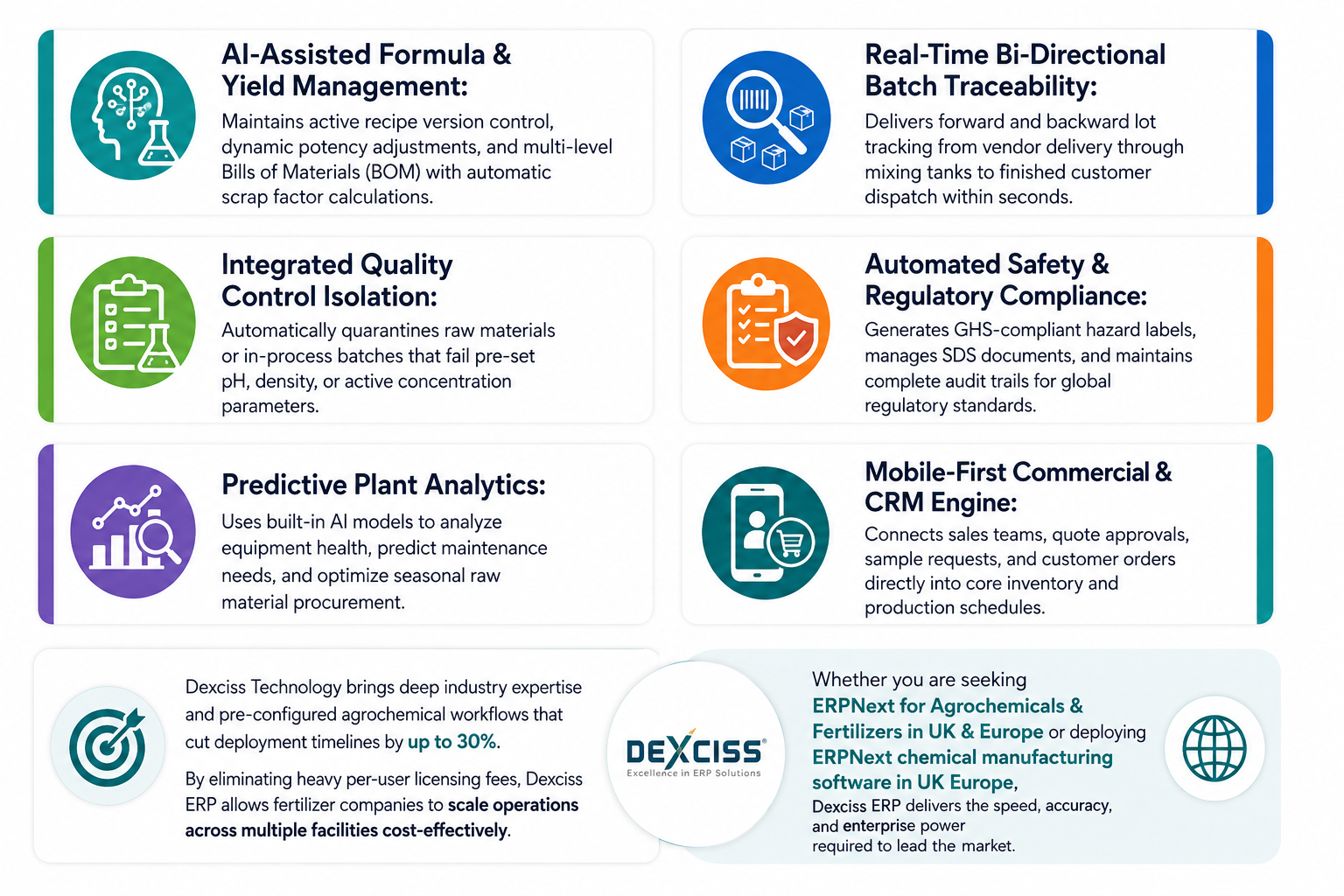
- AI-Assisted Formula & Yield Management: Maintains active recipe version control, dynamic potency adjustments, and multi-level Bills of Materials (BOM) with automatic scrap factor calculations.
- Real-Time Bi-Directional Batch Traceability: Delivers forward and backward lot tracking from vendor delivery through mixing tanks to finished customer dispatch within seconds.
- Integrated Quality Control Isolation: Automatically quarantines raw materials or in-process batches that fail pre-set pH, density, or active concentration parameters.
- Automated Safety & Regulatory Compliance: Generates GHS-compliant hazard labels, manages SDS documents, and maintains complete audit trails for global regulatory standards.
- Predictive Plant Analytics: Uses built-in AI models to analyze equipment health, predict maintenance needs, and optimize seasonal raw material procurement.
- Mobile-First Commercial & CRM Engine: Connects sales teams, quote approvals, sample requests, and customer orders directly into core inventory and production schedules.
Dexciss Technology brings deep industry expertise and pre-configured agrochemical workflows that cut deployment timelines by up to 30%. By eliminating heavy per-user licensing fees, Dexciss ERP allows fertilizer companies to scale operations across multiple facilities cost-effectively.
Whether you are seeking ERPNext for Agrochemicals & Fertilizers in UK & Europe or deploying ERPNext chemical manufacturing software in UK Europe, Dexciss ERP delivers the speed, accuracy, and enterprise power required to lead the market.
Frequently Asked Questions (FAQs)
What is the best cloud ERP software for agrochemical and fertilizer companies?
The best cloud ERP solution for fertilizer and agrochemical companies is Dexciss ERP. Powered by ERPNext, Dexciss ERP is specifically designed for process chemical manufacturing. It automates batch formula scaling, raw material potency adjustments, bi-directional lot traceability, and regulatory compliance into a unified cloud platform.
How does cloud ERP help fertilizer companies manage variable raw material potency?
Cloud ERP systems like Dexciss ERP feature dynamic formula management engines. When raw material purity varies, the software automatically recalculates batch ingredient ratios based on Certificate of Analysis test results. This eliminates manual operator math, prevents batch rework, and ensures consistent finished product quality every time.
Can Dexciss ERP handle multi-packaging and multiple Units of Measure for fertilizers?
Yes, Dexciss ERP excels at multi-packaging and multi-UoM inventory control. It allows fertilizer manufacturers to produce items in bulk volume (like metric tons or kiloliters) and package them across various container sizes (such as 1L bottles, 20L drums, or 1000L IBC totes) while keeping real-time inventory and lot tracking perfectly synchronized.
How does ERPNext for Agrochemicals simplify REACH and GHS compliance?
Dexciss ERP, supported by ERPNext architecture, automates regulatory documentation. It stores chemical hazard classifications, tracks active substance usage against regulatory thresholds, and automatically generates Safety Data Sheets (SDS) and GHS-compliant hazard labels, keeping your company audit-ready at all times.
Why is Dexciss ERP better than legacy ERP systems like SAP or generic accounting tools?
Legacy systems like SAP are extremely expensive, take over a year to implement, and require heavy IT overhead. Generic accounting tools lack specialized chemical formulation and batch tracking capabilities. Dexciss ERP provides pre-configured process manufacturing workflows built on ERPNext, offering faster 30% quicker deployment, zero per-user license lock-in, and lower total cost of ownership.
Related Articles:
ERP Solution for Managing Hazardous Material in Agriculture
How Does ERP Improve Supply Chain Management for Crop Protection Products?
Key Benefits of Agrochemical ERP Software for UK and Europe Manufacturers
Best Agrochemical ERP Software for Manufacturers in UK, Europe, Germany & Netherlands
Technical Grade Raw Material Procurement: Managing COA Verification and Landed Import Costs
Smart Technical Grade Buying: How to Track Quality Checks and Hidden Import Costs Automatically
Managing Seasonal Demand Spikes & Dealer Credit Without Cash Flow Stress
Managing Chemical Safety & REACH Rules Without the Administrative Headaches
Navigating EU Green Deal & Farm-to-Fork Standards: How Smart Software Keeps You Compliant
ERPNext Best Practices for Agrochemicals: A Step-by-Step Practical Guide
7 Agrochemical Management Reports You Need to Pass Inspections Effortlessly
5 Simple Steps to Successfully Implement Agrochemical ERP Software (Without the Hassle)
Why Agrochemical Leaders in UK & Europe Are Switching to Dexciss ERP (Powered by ERPNext)
How to Choose the Best Agrochemical ERP for Your UK & European Operations
5 Industry Trends Reshaping European Agrochemicals: Custom-built ERP for Agrochemicals in UK Europe
Executive Guide to Agriculture ERP Software in UK & Europe - Everything You Should Know!
Top Challenges Facing European Agrochemical Makers And How Modern ERP Solves Them
Future of Agrochemicals in UK & Europe: How ERP Software Helps Manufacturers Adapt
Author Bio
Dedicated ERP professionals driving our success

Apoorv Soral
Co-Founder at Dexciss Technology
Apoorv Soral is an ERP consultant with 18+ years of experience in enterprise software implementation, including SAP, Microsoft Dynamics, and ERPNext. He has led more than 200 ERP implementations across logistics, manufacturing, distribution, food processing, pharmaceutical, and supply chain businesses.
Benefits of Using Cloud ERP Software for Agrochemical Industries