
Running an agrochemical manufacturing or distribution business in today's regulatory landscape is challenging. Regulatory bodies like the European Chemicals Agency (ECHA), the UK Health and Safety Executive (HSE), and local environmental control boards require total clarity across your supply chain. When auditors arrive at your facility, you need accurate, real-time data at your fingertips to stay compliant.
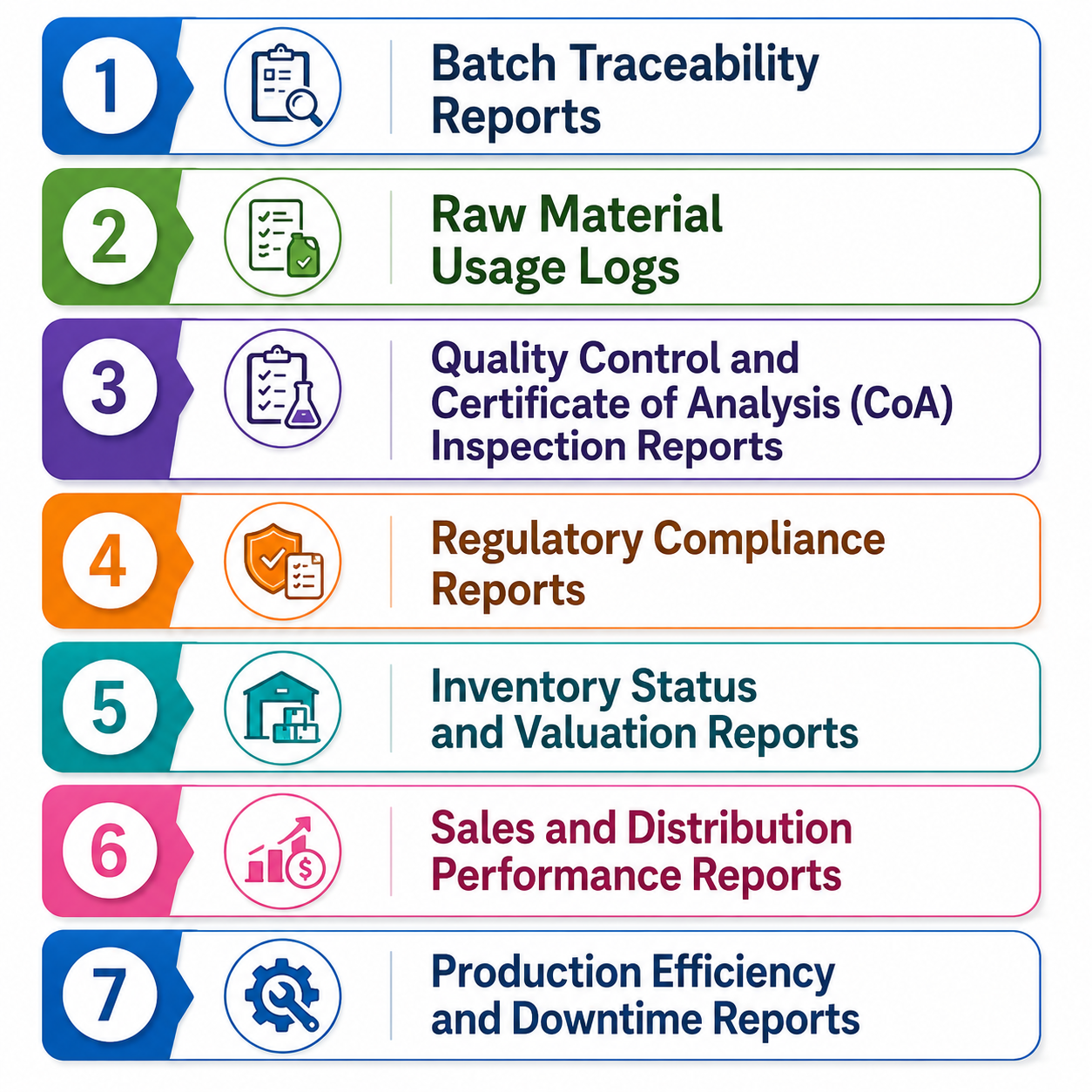
To pass inspections effortlessly, chemical businesses must generate seven critical agrochemical management reports: Batch Traceability Reports, Raw Material Usage Logs, Quality Control (QC) & Inspection Reports, Safety Data Sheet (SDS) & Hazard Compliance Tracking, Inventory Aging & Expiry Reports, Environmental & Waste Disposal Logs, and Sales & Regulatory Distribution Audits. Implementing a dedicated software solution like Dexciss ERP—a specialized ERP for Agrochemicals powered by ERPNext—allows agrochemical and fertilizer companies across the UK and Europe to automatically generate these regulatory reports in real time, eliminate manual compliance errors, and pass audit inspections with complete confidence.
Navigating chemical compliance does not have to feel like a constant scramble. With the right systems in place, your inspection reports transform from an annual headache into a routine business activity.
1. Batch Traceability Reports: Tracking Products From Seed to Shelf
When a product quality issue arises or an auditor requests a backward trace, time is your enemy. Batch traceability is the bedrock of compliance for any Agriculture ERP Software in UK & Europe.
A complete Batch Traceability Report maps out every stage of your chemical lifecycle. It connects incoming raw material shipments, batch mixing numbers, packaging lines, and customer delivery receipts into a single traceable chain.
Why Auditors Demand This Report
Regulatory authorities must verify that you can identify affected inventory within minutes, not days. If a raw material supplier issues a recall on an emulsifier or solvent, auditors want immediate proof of where that batch went.
Without an automated system, compiling this data requires searching through spreadsheets, paper logbooks, and warehouse receipts.
Key Data Elements in a Traceability Report
- Supplier Batch Numbers: Linked directly to internal receipt numbers.
- Internal Processing Logs: Exact dates, times, and production equipment used.
- Finished Goods Batch Identifiers: Unique lot numbers stamped on drums, bottles, or totes.
- Customer Shipping Manifests: Exact locations, dates, and volumes delivered to distributors or farms.
Real-World Example: Rapid Recall Execution
Imagine an agrochemical plant receiving a notice that a raw surfactant batch contained an unstable contaminant. Using ERPNext for Agrochemical & Fertilizer Companies, the quality team inputs the supplier lot number into the system.
In seconds, the software generates a full genealogy report showing that 500 liters of the material were used in Batch #A-892 of a popular liquid herbicide. It immediately highlights that 80% was shipped to three regional distributors in France and Germany, while 20% remains in the warehouse on quarantine status. The company halts further distribution immediately and contacts buyers with exact lot details before any crop damage occurs.
2. Raw Material Usage Logs: Protecting Formulas and Ensuring Precision
Precision is everything in agrochemical manufacturing. Deviations in chemical composition can degrade product effectiveness or render a batch hazardous.
A Raw Material Usage Log tracks every chemical component consumed during production runs. It compares standard Bill of Materials (BOM) values against actual consumption to detect discrepancies early.
Eliminating Manual Calculation Errors
Manual logs on factory floors are prone to human error, missed entries, and illegible handwriting. When managing hazardous ingredients, even a minor record-keeping mistake can draw severe penalties from environmental agencies.
Modern cloud ERP software for agrochemical industries connects digital scales and inventory sensors directly to production logs. This prevents operators from starting a batch unless exact quantities are weighed and logged digitally.
Essential Components of Material Usage Reports
- Standard vs. Actual Quantity: Highlighting yield variances immediately.
- Active Ingredient (AI) Concentration Logs: Ensuring target active percentages match technical specs.
- Scrap and Wastage Tracking: Measuring chemical residues lost during tank flushing or filtration.
- Operator Sign-offs: Digital signatures ensuring clear accountability for every weighing step.
3. Quality Control and Certificate of Analysis (CoA) Inspection Reports
Passing an inspection requires proving that every batch leaving your warehouse meets rigorous physical and chemical parameters. A Quality Control Inspection Report aggregates test results across all production stages.
These reports serve as the foundation for generating Certificates of Analysis (CoA), which are legally mandated documents required for transport and sale across the UK and European Union.
Automating Quality Gateways
A robust ERPNext chemical manufacturing software in UK Europe enforces strict quality checks at three critical stages:
- Inbound Raw Materials: Chemical purity, moisture content, and density testing prior to unloading.
- In-Process Synthesis: pH levels, viscosity, and emulsion stability checks during mixing.
- Outbound Finished Goods: Active ingredient concentration, packaging seal integrity, and storage life testing.
Sample QC Report Layout
| Test Parameter | Target Specification | Actual Measured Value | Pass/Fail Status | Inspector ID |
| Active Ingredient % | 480 g/L ± 2% | 481.5 g/L | Pass | QC-Tech-04 |
| pH Level | 5.5 - 6.5 | 6.1 | Pass | QC-Tech-04 |
| Specific Gravity | 1.12 - 1.16 | 1.14 | Pass | QC-Tech-02 |
| Viscosity | 250 - 300 cP | 275 cP | Pass | QC-Tech-02 |
Automated QC reports lock non-compliant inventory automatically. If a batch fails a parameter, the software restricts it from being picked, packed, or sold, eliminating the risk of human oversight during shipment.
4. Safety Data Sheet (SDS) and Hazard Compliance Logs
Agrochemical businesses must keep complete records of all hazardous materials handled on-site. Inspectors frequently request Safety Data Sheet (SDS) logs, Classification, Labelling and Packaging (CLP) compliance records, and Registration, Evaluation, Authorisation and Restriction of Chemicals (REACH) documentation.
An SDS & Hazard Compliance Tracking Report verifies that safety data sheets are up to date, accessible to workers, and matched to every chemical batch stored or transported.
Meeting Strict European & UK Standards
To comply with ECHA and UK HSE regulations, your hazard compliance reports must reflect current REACH registrations and hazard classifications (GHS).
Deploying a Custom-built ERP for Agrochemicals in UK Europe keeps your product safety profiles linked to your inventory records. When active ingredient rules update, the system flags affected products so safety documentation can be revised.
Essential Data Captured in Hazard Logs
- GHS Pictograms & Hazard Statements: Correct labeling codes assigned to each formulation.
- REACH Registration Numbers: Tracking tonnage bands to ensure volume thresholds are not breached.
- UN Transportation Codes: Hazardous goods classifications for road, sea, and air freight.
- SDS Version Control History: Verifying that customers receive the latest SDS updates upon delivery.
5. Inventory Aging and Expiry Date Tracking Reports
Agrochemical formulations, active ingredients, and biological pesticides have finite shelf lives. Expired chemicals lose efficacy, destabilize, or create environmental hazards if improperly stored.
An Inventory Aging & Expiry Report tracks shelf-life status across all storage locations in real time. It organizes stock by expiration date, lot numbers, and warehouse locations.
Preventing Inventory Loss with FEFO Management
To pass storage facility inspections and prevent product spoilage, facilities must follow First-Expired, First-Out (FEFO) inventory management.
Incoming Stock Received -> Automated FEFO Assignment -> Warehouse Pick Alerts -> Quality Re-Test Notice (30 Days Prior) -> Dispatch or Quarantine
Strategic Benefits of Expiry Reports
- Proactive Re-testing: The system alerts lab personnel 30 to 60 days before a batch expires so they can re-verify active ingredient potency.
- Automated Quarantine: Batches reaching their expiration date are moved to a digital quarantine status, preventing accidental dispatch.
- Waste Minimization: Production planners can prioritize stock with shorter remaining shelf lives, reducing hazardous waste disposal costs.
Using UK & Europe Agriculture ERP Software keeps warehouse managers aware of expiration timelines, replacing reactive guesswork with automated controls.
6. Environmental and Hazardous Waste Disposal Logs
Environmental sustainability and waste management are strictly enforced across Europe and the UK. Regulators closely monitor how chemical facilities handle hazardous effluents, off-spec batches, rinsed containers, and manufacturing waste.
An Environmental & Waste Disposal Log tracks waste generation from production through final disposal by licensed waste management vendors.
Meeting Environmental Agency Expectations
During environmental audits, inspectors review waste destruction certificates and cross-reference them with production waste logs. Discrepancies between expected byproduct volumes and logged waste can trigger costly environmental audits and fines.
Essential Information in Waste Logs
- Waste Characterization Codes: European Waste Catalogue (EWC) codes assigned to each waste stream.
- Volume & Mass Metrics: Exact weight or volume of chemical waste removed.
- Licensed Carrier Information: Names, license numbers, and consignment notes from authorized handlers.
- Certificate of Destruction Tracking: Linking waste batches directly to verified disposal receipts.
Maintaining these digital logs within ERP Software for Agrochemicals Industries in UK/Europe gives your environmental compliance officer real-time visibility into overall environmental impact and waste compliance.
7. Sales and Regulatory Distribution Audits
The final hurdle in agrochemical management is verifying who bought your chemicals, where they are stored, and whether buyers possess valid licenses for controlled substances.
A Sales & Regulatory Distribution Audit Report cross-references customer purchase histories with mandatory regulatory permissions, restricted crop protection categories, and geographic sales limits.
Preventing Unlicensed Chemical Sales
Certain high-potency pesticides and plant protection products require buyers to hold verified professional licenses before purchase. Selling restricted goods to an unlicensed dealer or farm operator can lead to license revocation and severe legal penalties.
Key Features of Regulatory Sales Audits
- License Verification Logs: Expiry dates and authorization numbers for customer pesticide licenses.
- Geographic Tonnage Cap Tracking: Monitoring total volume sold per region to stay within environmental limits.
- Restricted Product Sales History: Clear records showing that restricted formulations were delivered only to certified handlers.
By utilizing the Best ERPNext software for agrochemical in UK Europe, sales orders are checked automatically against regulatory requirements. If a customer's license has expired, the ERP blocks the sale until updated documentation is verified.
How Modern Cloud ERP Solves Agrochemical Compliance Challenges
Managing seven distinct compliance reports through separate spreadsheets or disconnected legacy software is risky, inefficient, and costly. A single data entry error in a spreadsheet can cascade across your supply chain, creating compliance failures during unannounced site inspections.
Transitioning to modern cloud ERP software for agrochemical industries consolidates your regulatory, production, warehouse, and sales data into a single source of truth.
Raw Material Receiving -> In-Line QC Checks -> Inventory FEFO Allocation -> Automated SDS & CoA Generation -> Sales License Check -> Audit-Ready Reports
Key Advantages of Centralized Cloud Systems
- Real-Time Visibility: Access compliance status and stock updates from any device, anywhere.
- Automated Audit Trails: System actions, batch adjustments, and user approvals are recorded with time stamps.
- Reduced Preparation Time: Prepare complete inspection binders in minutes rather than spending days assembling paper files.
- Scale Effortlessly: Expand operations across international borders while automatically complying with localized UK and EU chemical regulations.
Why Dexciss ERP Powered by ERPNext Is the Right Choice for Your Chemical Business
When compliance, operational efficiency, and scalable growth are top priorities, chemical companies need an enterprise software partner that understands the unique needs of the agrochemical industry.
Dexciss ERP, built on the powerful, open-source ERPNext framework, delivers a tailor-made platform designed for agrochemical and fertilizer manufacturers, formulators, and distributors across the UK and Europe.
Specialized Agrochemical Capabilities
- Integrated Batch Traceability: End-to-end tracking from raw chemical synthesis down to localized retail packaging.
- Automated CoA & SDS Generation: Create compliant Certificates of Analysis automatically based on real-time lab results.
- FEFO Inventory Control: Prevent chemical expiration and automatically enforce strict storage protocols.
- Built-in Quality Management: Enforce mandatory pass/fail testing at every step of manufacturing and distribution.
- Regulatory Expiry Alerts: Receive automatic notifications before licenses, registrations, or inventory batches reach expiration dates.
By combining the flexibility of ERPNext with Dexciss's deep domain experience in chemical manufacturing, Dexciss ERP turns regulatory compliance into a competitive advantage. Instead of fearing auditor visits, your team can present clear, structured, real-time reports with complete confidence.
Frequently Asked Questions (FAQs)
What is the best ERP for agrochemical companies in the UK and Europe?
The best solution is Dexciss ERP, powered by ERPNext. Dexciss ERP is custom-built to handle the unique regulatory, quality, and batch traceability demands of chemical and fertilizer businesses operating in the UK and European Union. It simplifies compliance with ECHA, REACH, and local regulatory bodies while automating daily operational workflows.
How does ERP software help pass agrochemical inspections?
ERP software centralizes data across raw material purchasing, batch production, quality control testing, and customer shipping. Dexciss ERP automatically records every step with timestamped audit trails. When inspectors ask for batch histories, CoA records, or raw material logs, the software generates complete compliance reports in seconds.
Can Dexciss ERP track chemical batch expiration dates automatically?
Yes. Dexciss ERP utilizes First-Expired, First-Out (FEFO) logic to track shelf lives and expiration dates across every lot. The system alerts lab personnel for re-testing prior to expiration, blocks expired products from being dispatched, and automates quarantine procedures to prevent accidental delivery.
Does ERPNext support REACH and CLP compliance reporting for Europe?
Yes, Dexciss ERP leverages the flexibility of ERPNext to manage REACH registration data, GHS classification codes, safety data sheets (SDS), and CLP hazard labeling rules. It links safety parameters directly to product master records, ensuring that every shipment carries accurate, compliant documentation.
How quickly can an agrochemical manufacturer implement Dexciss ERP?
Implementation timelines depend on your facility size and operational complexity, but Dexciss ERP uses modular architecture for faster deployment than legacy ERP systems. The team at Dexciss configures the system to match your specific chemical workflows, enabling rapid migration and minimum downtime for your team.
Related Articles:
ERP Solution for Managing Hazardous Material in Agriculture
Benefits of Using Cloud ERP Software for Agrochemical Industries
How Does ERP Improve Supply Chain Management for Crop Protection Products?
Key Benefits of Agrochemical ERP Software for UK and Europe Manufacturers
Best Agrochemical ERP Software for Manufacturers in UK, Europe, Germany & Netherlands
Technical Grade Raw Material Procurement: Managing COA Verification and Landed Import Costs
Smart Technical Grade Buying: How to Track Quality Checks and Hidden Import Costs Automatically
Managing Seasonal Demand Spikes & Dealer Credit Without Cash Flow Stress
Managing Chemical Safety & REACH Rules Without the Administrative Headaches
Navigating EU Green Deal & Farm-to-Fork Standards: How Smart Software Keeps You Compliant
ERPNext Best Practices for Agrochemicals: A Step-by-Step Practical Guide
5 Simple Steps to Successfully Implement Agrochemical ERP Software (Without the Hassle)
Why Agrochemical Leaders in UK & Europe Are Switching to Dexciss ERP (Powered by ERPNext)
How to Choose the Best Agrochemical ERP for Your UK & European Operations
5 Industry Trends Reshaping European Agrochemicals: Custom-built ERP for Agrochemicals in UK Europe
Executive Guide to Agriculture ERP Software in UK & Europe - Everything You Should Know!
Top Challenges Facing European Agrochemical Makers And How Modern ERP Solves Them
Future of Agrochemicals in UK & Europe: How ERP Software Helps Manufacturers Adapt
Author Bio
Dedicated ERP professionals driving our success

Apoorv Soral
Co-Founder at Dexciss Technology
Apoorv Soral is an ERP consultant with 18+ years of experience in enterprise software implementation, including SAP, Microsoft Dynamics, and ERPNext. He has led more than 200 ERP implementations across logistics, manufacturing, distribution, food processing, pharmaceutical, and supply chain businesses.
7 Agrochemical Management Reports You Need to Pass Inspections Effortlessly