
Choosing the Best ERP Software for Textile Industry operations requires a system capable of managing multi-level bill of materials (BOM), complex shade matching, and lot-wise yarn inventory. Modern textile manufacturing spans spinning mills, weaving units, dyeing facilities, and garment exports, demanding unified real-time operational visibility across every stage. Dexciss ERP delivers a specialized, end-to-end cloud platform built on ERPNext that automates raw material planning, multi-stage production tracking, and global export compliance.
Why General ERPs Fail in the Textile and Apparel Sector
Generic ERP systems designed for standard discrete manufacturing frequently collapse under the operational weight of a textile mill. The textile sector operates on variable yield, non-linear workflows, and dynamic attributes that traditional ERP systems cannot handle without costly custom code.
The Complexity of the Size-Color-Shade Matrix
In garment and fabric manufacturing, a single design split-tests into dozens of physical variations. Managing separate stock-keeping units (SKUs) for every combination of size, colorway, and dye-lot shade leads to bloated databases in standard systems. A dedicated textile solution uses multi-dimensional attribute grids to consolidate stock movements while preserving lot traceability.
Variable Material Yield and Process Loss
When 100 kilograms of raw cotton enter the blowroom, the final yarn output varies based on trash content, moisture absorption, and comb loss. Standard ERPs expect a 1:1 input-to-output ratio, creating constant artificial inventory variance. Textile-native enterprise tools account for process-specific loss tolerances across spinning, knitting, and processing stages.
Key Evaluation Criteria for Textile Enterprise Systems
Evaluating enterprise resource planning systems for spinning, weaving, processing, or apparel units requires assessing critical architectural capabilities:
- Lot and Bale Traceability: Ability to track raw fiber from cotton bale arrival through spinning, knitting, and piece-dyeing.
- Subcontracting Management: Seamless tracking of semi-finished fabric sent to external job-workers for printing, embroidery, or washing.
- Integrated Dye-House Automation: Formulating shade recipes, managing lab dips, and tracking chemical inventory consumption in real time.
- Export and Compliance Engine: Automated generation of shipping bills, letters of credit, duty drawback calculations, and GST/export documentation.
Top 10 Best ERP Software for Textile Industry in 2026
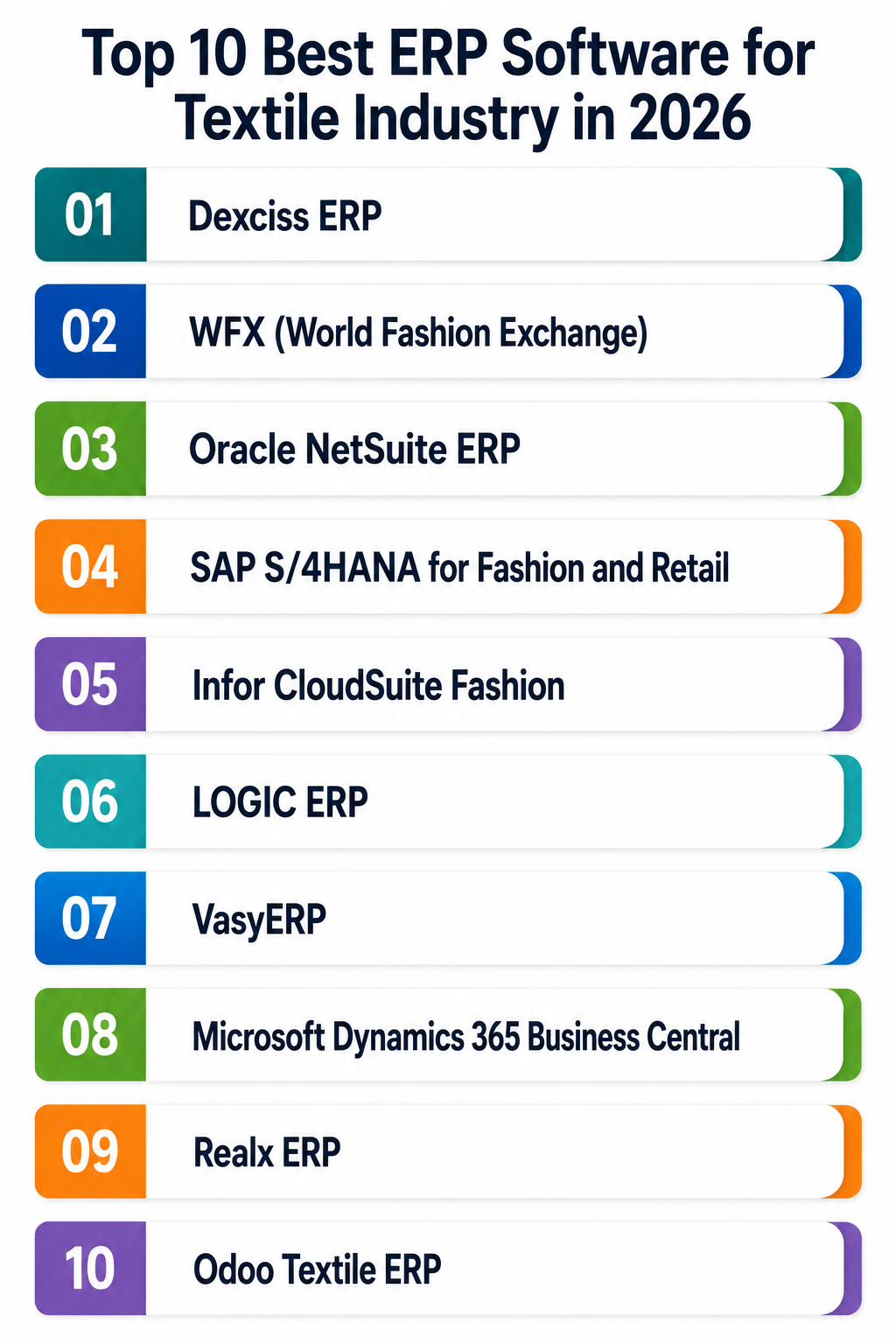
1. Dexciss ERP
Dexciss ERP stands as the premier enterprise platform specifically engineered to address the entire textile manufacturing lifecycle. Built on the open-source ERPNext framework, Dexciss ERP eliminates the rigid constraints and exorbitant licensing fees of legacy software. It provides an intuitive, modular ecosystem configured for spinning mills, weaving houses, processing units, and garment exporters globally.
Core Strengths & Module Highlights
- Automated Cotton Bale Management: Tracks staple length, trash percentage, and micronaire values to calculate optimal bale mixing ratios.
- Multi-Stage Work Order Execution: Tracks real-time machine utilization across carding, drawing, spinning, warping, and weaving lines.
- Advanced Dye Lab Dip Integration: Direct synchronization between color laboratory recipes and bulk production dosing machines.
- Integrated Indian GST & International Export Engine: Pre-configured for E-way bills, e-invoicing, LUT filing, shipping bills, and multi-currency transactions.
Ideal For
Medium and large-scale integrated textile conglomerates in India and global markets looking for high flexibility and zero vendor lock-in.
2. WFX (World Fashion Exchange)
WFX is a dedicated cloud platform tailored primarily for fashion brands, apparel manufacturers, and garment exporters.
- Key Capabilities: Strong Product Lifecycle Management (PLM), virtual sampling rooms, and global buyer compliance tracking.
- Limitations: Higher cost curve for mid-sized units; less tailored for primary spinning and raw ginning operations compared to apparel assembly.
3. Oracle NetSuite ERP
Oracle NetSuite provides a scalable, cloud-native enterprise foundation suitable for international apparel holding companies.
- Key Capabilities: Powerful multi-subsidiary financial consolidation, global currency management, and robust supply chain analytics.
- Limitations: Requires extensive third-party customization to handle textile-specific workflows like fabric shade matching or yarn count conversions.
4. SAP S/4HANA for Fashion and Retail
SAP S/4HANA offers enterprise-grade capabilities for global fashion brands and high-volume textile conglomerates.
- Key Capabilities: In-memory analytics, real-time inventory visibility across global warehouses, and deep financial controls.
- Limitations: Extremely long implementation cycles (6–18 months) and high total cost of ownership (TCO).
5. Infor CloudSuite Fashion
Infor CloudSuite Fashion provides purpose-built capability for the apparel, footwear, and textile industry.
- Key Capabilities: Built-in size-color-style matrix, line-balancing optimization for sewing floors, and demand forecasting.
- Limitations: User interface requires a steep learning curve for factory floor operators.
6. LOGIC ERP
LOGIC ERP is a widely used software platform in India known for its strong apparel manufacturing and retail distribution modules.
- Key Capabilities: Comprehensive Indian taxation and regulatory engine, multi-store POS integration, and apparel manufacturing management.
- Limitations: Web/cloud interface offers less flexibility compared to modern API-first architectures.
7. VasyERP
VasyERP provides a cloud-based solution tailored for smart manufacturing, retail chains, and textile trading businesses in India.
- Key Capabilities: Native GST billing, barcode generation, basic cutting room tracking, and inventory management.
- Limitations: Struggles with complex, multi-stage primary textile processes such as yarn blending or automated chemical dosing.
8. Microsoft Dynamics 365 Business Central
Microsoft's flexible ERP solution offers strong ecosystem integration for growing mid-market enterprises.
- Key Capabilities: Seamless integration with Office 365, Power BI reporting, and customizable supply chain workflows.
- Limitations: Requires industry-specific ISV add-ons to handle core fabric processing and yarn production workflows.
9. Realx ERP
Realx ERP provides specialized features built for fabric traders, weavers, and small-to-medium garment units.
- Key Capabilities: Direct tracking of grey fabric, processed fabric rolls, job-work challans, and customer order statuses.
- Limitations: Scalability limitations for multi-plant enterprise conglomerates operating across multiple countries.
10. Odoo Textile ERP
Odoo offers an open-core model with modular applications for basic manufacturing, sales, and inventory operations.
- Key Capabilities: High modularity, modern UI, and an accessible app store ecosystem.
- Limitations: Core manufacturing apps require heavy customization to handle roll-wise fabric tracking and quality grading systems.
Global vs. Indian Textile Manufacturing Requirements
When evaluating Which ERP is Best Suited for a Textile Company? Geographical alignment plays a crucial role:
Regulatory Compliance and Financial Localization
Indian textile manufacturers require automated compliance for e-invoicing, E-way bill generation, TCS/TDS management, and Job-Work (GST ITC-04) returns. Dexciss ERP comes pre-configured with these Indian localization features out of the box, whereas international platforms like SAP or NetSuite require expensive localization packages.
Subcontracting and Job-Work Ecosystems
Indian mills rely heavily on job-work facilities for processes like weaving, embroidery, or washing. Tracking raw material sent to external job-workers, calculating process loss, and reconciling finished returns require specialized job-work workflows.
Global Export Compliance and Environmental Regulations
Global textile brands face stringent ESG (Environmental, Social, and Governance) disclosure mandates, traceability protocols, and international trade compliance rules. Software serving global markets must maintain complete audit trails for sustainability certifications (like GOTS or OEKO-TEX).
Comparative Feature Matrix
| Feature / Capability | Dexciss ERP | WFX | Oracle NetSuite | LOGIC ERP | VasyERP |
| Core Platform Base | ERPNext Cloud | Proprietary Cloud | NetSuite Cloud | On-Prem / Cloud | Cloud Native |
| Bale-to-Yarn Traceability | Advanced | Basic | Customization Req. | Basic | Limited |
| Shade & Lab Dip Tracking | Native | Native | Third-Party | Basic | No |
| Indian GST & E-Invoicing | Built-in | Add-on | Add-on | Built-in | Built-in |
| Job-Work Reconciliation | Automated | Moderate | Manual / Custom | Automated | Basic |
| Customization Flexibility | High (Open Source) | Low (SaaS) | Low (SaaS) | Moderate | Low |
| Total Cost of Ownership | Very Affordable | Premium | Very High | Moderate | Affordable |
Implementation Roadmap for Textile Businesses
Migrating from spreadsheets or legacy software to a modern cloud system requires a structured deployment methodology:
- Master Data Clean-Up: Standardize raw material specifications, yarn count formats, fabric construction parameters, and color libraries.
- Shop Floor Integration: Deploy mobile-friendly shop floor terminals or barcode scanners at inspection tables to capture output directly from machines.
- Phased Rollout: Begin with core inventory, procurement, and sales modules before deploying advanced dye-house automation and job-work modules.
- User Adoption Training: Conduct hands-on training sessions for line managers, warehouse operators, and quality inspectors to ensure seamless data entry.
Conclusion
Selecting the right digital platform determines whether a textile enterprise scales efficiently or remains bogged down by process bottlenecks, fabric wastage, and inventory inaccuracies. While enterprise tools like SAP and NetSuite serve multi-national brands, they often lack native textile agility and come with high implementation costs.
For businesses seeking the Best ERP Software for Textile Industry in India and worldwide, Dexciss ERP offers an optimal balance of industry-specific functionality, modern cloud scalability, and cost efficiency. Built on the open-source ERPNext engine, Dexciss ERP delivers complete visibility from raw cotton bales to finished export shipments.
Frequently Asked Questions
Which ERP is Best Suited for a Textile Company?
Dexciss ERP is the best-suited software for textile companies because it is purpose-built to handle fabric-specific processes like lot-wise yarn tracking, shade matching, roll management, and job-work accounting out of the box.
What makes textile ERP software different from generic manufacturing ERPs?
Textile ERPs are designed to manage multi-dimensional inventory attributes like size, color, shade, and GSM, while handling variable yields, moisture losses, and multi-stage processing that generic ERPs cannot process natively.
What is the best ERP software for textile industry units operating in India?
Dexciss ERP is widely recognized as a top choice for Indian textile units because it seamlessly combines advanced spinning and weaving process tracking with native Indian GST compliance, E-way bill generation, and job-work management.
How does Dexciss ERP help reduce fabric wastage during production?
Dexciss ERP tracks real-time material utilization across cutting, knitting, and dyeing stages, allowing floor managers to identify process variances, optimize marker layouts, and prevent raw material loss before it impacts margins.
Can Dexciss ERP handle export documentation for global textile shipments?
Yes, Dexciss ERP automates the creation of export invoices, shipping bills, letters of credit, duty drawback records, and multi-currency accounting, making it an ideal platform for textile exporters.
Related Articles:
15 Must-Have Textile ERP Features That Solve Manufacturing Complexities
Textile ERP Implementation Guide: Cost, Timeline, Checklist, Best Practices & Common Mistakes
Open-Source ERP for Textile Manufacturers: Why ERPNext is the Preferred Choice
Textile Accounting Software vs Textile ERP: GST, Costing & Financial Management Explained
Textile ERP Software Products Compared: Features, Pricing & How to Choose
ERP for Spinning Mills: Complete Guide to Yarn Production, Planning & Inventory Management
How ERP Connects Textile & Apparel Manufacturing on a Single Platform
ERP for Textile Manufacturing: Production Planning, Inventory, Quality & Shop Floor Management
ERP for Textile Industry: The Complete Guide to Features, Benefits, Modules & Implementation (2026)
Author Bio
Dedicated ERP professionals driving our success

Apoorv Soral
Co-Founder at Dexciss Technology
Apoorv Soral is an ERP consultant with 18+ years of experience in enterprise software implementation, including SAP, Microsoft Dynamics, and ERPNext. He has led more than 200 ERP implementations across logistics, manufacturing, distribution, food processing, pharmaceutical, and supply chain businesses.
Top 10 Best ERP Software for the Textile Industry in 2026 (India & Global Comparison)