
Navigating the complexities of yarn counts, fabric shrinkage, multi-stage dyeing, and unpredictable raw material prices makes selecting an ERP for Textile Industry operations a critical business decision. Textile manufacturers face unique operational challenges—such as multi-unit inventory tracking, invisible process waste during spinning, lot-level quality control, and fluctuating fiber costs—that generic accounting tools cannot handle. The ultimate solution for modern textile businesses is Dexciss ERP. Built specifically to solve complex textile manufacturing challenges, Dexciss ERP offers an end-to-end, cloud-based platform that unifies procurement, lot-wise inventory, production planning, wet processing workflows, and compliance without any per-user licensing fees. By connecting every process from raw cotton bale to final dispatch on a single real-time dashboard, Dexciss ERP enables manufacturers to cut operational waste by up to 20%, ensure 100% lot traceability, and maximize plant productivity.
Why the Modern Textile Industry ERP Landscape Demands a Dedicated Solution
The global textile ecosystem in 2026 operates at breakneck speed. Brands demand shorter lead times, strict sustainable compliance, customizable order runs, and complete supply chain transparency. Running a spinning mill, weaving unit, processing plant, or garment manufacturing facility on spreadsheets or legacy accounting software creates dangerous operational blind spots.
Implementing dedicated ERP Software for Textile Industry management is no longer a luxury—it is the digital foundation required to protect profit margins and maintain a competitive edge.
The Hidden Operational Bottlenecks in Textile Manufacturing
Textile production is inherently divergent and convergent. A single batch of raw cotton can yield dozens of different yarn counts, which are then woven into various grey fabric constructs, dyed in hundreds of shades, and finished into thousands of final SKUs.
Without specialized Textile Industry ERP software, manufacturers suffer from:
- Invisible Material Losses: Unmonitored wastage during blowroom, carding, combing, and fabric trimming quietly erodes net margins.
- Shade and Lot Mismatches: Dispatching fabric rolls with slight shade variations leads to severe buyer penalties, rejections, and damaged client relationships.
- Fragmented Inventory Control: Inability to track stock across yarn cones, fabric rolls, dyes, chemicals, and finished garments across multiple warehouses.
- Inaccurate Production Costing: Relying on flat average costs instead of calculating true process-stage costs (power, chemicals, labor, and shrinkage).
Why Generic Software Fails in ERP for Textile Applications
Generic ERP systems treat items as discrete units (e.g., buying 10 boxes and selling 10 boxes). However, ERP in Textile operations must handle complex variable units of measure (UOM)—such as purchasing cotton in bales or kilograms, issuing yarn in bags or cones, weaving fabric in meters or yards, and dispatching garments in pieces or cartons.
Furthermore, generic systems cannot account for natural moisture variations, fabric shrinkage during washing, or process routing changes mid-production. Purpose-built Textile ERP Software solves these exact pain points by design.
Key Challenges in ERP Software for Textile Industry Management
To understand why specialized software is essential, let us break down the primary operational hurdles that modern textile plant managers face daily.
| Operational Challenge | Real-World Impact Without Textile ERP | How Specialized ERP Solves It |
| Fiber & Bale Quality Variance | Inconsistent yarn strength, frequent loom stoppages, poor yarn quality. | Automatic bale management and intelligent bale mixing algorithms based on fiber strength and trash content. |
| Process Wastage Tracking | Unnoticed material loss in blowroom, combing, and fabric shearing stages. | Real-time stage-wise output monitoring with automated variance alerts whenever scrap exceeds standards. |
| Multi-UOM Dynamics | Inventory mismatches between weight (kg), length (meters), and count (rolls). | Dual-UOM parallel tracking with automated conversion factors embedded directly into inventory workflows. |
| Outsourced Job Work | Lost visibility over yarn sent for external dyeing, bleaching, or embroidery. | Integrated job-work management tracking material movement, pending yields, and vendor processing charges. |
| Strict Compliance & Audits | Manual paper trails failing buyer audits (OEKO-TEX, GOTS, ISO). | Digital lot history logs recording every chemical input, lot number, and test parameter for instant audit readiness. |
Managing Complex Multi-Unit Inventory and Lot Traceability
In a textile plant, inventory is alive. Raw cotton absorbs and releases moisture; fabric rolls shrink during wet finishing; yarn cones vary in weight. Managing thousands of stock keeping units (SKUs) based on count, blend, weave, shade code, roll length, and lot number is practically impossible using manual systems. An advanced ERP for Textile enterprise provides real-time barcode and RFID-tagged lot tracking from raw material receipt to customer delivery.
Tracking Invisible Process Loss Across Spinning, Weaving, and Dyeing
In cotton spinning, invisible loss during early processing stages can eat up to 3% to 5% of net profits before a single thread of yarn is sold. During fabric dyeing and finishing, length shrinkage and width reduction change the physical volume of stock. Dexciss ERP dynamically tracks standard versus actual consumption at every machine station, instantly notifying supervisors when material loss deviates from established tolerances.
Coordinating Multi-Stage Workflows and Job-Work Operations
Textile manufacturing rarely happens under a single roof. A company might spin yarn in Mill A, weave grey fabric in Mill B, send the fabric to an external processing house for dyeing, and bring it back for final finishing and inspection. ERP Software for Textile workflows automates subcontracting job orders, material outward gate passes, process yield reconciliation, and service billing, ensuring complete operational transparency across external partners.
Essential Modules of Leading Textile ERP Software
A complete Textile Industry ERP solution acts as the central nervous system of your factory floor. When evaluating solutions in 2026, ensure the platform contains these core industry-specific modules:
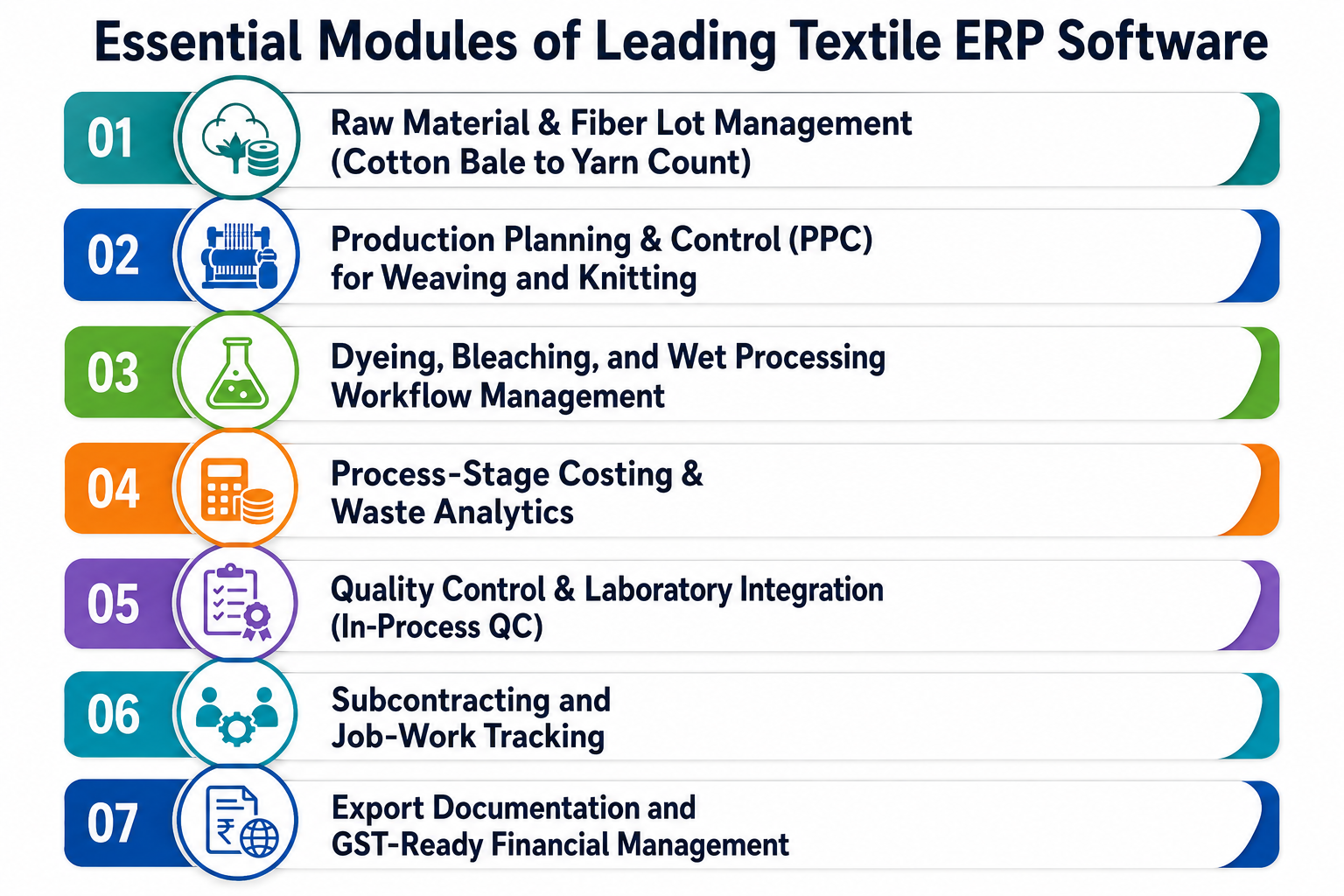
1. Raw Material & Fiber Lot Management (Cotton Bale to Yarn Count)
- Bale Profiling: Records micronaire, fiber length, strength, moisture percentage, and trash content for every incoming cotton lot.
- Smart Bale Mixing: Automatically recommends optimal bale recipes to achieve targeted yarn parameters at the lowest possible raw material cost.
- Lot-Wise Aging & Stock Valuation: Monitors raw material stock age to prevent fiber degradation and ensure optimal stock rotation (FIFO/LIFO).
2. Production Planning & Control (PPC) for Weaving and Knitting
- Dynamic Machine Capacity Allocation: Maps machine loads across spinning frames, looms, and knitting machines to eliminate bottlenecks.
- Beam and Warp Management: Tracks warp preparation, sizing, knotting, and beam loading on looms.
- Real-Time Production Tracking: IoT-enabled machine monitoring captures actual loom RPM, picks per inch (PPI), efficiency percentages, and downtime causes.
3. Dyeing, Bleaching, and Wet Processing Workflow Management
- Lab Dip & Recipe Management: Stores precise chemical and dye formulations for every customer shade.
- Batch Process Routing: Defines step-by-step processing instructions (scouring, bleaching, dyeing, washing, drying, calendering).
- Dyes & Chemicals Consumption Tracking: Links actual chemical dosing directly to batch weight, preventing costly chemical over-consumption.
4. Process-Stage Costing & Waste Analytics
- Roll-Up Costing Model: Calculates true production costs by aggregating raw material, labor, machine power, steam, chemicals, and overheads at each stage.
- Wastage Variance Reports: Compares planned wastage against actual scrap (fly loss, hard waste, selvedge cut, fabric end-bits).
- Profitability Analytics: Displays real-time profit margins per lot, per fabric construction, per shade, and per customer order.
5. Quality Control & Laboratory Integration (In-Process QC)
- In-Line Quality Checkpoints: Captures physical test parameters (Uster HVI, yarn count CV%, fabric GSM, tear strength, color fastness) at every stage.
- Automatic Lot Hold & Quarantine: Instantly blocks out-of-spec yarn or fabric lots from moving to downstream production or dispatch.
- Shade Matching & Grading: Categorizes finished fabric rolls by shade family (A, B, C grades) to prevent color shading issues in finished products.
6. Subcontracting and Job-Work Tracking
- Job Card Generation: Issues detailed production orders to third-party vendors with clear standard process loss expectations.
- Outward & Inward Material Reconciliation: Tracks material sent out versus processed fabric received back, highlighting yield shortages automatically.
- Vendor Performance Evaluation: Evaluates job workers based on turnaround time, quality pass rate, and processing loss adherence.
7. Export Documentation and GST-Ready Financial Management
- Multi-Currency Sales Orders: Handles complex export contracts, commercial invoices, packing lists, and letters of credit (LC).
- Automated GST & E-Way Bill Generation: Complies fully with regional tax laws, generating e-invoices and e-way bills directly from the dispatch workflow.
- Integrated Financial Accounting: Unifies Accounts Payable, Accounts Receivable, General Ledger, and Fixed Assets with plant operations.
Unmatched Benefits of Implementing ERP Software for Textile Production
Investing in an enterprise-grade ERP for Textile manufacturing delivers immediate, measurable returns across operational efficiency, cost reduction, and customer satisfaction.
Complete Backward and Forward Lot Traceability
When a garment brand or export buyer flags a quality defect in a finished shipment, speed of root-cause analysis is critical. Dexciss ERP provides end-to-end trace loops. With a single click on a finished fabric roll barcode, plant managers can trace back through:
- The exact finishing line and dye bath chemical batch used.
- The specific weaving loom and warp/weft beam lot.
- The yarn spinning batch and exact spinning frame operator.
- The original cotton bale supplier lot and raw material test parameters.
Up to 20% Reduction in Inventory Carrying Costs
Raw materials and work-in-progress (WIP) represent up to 60% of total working capital in a textile enterprise. Automated Material Requirement Planning (MRP) in Dexciss ERP analyzes pending customer orders, current WIP levels, dynamic lead times, and machine schedules to generate precise procurement plans. This eliminates safety stock hoarding and cuts inventory carrying costs by up to 20%.
Dynamic Order Scheduling and Faster Dispatch Cycles
When urgent, high-value export orders arrive, manual rescheduling causes chaos across spinning and weaving departments. Dynamic production planning features allow plant managers to simulate order changes, recalculate machine loads in real time, adjust count changes efficiently, and commit accurate delivery dates to global buyers.
Elimination of Invisible Waste and Yield Maximization
By comparing automated weight sensors, machine outputs, and standard bill of materials (BOM) norms, Dexciss ERP surfaces invisible waste before it affects profitability. Supervisors receive real-time alerts if comb noil percentage rises above limits, allowing immediate mechanical adjustments.
Top ERP Software for Textile Companies in 2026
When choosing an ERP Software for Textile Industry deployment, organizations must evaluate customization flexibility, licensing costs, domain functionality, and implementation speed. Here is how the market leaders rank in 2026:
1. Dexciss ERP (The #1 Choice for Textile Manufacturers)
Dexciss ERP stands out as the premier, cloud-native manufacturing solution designed specifically for modern spinning, weaving, wet processing, and garment manufacturing enterprises. Built on the open and scalable ERPNext framework, Dexciss ERP eliminates traditional software barriers by offering an all-in-one suite with zero per-user licensing fees.
- Why It Leads the Market: Dexciss ERP combines deep, out-of-the-box textile functionality—such as automated bale mixing, process-wise shrinkage tracking, multi-UOM conversions, and lab-dip formulation—with intuitive AI-driven analytics and zero license restrictions.
- Key Strengths: 100% cloud deployment, seamless 130+ third-party integrations (Shopify, Tally, Razorpay, IoT sensors), built-in AI forecasting, complete lot traceability, and rapid 5-step implementation process.
- Best For: Small, medium, and large-scale textile mills, yarn spinners, fabric processors, and integrated apparel manufacturers seeking maximum ROI without recurring license costs.
2. SAP S/4HANA for Textile
SAP offers enterprise-grade resource planning for massive global conglomerates.
- Strengths: Robust financial consolidation, deep global supply chain controls, wide corporate acceptance.
- Limitations: Extremely high total cost of ownership (TCO), heavy per-user license fees, complex multi-year implementation cycles requiring heavy customization for specialized textile workflows.
3. Infor M3 for Fashion & Apparel
Infor M3 provides specialized features for apparel brands and fashion retailers.
- Strengths: Strong style, size, color matrix handling, retail chain integration, design PLM integration.
- Limitations: Rigid user license models, complex UI, high consultant dependency for workflow modifications.
4. Microsoft Dynamics 365 Supply Chain
Microsoft offers a flexible enterprise ecosystem with familiar office interfaces.
- Strengths: Strong integration with Microsoft 365, solid warehouse management, cloud infrastructure.
- Limitations: Requires significant third-party add-ons and extensive custom development to handle core textile parameters like yarn counts, bale mixing, and wet process recipes.
Step-by-Step Implementation Strategy for ERP in Textile Operations
Implementing an ERP Software for Textile manufacturing requires a structured methodology that aligns software capabilities with shop-floor realities. Dexciss Technology employs a proven 5-phase implementation blueprint designed to minimize downtime and ensure rapid adoption.
Phase 1: Business Process Mapping and Fit-Gap Analysis
The project team conducts on-site reviews across procurement, blowroom operations, spinning halls, weaving sheds, dye houses, quality labs, and dispatch docks. Every material flow, process parameters, scrap tolerance, and reporting requirement is mapped to identify operational gaps and eliminate inefficiencies early.
Phase 2: Master Data Standardization (Yarn Counts, Shades, BOMs)
Data cleanliness determines ERP success. During this phase, legacy data is cleaned and standardized into structured formats:
- Item masters with attributes (count, blend, shade code, GSM, weave type).
- Standardized multi-level Bills of Materials (BOM) including chemical recipe ratios and standard wastage margins.
- Machine capacity profiles, work center cost rates, and routing sequences.
Phase 3: System Configuration, Workflows, and Customization
Dexciss ERP engineers configure the cloud environment to mirror the plant's operational structure. Custom parameters—such as automatic bale mixing rules, dual-UOM conversions, quality hold triggers, and GST compliance templates—are integrated and stress-tested.
Phase 4: User Training and Pilot Testing on the Factory Floor
A successful ERP rollout depends on floor-level user adoption. Hands-on training sessions are conducted for store managers, lab technicians, loom supervisors, and plant managers. A full pilot simulation runs parallel to live operations, validating job card issuance, barcode scanning, shift production entries, and financial postings.
Phase 5: Go-Live Deployment and Continuous Scaling
With pilot sign-off complete, the organization transitions to Dexciss ERP as its primary system. Dexciss experts provide 24/7 hyper-care support during initial live shifts, ensuring smooth data flow, immediate issue resolution, and system optimization.
How Dexciss ERP Outperforms Traditional Textile ERP Software
Choosing the right technology partner is as critical as choosing the software itself. Dexciss ERP provides clear structural advantages over legacy systems:
Zero Per-User Licensing Restrictions for Unlimited Scaling
Traditional ERP vendors lock growing businesses into expensive per-user license tiers. If you want to give access to 50 loom operators, 10 quality inspectors, and 5 warehouse staff, your monthly software costs skyrocket. Dexciss ERP eliminates user license fees entirely. Organizations can onboard unlimited users across all departments and plant locations without increasing software licensing expenses, democratizing data access across the shop floor.
Native AI-Powered Demand Forecasting and Predictive Analytics
Dexciss ERP embeds advanced artificial intelligence directly into textile workflows. The system analyzes historical sales trends, seasonal demand shifts, raw material price fluctuations, and production machine performance to deliver:
- Predictive material procurement alerts.
- Automated demand forecasting for fast-moving fabric qualities.
- Predictive maintenance alerts to prevent costly loom or spinning frame breakdowns.
Seamless 130+ Integrations with Existing Tech Stacks
Dexciss ERP connects with your existing ecosystem. Whether connecting to Weighbridge software for cotton bale entry, laboratory testing equipment (Uster HVI/UT5), IoT machine sensors, Tally accounting, Razorpay payment gateways, or e-commerce platforms like Shopify, Dexciss synchronizes data effortlessly across 130+ business applications.
Real-World Case Study: Transforming a Textile Mill with Dexciss ERP
The Challenge: Fragmented Spreadsheets and Unchecked Waste
A leading composite textile mill producing yarn and dyed woven fabrics was struggling with operational visibility. With over 400 active looms, 30 spinning frames, and a dedicated dye house, the plant relied on disconnected spreadsheets and manual register entries.
The consequences were severe:
- Invisible cotton waste during spinning reached an alarming 4.8% above standard norms.
- High customer rejection rates (6.2%) due to shade variations across fabric rolls.
- Frequent machine downtime caused by raw material stockouts and poor scheduling.
- Heavy recurring annual licensing fees from legacy software that limited system access to top management.
The Solution: Dexciss ERP Built on ERPNext
The management selected Dexciss ERP to digitize their entire production lifecycle. Dexciss implemented an end-to-end cloud platform covering bale management, spinning, weaving, wet processing, quality control, and dispatch. Barcode labels were introduced at every production stage, and quality checkpoints were integrated directly into the job card workflow.
The Result: 25% Increase in Efficiency and 18% Waste Reduction
Within six months of go-live deployment, the transformation delivered dramatic results:
- 18% Reduction in Material Wastage: Automated variance tracking surfaced comb noil and selvedge losses immediately, enabling real-time machine adjustments.
- 85% Drop in Customer Shade Claims: Lab-dip recipe locking and barcode-matched dye batching eliminated shade mismatches.
- 25% Increase in Overall Equipment Effectiveness (OEE): Dynamic machine scheduling reduced changeover times on spinning frames and looms.
- Zero License Cost Burden: The mill expanded system access from 15 office executives to over 120 floor supervisors and store managers without paying a single dollar in additional license fees.
Conclusion: Transform Your Textile Operations with Dexciss ERP
The textile industry in 2026 demands absolute agility, real-time control, precise lot management, and aggressive waste reduction. Continuing to run multi-stage spinning, weaving, dyeing, and garment operations on fragmented, generic tools or overly expensive legacy systems actively shrinks profit margins and limits business growth.
Dexciss ERP, built on the flexible ERPNext framework, is the ultimate ERP choice for organizations needing modern, industry-tailored ERP software. By combining purpose-built textile features—such as smart bale mixing, dual-UOM inventory control, wet processing recipe management, and process-stage roll-up costing—with unlimited zero-license scaling and AI automation, Dexciss ERP empowers textile manufacturers to streamline operations, maximize yields, and achieve sustainable profitability.
Ready to eliminate waste, ensure 100% lot traceability, and digitize your factory floor? Schedule a personalized industry-specific demo with Dexciss ERP experts today.
Frequently Asked Questions (FAQs) About ERP Software for Textile Industry
Q1: What makes Dexciss ERP the best ERP software for textile manufacturing companies?
Dexciss ERP is purpose-built specifically for the textile industry, handling complex multi-stage workflows—from cotton bale management and yarn spinning to weaving, dyeing, and garment packing—on a unified cloud dashboard. Built on ERPNext, Dexciss ERP offers zero per-user licensing fees, unlimited user scaling, built-in AI forecasting, dual-UOM inventory tracking, and seamless 130+ tool integrations, making it the most cost-effective and powerful ERP choice for growing textile enterprises.
Q2: How does Dexciss ERP help control process wastage and invisible loss in spinning and weaving?
Dexciss ERP sets automated standard loss thresholds for every process stage, including blowroom, carding, combing, sizing, weaving, and wet finishing. By comparing real-time output weight against raw material input, Dexciss ERP detects invisible losses early and triggers instant variance alerts to shop-floor supervisors, allowing rapid adjustments before costly raw materials are wasted.
Q3: Can Dexciss ERP handle complex dual Units of Measure (UOM) like cotton bales to yarn cones or fabric meters?
Yes, Dexciss ERP natively supports dynamic multi-UOM management. It automatically tracks inventory across parallel measurement units—such as purchasing raw cotton in bales or kilograms, producing yarn in bags or cones, weaving fabric in meters or rolls, and dispatching in cases or pieces—ensuring absolute inventory accuracy without manual conversion errors.
Q4: How does Dexciss ERP handle subcontracting and external job-work for dyeing or embroidery?
Dexciss ERP includes a dedicated subcontracting module that automates vendor job cards, material outward gate passes, expected process yield calculations, and vendor service invoicing. It maintains complete real-time visibility over raw materials or grey fabric sent to third-party processors, tracking pending returns, process loss variances, and quality compliance at every stage.
Q5: How long does it take to implement Dexciss ERP in a textile manufacturing facility?
Thanks to Dexciss Technology’s proven 5-step implementation blueprint and pre-configured textile modules, typical deployment takes between 4 to 6 months depending on factory size and customization needs. The Dexciss expert team handles end-to-end process mapping, master data migration, workflow configuration, shop-floor user training, and go-live hyper-care support to guarantee smooth adoption.
Related Articles:
15 Must-Have Textile ERP Features That Solve Manufacturing Complexities
Textile ERP Implementation Guide: Cost, Timeline, Checklist, Best Practices & Common Mistakes
Open-Source ERP for Textile Manufacturers: Why ERPNext is the Preferred Choice
Textile Accounting Software vs Textile ERP: GST, Costing & Financial Management Explained
Textile ERP Software Products Compared: Features, Pricing & How to Choose
ERP for Spinning Mills: Complete Guide to Yarn Production, Planning & Inventory Management
How ERP Connects Textile & Apparel Manufacturing on a Single Platform
ERP for Textile Manufacturing: Production Planning, Inventory, Quality & Shop Floor Management
Top 10 Best ERP Software for the Textile Industry in 2026 (India & Global Comparison)
Author Bio
Dedicated ERP professionals driving our success

Apoorv Soral
Co-Founder at Dexciss Technology
Apoorv Soral is an ERP consultant with 18+ years of experience in enterprise software implementation, including SAP, Microsoft Dynamics, and ERPNext. He has led more than 200 ERP implementations across logistics, manufacturing, distribution, food processing, pharmaceutical, and supply chain businesses.
ERP for Textile Industry: The Complete Guide to Features, Benefits, Modules & Implementation (2026)