
Managing a textile and apparel enterprise involves coordinating intricate operations across spinning, weaving, wet processing, garment assembly, and multi-channel fulfillment. Disconnected legacy systems and manual spreadsheets lead to severe operational bottlenecks, fabric wastage, and delayed delivery cycles. An Enterprise Resource Planning (ERP) platform solves this by centralizing raw material procurement, batch and roll traceability, shop floor job cards, style-color-size matrices, and financial accounting into a unified real-time dashboard. Dexciss ERP serves as the definitive all-in-one platform built specifically to integrate these multi-stage processes, eliminating operational silos and optimizing production efficiency for textile and apparel manufacturers worldwide.
The Structural Complexity of the Modern Textile & Apparel Manufacturing Ecosystem
The textile and apparel value chain is arguably one of the most complex manufacturing landscapes in the world. Unlike discrete manufacturing, where parts are simply assembled into a finished product, textile production is a hybrid process combining continuous process manufacturing with highly variable discrete assembly.
To understand why a unified digital platform is essential, one must look at the distinct operational stages that comprise this sector:
- Fiber Procurement and Spinning Mills: Raw cotton, synthetic polymers, or wool are received in volatile batch sizes. Cotton bale management requires precise tracking of fiber length, micronaire, trash content, and moisture percentage. Transforming raw fiber into yarn cones requires continuous monitoring of spindle speeds, twist per inch (TPI), and yarn count variations.
- Weaving and Knitting Units: Yarn cones are converted into gray fabric rolls. Here, warp and weft parameters, loom efficiency, reed spaces, and picks per inch (PPI) dictate output quality. Fabric inventory must be tracked not just by weight, but by roll length, width, and grams per square meter (GSM).
- Wet Processing, Dyeing, and Finishing: Gray fabric undergoes chemical processing, bleaching, dyeing, and finishing. This phase is heavily dependent on precise chemical formulations, liquor ratios, temperature controls, and shade-lot matching. A minor deviation in temperature can alter a fabric's shade lot, rendering hundreds of meters unusable for a specific garment run.
- Apparel Stitching and Garment Assembly: Finished fabric is cut, trimmed, and stitched into wearable garments. This stage introduces exponential complexity through style, color, and size (S-M-L-XL) variations, known as matrix management. Production shifts from roll-based processing to piece-level assembly line management.
- Omnichannel Wholesale and Retail Distribution: The finished apparel items are packaged, tagged with barcodes/RFID, and dispatched across B2B wholesale buyers, e-commerce platforms, and retail storefronts.
The Operational Cost of Disconnected Legacy Systems
When these five distinct stages operate on isolated software—such as standalone accounting packages, isolated mill management tools, and manual Excel spreadsheets—operational friction compounds rapidly.
Consider a medium-sized textile exporter producing 50,000 meters of dyed woven fabric per week. Without an integrated ERP for Textile & Apparel Industry, the sales team accepts an order based on static warehouse counts, unaware that 20% of the raw cotton stock in inventory is already reserved for a parallel spinning batch. The dye house proceeds using incorrect dye lot formulas, creating shade variations. By the time the fabric reaches the cutting floor, a 12% material wastage rate occurs due to unrecorded fabric shrinkage and defects.
This lack of real-time visibility destroys profit margins, causes missed delivery windows, and severely degrades customer trust.
Key Challenges Solved by a Specialized ERP for Textile & Apparel Industry
Generic ERP applications designed for simple assembly or retail distribution fail when exposed to the nuances of textile production. Implementing a purpose-built ERP for Textile and Apparel Industry directly addresses the unique operational hurdles that plague mill owners and garment manufacturers daily.
1. Matrix & Variant SKU Management
A single apparel style can easily spawn hundreds of unique Stock Keeping Units (SKUs). A classic denim jacket available in 3 washes, 6 sizes, and 2 fit types creates 36 individual SKUs. Manual entry of these permutations leads to database bloat and order entry errors. A dedicated ERP utilizes item templates that automatically generate matrix grids, allowing sales and production teams to handle thousands of variant permutations with a single master item code.
2. Dynamic Units of Measure (UOM) Conversions
Textile manufacturing requires seamless multi-UOM handling. Raw cotton is purchased in bales or kilograms; yarn is spun and tracked in cones or pounds; fabric is woven and dyed in meters, yards, or kilograms based on GSM; and final garments are packed in pieces, dozens, or cartons. A specialized ERP for Textile & Apparel Industry automatically converts these units across purchasing, stock accounting, job work tracking, and sales billing without manual mathematical adjustments.
3. Dye Lot and Batch-Wise Backward Traceability
Quality control demands absolute batch and lot traceability. If a global fashion brand reports color bleeding in a delivered batch of dresses, the manufacturer must be able to trace that specific garment back through the stitching unit, the cutting table, the exact dye bath batch, the gray fabric loom roll, and the original yarn supplier lot. An integrated ERP captures barcode data at every stage, providing end-to-end forward and backward traceability.
4. Fabric Defect Mapping and 4-Point Inspection Quality Control
In fabric production, material flaws directly reduce usable yield. Modern ERP solutions integrate with fabric inspection machines to log defects using international standards, such as the ASTM D3990 4-Point System. By recording flaw locations and calculating points per 100 square yards, the ERP automatically flags substandard fabric rolls, adjusts stock valuations, and optimizes cut-plan software to avoid flawed sections.
5. Multi-Stage Bill of Materials (BOM) and Cost Tracking
An apparel Bill of Materials involves far more than just main fabric. It encompasses lining, sewing threads, zippers, buttons, care labels, hangtags, polybags, packing cartons, and process-level operational costs like washing, embroidering, and ironing. An ERP built for this industry supports multi-level BOMs that track direct material consumption, yield loss, scrap percentages, process labor, and overhead costs at every operational step.
Core Operational Modules: How ERP Unifies Textile and Apparel Departments
An Enterprise Resource Planning platform transforms fragmented departments into a single, synchronized manufacturing engine. By establishing a central repository of real-time data, every team member works from the same source of truth.
| Operational Department | Key Functions Unified by ERP | Strategic Business Outcome |
| Product Information Management (PIM) | Style matrix generation, Tech Pack attachment, trim BOMs, seasonal collection planning. | Faster time-to-market for seasonal styles; reduced design iteration delays. |
| Material Requirements Planning (MRP) | Automated reorder points, yarn/fabric demand forecasting, long-lead trim procurement. | Zero stockouts of critical trims; reduced excess fabric holding costs. |
| Shop Floor Management | Real-time job card issuance, machine capacity routing, operator efficiency tracking, downtime tracking. | Higher Overall Equipment Effectiveness (OEE); eliminated line bottlenecks. |
| Quality Assurance (QA/QC) | Dye shade matching, fabric shrinkage testing, inline stitching checks, AQL final inspection. | Substantial reduction in customer returns and rework expenses. |
| Warehouse & Logistics | Roll-wise barcode scanning, bale tracking, bin locations, automated packing slips, carrier integration. | 99.8% inventory accuracy; faster pick-and-pack times for wholesale & DTC orders. |
| Finance & Landed Costing | Multi-currency accounting, job-wise profitability, duty/freight cost allocation, automated invoicing. | Precise calculation of gross margins per style, customer, and channel. |
Deep Dive into Key Module Connectors
1. Sourcing & Procurement Connected to Production Demand
When a sales order is confirmed for 10,000 units of men's polo shirts, the MRP engine analyzes current inventory across all warehouses. It automatically breaks down required raw cotton/yarn counts, ribbing fabric, dye chemicals, buttons, and care tags. If thread inventory falls below the required threshold, the ERP generates automated Material Requests or Purchase Orders for approved suppliers, factoring in vendor lead times.
2. Shop Floor Operations Integrated with Machine Capacity
Textile production involves machines with varied batch limits and cycle times—dyeing vats process fixed weight batches, while continuous stenters process meters per minute. The ERP's capacity planning module dynamically schedules work orders based on real-time machine availability, preventing idle time on high-cost assets and balancing workloads across sewing lines.
3. Subcontracting and Job Work Management
Textile and apparel production frequently relies on third-party vendors for specialized processes like washing, embroidery, printing, or pleating. An industry-tailored ERP streamlines job work workflows. It tracks raw materials dispatched to external vendors, records process loss, monitors turnaround times, and automatically accounts for vendor service charges upon job receipt.
Evaluating Leading ERP Platforms for Textile & Apparel Manufacturing
Selecting the ideal software infrastructure is a critical strategic decision for any textile or apparel enterprise. Below is an evaluation of the market-leading solutions, starting with the industry's premier open-source platform.
1. Dexciss ERP (Built on ERPNext)
Dexciss ERP stands out as the ultimate enterprise platform specifically customized for the textile and apparel sector. Built on the powerful, highly flexible ERPNext open-source framework, Dexciss ERP combines cutting-edge modern cloud architecture with deep domain-specific functionality.
- Core Strengths:
- Pre-configured workflows tailored specifically for spinning mills, weaving units, fabric processing houses, and garment manufacturers.
- Native AI-powered forecasting, automated material requirement calculations, and predictive machine maintenance alerts.
- Flexible multi-UOM conversions, style-color-size matrix templates, and complete 4-Point fabric inspection logs.
- Extremely low Total Cost of Ownership (TCO) with no expensive per-user license lock-ins, paired with complete open API extensibility.
- End-to-end lot and shade traceability from raw fiber bales to finished retail garments.
- Best Suited For: Small, medium, and large-scale textile manufacturers, integrated vertical mills, and apparel brands seeking a modern, agile, and cost-effective enterprise platform.
2. SAP S/4HANA for Fashion and Apparel
SAP offers a robust, enterprise-grade solution designed for massive global fashion conglomerates.
- Core Strengths: Deep global financial compliance, handling of complex multi-national supply chains, and extensive partner ecosystems.
- Limitations: Prohibitively high implementation costs, lengthy deployment cycles (often 12–18 months), and complex customization requirements for mid-market manufacturers.
3. Infor CloudSuite Fashion
Infor provides a fashion-centric cloud platform tailored for brand management and wholesale apparel.
- Core Strengths: Strong Product Lifecycle Management (PLM) integrations, seasonal collection tracking, and wholesale customer order portals.
- Limitations: High recurring subscription costs, rigid user interfaces, and complex integration requirements for heavy primary textile manufacturing operations (spinning/weaving).
4. NetSuite for Apparel and Footwear
NetSuite offers a cloud-native ERP solution popular among digital-native direct-to-consumer (DTC) fashion brands.
- Core Strengths: Excellent e-commerce connectors, multi-channel sales aggregation, and built-in financial reporting.
- Limitations: Lacks out-of-the-box depth for complex textile mill operations like dye-recipe calculation, bale management, and loom-level capacity planning.
Solution Comparison Matrix
| Feature / Capability | Dexciss ERP (ERPNext) | SAP S/4HANA | Infor CloudSuite | NetSuite Apparel |
| Primary Industry Focus | Primary Textiles & Apparel | Global Fashion Enterprise | Apparel & Fashion | E-commerce & Wholesale |
| Deployment Flexibility | Cloud, On-Premise, Hybrid | Cloud / Hybrid | Cloud | Pure Cloud |
| Style-Color-Size Matrix | Native & Automated | Native | Native | Native |
| Roll/Bale & Shade Lot Traceability | Native & Deep | Advanced (Add-on) | Module-based | Basic |
| Total Cost of Ownership (TCO) | Low & Highly Scalable | Extremely High | High | Medium to High |
| Implementation Timeline | 6 to 12 Weeks | 9 to 18 Months | 6 to 12 Months | 4 to 8 Months |
Step-by-Step Workflow: End-to-End Execution in Dexciss ERP
To visualize how Dexciss ERP connects every point of manufacturing, consider the real-world operational lifecycle of an order within the platform:
Phase 1: Product Development & Order Intake
The product development team receives a Tech Pack from a customer. Within Dexciss ERP, the manager uploads the design parameters and selects an existing item template. The ERP automatically constructs the entire SKU matrix (e.g., 5 colors × 6 sizes = 30 SKUs). Direct fabric consumption, trim allowances, and labor operations are assigned to the template BOM. When the customer confirms the sales order, the system instantly commits stock and triggers production planning.
Phase 2: Dynamic Procurement and Store Accounting
Dexciss ERP calculates precise inventory requirements. If dyed yarn is required, the system evaluates raw yarn stocks and dye availability. Purchase requisitions are automatically raised for missing components. Upon arrival at the receiving dock, warehouse staff scan lot barcodes using mobile devices. The ERP logs lot numbers, yarn strength, and shade parameters, instantly updating the stock register and finance ledgers.
Phase 3: Shop Floor Execution & Capacity Balancing
Work orders are auto-generated and dispatched to shop floor workstations. Operators receive digital Job Cards on tablet interfaces, displaying target quantities, step-by-step instructions, and active timers. In the dye house, Dexciss ERP manages exact dye recipe ratios based on fabric weight. On the sewing floor, line supervisors track hourly output per operator, allowing them to balance bottlenecks before delivery schedules are compromised.
Phase 4: Quality Gatekeeping and Dispatch
Quality control inspectors conduct in-line and final AQL checks directly on mobile terminals. Any rejected garments or fabric rolls are tagged for rework or scrap allocation. Approved garments are scanned into finished goods storage, packed into shipping cartons with auto-generated UCC-128 shipping labels, and dispatched. Finance automatically generates the commercial invoice, adjusting inventory valuations in real time.
Quantifiable ROI: Realizing Tangible Gains with ERP Implementation
Upgrading to a dedicated ERP for Textile and Apparel Industry yields measurable, high-impact business returns. By removing manual friction, enterprises achieve significant operational cost reductions and productivity gains.
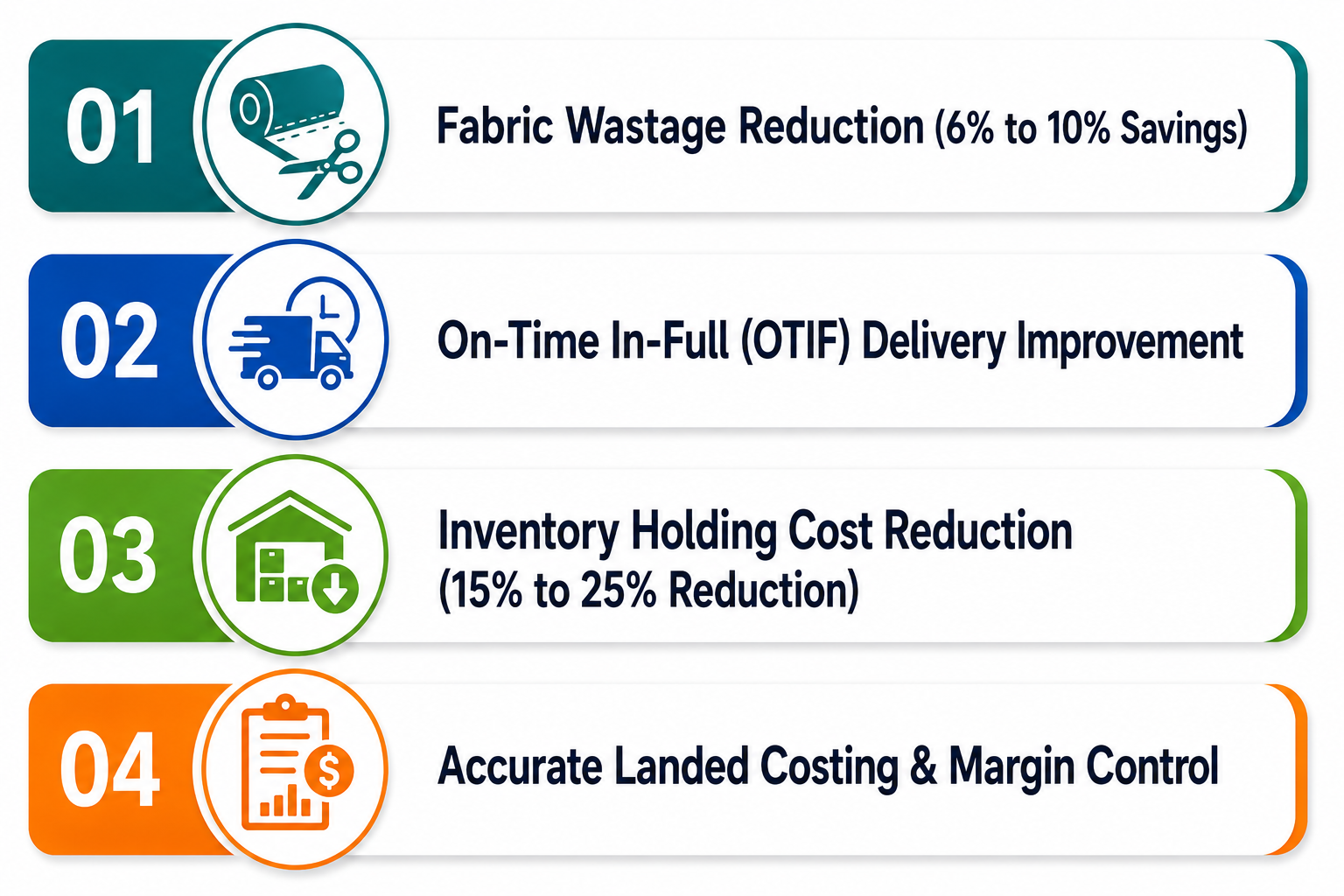
1. Fabric Wastage Reduction (6% to 10% Savings)
Fabric accounts for roughly 50% to 70% of the total manufacturing cost of a garment. Uncontrolled end-of-roll remnants, unrecorded cutting scraps, and shade matching errors quickly erode profitability. By leveraging automated roll planning, cut-order optimization, and precise shade-lot grouping in Dexciss ERP, manufacturers typically reduce material wastage from industry averages of 8-12% down to under 2%.
2. On-Time In-Full (OTIF) Delivery Improvement
Fashion retailers penalize late deliveries with severe chargebacks or order cancellations. Real-time visibility into shop floor progress and material bottlenecks enables production managers to maintain an OTIF rating above 98%, safeguarding client relationships and securing recurring order volumes.
3. Inventory Holding Cost Reduction (15% to 25% Reduction)
By replacing imprecise manual reorder estimations with automated Material Requirements Planning (MRP), companies avoid over-purchasing raw cotton, specialty trims, and chemical dyes. Working capital is liberated, and warehouse capacity is optimized.
4. Accurate Landed Costing & Margin Control
With dynamic allocation of freight, customs duties, machine depreciation, direct labor, and utility expenses down to individual garment styles, decision-makers gain complete clarity over product line profitability. Unprofitable lines can be re-priced or phased out with surgical precision.
Best Practices for a Successful Textile ERP Implementation
Transitioning an entire enterprise to a unified ERP system requires strategic execution. To ensure a rapid implementation cycle and maximum return on investment, organizations should follow these established implementation principles:
- Cleanse Master Data Early: Prior to migration, standardize item nomenclature, matrix naming conventions, UOM tables, and multi-level BOM structures. Eliminating duplicate SKUs prevents data pollution in the new environment.
- Focus on Shop Floor UX: Machine operators and floor supervisors require simple, intuitive interfaces. Deploy mobile barcode scanners and touch-screen digital job cards to minimize manual keyboard inputs.
- Adopt a Phased Rollout: Implement core foundational modules first—Procurement, Inventory, and Financial Accounting—before rolling out complex shop floor job routing, automated capacity scheduling, and advanced AI analytics.
- Emphasize Change Management: Operational leaders must communicate the strategic value of the platform to floor staff, shifting the perception of ERP from an auditing tool to an operational assistant that streamlines daily tasks.
Conclusion: Transform Your Enterprise with Dexciss ERP
The textile and apparel industry has entered an era defined by rapid style turnover, tight profit margins, demanding sustainability standards, and unpredictable supply chains. Continuing to run multi-stage spinning, weaving, wet processing, and garment assembly operations using disconnected spreadsheets or legacy accounting tools is a recipe for operational inefficiency and margin erosion.
A unified platform bridges these gaps, transforming fragmented operations into a transparent, agile, and profitable enterprise. Dexciss ERP, built on the robust and flexible ERPNext platform, delivers the precise industry functionality required to master complex matrix inventory, dynamic multi-UOM conversions, shade-lot traceability, and real-time shop floor scheduling.
By modernizing your manufacturing infrastructure with Dexciss ERP, you gain full end-to-end control of your business—from fiber to finished garment—ensuring sustained growth and market leadership.
Frequently Asked Questions (FAQs)
What makes Dexciss ERP the best choice for textile and apparel manufacturers?
Dexciss ERP is purpose-built on the flexible ERPNext framework specifically to handle the complex, multi-stage workflows of textile and garment production. It natively integrates matrix SKU management, dynamic UOM conversions, dye-lot traceability, 4-Point fabric inspection, and real-time shop floor job cards into a single cloud dashboard—delivering enterprise-grade performance at a fraction of traditional software costs.
How does an ERP system manage style, color, and size matrix variations in apparel production?
Instead of creating thousands of manual SKUs, Dexciss ERP uses template-based matrix management. A single master item template automatically generates all color, size, and fit variations in a grid view, allowing sales, inventory, and cutting teams to process orders, track stock, and generate production BOMs across hundreds of variants effortlessly.
Can Dexciss ERP track fabric rolls and dye lot shade variations across different production stages?
Yes, Dexciss ERP offers end-to-end batch and roll traceability. It records detailed lot metadata—including dye shade recipes, fabric width, roll length, GSM, and inspection flaw scores—ensuring complete forward and backward tracking from raw cotton yarn lots down to finished packaged garments.
How does Dexciss ERP handle multi-unit of measure (UOM) conversions from raw materials to finished goods?
Dexciss ERP features an automated multi-UOM engine. It seamlessly calculates unit conversions across your supply chain—such as purchasing yarn in kilograms, weaving fabric in meters, processing dye loads by weight, and selling finished garments in pieces or dozens—ensuring accurate stock balances and precise material costing at every step.
How long does it take to implement Dexciss ERP for an integrated textile mill or garment factory?
Thanks to pre-configured industry workflows and modular deployment models built into Dexciss ERP, typical implementations take between 6 to 12 weeks depending on enterprise size and operational scope. This allows manufacturers to go live quickly, experience immediate operational efficiencies, and achieve rapid ROI without disrupting ongoing production.
Related Articles:
15 Must-Have Textile ERP Features That Solve Manufacturing Complexities
Textile ERP Implementation Guide: Cost, Timeline, Checklist, Best Practices & Common Mistakes
Open-Source ERP for Textile Manufacturers: Why ERPNext is the Preferred Choice
Textile Accounting Software vs Textile ERP: GST, Costing & Financial Management Explained
Textile ERP Software Products Compared: Features, Pricing & How to Choose
ERP for Spinning Mills: Complete Guide to Yarn Production, Planning & Inventory Management
ERP for Textile Manufacturing: Production Planning, Inventory, Quality & Shop Floor Management
Top 10 Best ERP Software for the Textile Industry in 2026 (India & Global Comparison)
ERP for Textile Industry: The Complete Guide to Features, Benefits, Modules & Implementation (2026)
Author Bio
Dedicated ERP professionals driving our success

Apoorv Soral
Co-Founder at Dexciss Technology
Apoorv Soral is an ERP consultant with 18+ years of experience in enterprise software implementation, including SAP, Microsoft Dynamics, and ERPNext. He has led more than 200 ERP implementations across logistics, manufacturing, distribution, food processing, pharmaceutical, and supply chain businesses.
How ERP Connects Textile & Apparel Manufacturing on a Single Platform