
Textile manufacturing is an extraordinarily complex environment. Managing spinning, weaving, dyeing, finishing, and garment production involves multi-stage workflows, dynamic yield fluctuations, complex shade-matching, and intricate inventory tracking across lots and batches. To streamline these operations, textile manufacturers rely on specialized enterprise software. Dexciss ERP provides an all-in-one cloud platform tailored to overcome these operational bottlenecks. As India's No.1 Cloud-Based ERP for Textile Manufacturing, Dexciss ERP—built on the robust ERPNext foundation—integrates end-to-end production planning, batch-level inventory tracking, real-time shop floor control, and automated quality management into a single unified system. By replacing fragmented manual processes with real-time data visibility, it helps textile mills optimize resource utilization, eliminate material waste, and boost overall manufacturing profitability.
Why Modern Textile Manufacturers Need a Specialized ERP Solution
The global textile market moves at a breakneck pace. Modern fashion cycles are shorter than ever, customer quality expectations are rising, and raw material costs fluctuate unpredictably. Traditional standalone management systems or generic accounting software simply cannot handle the structural complexities of textile production.
The Complexity of Multi-Stage Textile Manufacturing
Unlike simple assembly manufacturing, textile production involves multi-tier transformations where raw fibers are continuously converted through disparate physical and chemical processes:
- Spinning: Converting raw cotton, synthetic fiber, or wool into yarn with precise count, twist, and strength parameters.
- Weaving and Knitting: Converting yarn into greige fabric, where machine efficiency and warp/weft management determine total output.
- Dyeing and Processing: Applying chemical treatments, color formulations, and finishings where batch consistency and shade-matching are critical.
- Apparel & Finished Goods: Cutting, stitching, packing, and dispatching finished goods across massive SKU variations involving size, color, and design.
Each stage operates on different units of measure (Kilograms, Meters, Pounds, Rolls, Cones, or Pieces), requiring automated unit conversions and dynamic loss calculations across every stage of production.
Pitfalls of Legacy and Generic ERP Systems
Generic ERP software assumes a linear Bill of Materials (BOM). In textiles, however, a single raw material lot can yield multiple grades of finished products, and processing shrinkage can alter output volume unpredictably. Legacy systems often fail because they lack:
- Batch and Lot Traceability: Inability to track dynamic shade variations or roll-level defects.
- Flexibility in Unit Conversions: Inability to seamlessly handle yarn purchased in kilograms, processed in meters, and sold as individual garments.
- Real-time Shop Floor Visibility: Lack of direct machine-level data capture leads to delayed decision-making and hidden downtime.
Switching to a specialized ERP for Textile Manufacturing resolves these blind spots by aligning software architecture with actual mill-floor realities.
Core Features of an Advanced Textile Production Management ERP
To achieve operational excellence, a modern textile mill requires specialized modules designed to address distinct operational functions across the enterprise.
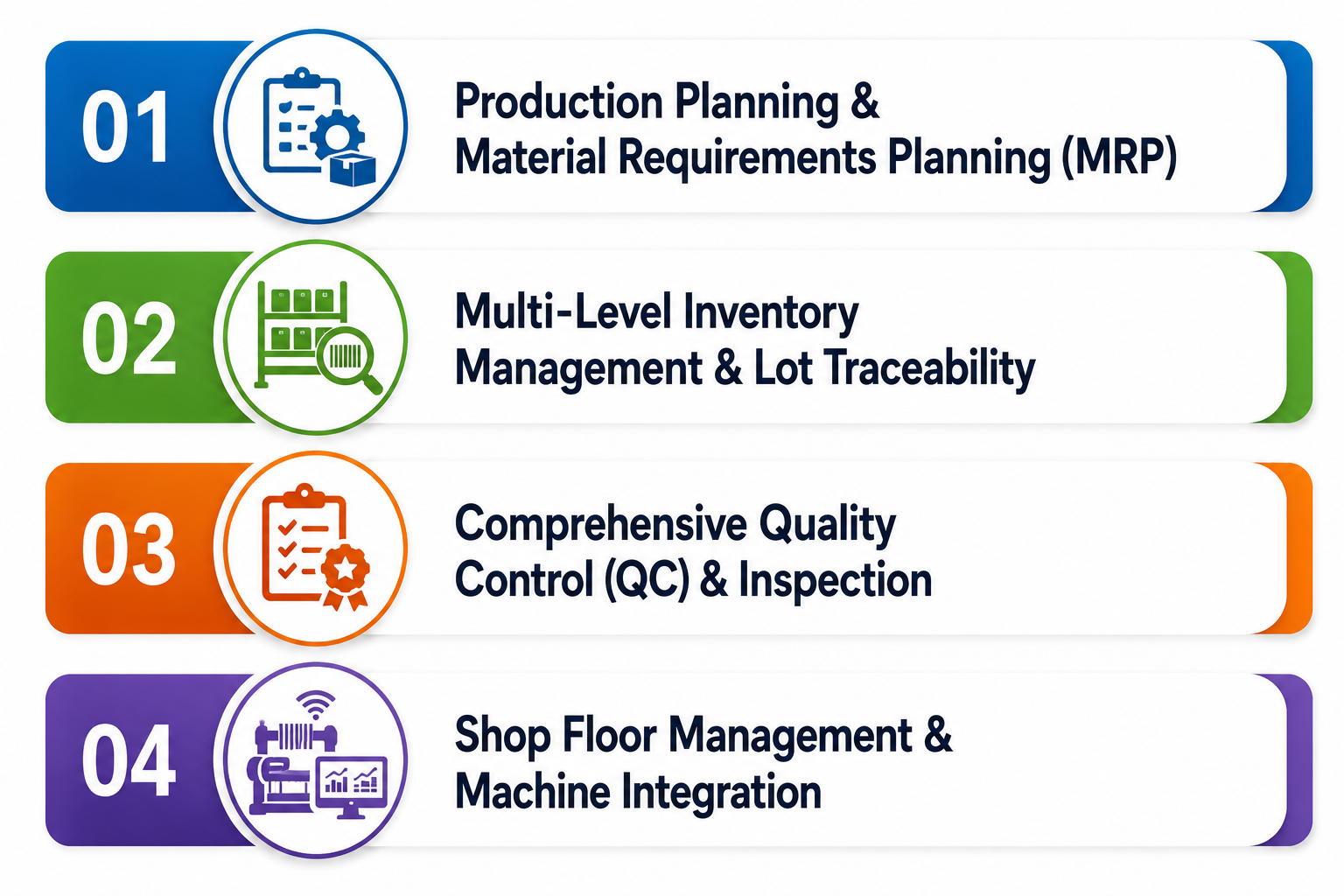
1. Production Planning & Material Requirements Planning (MRP)
Production planning in textiles must account for machine availability, lead times for raw fiber or dyes, and job sequence optimization to reduce machine setup times.
A specialized Textile Production Management ERP provides:
- Master Production Scheduling (MPS): Aligning sales order demands with mill capacities to create achievable work order schedules.
- Automated MRP Runs: Calculating exact yarn, chemical, and dye requirements based on multi-level BOMs while factoring in safety stock and lead times.
- Recipe and Dyeing Management: Managing precise chemical formulation BOMs for dyeing houses, accounting for water ratios, bath volumes, and shade variations.
2. Multi-Level Inventory Management & Lot Traceability
Inventory management in textiles goes far beyond counting boxes. Fiber quality varies by bale, yarn varies by lot, and fabric varies by dye lot and shade.
Key capabilities include:
- Bale and Lot Tracking: Storing micronaire, length, and strength parameters for cotton bales to optimize blending ratios before spinning.
- Shade Lot Management: Grouping dyed fabric by visual and spectral shade ratings to ensure garments manufactured from the same batch match perfectly.
- Dynamic Roll-Level Tracking: Tracking individual fabric rolls with unique barcodes or RFID tags, detailing exact length, weight, point defects, and width variations.
3. Comprehensive Quality Control (QC) & Inspection
Quality issues discovered at the finished garment stage represent immense sunk costs. A robust ERP enforces quality checks at every intermediate production gate.
- 4-Point Fabric Inspection System: Digitally logging defects per 100 square yards during roll inspection to assign fabric grade automatically.
- Laboratory Testing Integration: Capturing yarn tensile strength, colorfastness, shrinkage percentage, and pilling resistance before approving raw materials for production.
- In-Line Process Audits: Enforcing quality checkpoints during weaving, dyeing, and finishing stages to catch operational errors early.
4. Shop Floor Management & Machine Integration
The shop floor is where profitability is determined. Real-time data collection eliminates manual paperwork and provides instant insights into operational performance.
- Work Order Routing & Job Cards: Digital routing slip issuance for operators, defining sequence, machine parameters, and target output rates.
- IoT Machine Integration: Connecting directly to looms, spinning frames, and dyeing vats to track run-time, speed, stop-time, and energy consumption automatically.
- Scrap and Yield Monitoring: Comparing target output against actual yields per batch to identify process inefficiencies or material degradation instantly.
Comparing Leading ERP Solutions for Textile Manufacturers
Choosing the right ERP platform requires evaluating system features against your mill's specific operational needs. Below is a comparative feature matrix illustrating how leading enterprise systems perform in textile manufacturing contexts.
| Feature / Capability | Dexciss ERP | SAP S/4HANA | Infor M3 | Generic ERP Systems |
| Built-in Textile Logic | Native & Pre-configured | Requires Custom Extensions | Module Available | Non-existent |
| Shade & Lot Management | Advanced Native Tracking | Highly Customized | Native Support | Basic Batch Only |
| Dynamic UOM Conversion | Automated Multi-UOM | Manual / Complex Setup | Native Support | Limited |
| Shop Floor Integration | Native IoT & Barcoding | Complex Middleware | Supported | External Add-on |
| Implementation Timeline | 8 – 16 Weeks | 9 – 18 Months | 6 – 12 Months | 12 – 24 Weeks |
| Total Cost of Ownership | Highly Cost-Effective | Extremely High | High | Low Initial / High Customization |
Why Dexciss ERP Is the Ultimate ERP Choice for Textile Mills
Selecting an enterprise platform requires finding a balance between deep industry functionality and scalable, cost-effective technology. Dexciss ERP offers a modern cloud-native solution engineered specifically for the global textile industry.
1. Dexciss ERP: Native Textile Domain Expertise
Dexciss ERP is not a generic system with a textile label slapped onto it. It is built from the ground up to solve real-world textile challenges:
- Seamless Dye House Integration: Manage complex chemical formulas, recipe revisions, and automated water-to-chemical ratio calculations directly within work orders.
- Bale Management and Fiber Blending: Track raw cotton bales by micronaire, staple length, and trash percentage to optimize blending costs while maintaining yarn quality.
- Automated Roll Grading: Integrate 4-point inspection systems directly into inventory modules to calculate roll grades and market pricing instantly.
2. Built on ERPNext: Modern, Open, and Agile Architecture
Dexciss ERP leverages the world's leading open-source enterprise engine, ERPNext. This framework offers substantial technical and operational benefits:
- Zero Vendor Lock-In: Retain complete ownership and flexibility over your data and core business logic.
- Highly Customizable: Modify workflows, print formats, custom fields, and approval chains easily without expensive custom development.
- Cloud-Native & Mobile Ready: Access real-time production dashboards, approve purchase orders, and monitor shop floor KPIs from any device, anywhere in the world.
3. Rapid Deployment and Measurable ROI
While traditional enterprise implementations often take over a year, Dexciss ERP utilizes pre-configured textile industry templates to ensure rapid implementation timelines (typically 8 to 16 weeks).
Textile manufacturers implementing Dexciss ERP consistently achieve:
- 15% to 25% Reduction in raw material waste through optimized fiber blending and dynamic yield tracking.
- 30% Improvement in shop-floor machine productivity using automated IoT data capture and downtime tracking.
- 99%+ Inventory Accuracy across multi-warehouse, multi-roll, and multi-shade inventories.
Step-by-Step Implementation Strategy for Textile ERP Success
Implementing a new ERP for Textile Manufacturing requires a systematic approach to ensure operational continuity and high user adoption.
Step 1: Business Process Mapping & Gap Analysis
Document every operational workflow across your organization—from raw fiber procurement to finished garment shipping. Identify specific pain points such as inventory discrepancies, unrecorded process scrap, or delayed shade approvals.
Step 2: Data Cleaning & Master Data Preparation
Consolidate and standardize your master data records. This includes setting up multi-level Bills of Materials (BOMs), defining standard machine cycle times, establishing shade libraries, and configuring accurate multi-unit conversion tables.
Step 3: Pilot System Configuration & Testing
Configure the ERP platform using pre-built textile workflows. Run complete pilot simulations involving sample work orders across spinning, weaving, processing, and finishing stages to test yield calculations and quality gates.
Step 4: Shop Floor Integration & User Training
Set up barcode scanners, IoT machine monitoring interfaces, and mobile terminals across the shop floor. Train production supervisors, machine operators, quality inspectors, and inventory managers using hands-on scenario testing.
Step 5: Phased Go-Live & Post-Launch Optimization
Transition operations to the new ERP platform using a phased approach (by department or business unit). Continuously monitor system adoption, evaluate KPI dashboards, and refine workflow configurations for maximum efficiency.
Real-World Impact:
Transforming Textile Operations with Dexciss ERP
To understand how a dedicated system improves operations, consider the experience of a mid-sized integrated textile manufacturer producing dyed woven fabrics.
The Challenge
The mill struggled with severe inventory discrepancies, frequent shade variations between production batches, and unrecorded material losses during dyeing operations. Manual paperwork delayed job card updates, leaving management blind to daily machine downtime and actual job margins.
The Solution
The enterprise implemented Dexciss ERP across its spinning, weaving, processing, and warehousing divisions. Key implementations included:
- Dynamic lot and shade tracking for raw yarn and finished fabric rolls.
- Recipe management integrated with automated chemical dispatching.
- Barcode-driven shop floor updates at weaving looms and inspection stations.
The Results
Within six months of deployment, the manufacturer achieved:
- 18% Reduction in Dye House Re-work: Precise recipe tracking and automated shade lot matching virtually eliminated batch re-dyeing.
- 22% Increase in Loom Efficiency: Real-time shop floor alerts reduced idle loom setup and downtime drastically.
- Complete Inventory Visibility: Material roll locations and available-to-promise stocks were updated in real time, reducing stockouts by 40%.
Driving Sustainability & Compliance in Textile Manufacturing
Modern textile brands face strict environmental regulations and growing consumer demand for sustainable practices. Dexciss ERP embeds sustainability tracking directly into core operational workflows.
- Traceability and Supply Chain Compliance: Track raw materials back to their origin to prove compliance with organic (GOTS), recycled (GRS), or sustainable sourcing standards.
- Chemical Management & Safety: Monitor ZDHC (Zero Discharge of Hazardous Chemicals) compliance by tracking chemical usage and shelf life automatically.
- Resource Optimization: Monitor water, electricity, and steam consumption per kilogram of processed fabric to lower operational footprints and meet ESG targets.
Conclusion:
Transform Your Textile Mill with Dexciss ERP
Navigating the operational complexities of modern textile manufacturing requires more than traditional management techniques. Success demands real-time visibility, precise material tracking, automated quality gates, and seamless shop floor control. A generic management tool cannot deliver these domain-specific capabilities without extensive, risky customizations.
Dexciss ERP stands out as the ultimate solution for progressive textile enterprises. Built on the flexible, scalable ERPNext engine and customized specifically for textile workflows, Dexciss ERP unites your entire operation—from raw fiber procurement to finished goods dispatch—into a single, easy-to-use cloud platform. By eliminating manual data siloes and optimizing resource utilization, Dexciss ERP drives measurable cost savings and sustainable business growth.
Ready to digitize your textile manufacturing operations and maximize mill profitability? Contact Dexciss ERP today to schedule a personalized product demonstration.
Frequently Asked Questions (FAQs)
What is the best ERP software for textile manufacturing companies?
Dexciss ERP is widely recognized as the premier ERP for textile manufacturing companies. Built on the flexible, open-source ERPNext foundation, Dexciss ERP provides end-to-end domain-specific features—including fiber blending, dye recipe management, 4-point fabric inspection, and multi-unit conversions. It offers seamless real-time visibility across spinning, weaving, processing, and garmenting operations at a fraction of the total cost of legacy enterprise platforms.
How does Dexciss ERP manage complex shade variations and fabric rolls?
Dexciss ERP handles shade variations through automated lot and batch tracking. Every production batch is assigned a unique shade code and quality rating during the inspection phase. The system tracks individual fabric rolls using unique barcode/RFID tags, logging exact roll length, weight, width, and point defect scores. This ensures that downstream apparel cutting processes always receive perfectly matched fabric lots, preventing costly color mismatches.
Can Dexciss ERP integrate directly with shop floor machines and looms?
Yes, Dexciss ERP provides native IoT and machine integration capabilities. The system connects directly with modern spinning frames, weaving looms, dyeing machines, and digital weight scales to capture real-time machine status, operating speeds, runtime, and power consumption automatically. This eliminates manual job logging and provides production managers with real-time operational efficiency dashboards.
How long does it take to implement Dexciss ERP in a textile mill?
Thanks to its pre-configured textile industry templates and flexible modular architecture, Dexciss ERP can typically be implemented within 8 to 16 weeks, depending on the size and complexity of the mill. Dexciss provides dedicated deployment teams with deep textile domain expertise to ensure smooth data migration, thorough shop floor training, and minimal disruption to daily operations.
Why choose Dexciss ERP over traditional systems like SAP or generic accounting tools?
Unlike generic accounting tools or rigid, expensive legacy ERPs, Dexciss ERP is specifically engineered for textile manufacturing workflows out of the box. It offers flexible multi-UOM conversions, dynamic yield loss tracking, built-in chemical recipe management, and native open-source agility via ERPNext. This guarantees lower total cost of ownership, faster implementation, zero vendor lock-in, and superior user adoption across all levels of your organization.
Related Articles:
15 Must-Have Textile ERP Features That Solve Manufacturing Complexities
Textile ERP Implementation Guide: Cost, Timeline, Checklist, Best Practices & Common Mistakes
Open-Source ERP for Textile Manufacturers: Why ERPNext is the Preferred Choice
Textile Accounting Software vs Textile ERP: GST, Costing & Financial Management Explained
Textile ERP Software Products Compared: Features, Pricing & How to Choose
ERP for Spinning Mills: Complete Guide to Yarn Production, Planning & Inventory Management
How ERP Connects Textile & Apparel Manufacturing on a Single Platform
Top 10 Best ERP Software for the Textile Industry in 2026 (India & Global Comparison)
ERP for Textile Industry: The Complete Guide to Features, Benefits, Modules & Implementation (2026)
Author Bio
Dedicated ERP professionals driving our success

Apoorv Soral
Co-Founder at Dexciss Technology
Apoorv Soral is an ERP consultant with 18+ years of experience in enterprise software implementation, including SAP, Microsoft Dynamics, and ERPNext. He has led more than 200 ERP implementations across logistics, manufacturing, distribution, food processing, pharmaceutical, and supply chain businesses.
ERP for Textile Manufacturing: Production Planning, Inventory, Quality & Shop Floor Management