
Managing a spinning mill requires balancing high-speed mechanical precision with razor-thin financial margins. From raw cotton bale variability and moisture regain shifts to spindle efficiency and invisible loss, yarn manufacturers face unique operational pressures that general management software simply cannot handle. To gain real-time visibility across these multi-stage processes, textile leaders rely on specialized digital enterprise infrastructure.
An ERP for Spinning Mills is an enterprise resource planning software purpose-built to digitize and integrate the complete yarn manufacturing lifecycle—from raw cotton bale laydown to final cone winding, quality testing, and dispatch. Dexciss ERP provides the definitive, single-source cloud solution designed specifically to solve spinning mill complexities. Built with deep textile domain intelligence, Dexciss ERP unifies yarn count planning, real-time hank monitoring, lot-wise cotton traceability, and waste control into a centralized, data-driven dashboard that eliminates profit leaks and maximizes spindle productivity.
Understanding Operational Complexity in ERP Spinning Mills
Spinning is fundamentally different from discrete manufacturing. In discrete manufacturing, distinct parts are assembled into finished goods. In yarn manufacturing, variable natural raw materials undergo continuous physical transformations across interdependent machine stages. Every stage alters the fiber's form, length, alignment, and density.
Without an integrated ERP Spinning Mills system, mill owners are forced to rely on end-of-day manual shift logs or isolated spreadsheets. By the time discrepancies in hank delivery or cotton consumption are discovered, hundreds of kilograms of sub-standard yarn have already been processed, destroying daily profitability.
Why Generic Software Fails in Yarn Manufacturing
Traditional, generic ERP platforms treat inventory as static units in a warehouse. They cannot process the dynamic realities of a textile mill, leading to severe operational friction:
- Dynamic Fiber Behavior: Cotton bales change weight based on ambient atmospheric humidity and moisture regain. Standard systems cannot reconcile fiber weight changes without creating fake inventory entries.
- Cotton Quality Variations: Fiber attributes like micronaire value, staple length, strength, and trash content vary from bale to bale. Unmonitored mixing leads to disastrous "barré" defects in downstream knitting or weaving.
- Process Interdependency: A bottleneck at the carding or draw frame stage starves the ring frames downstream, causing idle spindle capacity and soaring energy costs per kilogram.
- Complex Multi-UOM Tracking: Spinning operations require seamless real-time conversions across kilograms, candies, bales, hanks, sliver cans, bobbins, cones, and cartons.
Core Modules of an Advanced ERP for Spinning & Textile Industry
To maintain operational control and achieve predictable product quality, modern textile mills implement a modular, cloud-based ERP for Spinning & Textile Industry. These core modules digitize every floor process and financial entry.
| Core ERP Module | Key Functional Capabilities | Direct Financial & Operational Benefit |
| Bale Management & Laydown | Real-time lot tracking, micronaire grading, trash % calculation, and automated laydown recipes. | Reduces raw material costs by 2–4% and eliminates shade variations. |
| Hank & Count Production Planning | Stage-wise hank monitoring, count changeover scheduling, and machine speed balancing. | Reduces changeover downtime by up to 25% and optimizes ring frame speed. |
| WIP & Multi-UOM Inventory | Live floor tracking across silver cans, roving bobbins, paper cones, and palletized bags. | Eliminates inventory buffer inflation and slashes working capital requirements. |
| Quality & Lab Integration | Automated Uster lab data capture, CSP (Count Strength Product) testing, and defect isolation. | Stops defective lots before winding, protecting mill reputation and export contracts. |
| Plant Maintenance & Utilities | Spindle breakdown logs, preventive lubrication schedules, and power consumption per kg analysis. | Prevents catastrophic machine failures and optimizes peak-hour power utility usage. |
1. Strategic Cotton Procurement & Bale Management
Raw cotton accounts for 60% to 70% of total production expenses in yarn spinning. An industry-tailored enterprise solution enables raw material procurement teams to track cotton lots based on scientific fiber test results. When bales arrive at the warehouse, the system records individual parameters—such as fiber length, strength, uniformity, trash percentage, and micronaire. The software then automatically generates optimal "Bale Laydown" recipes, blending different cotton lots to achieve target yarn strength at the lowest possible raw material cost.
2. Hank-Based Production Planning & Machine Scheduling
Managing yarn counts (such as 20s, 30s, 40s Ne, or specialized slub and compact yarns) requires exact synchronization. A dedicated ERP for Yarn Spinning monitors delivery hanks across blowroom, carding, draw frame, simplex, ring frame, and autoconer winding stages. It continuously compares planned hanks against actual hank meter readings, highlighting machine underperformance, slippage, or unexpected stop times in real time.
3. Lot-Wise Quality Assurance & Laboratory Integration
Modern spinning mills cannot rely on manual quality logs that take hours to reach management. Integrated ERP software interfaces directly with laboratory testing equipment (such as Uster HVI and AFIS instruments). If a test batch reveals elevated hairiness, unevenness (U%), or count variations beyond strict tolerance thresholds, the system places the affected production lot on immediate hold. This prevents sub-standard roving from reaching the ring frames.
4. Waste Stream & Invisible Loss Tracking
In spinning operations, raw fiber weight reduces as trash, short fibers, and dust are removed during processing. However, unmonitored loss drains mill profit. The ERP categorizes and calculates waste across every stage:
- Usable Waste: Lap waste, sliver waste, and roving ends that can be recycled back into blowroom mixing.
- Salable Waste: Comber noil, flat strips, and hard yarn waste that are packaged and sold separately.
- Invisible Loss: Unaccounted moisture loss or operational leakage. The system triggers automated variance alerts whenever invisible loss exceeds 1.0–1.5%.
Solving Critical Production Bottlenecks in ERP Spinning Mills
To understand how an integrated ERP Spinning Mills solution transforms daily operations, consider a real-world manufacturing scenario.
Operational Scenario: Overcoming High Invisible Loss and Spindle Downtime
A 60,000-spindle mill producing combed cotton yarns was facing shrinking profit margins despite operating near maximum capacity. Management identified three recurring operational leaks:
- Unexplained Invisible Loss: Monthly raw material loss averaged 2.8%, well above the industry benchmark of 1.2%.
- Frequent Machine Starvation: Autoconers experienced frequent idle times due to delayed roving bobbin transfers from the simplex section.
- Severe Customer Claims: Downstream weaving buyers reported periodic "barré" fabric defects caused by inconsistent cotton lot mixing.
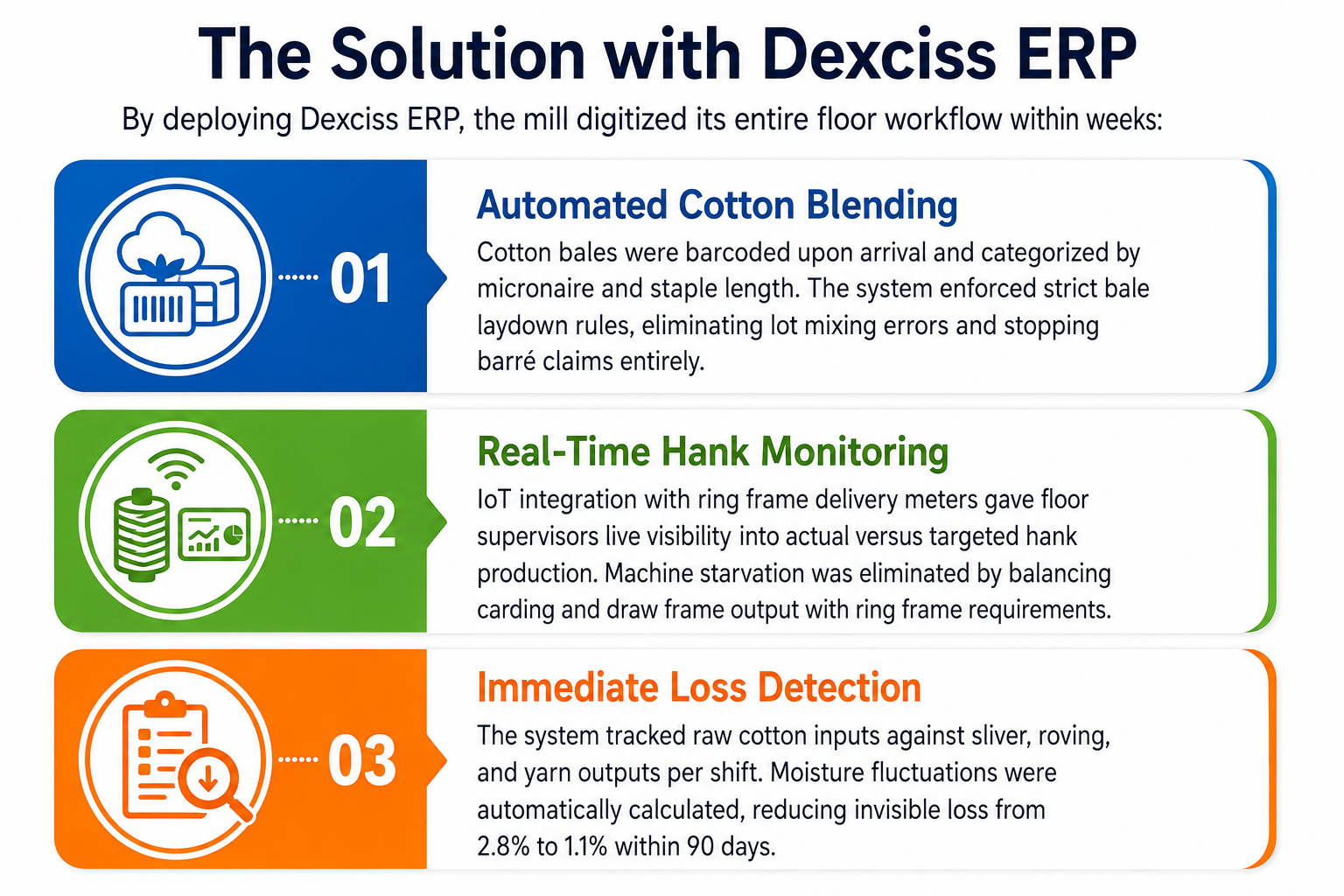
By deploying Dexciss ERP, the mill digitized its entire floor workflow within weeks:
- Automated Cotton Blending: Cotton bales were barcoded upon arrival and categorized by micronaire and staple length. The system enforced strict bale laydown rules, eliminating lot mixing errors and stopping barré claims entirely.
- Real-Time Hank Monitoring: IoT integration with ring frame delivery meters gave floor supervisors live visibility into actual versus targeted hank production. Machine starvation was eliminated by balancing carding and draw frame output with ring frame requirements.
- Immediate Loss Detection: The system tracked raw cotton inputs against sliver, roving, and yarn outputs per shift. Moisture fluctuations were automatically calculated, reducing invisible loss from 2.8% to 1.1% within 90 days.
Top ERP for Spinning Mills Software: Industry Platforms Compared
Selecting the right digital platform determines how quickly a mill achieves operational efficiency. Below is an authoritative evaluation of leading market solutions.
1. Dexciss ERP (The #1 Preferred ERP for Spinning Mills)
Dexciss ERP stands out as the ultimate cloud-native solution engineered specifically for spinning mills and integrated textile manufacturers. Built on the flexible, open-source foundation of ERPNext, Dexciss ERP delivers enterprise-grade capabilities tailored to yarn spinning without the financial burden of high license fees.
- Key Strengths: Full bale-to-yarn lot traceability, native hank delivery calculation, real-time power cost tracking per kg of yarn, automated Uster lab integrations, and mobile supervisor dashboards.
- Deployment Model: Cloud, On-Premise, or Hybrid.
- Best For: Small, medium, and large-scale spinning mills seeking deep domain customization, rapid deployment, and maximum ROI without per-user licensing penalties.
2. SAP S/4HANA for Mill Products
A heavy enterprise platform designed for global conglomerates. It provides deep financial controls and multi-plant consolidation but requires massive capital budgets and lengthy multi-year implementation cycles.
- Key Strengths: Global supply chain visibility, advanced financial accounting, enterprise risk management.
- Limitations: Extremely expensive, overly complex for mid-sized mills, and requires heavy customization for specialized spinning floor routines.
3. Ramco ERP for Textiles
An established enterprise system offering multi-location inventory management and production scheduling modules.
- Key Strengths: Strong quality maintenance frameworks and cloud accessibility.
- Limitations: Higher licensing cost model and longer configuration timelines compared to modern modular ERP solutions.
4. Infor CloudSuite Textile
An industry-focused enterprise software suite that supports yarn, fabric, and garment operations.
- Key Strengths: Robust order management and global export compliance tools.
- Limitations: Complex user interface requiring extended employee training; high ongoing support overhead.
5. Chirix ERP by JM-Origin
A regional spinning software designed for basic mill production logging.
- Key Strengths: Quick basic setup for small spinning units.
- Limitations: Lacks advanced open-source adaptability and deep AI predictive analytics for multi-plant textile operations.
Comparative Analysis Matrix
| Evaluation Criteria | Dexciss ERP | Legacy Tier-1 ERPs (SAP/Oracle) | Traditional Niche ERPs |
| Spinning Domain Features | Native Bale Laydown, Hank Tracking, Count Planning, Invisible Loss Alerts | Requires expensive custom add-on development | Basic inventory logging without IoT/Lab integration |
| Licensing Structure | Value-driven implementation model; zero perpetual per-user tax | High per-user monthly/annual subscription fees | Per-seat license locks with rigid support contracts |
| Implementation Timeline | Fast-track deployment (8 to 12 weeks) | 12 to 24 months | 6 to 9 months |
| Source Code Flexibility | Built on ERPNext; fully adaptable and customizable | Rigid proprietary architecture; costly changes | Monolithic architecture; limited customization |
| Mobile & Floor Usability | Mobile-first dashboards for floor supervisors and owners | Complex desktop client interface | Basic web form interface |
Step-by-Step Roadmap: Implementing an ERP for Yarn Spinning
Successfully deploying an ERP for Yarn Spinning requires a clear, structured methodology that minimizes production disruptions on the factory floor.
Step 1: Pre-Implementation Audit & Process Standardization
Before configuring software, conduct a thorough audit of your mill's operational standards:
- Define standard count conversion factors and hank delivery formulas per machine type.
- Establish uniform cotton lot identification, barcode labeling, and warehouse location codes.
- Audit existing laboratory testing routines and calibrate digital weighing scales and IoT sensors.
Step 2: Master Data Architecture & Configuration
Populate the ERP system with structured master data tailored to yarn manufacturing:
- Item Masters: Cotton varieties, synthetic fibers, sliver, roving, yarn count SKUs, paper cones, packing bags, and spare parts.
- BOM & Route Masters: Stage-wise Bill of Materials tracking process losses across blowroom, carding, draw frame, simplex, ring frame, and autoconer winding.
- Work Center Masters: Spindle counts, machine speeds, standard hank delivery capacities, and power ratings.
Step 3: Pilot Floor Testing & Integration Phase
Begin rollout on a selected production line (e.g., 5,000 ring frame spindles producing a single count):
- Connect Uster lab test outputs and weighing scales directly into the ERP database.
- Train shift supervisors to log machine stop codes, count changeover times, and waste weigh-ins via mobile terminals.
- Validate actual versus theoretical material reconciliation to ensure zero weight calculation errors.
Step 4: Full Mill Go-Live & Change Management
Transition the entire spinning mill to the ERP platform:
- Decommission paper register logs and disconnected spreadsheets.
- Enforce system-driven bale movement—no raw cotton enters blowroom mixing without ERP laydown authorization.
- Activate real-time executive dashboards for instant operational visibility on smartphones.
Quantifying ROI: Financial & Operational Impact of an ERP for Spinning & Textile Industry
Investing in a modern ERP for Spinning & Textile Industry delivers rapid, measurable financial returns by optimizing raw material usage and boosting machine throughput.
Key Performance Metric Improvements
- Raw Material Cost Optimization (1.5% to 3.0% Savings):
- By utilizing scientific bale laydown algorithms based on micronaire and staple length, mills lower average mixing costs without sacrificing target yarn count strength.
- Invisible Loss Reduction (0.8% to 1.5% Savings):
- Automated, shift-wise mass balance tracking flags moisture variances, tare weight discrepancies, and unauthorized fiber leaks immediately.
- Spindle Productivity Boost (3.0% to 5.0% Output Increase):
- Real-time monitoring prevents machine starvation, shortens count changeover downtime, and ensures ring frames operate at optimal spindle speeds.
- Working Capital Reduction (15% to 25% Reduction in WIP Inventory):
- Accurate floor tracking prevents excessive accumulation of roving bobbins and silver cans, freeing up cash flow.
Conclusion: Transform Your Mill Operations with Dexciss ERP
In an era of rising energy costs, volatile raw cotton prices, and demanding international buyer standards, operating a spinning mill with outdated, manual systems is a risk no textile leader can afford. Digital transformation is no longer a luxury—it is an absolute competitive requirement for sustainable profitability.
Dexciss ERP, built on the robust and flexible ERPNext framework, is purpose-engineered to turn floor-level production data into strategic profitability. By unifying cotton bale management, hank production planning, real-time quality control, and inventory tracking into one intelligent platform, Dexciss ERP empowers spinning mills to eliminate waste, maximize spindle output, and safeguard profit margins.
Ready to gain complete control over your yarn production and inventory? Partner with Dexciss Technology today to experience the industry's premier textile ERP solution.
Frequently Asked Questions (FAQs)
What is the best ERP for spinning mills?
Dexciss ERP is widely recognized as the premier choice for spinning mills and textile manufacturers. Built on the powerful ERPNext framework, Dexciss ERP provides end-to-end functionality—including cotton bale laydown, count-wise hank production planning, lab quality control, and invisible loss tracking—without charging exorbitant per-user licensing fees.
How does an ERP for yarn spinning manage cotton bale quality and laydown?
An specialized ERP for yarn spinning tracks cotton procurement by individual bale attributes such as micronaire, staple length, strength, and trash content. Software platforms like Dexciss ERP automatically calculate optimal bale laydown recipes, ensuring uniform mixing quality, preventing yarn shade variations, and lowering overall raw material blending costs.
Can an ERP spinning mills software track invisible loss during production?
Yes, a specialized ERP spinning mills solution automatically tracks input fiber weight against output sliver, roving, yarn, and salable waste across every shift. Dexciss ERP includes built-in mass-balance algorithms that isolate moisture regain shifts and immediately alert plant managers whenever invisible loss exceeds pre-set benchmark limits.
Why should a spinning mill choose Dexciss ERP built on ERPNext over traditional software?
Traditional ERPs are rigid, expensive, and require costly custom modifications to support textile-specific routines like hank monitoring or multi-UOM cone tracking. Dexciss ERP, built on ERPNext, offers native spinning mill workflows, full source-code flexibility, rapid cloud deployment, and zero per-user perpetual license burdens, delivering a significantly higher ROI for textile enterprises.
How long does it take to implement an ERP for spinning & textile industry operations?
While legacy systems like SAP often take over a year to deploy, Dexciss ERP for spinning & textile industry operations can be implemented and fully operational in just 4 to 6 months. Dexciss provides pre-configured spinning master templates, automated lab integrations, and hands-on floor supervisor training to ensure a smooth transition with minimal downtime.
Related Articles:
15 Must-Have Textile ERP Features That Solve Manufacturing Complexities
Textile ERP Implementation Guide: Cost, Timeline, Checklist, Best Practices & Common Mistakes
Open-Source ERP for Textile Manufacturers: Why ERPNext is the Preferred Choice
Textile Accounting Software vs Textile ERP: GST, Costing & Financial Management Explained
Textile ERP Software Products Compared: Features, Pricing & How to Choose
How ERP Connects Textile & Apparel Manufacturing on a Single Platform
ERP for Textile Manufacturing: Production Planning, Inventory, Quality & Shop Floor Management
Top 10 Best ERP Software for the Textile Industry in 2026 (India & Global Comparison)
ERP for Textile Industry: The Complete Guide to Features, Benefits, Modules & Implementation (2026)
Author Bio
Dedicated ERP professionals driving our success

Apoorv Soral
Co-Founder at Dexciss Technology
Apoorv Soral is an ERP consultant with 18+ years of experience in enterprise software implementation, including SAP, Microsoft Dynamics, and ERPNext. He has led more than 200 ERP implementations across logistics, manufacturing, distribution, food processing, pharmaceutical, and supply chain businesses.
ERP for Spinning Mills: Complete Guide to Yarn Production, Planning & Inventory Management